
物联网

Search documents
重磅!全球关键电子材料应用进展与我国未来发展方向(23000字)
材料汇· 2025-12-23 15:04
Core Viewpoint - The article emphasizes the importance of electronic materials in various high-tech industries, highlighting the need for innovation and domestic production capabilities to enhance China's competitiveness in the global market [7][9]. Group 1: Industry Overview - Electronic materials are crucial for manufacturing electronic devices, integrated circuits (ICs), and optoelectronic devices, directly impacting product functionality and efficiency [7]. - The global semiconductor industry is projected to reach a total sales of $526.8 billion in 2023, with IC electronic materials accounting for approximately 12.7% of this market [7]. - The demand for electronic materials is increasing in sectors such as ICs, display technology, photovoltaic energy, and high-end capacitors/resistors, driven by advancements in information technology and communication [7][9]. Group 2: Key Electronic Materials - **Semiconductor Materials**: Silicon (Si) is the primary material used in over 95% of semiconductor devices, with a market dominated by companies like Shin-Etsu Chemical and Sumco, holding over 90% market share in 8-12 inch wafers [11][15]. - **Electronic Specialty Gases**: The market for electronic specialty gases is highly concentrated, with major players like Air Products and Linde holding over 80% market share. The largest category, NF3, has a market size of $8.8 billion [16][18]. - **Photoresists**: The photoresist market is critical for IC manufacturing, with costs accounting for about 35% of total chip manufacturing costs. The development of EUV photoresists is essential for advanced nodes below 7nm [19][21]. - **Wet Electronic Chemicals**: The global market for wet electronic chemicals was valued at 639.1 billion yuan in 2022, with a projected growth rate of 8.9% annually [25]. - **CMP Materials**: Chemical Mechanical Polishing (CMP) materials are vital for achieving high precision in wafer manufacturing, with the global market for CMP pads and slurries growing significantly from 2016 to 2021 [28][29]. - **Third-Generation Semiconductor Materials**: Materials like SiC and GaN are gaining traction due to their superior properties for high-frequency and high-power applications, with China's market for these materials reaching approximately 85.4 billion yuan in 2023 [30][31]. Group 3: Market Dynamics and Trends - The electronic materials industry is characterized by a high degree of international competition, with the U.S., Europe, Japan, South Korea, and China being the main players [8]. - The ongoing technological revolution and industrial transformation present both challenges and opportunities for the electronic materials sector, necessitating advancements in material performance to meet the demands of emerging technologies like 6G and quantum computing [8][9]. - The article highlights the need for China to enhance its domestic production capabilities and innovation in electronic materials to ensure supply chain security and reduce reliance on foreign imports [9].


阿里1688公布年度商业领袖,称增长不靠“卷”要靠“稳”
Xin Lang Cai Jing· 2025-12-23 11:05
Core Insights - Alibaba's 1688 platform held its annual Business Leaders Summit, announcing the 2025 Business Leaders Award winners across various industries, emphasizing the shift from price competition to reliability in business success [1][4] - The Chinese economy is currently experiencing a K-shaped divergence, where only companies that embrace digitalization and possess operational resilience can navigate through economic fluctuations [1][4] - There is a noticeable trend among merchants on 1688 moving from large-scale traffic competition to a focus on refined supply chain value [1][4] Industry Trends - The manufacturing sector is facing challenges such as quality stability and structural imbalances, prompting companies to seek breakthroughs through full-chain innovation ecosystems, smart manufacturing technology advancements, and optimized resource allocation [2][5] - New technologies like AI, big data, and IoT are enabling many companies to achieve both increased production capacity and reduced labor costs, showcasing strong growth potential [2][5] - Examples of successful companies include Shanghai Yifei Packaging, which upgraded to a "one-stop safety delivery solution" provider through AI-driven capabilities, and Weifang Nao Cosmetics, which entered the healing economy with "scientific-grade essential oils" [2][5] Evaluation Criteria - The 1688 Business Leaders Award evaluation established three measurable and observable key dimensions, creating a corresponding value assessment system [3][6] - Award-winning companies were identified through a combination of big data analysis, expert reviews, and on-site evaluations, demonstrating significant advancement and industry exemplarity across various categories such as packaging, apparel, and home improvement [3][6] - The platform has developed a positive cycle in its merchant growth system, focusing on discovering benchmarks, extracting methods, and empowering ecosystems, providing a clear "coordinate system" and reusable "methodology library" for the industry [3][6]

齐心集团成立科技公司,含AI及物联网业务
Qi Cha Cha· 2025-12-23 08:04
Core Insights - Qixin Group has established a new technology company, Shenzhen Yinchuan Technology Co., Ltd., which focuses on artificial intelligence and Internet of Things (IoT) services [1] Company Developments - Shenzhen Yinchuan Technology Co., Ltd. is fully owned by Qixin Group [1] - The business scope of the new company includes AI industry application system integration services, IoT technology services, IoT application services, and computer system services [1]

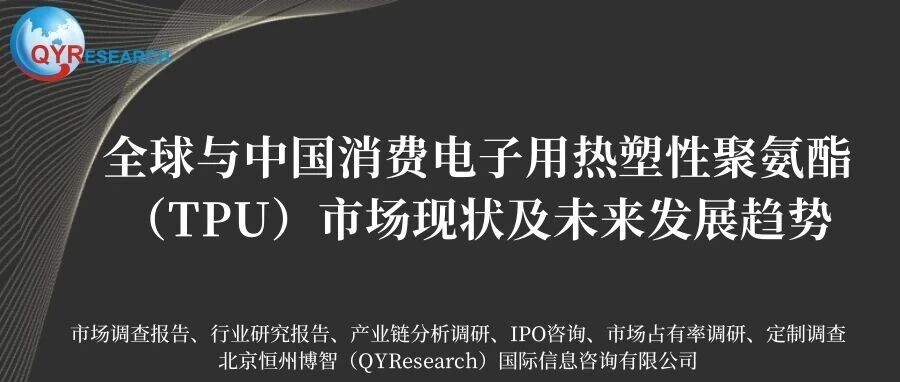
全球与中国消费电子用热塑性聚氨酯(TPU)市场现状及未来发展趋势
QYResearch· 2025-12-23 07:04
Core Viewpoint - The thermoplastic polyurethane (TPU) industry for consumer electronics is at a critical turning point, facing short-term price pressures but long-term opportunities driven by trends towards green, high-performance, and intelligent materials [7]. Group 1: Current Industry Status - TPU is a high-performance polymer material used in consumer electronics for protective cases, functional components, and structural parts, with specific mechanical and environmental properties [2][5]. - The global TPU market for consumer electronics is projected to grow from $547.50 million in 2024 to $1,025.35 million by 2031, with a compound annual growth rate (CAGR) of 9.60% [16]. - The Chinese market is rapidly evolving, expected to account for approximately 49.87% of the global market by 2031, growing from $252.96 million in 2024 [16]. Group 2: Market Growth Drivers - The demand for TPU in consumer electronics is driven by the need for lightweight, durable materials in smartphones, wearables, and flexible displays, with increasing penetration in protective cases and smart device applications [20][22]. - Innovations in TPU manufacturing are leading to customized products with unique properties such as flame retardancy, UV resistance, and antibacterial features, expanding applications across various industries [9][10]. Group 3: Technological and Environmental Trends - The industry is witnessing a shift towards bio-based and biodegradable TPU products, with companies like BASF and Wanhua Chemical introducing bio-based TPU with 30%-70% bio-content [11]. - The development of recycling technologies is expected to enhance TPU waste recycling rates, aligning with global carbon neutrality goals [11]. Group 4: Competitive Landscape - The top three global manufacturers, BASF, Covestro, and Huntsman, hold over 41% market share, indicating a highly competitive environment, particularly in China [17][19]. - The market is characterized by a "two super, many strong" structure, with leading companies like Huafeng Group and Wanhua Chemical dominating the high-end market, while smaller firms operate in the low-end market [19]. Group 5: Policy and Regulatory Environment - Government policies such as "Made in China 2025" and the "Internet Plus" initiative are promoting high-end and intelligent development in the TPU sector, encouraging its application in electronic products [24]. - Environmental regulations are driving the development of green TPU materials, reducing reliance on traditional petroleum-based materials [24].
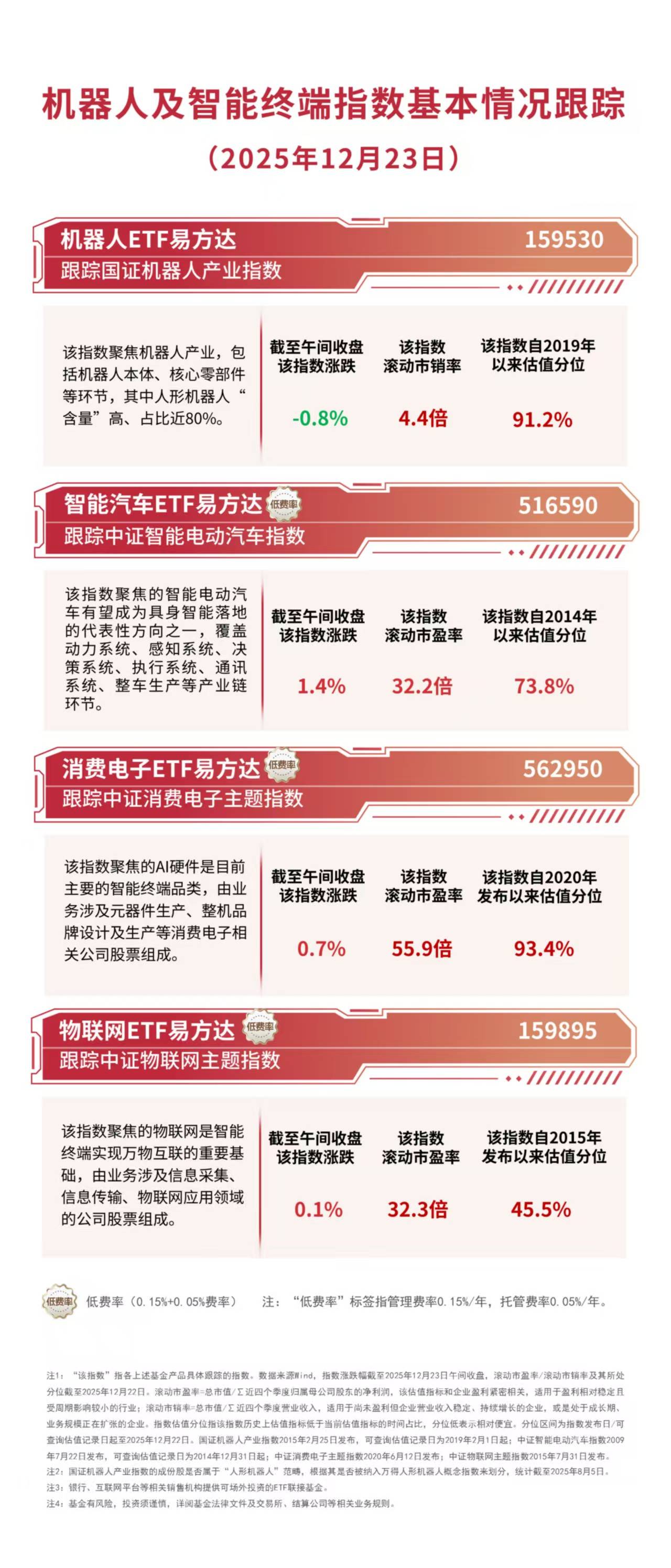
机器人板块震荡调整,资金逆势加仓,机器人ETF易方达(159530)半日净申购近7000万份
Sou Hu Cai Jing· 2025-12-23 04:48
Group 1 - The index experienced a rise of 0.7% with a rolling price-to-earnings ratio of 55.9 times, reflecting a valuation increase of 93.4% since its inception [4] - Another index showed a slight increase of 0.1% with a rolling price-to-earnings ratio of 32.3 times, indicating a valuation growth of 45.5% since its launch [5]

国务院国资委:抓好专业化、市场化产业投融资体系建设
Sou Hu Cai Jing· 2025-12-23 03:45
Core Insights - The State-owned Assets Supervision and Administration Commission (SASAC) emphasizes the collaborative efforts of state-owned enterprises (SOEs) in upgrading traditional industries and nurturing emerging sectors, with a focus on initiatives like "AI+" and industrial renewal [1][2] - During the 14th Five-Year Plan period, SOEs have achieved an annual investment growth rate exceeding 20% in emerging industries, establishing world-class industrial clusters in areas such as new information technology, new energy, and high-end equipment manufacturing [1] - The 15th Five-Year Plan will guide SOEs to concentrate on their core responsibilities, enhance the real economy, and transition the industrial system towards higher value-added and technology-intensive sectors [1] Group 1: Traditional Industry Transformation - SOEs are undertaking a new round of digital transformation, integrating AI, big data, cloud computing, 5G, and IoT into traditional industries to promote technological upgrades and equipment modernization [1] - The focus is on implementing carbon peak plans in key sectors, promoting efficient resource recycling, accelerating product iteration, and enhancing the supply of high-end products [1] Group 2: Emerging and Future Industry Development - The SASAC is implementing renewal and launch actions, targeting significant growth areas over the next five years, including new energy, new energy vehicles, aerospace, and low-altitude economy [2] - There is an emphasis on developing a professional and market-oriented investment and financing system for industries, utilizing state capital investment and operation companies to support strategic emerging industries [2] - The goal is to establish a comprehensive investment system covering all stages from seed to growth, enhancing the decision-making mechanism for industrial investments [2]
上博科技(海南)有限公司成立,注册资本1000万人民币
Sou Hu Cai Jing· 2025-12-23 03:29
天眼查显示,近日,上博科技(海南)有限公司成立,法定代表人为范卫红,注册资本1000万人民币, 由衣拉拉集团股份有限公司全资持股。 企业名称上博科技(海南)有限公司法定代表人范卫红注册资本1000万人民币国标行业科学研究和技术 服务业>研究和试验发展>工程和技术研究和试验发展地址海南省海口市美兰区国兴大道11号国瑞大厦C 座东塔办公楼32层S5O区96号企业类型有限责任公司(非自然人投资或控股的法人独资)营业期限 2025-12-22至无固定期限登记机关海南省市场监督管理局 来源:市场资讯 序号股东名称持股比例1衣拉拉集团股份有限公司100% 经营范围含一般经营项目:技术服务、技术开发、技术咨询、技术交流、技术转让、技术推广;软件开 发;信息系统集成服务;物联网技术服务;信息技术咨询服务;网络技术服务;计算机系统服务;云计 算装备技术服务;数字技术服务;以自有资金从事投资活动(经营范围中的一般经营项目依法自主开展 经营活动,通过国家企业信用信息公示系统(海南)向社会公示) ...
趋势研判!2025年中国物联网网关行业政策背景、发展现状、细分市场及未来发展趋势分析:智联万物加速渗透,物联网网关前景广阔[图]
Chan Ye Xin Xi Wang· 2025-12-23 03:10
Core Insights - The Internet of Things (IoT) gateway is a crucial hub in the IoT architecture, facilitating interconnectivity between the perception layer, network layer, and application layer, while performing key functions such as data collection, protocol conversion, and edge computing [1][2][3] - The global IoT market is experiencing rapid growth, with revenues expected to reach $1.016 trillion in 2024 and projected to rise to $2 trillion by 2030, with the Asia-Pacific region contributing 55% of the revenue, primarily driven by China [1][7] - The Chinese IoT industry is set to reach a market size of 4.01 trillion yuan in 2024, increasing to 4.55 trillion yuan in 2025, with a year-on-year growth rate of approximately 13.7% [1][7] - The IoT gateway market in China is expected to grow to 45 billion yuan in 2024 and surpass 51.8 billion yuan in 2025, with an annual compound growth rate of over 15% [1][8] Industry Overview - The IoT gateway serves as a key device for interconnecting various IoT terminal devices with different protocols, types, and transmission rates, while also performing data collection, protocol conversion, edge computing, data filtering, and secure transmission [2][3] - The IoT gateway can be categorized based on protocol type, deployment scenario, and functional characteristics, including wireless protocol gateways, wired protocol gateways, and multi-protocol fusion gateways [3][5] Market Dynamics - The industrial-grade gateway accounts for over 42% of the market, with significant demand from key industries such as automotive manufacturing and energy and chemical sectors [8] - The consumer-grade gateway market is driven by the proliferation of smart home devices, while the automotive IoT gateway is experiencing rapid growth due to the development of V2X infrastructure [8] - Edge computing gateways, although currently holding a market share of about 6%-10%, are seeing a penetration rate of 35% due to the demand for real-time industrial applications [8] Policy Environment - The Chinese government has implemented various policies to promote the high-quality development of the IoT industry, including the "Digital China Construction Overall Layout Plan" and local initiatives aimed at integrating new information technologies with vertical sectors [6][7] Industry Chain - The IoT gateway industry chain is clearly defined, with upstream focusing on hardware and core technology suppliers, midstream consisting of gateway manufacturers and integrators, and downstream involving users and service providers in various IoT application fields [6] Competitive Landscape - The industry is characterized by a competitive landscape dominated by local giants like Huawei and ZTE, which hold approximately 41% of the market share, while specialized companies like Yihantong focus on specific verticals [10] Future Trends - The IoT gateway industry is expected to evolve towards deeper technological integration, with a focus on edge computing and artificial intelligence, transforming gateways into intelligent decision-making terminals [11] - The market will shift towards customized solutions for vertical industries, with a focus on adapting gateways to specific scenarios [12] - The trend of domestic substitution will continue, with local companies building self-sufficient supply chains and innovative service models emerging, such as "device as a service" [13][14]






电广传媒涨2.22%,成交额3.95亿元,主力资金净流入770.69万元
Xin Lang Cai Jing· 2025-12-23 02:29
Core Viewpoint - The stock of Electric Broad Media has shown significant growth, with a year-to-date increase of 43.83% and a recent surge in trading activity, indicating strong investor interest and confidence in the company's performance [1][2]. Group 1: Stock Performance - As of December 23, Electric Broad Media's stock price reached 10.14 yuan per share, with a trading volume of 3.95 billion yuan and a market capitalization of 14.374 billion yuan [1]. - The stock has experienced a 16.69% increase over the past five trading days, a 17.77% increase over the past 20 days, and a 24.26% increase over the past 60 days [1]. Group 2: Financial Performance - For the period from January to September 2025, Electric Broad Media reported a revenue of 3.19 billion yuan, reflecting a year-on-year growth of 16.32%, and a net profit attributable to shareholders of 132 million yuan, which is a substantial increase of 116.61% [2]. - The company's main revenue sources include advertising operations (65.66%), investment management (12.73%), and gaming (12.50%) [1]. Group 3: Shareholder Information - As of September 30, 2025, the number of shareholders for Electric Broad Media was 76,800, a decrease of 14.36% from the previous period, while the average number of circulating shares per person increased by 16.77% to 18,447 shares [2]. - The top circulating shareholder is Hong Kong Central Clearing Limited, holding 15.2241 million shares, an increase of 7.3903 million shares from the previous period [3].

以技术化、制度化、法治化提升公共安全治理水平
Xin Lang Cai Jing· 2025-12-23 00:30
Core Viewpoint - The article emphasizes the modernization of public safety governance in Guangdong, highlighting the importance of technology, institutional frameworks, and legal systems in enhancing public safety and addressing various security risks in the context of global uncertainties [1][7]. Group 1: Technological Empowerment in Public Safety Governance - The Guangdong Provincial Committee's "1310" initiative aims to advance the construction of a law-based and safe Guangdong, achieving breakthroughs in the new security framework [2]. - The application of digital technologies such as AI, big data, IoT, and cloud computing transforms public safety governance from passive responses to proactive warnings and from collective experience to data-driven decision-making [2]. - The "Yue Ping An" social governance cloud platform significantly enhances the technological capabilities of public safety governance by integrating risk warnings and services [2]. Group 2: Institutional Framework for Public Safety Governance - Institutionalization of public safety governance involves creating a clear, effective, and orderly system to ensure that stakeholders operate under established rules and procedures [3]. - The need for an authoritative and efficient emergency management system is highlighted, with existing frameworks like the six-level emergency command system in place [3]. - Regular risk assessments and a multi-participation system are essential for addressing the complexities of social relationships in public safety [3]. Group 3: Legal Framework in Public Safety Governance - Legalization of public safety governance is crucial for ensuring systematic, normative, and coordinated governance, as emphasized by Xi Jinping [5]. - Recent legislative updates, including the revised Emergency Response Law and various local regulations, aim to optimize public safety governance [6]. - The judicial system in Guangdong promotes public safety governance through the publication of typical cases and timely legal adjudications [6]. Group 4: Overall Modernization of Public Safety Governance - The modernization of public safety governance in Guangdong relies on the synergy of technological, institutional, and legal advancements [7]. - Continuous optimization of these three aspects is necessary for effective public safety governance, indicating an ongoing process rather than a one-time effort [7].