AI芯片

Search documents
罕见,连续减持套现!“AI芯片霸主”股价暴跌
Zhong Guo Ji Jin Bao· 2025-10-12 07:20
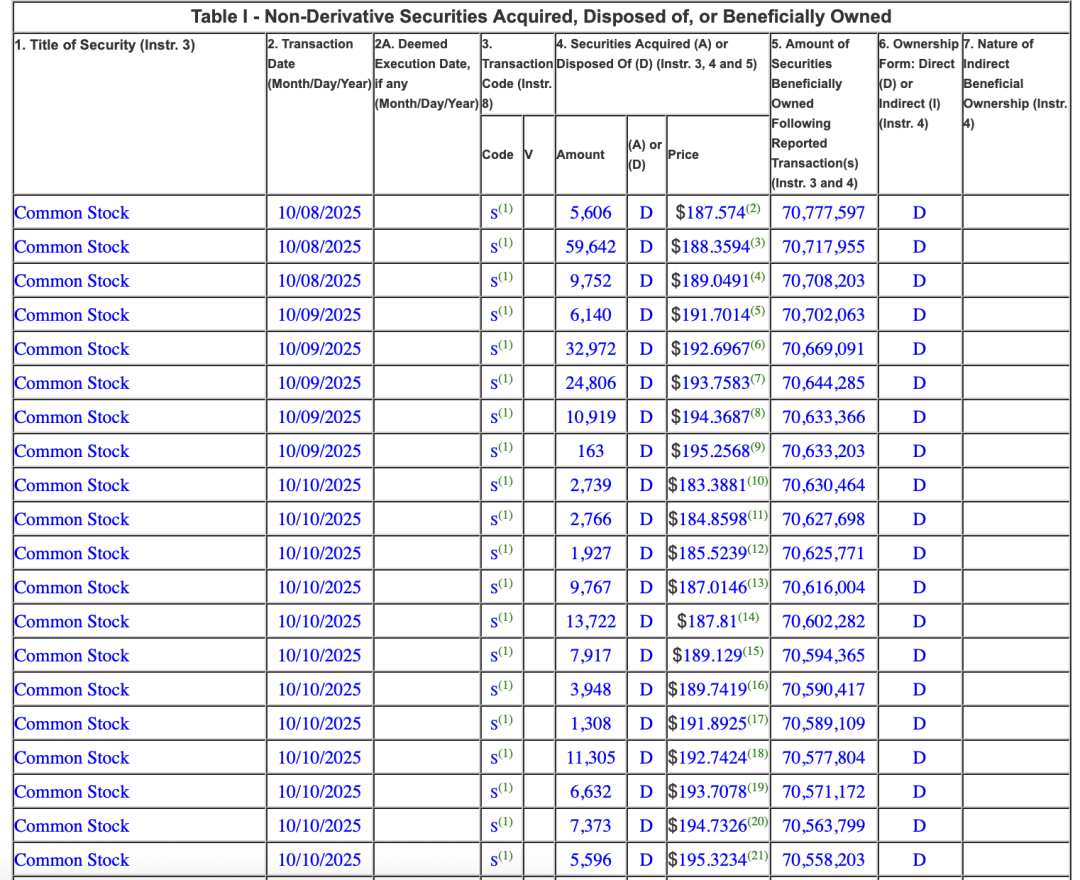
Group 1 - Nvidia's CEO Jensen Huang sold 225,000 shares of the company's stock between October 8 and 10, cashing out over $42.8 million [1] - Huang had previously sold 75,000 shares from October 1 to 7, totaling over $70.24 million [2] - Cumulatively, Huang has cashed out over $113 million from stock sales in October alone [3] Group 2 - As of October 10, 2025, Huang still holds over 70.6 million shares of Nvidia stock [4] - Nvidia's stock price has increased by over 36% this year, outperforming the Nasdaq Composite Index's 14.98% gain [5] - On October 9, Nvidia's stock reached a record high of $195.62 per share, with a market capitalization peaking at $4.73 trillion [5][6] Group 3 - On October 10, Nvidia's stock price fell by 4.89%, resulting in a market value loss of approximately $228.66 billion, equivalent to about 1.63 trillion RMB [6] - The latest closing price was $183.16 per share, with a market capitalization of $4.45 trillion [6]

罕见,连续减持套现!刚刚,股价暴跌
中国基金报· 2025-10-12 06:40
【导读】黄仁勋10月份持续卖出英伟达,已套现超1.1亿美元 中国基金报记者 张舟 在"AI芯片霸主"英伟达的股价飙升至历史新高之时,"掌门人"黄仁勋在10月份持续出售该 股。 美东时间10月10日盘后,英伟达提交 至美国证券交易委员会(SEC)的文件显示 , 公司 CEO黄仁勋在10月8日至10日期间,通过20笔交易卖出22.5万股股票,套现逾4280万美元 | | 2. Transaction | 2A. Deemed | Table I - Non-Derivative Securities Acquired, Disposed of, or Beneficially Owned 3. | | 4. Securities Acquired (A) or | | 5. Amount of | 6. Ownership 7. Nature of | | --- | --- | --- | --- | --- | --- | --- | --- | --- | | 1. Title of Security (Instr. 3) | Date (Month/Day/Year) lif any | Executio ...

重金押注长江存储、中晟微,养元饮品和金字火腿开讲“芯故事”
3 6 Ke· 2025-10-11 11:57
Core Insights - Traditional food companies like Jinzi Ham and Yangyuan Beverage are making significant investments in the semiconductor industry, raising questions about their motivations and the potential for success in this new sector [1][4][5] Group 1: Investment Moves - Jinzi Ham announced plans to invest up to 300 million RMB in Zhongsheng Microelectronics, acquiring up to 20% equity, despite the latter's low revenue of 51,000 RMB and a net loss of 20.37 million RMB in the first seven months of the year [1][2] - Yangyuan Beverage invested 1.6 billion RMB in Changjiang Storage Technology, acquiring 0.99% equity, with the investment framed as a financial move rather than a strategic one [2][3] Group 2: Market Potential - The global optical device market is projected to reach 52 billion USD by 2029, with a compound annual growth rate of 11%, driven by data center interconnect demand [2] - Jinzi Ham's investment in Zhongsheng Microelectronics is seen as a bet on future market potential, despite the current lack of profitability [2][4] Group 3: Company Performance - Yangyuan Beverage reported a 16.19% decline in revenue to 2.465 billion RMB and a 27.76% drop in net profit to 744 million RMB in the first half of 2025, marking the first time in three years that both metrics declined [5][7] - Jinzi Ham's revenue fell by 14.73% to 170 million RMB, with net profit down 25.11% to 22.92 million RMB in the same period [6] Group 4: Strategic Rationale - Both companies are leveraging their brand strength and market positioning to explore new growth avenues in the semiconductor sector, with Jinzi Ham focusing on optical communication chips and Yangyuan Beverage eyeing storage chips [4][6] - The investments are seen as a way to tap into the growing demand for advanced technology products, particularly in AI and data storage [3][4]


英特尔展示1.8nm工艺晶圆!
国芯网· 2025-10-10 13:48
Core Viewpoint - Intel's Panther Lake chip, based on the 18A (1.8nm) process, is seen as a crucial factor for the company's turnaround in the semiconductor market, especially after years of lagging behind competitors like TSMC and AMD [2][5]. Group 1: Product Development and Features - The Panther Lake chip is designed to support various consumer and commercial AI PCs, gaming devices, and edge computing solutions, featuring a scalable multi-chip architecture with up to 16 performance and efficiency cores, resulting in over 50% performance improvement compared to the previous generation [4]. - The XPU design of Panther Lake allows for next-generation AI acceleration, with a maximum platform performance of 180 TOPS (trillions of operations per second) [4]. - The 18A process is Intel's first self-developed 2nm process node, offering up to 15% energy efficiency improvement and 30% higher chip density compared to the Intel 3 process [4]. Group 2: Market Position and Financial Performance - Intel has faced continuous revenue decline for six consecutive quarters, with a projected net loss of $7.6 billion for the 2024 fiscal year, leading to a significant loss of market share in the AI chip sector, where NVIDIA holds over 80% market share [5][6]. - The company has been under pressure to regain its technological leadership and customer trust, with Panther Lake representing a strategic mission to reclaim its position in the market [6]. Group 3: Capital and Investment Support - Intel has secured substantial capital support through various investments, including $8.9 billion from the U.S. government, $2 billion from SoftBank, and $5 billion from NVIDIA, totaling $15.9 billion, which alleviates financial pressure for Panther Lake's production and market launch [6]. - Following the announcement of these investments, Intel's stock price surged from $22.1 to $26.8 per share, marking a single-day increase of over 21%, and later reached a new high of $34.5 per share [6]. Group 4: Market Sentiment and Future Outlook - As of October 9, Intel's stock closed at $37.2 per share, reflecting a cumulative increase of 68.3% since early August, with a market capitalization of $174.2 billion [7]. - Despite the positive stock performance, market confidence remains cautious, with analysts emphasizing the need for Intel to convince customers to pre-order its next-generation 14A chip manufacturing technology to avoid potential setbacks [7].


为什么 OpenAI 们都要搞 AI 基建?Groq 创始人把背后的逻辑讲透了
Founder Park· 2025-10-10 13:27
Core Insights - OpenAI is actively investing in chip development and collaborating with companies like NVIDIA, AMD, and Oracle to build next-generation AI infrastructure, highlighting the critical role of chips and data centers in AI advancement [2][3] - The growth of AI applications is currently limited by the availability of computing power, indicating that companies with greater access to this resource can serve more users and generate higher revenues [3][23] - A differentiated and efficient supply chain serves as a significant competitive advantage in a market with nearly unlimited demand for AI products [3] Group 1 - The difficulty of chip manufacturing is often underestimated, as it involves complex software ecosystems and continuous engineering optimization [7][15] - Major tech companies are pursuing chip development not just for performance but to gain control over their supply chains and bargaining power [7][30] - The current market for computing power is characterized by scarcity, with many companies still relying on older NVIDIA H100 GPUs, which generate revenue significantly higher than their operational costs [7][47] Group 2 - The investment landscape in AI is robust, with companies like Microsoft deploying large amounts of GPUs for internal use, generating more revenue than renting them out [13][21] - A small number of companies contribute to the majority of AI revenue, indicating a highly concentrated market where supply and demand dynamics play a crucial role [14][36] - The challenges of entering the chip market are significant, with many projects failing despite initial investments, underscoring the complexity of chip design and production [15][28] Group 3 - The return on investment for data centers is longer than for chips, with significant capital expenditures required for infrastructure development [37][39] - Companies are increasingly focused on shortening payback periods and minimizing operational costs to remain competitive in a rapidly evolving market [46][50] - The supply of computing power is a decisive factor in determining market winners, with companies that can secure more capacity gaining a competitive edge [51][52] Group 4 - The AI industry is experiencing a shift where the demand for computing power is expected to grow exponentially, leading to potential shortages [92][94] - The relationship between AI advancements and computing power is unique, as improvements in one area can lead to enhancements in the other, creating a feedback loop [96][97] - The future of AI may lead to significant changes in labor markets, with potential job shortages arising from increased automation and efficiency [97][99]


中电鑫龙:目前暂未与阿里巴巴在AI芯片方面展开业务合作
Zheng Quan Ri Bao Wang· 2025-10-10 11:48
Core Viewpoint - The company, Zhongdian Xindong (002298), has confirmed that it is not currently engaged in any business collaboration with Alibaba in the AI chip sector, although it does have other business partnerships with Alibaba [1] Group 1 - The company has provided smart power distribution equipment and related services for Alibaba's Jiangsu headquarters project [1]

湾芯展开幕倒计时!这份观展攻略请收好
半导体芯闻· 2025-10-10 09:37
Core Viewpoint - The second Greater Bay Area Semiconductor Industry Ecosystem Expo (Bay Chip Expo 2025) will be held from October 15 to 17, 2025, at the Shenzhen Convention and Exhibition Center, featuring over 600 semiconductor companies and attracting more than 60,000 professional visitors [1]. Event Details - The expo will take place on October 15-17, 2025, with specific hours: October 15 and 16 from 9:00 AM to 5:00 PM, and October 17 from 9:00 AM to 4:00 PM [2]. - The venue is the Shenzhen Convention and Exhibition Center, specifically in halls 1, 2, and 9 [3]. Visitor Information - Free public transport tickets will be available for attendees, distributed on a first-come, first-served basis at the consultation desk [5][6]. - A luggage storage service will be provided at hall 1, section 1Q32 [8]. Registration Process - Attendees must register by scanning a QR code, filling in their information, and printing their badges at self-service stations [10]. - Entry requires a valid badge, and the event is restricted to individuals aged 18 and above [12]. Exhibition Overview - The expo will feature four main exhibition areas: Wafer Manufacturing, Compound Semiconductors, IC Design, and Advanced Packaging [19]. - Three ecological zones will focus on RISC-V, Chiplet and Advanced Packaging, and AI Chips and Edge Computing [19]. Conference and Forum Schedule - The event will host over 30 technical forums and product launches, including the opening ceremony and semiconductor industry summit [21]. - Notable forums include the International Advanced Lithography Technology Symposium, Chip Conference, and various discussions on semiconductor materials and technologies [32][33]. Special Events - The Bay Area Semiconductor Night and Bay Chip Awards Ceremony will take place on the evening of October 15, 2025 [32].

A股收评:指数大跌!沪指跌破3900点,科创50跌5.61%,创业板指跌4.55%,水泥建材、燃气股走高!超2700股上涨,成交2.53万亿缩量1377亿
Ge Long Hui· 2025-10-10 07:20
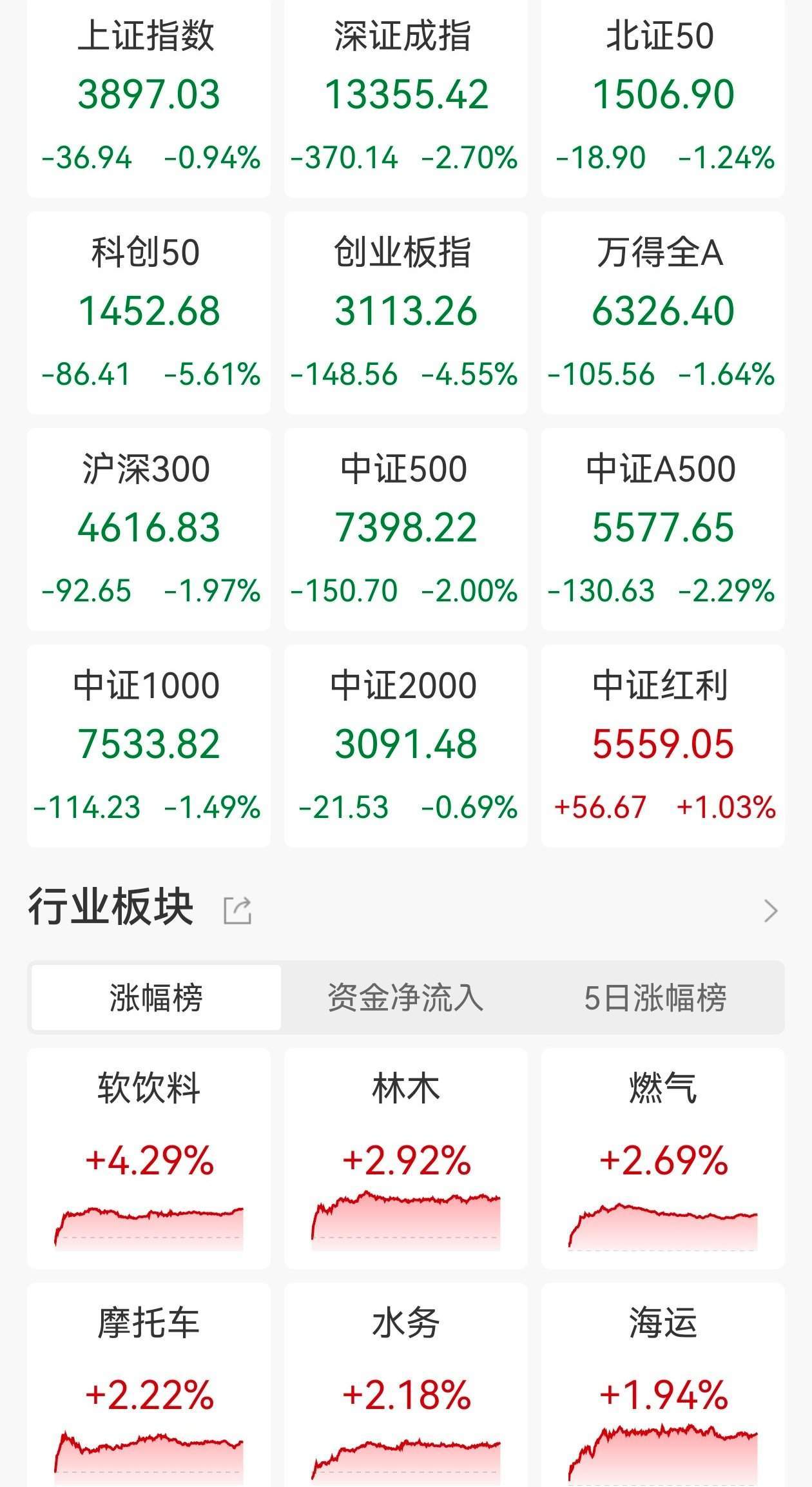
Market Overview - Major A-share indices experienced a collective decline, with the Shanghai Composite Index falling below 3900 points, closing at 3897, down 0.94% [1] - The Shenzhen Component Index dropped by 2.7%, while the ChiNext Index fell by 4.55% and the STAR Market 50 Index decreased by 5.61% [1][2] - Total market turnover was 2.53 trillion yuan, a decrease of 137.7 billion yuan compared to the previous trading day, with over 2700 stocks rising and more than 2500 stocks declining [1] Index Performance - Shanghai Composite Index: 3897.03, down 36.94 points (-0.94%) [2] - Shenzhen Component Index: 13355.42, down 370.14 points (-2.70%) [2] - ChiNext Index: 3113.26, down 148.56 points (-4.55%) [2] - STAR Market 50 Index: 1452.68, down 86.41 points (-5.61%) [2] - CSI 300 Index: 4616.83, down 92.65 points (-1.97%) [2] - CSI 500 Index: 7398.22, down 150.70 points (-2.00%) [2] - CSI A500 Index: 5577.65, down 130.63 points (-2.29%) [2] Sector Performance - Battery stocks faced significant declines, particularly solid-state and blade battery sectors, with companies like Putailai and Shanghai Xiba experiencing trading halts [3] - The semiconductor sector also saw major drops, with stocks like Dongxin Co. and Jinghe Integration falling over 10% [3] - Precious metals sector corrected, with Western Gold hitting the trading limit down [3] - CPO concept stocks declined, led by Dekeli [3] - Gas stocks performed well, with Dazhong Public Utilities and Hongtong Gas both hitting the trading limit up [3] - The cement and building materials sector rose due to support from multiple government departments, with Huaxin Cement hitting the trading limit up [3] - Coal sector saw gains, with Dayou Energy hitting the trading limit up [3] - Other sectors with notable increases included beauty care, public utilities, and shipping ports [3]

A股收评:大跌!沪指跌破3900点,科创50指数跌5.61%,创业板指跌4.55%,水泥建材、燃气股逆市走高
Ge Long Hui· 2025-10-10 07:13
Market Overview - Major A-share indices collectively declined, with the Shanghai Composite Index falling below 3900 points, closing at 3897, down 0.94% [1] - The Shenzhen Component Index dropped 2.7%, the ChiNext Index fell 4.55%, and the STAR 50 Index decreased by 5.61% [1] - Total market turnover was 2.53 trillion yuan, a decrease of 137.7 billion yuan compared to the previous trading day, with over 2700 stocks rising and more than 2500 stocks falling [1] Sector Performance - Battery stocks experienced significant declines, particularly solid-state and blade battery sectors, with companies like Putailai and Shanghai Xiba facing trading halts [1] - The semiconductor sector also saw major losses, with stocks such as Dongxin Technology and Jinghe Integrated falling over 10% [1] - Precious metals sector corrected, with Western Gold facing a trading halt [1] - CPO concept stocks declined, led by Dekeli [1] - AI chips, automotive chips, and composite flow battery sectors were among the hardest hit [1] Gaining Sectors - Gas stocks performed well, with Dazhong Public Utilities and Hongtong Gas both hitting the daily limit [1] - The cement and building materials sector rose due to support from the Ministry of Industry and Information Technology and other departments, with Huaxin Cement reaching the daily limit [1] - The coal sector also saw gains, with Dayou Energy hitting the daily limit [1] - Other sectors with notable increases included beauty care, public utilities, and shipping ports [1] Top Gainers - The beverage sector led the gainers with a 4.29% increase, followed by motorcycle and water utility sectors [2] - Gas sector also showed positive net capital inflow, indicating investor interest [2]
从佳能、索尼到尼康,为什么常见的相机品牌大多来自日本?| 声动早咖啡
声动活泼· 2025-10-10 04:07
Core Viewpoint - The article discusses the evolution of the camera industry, highlighting how Japanese brands have surpassed German manufacturers to dominate the interchangeable lens camera market, primarily through mass production and affordability strategies [3][4]. Group 1: Market Position and Trends - By the first half of 2025, interchangeable lens cameras are expected to account for 75% of global digital camera shipments [2]. - Canon has maintained the largest market share in interchangeable lens cameras for 22 consecutive years, followed by Sony, Nikon, and Fujifilm, which collectively hold over 90% of the market [3][4]. - Since 2011, sales of interchangeable lens cameras have been declining, with a brief recovery in 2022, but growth has slowed again, particularly in DSLR sales [8]. Group 2: Historical Context and Development - After World War II, Japanese camera manufacturers rebuilt their industrial systems with American assistance, focusing on mass production and cost reduction, while German brands remained high-end and hand-crafted [4]. - The introduction of the Ricohflex III in 1950 marked one of the first mass-produced twin-lens reflex cameras, significantly lowering costs and making cameras accessible to the general public [4]. - Nikon's launch of the Nikon F in 1959, which gained popularity among war correspondents, helped shift the perception of Japanese cameras from cheap imitations to reliable professional equipment [5]. Group 3: Technological Advancements - Japanese manufacturers were early adopters of electronic technology, automating processes like metering and focusing, which reduced the learning curve for users [5]. - Canon introduced the first fully electronic SLR with a built-in CPU in 1976, sparking a consumer trend towards automatic exposure cameras [5]. - The shift to digital photography was embraced by Japanese brands, while German companies like Leica were slow to adapt, leading to a significant market share for digital cameras [6]. Group 4: Ecosystem and Brand Loyalty - Users typically invest in a complete camera ecosystem, purchasing lenses and accessories that are brand-specific, which fosters brand loyalty [6]. - Major brands like Canon, Nikon, and Sony have developed extensive ecosystems, with hundreds of lens options available, reinforcing user retention within their brands [6][7]. - Professional markets, including media and sports, heavily rely on these ecosystems, with brands like Sony and Canon dominating the professional photography market at events like the Olympics [7]. Group 5: Current Challenges - Japanese camera brands face challenges from rising tariffs in the U.S., which have led to price increases for cameras [9]. - The rise of smartphones and action cameras has significantly impacted the interchangeable lens camera market, with sales in Japan dropping to 6.6 million units in 2022, less than half of the 2011 figures [9].