
产业结构升级

Search documents
公布啦!我国前三季度经济增长5.2%,GDP为141682亿美元,全球第2
Sou Hu Cai Jing· 2025-10-20 04:13
Economic Growth - China's economy achieved a substantial growth of 5.2% in the first three quarters of 2025, with nominal GDP reaching 10,150.36 billion RMB (approximately 1,416.82 billion USD), maintaining its position as the second-largest economy globally after the United States [1][3] - The net increase in GDP for the first three quarters amounted to 396.79 billion RMB, highlighting the significant absolute growth for an economy of this scale [3] Employment and Inflation - The average urban unemployment rate remained stable at 5.2%, indicating a generally steady employment situation [3] - The Consumer Price Index (CPI) saw a slight year-on-year decrease of 0.1% due to fluctuations in food and energy prices, while the core CPI, excluding these factors, rose by 0.6%, reflecting the effectiveness of policies aimed at boosting domestic demand and consumption [3] Foreign Trade and Currency Stability - China's foreign trade demonstrated strong adaptability, with import and export volumes reaching historical highs and showing a quarterly increase, underscoring the irreplaceable position of "Made in China" in global supply chains [4] - Foreign exchange reserves remained stable at over 3.3 trillion USD, with the RMB exchange rate maintaining a reasonable and balanced level, providing ample space for domestic macroeconomic policy implementation [4] High-Quality Development - The focus on high-quality development is evident, with significant advancements in innovation and technology, as China transitions from being the "world's factory" to a "global innovation hub" [6] - The proportion of value added from equipment manufacturing and high-tech manufacturing reached 35.9% and 16.7%, respectively, indicating a structural upgrade in the economy [6] Domestic Consumption - Final consumption expenditure contributed 53.5% to economic growth, becoming the main engine of growth, supported by targeted macroeconomic policies [9] - Policies such as the consumption upgrade program have stimulated demand for major consumer goods, including home appliances and automobiles [9] Future Outlook - The foundation for achieving the annual growth target remains solid, with the 5.2% growth in the first three quarters providing a strong basis [10] - Emerging industries such as artificial intelligence, green energy, and biomanufacturing are expected to create new growth points for the economy [10] - Despite challenges from external environments and internal structural issues, the long-term positive trend of the Chinese economy is expected to continue, contributing stability and positive energy to global economic growth [12]

消费市场运行总体平稳
Sou Hu Cai Jing· 2025-10-20 01:16
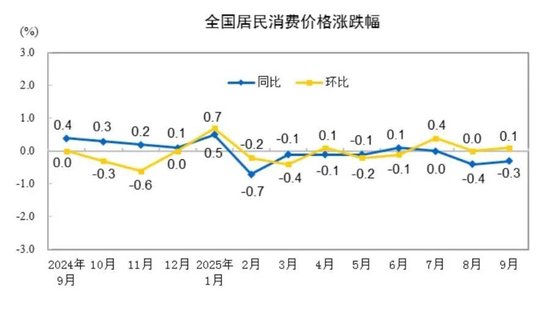
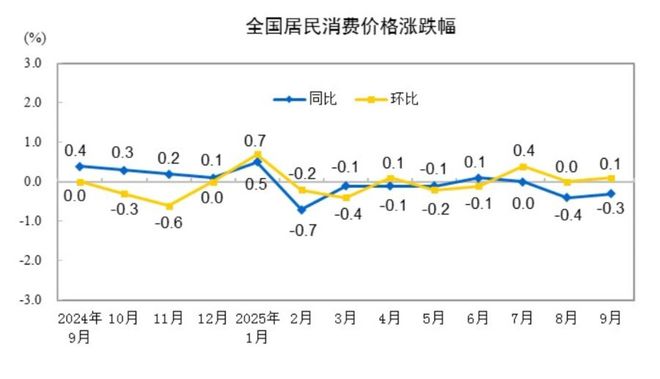
Group 1 - The consumer price index (CPI) increased by 0.1% month-on-month in September, while year-on-year it decreased by 0.3%, with the core CPI (excluding food and energy) rising by 1.0%, marking the fifth consecutive month of growth [1][2] - Food prices rose by 0.7% month-on-month, contributing approximately 0.13 percentage points to the CPI increase, while clothing prices increased by 0.8% due to seasonal changes [1] - The producer price index (PPI) remained flat month-on-month and decreased by 2.3% year-on-year, with the decline narrowing by 0.6 percentage points compared to the previous month [2][3] Group 2 - The year-on-year decline in CPI of 0.3% was primarily influenced by a negative carryover effect of approximately 0.8 percentage points, while new price changes contributed about 0.5 percentage points [2] - The PPI's month-on-month stability is attributed to improved supply-demand dynamics in certain industries, with coal processing prices rising by 3.8% and coal mining prices increasing by 2.5% [2][3] - The narrowing year-on-year decline in PPI is a result of ongoing macroeconomic policy effects, with some industries experiencing positive price changes due to market competition and structural upgrades [3]
9月PPI同比降幅继续收窄
Zhong Guo Hua Gong Bao· 2025-10-17 03:37
Group 1 - In September, China's Producer Price Index (PPI) remained flat month-on-month and decreased by 2.3% year-on-year, with the decline narrowing by 0.6 percentage points compared to the previous month [1] - The PPI's month-on-month performance showed two main characteristics: first, improvements in supply and demand structures led to price stabilization in certain industries, notably a 3.8% increase in coal processing prices and a 2.5% increase in coal mining and washing prices, both rising for two consecutive months [1] - Second, domestic oil-related industry prices fell due to external factors, with a 2.7% decrease in oil extraction prices, a 1.5% decrease in refined petroleum product manufacturing prices, a 0.6% decrease in organic chemical raw material manufacturing prices, and a 0.2% decrease in chemical fiber manufacturing prices [1] Group 2 - Year-on-year, the effects of macroeconomic policies have become evident, with some industry prices showing positive changes, particularly in coal processing, coal mining and washing, photovoltaic equipment and components manufacturing, and battery manufacturing, where price declines narrowed by 8.3, 3, 2.4, and 0.5 percentage points respectively [2] - The upgrading of industrial structures and the release of consumer potential have contributed to price increases in related industries, such as a 1.2% rise in electronic specialty materials manufacturing prices [2]
9月份核心CPI同比涨幅近19个月以来首次回到1% 部分领域市场供求关系逐步改善
Jing Ji Ri Bao· 2025-10-16 00:27
Core Insights - The consumer price index (CPI) showed a slight increase in September, with a month-on-month rise of 0.1%, marking a shift from the previous month where it was flat. The core CPI, excluding food and energy, rose by 1% year-on-year, the highest increase in 19 months, indicating a recovery in consumer prices [1][2][3] Group 1: CPI Analysis - The year-on-year CPI decreased by 0.3%, but the decline was less severe than the previous month, narrowing by 0.1 percentage points. The drop was primarily due to the "carryover effect" from previous price changes [2] - Food prices fell by 4.4% year-on-year, contributing approximately 0.83 percentage points to the CPI decline. However, the core CPI's increase of 1% reflects a more stable underlying price level [2][3] - The rise in CPI was supported by government policies aimed at boosting consumption, with significant price increases in home appliances and mobile phones [2] Group 2: PPI Analysis - The producer price index (PPI) remained flat month-on-month for two consecutive months, with a year-on-year decline of 2.3%, which is a reduction of 0.6 percentage points from the previous month. This indicates some stabilization in industrial prices [3][4] - Certain industries, such as coal processing and black metal smelting, have shown price increases for two months, reflecting improved supply-demand dynamics [3][4] - The overall decline in PPI is influenced by last year's low comparison base and the positive effects of macroeconomic policies [3] Group 3: Market Dynamics - The construction of a unified national market has led to a reduction in year-on-year price declines across various sectors, with notable improvements in market competition and order [4] - Upgrading industrial structures and releasing consumer potential have contributed to price increases in specific sectors, such as aircraft manufacturing and nutritional food production [4]
部分领域市场供求关系逐步改善
Jing Ji Ri Bao· 2025-10-16 00:07
Group 1 - The consumer price index (CPI) showed a slight increase in September, with a month-on-month rise of 0.1%, marking a shift from the previous month where it was flat [1][2] - The core CPI, excluding food and energy, rose by 1% year-on-year, the highest increase in 19 months, indicating a steady recovery in consumer prices [1][3] - Food prices increased by 0.7% month-on-month, with seasonal price rises observed in fresh vegetables, eggs, fresh fruits, lamb, and beef, while pork and aquatic product prices decreased due to sufficient supply [1][2] Group 2 - The producer price index (PPI) remained flat month-on-month for two consecutive months, with a year-on-year decline of 2.3%, but the rate of decline has narrowed by 0.6 percentage points compared to the previous month [3][4] - Improvements in supply-demand structure have led to price stabilization in certain industries, such as coal processing and black metal smelting, with some prices showing an upward trend [3][4] - The construction of a unified national market has contributed to a reduction in the year-on-year decline of prices in various sectors, with notable improvements in industries like coal mining and photovoltaic equipment manufacturing [4]
9月核心CPI,19个月来涨幅首次回到1%
2 1 Shi Ji Jing Ji Bao Dao· 2025-10-15 23:41
Group 1: CPI Analysis - In September, the national Consumer Price Index (CPI) decreased by 0.3% year-on-year, while it increased by 0.1% month-on-month [1][3][8] - The core CPI, excluding food and energy, rose by 1.0%, marking the first return to a 1% increase in nearly 19 months [6][8] - Food prices fell by 4.4%, contributing significantly to the CPI decline, while non-food prices increased by 0.7% [3][5][7] Group 2: PPI Analysis - The Producer Price Index (PPI) decreased by 2.3% year-on-year in September, with a month-on-month stability [1][8][11] - The decline in PPI was less severe than in previous months, narrowing by 0.6 percentage points compared to the previous month [1][8][11] - The industrial producer purchase prices also saw a year-on-year decrease of 3.1%, with a month-on-month increase of 0.1% [8][11] Group 3: Economic Insights - Economic policies have shown positive effects, leading to a narrowing of price declines in several industries [11][12] - The construction of a unified national market and the optimization of market competition have contributed to the recovery of prices in certain sectors [11][12] - The demand for high-quality and upgraded consumption has led to price increases in specific manufacturing sectors, such as a 14.7% rise in the price of arts and crafts products [12]
中国经济再现回暖信号
Di Yi Cai Jing Zi Xun· 2025-10-15 15:29
Group 1 - The continuous effectiveness of macro policies and financial support for the real economy has led to increased business activity and positive price changes in some industries, indicating a recovery in personal consumption and investment demand [2][7] - In September, the Consumer Price Index (CPI) and Producer Price Index (PPI) both showed a narrowing decline year-on-year, with the core CPI rising by 1% for the first time in 19 months [3][4] - The PPI decreased by 2.3% year-on-year in September, but the decline was 0.6 percentage points less than the previous month, indicating a stabilization in some industry prices due to improved supply-demand structures [5][6] Group 2 - The broad money supply (M2) and social financing scale maintained high growth rates in September, supporting a favorable monetary environment for economic recovery [2][7] - The M2 balance reached 335.38 trillion yuan, with an 8.4% year-on-year increase, reflecting the effectiveness of proactive fiscal policies and moderately loose monetary policies [7][8] - Experts suggest that the current economic challenge is not merely a lack of total demand but a structural imbalance, emphasizing the need for a shift in fiscal spending towards improving livelihoods and consumption [9]

9月核心CPI,19个月来涨幅首次回到1%
21世纪经济报道· 2025-10-15 13:50
Core Insights - The article discusses the recent trends in China's Consumer Price Index (CPI) and Producer Price Index (PPI), highlighting a decrease in CPI and a narrowing decline in PPI, indicating potential economic recovery and price stabilization [1][10]. CPI Analysis - In September, the national CPI decreased by 0.3% year-on-year, with urban areas down 0.2% and rural areas down 0.5% [4][6]. - Food prices fell by 4.4%, while non-food prices increased by 0.7%, contributing to the overall CPI decline [4][7]. - The core CPI, excluding food and energy, rose by 1.0%, marking the first return to this level in 19 months and indicating a continuous expansion for five consecutive months [7][9]. - The month-on-month CPI increased by 0.1%, with urban prices stable and rural prices rising by 0.2% [8][10]. PPI Analysis - The PPI for September showed a year-on-year decline of 2.3%, but the rate of decline narrowed by 0.6 percentage points compared to the previous month [10][12]. - The industrial producer purchase price index decreased by 3.1% year-on-year, with a month-on-month increase of 0.1% [10][12]. - The decline in PPI is attributed to a low comparison base from the previous year and the positive effects of macroeconomic policies [12][13]. Sector-Specific Insights - Certain industries, such as coal processing and photovoltaic equipment manufacturing, experienced a reduction in price decline, contributing to the overall narrowing of PPI [13]. - The modernization of the industrial system and the release of consumer potential have led to price increases in sectors like aircraft manufacturing and electronic materials [13]. - The article anticipates that the PPI decline will first widen and then narrow in 2025, influenced by ongoing market competition improvements [14].

9月核心CPI重返1%,物价修复态势延续
2 1 Shi Ji Jing Ji Bao Dao· 2025-10-15 09:42
Group 1: Consumer Price Index (CPI) Insights - In September, the national Consumer Price Index (CPI) decreased by 0.3% year-on-year, while it increased by 0.1% month-on-month [1][2] - The core CPI, excluding food and energy prices, rose by 1.0% year-on-year, marking the first return to a 1% increase in nearly 19 months [1][4] - The decline in CPI was primarily attributed to the "carryover effect," with food prices dropping by 4.4%, significantly impacting the overall CPI [4][6] Group 2: Producer Price Index (PPI) Insights - The Producer Price Index (PPI) decreased by 2.3% year-on-year in September, with the month-on-month figure remaining flat [1][6] - The year-on-year decline in PPI has narrowed by 0.6 percentage points compared to the previous month, indicating a potential stabilization in producer prices [6][9] - The prices of production materials showed a year-on-year decline of 2.4%, but the decrease has lessened compared to previous months, suggesting some recovery in production material pricing [8][10] Group 3: Economic Factors and Market Trends - The improvement in price indices is attributed to the release of consumer potential, industrial structure upgrades, and the continuous optimization of market competition [1][10] - Various macroeconomic policies are showing positive effects, leading to a reduction in the year-on-year price decline in several industries, including coal processing and photovoltaic equipment manufacturing [10][11] - The overall market is expected to see a gradual recovery, with projections indicating that the PPI decline will narrow in the latter half of 2025 due to improved market conditions [11]
9月中国PPI同比降幅收窄 部分行业产能治理见效
Zhong Guo Xin Wen Wang· 2025-10-15 08:54
Core Insights - In September, China's Producer Price Index (PPI) decreased by 2.3% year-on-year, with the decline narrowing by 0.6 percentage points compared to the previous month [1] - The effects of macroeconomic policies are becoming evident, leading to positive price changes in certain industries [1] Industry Analysis - The price declines in several industries have narrowed, indicating effective capacity management and improved market competition. The following industries saw reduced year-on-year price declines: - Coal processing: down 8.3 percentage points - Black metal smelting and rolling: down 3.4 percentage points - Coal mining and washing: down 3.0 percentage points - Photovoltaic equipment and components manufacturing: down 2.4 percentage points - Battery manufacturing: down 0.5 percentage points - Non-metallic mineral products: down 0.4 percentage points - The combined downward impact on PPI from these six industries decreased by approximately 0.34 percentage points compared to the previous month [1] Price Trends - Structural upgrades and the release of consumer potential have led to price increases in related industries: - Aircraft manufacturing: up 1.4% year-on-year - Electronic special materials manufacturing: up 1.2% year-on-year - Wearable smart devices manufacturing: up 0.1% year-on-year - Policies aimed at boosting consumption are showing effects, with prices for arts and crafts and ceremonial goods rising by 14.7% year-on-year, and nutritional food manufacturing prices increasing by 1.8% year-on-year [1] Month-on-Month Analysis - The improvement in supply-demand structure has stabilized prices in certain industries: - Coal processing prices increased by 3.8% month-on-month - Coal mining and washing prices rose by 2.5% month-on-month - Black metal smelting and rolling prices increased by 0.2% month-on-month - Non-metallic mineral products and lithium-ion battery manufacturing prices decreased by 0.4% and 0.2% month-on-month, respectively, with declines narrowing by 0.6 and 0.3 percentage points compared to the previous month [2]