物价修复

Search documents
——2026年1-2月财政数据解读:支出靠前发力
Huafu Securities· 2026-03-20 06:19
Revenue Insights - In January-February 2026, the general public budget revenue reached 4.4 trillion yuan, with a year-on-year growth of 0.7%, below the target growth rate of 2.2%[3] - Central revenue decreased by 1.7% year-on-year, while local revenue increased by 2.6%, exceeding the target growth rate[3] - Tax revenue grew by 0.1% year-on-year, and non-tax revenue increased by 3.4%, both turning positive compared to December 2025[3] Expenditure Insights - National fiscal expenditure in January-February 2026 was 4.7 trillion yuan, with a year-on-year growth of 3.6%, slightly below the annual target growth rate of 4.4%[4] - The progress of public fiscal expenditure was 15.6%, higher than the same period last year and faster than the 5-year average of 14.8%[4] - Significant increases were noted in social security and employment expenditures, which rose by 16 percentage points[16] Fund Insights - Government fund income decreased by 16% year-on-year, significantly below the budget target of 0.6%, with land use rights income dropping by 25.2%[5] - Government fund expenditure grew by 16%, surpassing the target growth rate of 5.1%, primarily due to the issuance of new special bonds[5] - The progress of government fund expenditure reached 11.1%, marking the highest level since 2020 for the same period[5] Market Outlook - Fiscal spending is expected to support economic recovery, with a focus on improving living standards and stabilizing revenue through price recovery[2] - The overall fiscal deficit rate is projected to decrease, but the recovery of the Producer Price Index (PPI) may amplify policy effects, leading to moderate fiscal expansion that could boost total demand[2]
朝闻国盛:央行四季度货币政策报告6大信号:存款“流失”的变与不变
GOLDEN SUN SECURITIES· 2026-02-12 00:47
Group 1: Macro Insights - The report indicates a positive outlook for the economy, emphasizing the importance of maintaining a moderately loose monetary policy to support economic stability and growth [5][11] - The report highlights a shift in focus towards promoting stable economic growth as a key consideration for monetary policy, indicating that a weakening economic fundamental may trigger further monetary easing [5] - The report discusses the impact of "deposit outflow" on liquidity, noting that while it affects the structure of bank liabilities, it does not significantly alter the overall liquidity situation in the financial system [5] Group 2: Price Trends - In January, the Consumer Price Index (CPI) growth rate fell to 0.2%, influenced by seasonal factors, while the core CPI showed improvement, reaching its highest level in six months [3] - The Producer Price Index (PPI) saw a narrowing decline, with a month-on-month increase of 0.4%, marking four consecutive months of growth [3] - The report anticipates a rebound in CPI readings for February, with an expected annual average around 0.7%, while core CPI is projected to remain strong, driven by factors such as gold prices and consumer services [3] Group 3: Banking Sector Insights - The average interest rate for new loans in Q4 2025 was reported at 3.15%, a decrease of 10 basis points from the previous quarter, indicating a continued downward trend in overall interest rates [8][11] - The report suggests that the banking sector will experience a significant repricing of deposits in 2026, which is expected to optimize funding costs and support a narrowing of interest margins [11] - The report emphasizes the importance of financial support for key sectors to stimulate domestic demand, with a focus on maintaining a stable lending environment [11] Group 4: Industry Performance - The report identifies the top-performing industries in January, with the oil and petrochemical sector leading at 17.3%, followed by construction materials at 14.5% and basic chemicals at 7.7% [1] - Conversely, the report notes the underperforming sectors, including defense and military, which saw a decline of 12.7% in January, and the computer sector, which fell by 8.2% [1]

1月CPI温和上涨 物价持续修复
Xin Lang Cai Jing· 2026-02-11 18:46
Group 1 - The National Bureau of Statistics released the first data on the Consumer Price Index (CPI) and Producer Price Index (PPI) based on the 2025 benchmark, indicating a 0.2% month-on-month increase in CPI and a 0.4% month-on-month increase in PPI for January [1] - The core CPI, excluding food and energy prices, showed a moderate month-on-month increase of 0.3%, the highest in six months, suggesting a gradual improvement in consumer demand [2][3] - The PPI has increased for four consecutive months, with a year-on-year decline of 1.4%, which is a narrowing of the decline by 0.5 percentage points compared to the previous month [2][3] Group 2 - The adjustment of the benchmark is expected to have a positive impact on the price index trends, with an average influence of approximately 0.06 and 0.08 percentage points on the CPI and PPI respectively [1] - The increase in PPI is attributed to the ongoing construction of a unified national market and rising demand in certain industries, such as cement manufacturing and lithium-ion battery production [3] - The performance of PPI is also influenced by international commodity prices and seasonal demand related to the Spring Festival, with expectations for PPI year-on-year data to potentially turn positive in the second quarter [3]


知名基金经理,“盯”上这只股
Zhong Guo Zheng Quan Bao· 2026-02-10 22:50
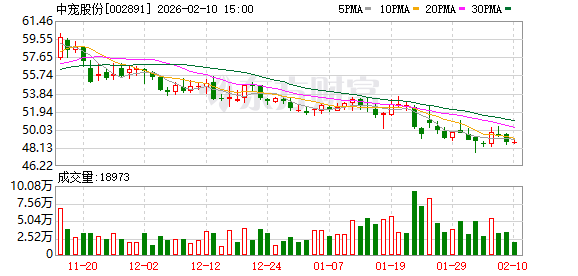
Core Viewpoint - The domestic consumption sector is experiencing a rebound as it approaches the Spring Festival holiday, supported by a recovery environment and low valuations [1] Group 1: Investment Activity - A-share leading pet company Zhongchong Co., Ltd. announced that as of January 23, well-known fund managers Xie Zhiyu and Qiao Qian have entered the top ten shareholders with their funds, holding a combined market value of over 800 million yuan [1][2] - The funds managed by Xie Zhiyu and Qiao Qian hold 6.43 million shares and 3.73 million shares of Zhongchong Co., Ltd., respectively, with estimated market values of 503 million yuan and 313 million yuan [2] - In the fourth quarter of 2025, some well-known active equity fund managers began to focus on the consumption sector, indicating a strategic shift towards undervalued consumer stocks [4] Group 2: Market Trends - As of February 10, 2025, the stock prices of Pop Mart and Laopu Gold have increased by over 40% and 20%, respectively, reflecting a warming trend in the consumption sector [3] - Traditional consumption stocks are seeing a resurgence, particularly in the liquor sector, as the market anticipates a recovery in consumer demand during the traditional peak season [4] - The market is observing a gradual improvement in price levels, with expectations of a moderate recovery in inflation, which could enhance the elasticity of the consumption sector [6] Group 3: Fund Manager Insights - Fund managers are increasingly optimistic about traditional consumer stocks, noting that strong brand equity and competitive advantages are providing a solid value foundation [6][7] - The proactive positioning of funds in low-valuation consumer stocks is seen as a strategy to enhance returns, especially in the context of improving market conditions [4][6] - New consumption sectors, such as trendy toys, beauty, personal care, and jewelry retail, are expected to present frequent opportunities for investment, with well-managed companies likely to emerge as winners [7]
知名基金经理 “盯”上这只股!
Zhong Guo Zheng Quan Bao· 2026-02-10 16:13
Group 1 - The domestic consumption sector is experiencing a rebound as it approaches the Spring Festival holiday, with valuations at the bottom and a recovering environment [2] - A-share leading pet company Zhongchong Co., Ltd. announced that as of January 23, well-known fund managers have entered its top ten shareholders, with a combined market value exceeding 800 million yuan [2][3] - In the fourth quarter of 2025, some well-known active equity fund managers began to position themselves in the consumption sector, anticipating a moderate recovery in prices and improved market conditions [2][8] Group 2 - The four funds managed by Xie Zhiyu and Qiao Qian hold significant shares in Zhongchong Co., Ltd., with estimated market values of 503 million yuan and 313 million yuan respectively [3] - The recent recovery in the consumption sector has led to increased attention from the market, with expectations of a gradual improvement in price levels [8][9] - Fund managers are optimistic about traditional consumer stocks, noting that strong brand companies are seeing improved sales and reduced historical inventory levels [8][9]

配置盘超预期,债市配置价值凸显,关注十年国债ETF(511260)
Sou Hu Cai Jing· 2026-02-05 01:21
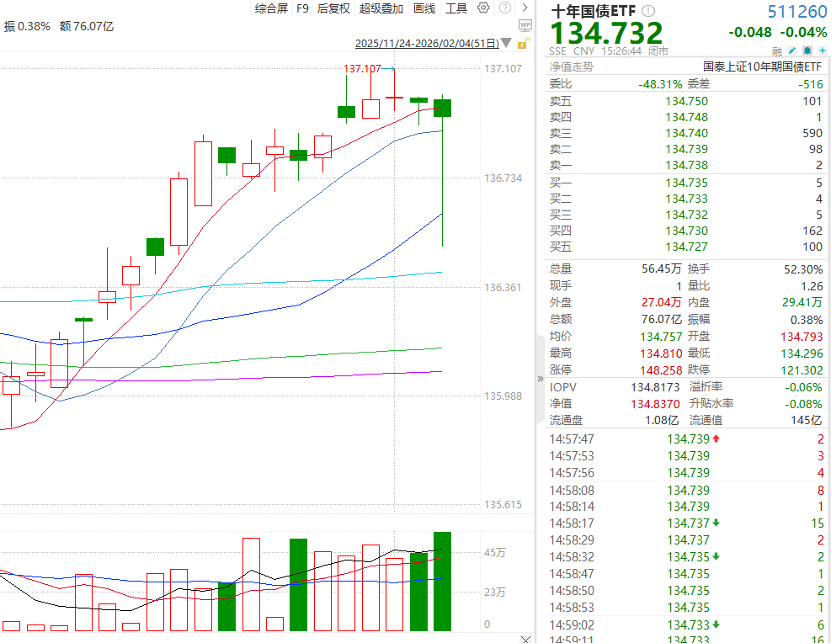
Group 1 - The core viewpoint of the article indicates that after an unexpected allocation by banks at the beginning of the year, the bond market has experienced a slow upward trend, with recent hesitations. The ten-year government bond ETF (511260) has shown a slight increase of 0.05% over the past five days [1] - Short-term interest rates may have opportunities to decline, but in the medium to long term, a narrow range of fluctuations is expected to persist. A configuration strategy is currently favored over swing trading, with a focus on medium-term government bond ETFs (511010) and the ten-year government bond ETF (511260) [1] - The short-term rebound in the bond market is attributed to an unexpected surplus in bank deposit retention rates, indicating a robust liability side. Additionally, interbank funding prices have decreased, and large banks have shown significant buying behavior in the bond market, reflecting ample liquidity [2][3] Group 2 - In the medium to long term, the narrow fluctuation pattern in the bond market remains unbroken. The nominal growth of the economy and monetary policy are the long-term main lines for the bond market, but both have not yet reached a stage where "qualitative changes occur due to quantitative changes." The K-shaped economic differentiation persists, with old momentum gradually bottoming out without triggering visible risks, while new momentum is attracting investor attention [3][5] - Inflation may rise this year, with expectations that CPI and PPI will continue to recover due to supply-side and demand-side policies. This potential inflationary pressure could be a risk point for the bond market [3] - The monetary policy stance remains relatively neutral, aiming to protect bank net interest margins and maintain a stable exchange rate, which suggests a strong guidance for keeping the bond market within a reasonable range. Overall, the bond market is expected to favor conservative configuration strategies this year [5]
国泰君安期货所长早读-20251212
Guo Tai Jun An Qi Huo· 2025-12-12 02:04
Report Industry Investment Rating No relevant content provided. Report's Core View The Central Economic Work Conference further clarified the direction and tasks of next year's economic work. There are new refinements in some areas compared to the Political Bureau meeting, including releasing many signals in traditional growth - stabilizing areas, emphasizing work related to prices, and focusing on "quality and efficiency improvement" and "cross - cycle" structural adjustment. Next year's economy is expected to continue to stabilize, with the repair of short - boards such as prices and more prominent economic development quality and efficiency [8]. Summary by Related Catalogs Macroeconomic Outlook - The Central Economic Work Conference continued to emphasize科技创新 and had new refinements in traditional growth - stabilizing areas, such as clearly mentioning "flexibly and efficiently using reserve requirement ratio cuts and interest rate cuts", "maintaining sufficient liquidity", and focusing on real estate with the focus on "controlling increments, reducing inventories, and optimizing supplies". It is expected that the deficit rate will remain and the total deficit scale will continue to expand moderately next year. These measures are conducive to improving the growth expectation [8]. - In terms of prices, the policy shows an attitude of attention. It is expected that the certainty of price repair next year will further increase [8]. - Next year's policy will focus on "quality and efficiency improvement" and "cross - cycle" structural adjustment in addition to stabilizing growth [8]. Commodity Analysis Precious Metals - **Silver**: The price reached a new high, with London silver accelerating to $64.3 per ounce. The current spot contradiction is difficult to solve, with low domestic inventory and a slight increase in overseas lease rate. There is a risk of a squeeze in both Shanghai and London. The market is expected to continue to be strong, but attention should be paid to the pressure level around $65 [10]. - **Gold**: The price showed an upward trend, with factors such as expected interest rate cuts and macro - economic policies influencing it [21]. Base Metals - **Copper**: The price rose due to the decline of the US dollar. China's copper imports increased in November, and Chile's copper exports also increased year - on - year. The trend intensity is strong [25][27]. - **Zinc**: The price is short - term strong with internal and external market resonance. Although the most severe stage of overseas supply shortage has passed, the risk of low inventory still exists. There is an expectation of zinc element surplus next year, but the short - term price has upward elasticity [11]. - **Lead**: The domestic inventory increased, and the price was under pressure [31]. - **Tin**: There was a new supply disturbance. The price showed a certain fluctuation [34]. - **Aluminum**: The price center moved up. The supply - demand surplus of alumina remained unchanged, and cast aluminum alloy followed the trend of electrolytic aluminum [37]. - **Nickel**: The structural surplus situation has changed, but the game contradiction remains unchanged. Stainless steel's supply and demand continue to be weak, and the cost - support logic is enhanced [46]. Energy and Chemicals - **LPG**: The price dropped significantly at night due to factors such as the decline of crude oil, weakening demand, and warehouse receipt pressure. It is expected to maintain a low - level shock in the short - term and face downward pressure in the medium - to - long - term [13]. - **PX**: The demand is seasonally weakening, but the supply is still tight, showing a high - level shock market. The overall supply - demand is tight, and there is an expectation of supply contraction in the future [86]. - **PTA**: The price is in a high - level shock situation, supported by the cost of PX. The 05 contract can hold a long - PX and short - PTA strategy [87]. - **MEG**: The trend is weak. Attention should be paid to the support of unplanned maintenance on the market. The price is expected to operate in the range of 3600 - 3900 [88]. Agricultural Products - **Palm Oil**: The reduction in production is not clear, and the rebound height is limited [183]. - **Soybean Oil**: The driving force from US soybeans is insufficient, and the price fluctuates mainly [183]. - **Soybean Meal**: US soybeans rose, and the domestic soybean meal showed a strong - side shock [189]. - **Corn**: Attention should be paid to the spot price. The price showed a certain fluctuation [193]. - **Sugar**: The price is in a range - bound shock [196]. - **Cotton**: The price is in a strong - side shock, and attention should be paid to downstream demand [200]. - **Eggs**: The price is in an adjustment shock [206]. - **Hogs**: The price increase due to cooling was less than expected, and the warehouse receipt increased. The trend is weak [208]. - **Peanuts**: Attention should be paid to the purchase of oil mills. The price showed a certain stability [212]. Others - **Iron Ore**: The downstream demand space is limited, and the valuation is high [57]. - **Rebar and Hot - Rolled Coil**: The apparent demand data is weak, and the price is in a low - level shock [60][61]. - **Silicon Iron and Manganese Silicon**: The spot price is short - term firm, and the price is in a wide - range shock [65]. - **Coke and Coking Coal**: The price is in a wide - range shock [70]. - **Log**: The price is in a low - level shock [74]. - **Container Freight Index (European Line)**: The short - term sentiment is optimistic, and the medium - term is a shock market [156]. - **Short - Fiber and Bottle Chip**: There is medium - term pressure, and a long - TA and short - PF/PR strategy can be held [170]. - **Offset Printing Paper**: It is advisable to wait and see [173]. - **Pure Benzene**: The price is in a short - term shock [178].
综合PMI跌破50,货币待加力
HUAXI Securities· 2025-11-30 11:53
Group 1: PMI Overview - The composite PMI fell to 49.7% in November, down 0.3 percentage points from October, marking the first drop below the neutral line since early 2023[1] - The manufacturing PMI slightly rebounded to 49.2%, up 0.2 percentage points, but remains below the neutral line[2] - The services PMI dropped significantly by 0.7 percentage points to 49.5%, contributing to the overall decline in the composite PMI[1] Group 2: Sector Performance - The manufacturing sector showed signs of recovery with new orders rebounding 0.4 percentage points to 49.2%, although still below the neutral line, indicating weak demand[2] - The construction sector's business activity index increased by 0.5 percentage points to 49.6%, driven by infrastructure-related activities, but remains below the neutral line[4] - The services sector experienced a notable decline, with business activity dropping significantly, reflecting seasonal effects post-holiday[1] Group 3: Economic Indicators - The average composite PMI for October-November was 49.85%, a significant slowdown from the third quarter average of 50.43%[7] - New export orders in manufacturing rebounded sharply by 1.7 percentage points to 47.6%, indicating potential recovery in exports[3] - The manufacturing raw material purchase price index rose by 1.1 percentage points to 53.6%, the highest in 18 months, suggesting rising input costs[3] Group 4: Policy Implications - The likelihood of increased monetary policy support is rising as economic indicators suggest continued slowdown[6] - The market remains skeptical about new supportive policies as the year-end approaches, with expectations for broad monetary easing not high[7] - The bond market's response to central bank bond purchases in November will be a key observation point for future monetary policy expectations[7]
9月物价延续修复态势 专家称货币政策或将继续保持适度宽松
Zhong Guo Jing Ying Bao· 2025-10-15 11:58
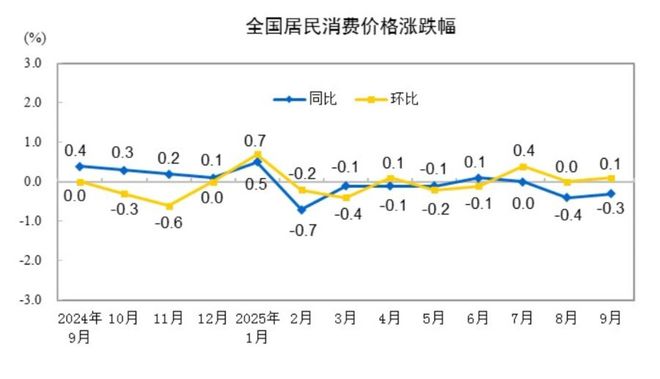
Core Insights - In September, the Consumer Price Index (CPI) decreased by 0.3% year-on-year, with the decline narrowing by 0.1 percentage points compared to August. The core CPI, excluding food and energy, rose by 1.0%, marking the fifth consecutive month of growth [1][2] - The Producer Price Index (PPI) fell by 2.3% year-on-year, with the decline narrowing by 0.6 percentage points from August [1][2] CPI Analysis - The slight narrowing of the CPI decline in September is attributed to effective consumption promotion policies, with increased prices for home appliances and mobile phones contributing positively. Additionally, a significant rise in international gold prices also played a role [2] - Food prices decreased by 4.4%, impacting the CPI by approximately 0.83 percentage points, while energy prices fell by 2.7%, contributing about 0.20 percentage points to the CPI decline [2] - The "tail effect" was noted as a significant factor in the CPI's year-on-year change, with a negative impact of about 0.8 percentage points from previous price changes [2] PPI Analysis - The narrowing of the PPI decline is influenced by a lower comparison base from the previous year and the positive effects of macroeconomic policies. Certain industries, such as coal processing and metal smelting, showed reduced price declines compared to August [4] - Prices in several sectors, including aircraft manufacturing and electronic materials, experienced year-on-year increases, indicating a recovery in some industrial prices [4] Future Outlook - The release of consumer service potential is expected to support a stable core CPI, with a gradual recovery anticipated in the CPI year-on-year [3] - The PPI is expected to stabilize as capacity governance continues in key industries, improving supply-demand structures [5] - The monetary policy is likely to maintain a moderately loose stance to support consumption and innovation, while addressing the weak internal growth dynamics [5]
9月核心CPI重返1%,物价修复态势延续
2 1 Shi Ji Jing Ji Bao Dao· 2025-10-15 09:42
Group 1: Consumer Price Index (CPI) Insights - In September, the national Consumer Price Index (CPI) decreased by 0.3% year-on-year, while it increased by 0.1% month-on-month [1][2] - The core CPI, excluding food and energy prices, rose by 1.0% year-on-year, marking the first return to a 1% increase in nearly 19 months [1][4] - The decline in CPI was primarily attributed to the "carryover effect," with food prices dropping by 4.4%, significantly impacting the overall CPI [4][6] Group 2: Producer Price Index (PPI) Insights - The Producer Price Index (PPI) decreased by 2.3% year-on-year in September, with the month-on-month figure remaining flat [1][6] - The year-on-year decline in PPI has narrowed by 0.6 percentage points compared to the previous month, indicating a potential stabilization in producer prices [6][9] - The prices of production materials showed a year-on-year decline of 2.4%, but the decrease has lessened compared to previous months, suggesting some recovery in production material pricing [8][10] Group 3: Economic Factors and Market Trends - The improvement in price indices is attributed to the release of consumer potential, industrial structure upgrades, and the continuous optimization of market competition [1][10] - Various macroeconomic policies are showing positive effects, leading to a reduction in the year-on-year price decline in several industries, including coal processing and photovoltaic equipment manufacturing [10][11] - The overall market is expected to see a gradual recovery, with projections indicating that the PPI decline will narrow in the latter half of 2025 due to improved market conditions [11]