
京津冀协同发展

Search documents
京津冀地区生产总值近12万亿元
Xin Lang Cai Jing· 2026-02-24 23:26
Core Insights - The Beijing-Tianjin-Hebei region is projected to see its GDP grow from 8.96 trillion yuan in 2020 to nearly 12 trillion yuan by 2025, with annual growth rates of 5.2%, 4.4%, and 5.4% for the three areas respectively [1][2] Economic Growth and Industrial Transformation - The industrial structure of the region is shifting, with the proportion of the tertiary industry increasing from 67.6% in 2020 to 70.1% in 2025, indicating a significant transition towards service-oriented sectors [2] - The added value of industrial enterprises above designated size is expected to grow by 6.6% year-on-year by 2025, with high-tech manufacturing leading the charge [2] - The production of integrated circuits is projected to increase by 74.3% compared to 2020, while the output of industrial robots is expected to grow exponentially [2] Collaborative Development and Innovation - By 2025, Tianjin is expected to receive 184.78 billion yuan in industrial project investments from Beijing and Hebei, accounting for 52.1% of all industrial project investments [3] - The number of national advanced manufacturing clusters in the region is set to increase from 2 in 2022 to 7 by 2025, showcasing enhanced industrial collaboration [3] - The total value of technology contracts in the region is projected to reach 1.4 trillion yuan by 2025, 1.8 times that of 2020, with Beijing's technology contracts to Tianjin and Hebei exceeding 320 billion yuan [3] Infrastructure and Urban Development - The urban sub-center in Tongzhou is expected to see an average GDP growth rate exceeding 6% during the 14th Five-Year Plan, with significant infrastructure projects being completed [4] - Xiong'an New Area is entering a phase of large-scale construction, maintaining an annual investment scale of 200 billion yuan, with numerous central enterprises relocating to the area [4] Transportation and Environmental Improvements - The region has added 710 kilometers of railway during the 14th Five-Year Plan, with total operational railway mileage reaching 10,394.9 kilometers [5] - The air quality and water ecosystem in the region are improving, with groundwater levels rising significantly compared to the end of the 13th Five-Year Plan [6] Social Welfare Enhancements - By 2025, the number of insured individuals from Tianjin and Hebei seeking medical treatment in Beijing is expected to increase by 25.2% year-on-year [6] - Collaborative educational initiatives are being established, with 314 quality schools in Beijing partnering with 496 schools in Hebei [6]
“十四五”京津冀GDP连跨三个万亿台阶
Xin Lang Cai Jing· 2026-02-24 19:19
Economic Growth - The GDP of the Beijing-Tianjin-Hebei region increased from 8.96 trillion yuan in 2020 to nearly 12 trillion yuan by 2025, achieving an average annual growth rate of 5.2%, 4.4%, and 5.4% for the three areas respectively [1][2] - The industrial structure shifted from a ratio of 4.7:27.7:67.6 in 2020 to 4.1:25.8:70.1 by 2025, with the tertiary industry surpassing 70% [2] - The region's retail sales of consumer goods rose from 29,809.8 billion yuan in 2020 to 33,299.8 billion yuan in 2025, with an average annual growth of 2.2% [2] Innovation - By the end of 2025, the region had over 2,000 national-level specialized and innovative "little giant" enterprises, nearly ten times the number at the end of 2020 [3] - The number of invention patents reached 141,000 by 2025, which is 1.9 times that of 2020 [3] - The transaction volume of technology contracts in the region reached 1.4 trillion yuan by 2025, 1.8 times higher than in 2020 [3] Employment and Income - Over the five years, the region created 7.749 million new urban jobs [5] - By 2025, the per capita disposable income for residents was 89,090 yuan in Beijing, 55,918 yuan in Tianjin, and 36,439 yuan in Hebei, with annual nominal growth rates of 5.1%, 5.0%, and 6.1% respectively [5] - The income gap between urban and rural residents narrowed, with the income ratios decreasing from 2.51, 1.86, and 2.26 in 2020 to 2.29, 1.74, and 2.04 by 2025 [5] Public Services - By September 2025, over 10,000 elderly residents from Beijing had moved into nursing homes in Hebei, indicating improved public service sharing among the three regions [4][5] - The number of medical institutions achieving mutual recognition of test results reached 1,326, with 834 institutions sharing medical imaging examination data [5] Education - By the end of 2025, 314 quality primary and secondary schools in Beijing collaborated with 496 schools in Hebei, enhancing educational cooperation [6]

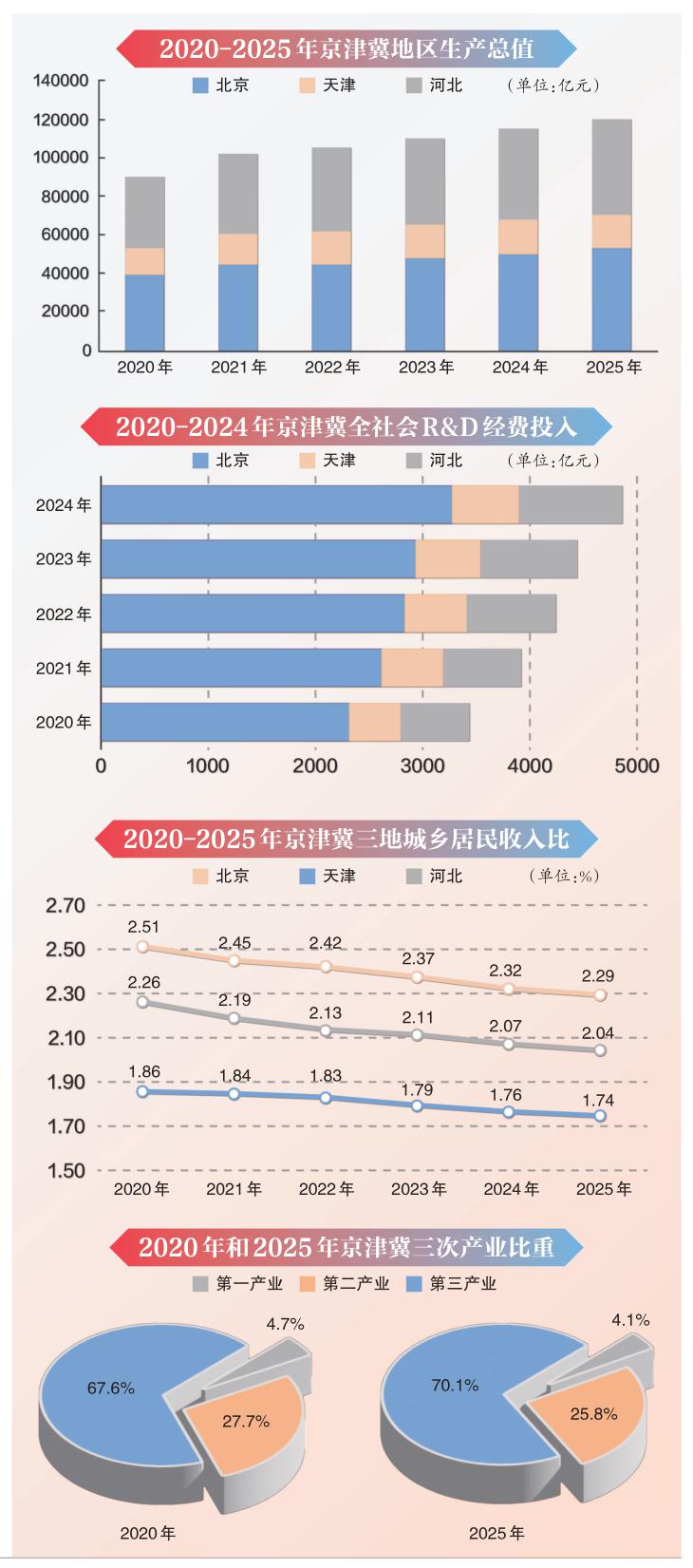
解构京津冀协同发展的“十四五”答卷
Bei Jing Shang Bao· 2026-02-24 16:56
Economic Growth - The GDP of the Beijing-Tianjin-Hebei region is projected to increase from 8.96 trillion yuan in 2020 to nearly 12 trillion yuan by 2025, crossing three trillion yuan milestones [1][3] - The average annual growth rates for the three areas during the "14th Five-Year Plan" period are expected to be 5.2% for Beijing, 4.4% for Tianjin, and 5.4% for Hebei [3] Industrial Transformation - The proportion of the tertiary industry in the region has surpassed 70%, with the three industries' structure changing from 4.7:27.7:67.6 in 2020 to 4.1:25.8:70.1 by 2025 [6] - The added value of high-tech manufacturing in Beijing and Tianjin is expected to account for 32.1% and 16.6% of the industrial output, respectively, by 2025 [6] Investment and Consumption - Fixed asset investments in the three regions are projected to grow by 5.5% in Beijing, 1.6% in Tianjin, and 6.1% in Hebei by 2025 [7] - The total retail sales of consumer goods in the region are expected to rise from 29,809.8 billion yuan in 2020 to 33,299.8 billion yuan by 2025, with an average annual growth rate of 2.2% [7] Innovation and Technology - The total value of technology contracts in the region is expected to reach 1.4 trillion yuan by 2025, which is 1.8 times that of 2020 [9] - The number of invention patents in the region is projected to reach 141,000 by 2025, which is 1.9 times that of 2020 [10] Infrastructure and Public Services - The construction of a "1-1.5 hour traffic circle" among major cities in the region has been largely achieved, with significant improvements in public transportation [11] - Collaborative projects in healthcare and elderly care have been established, enhancing the quality of public services across the region [12]
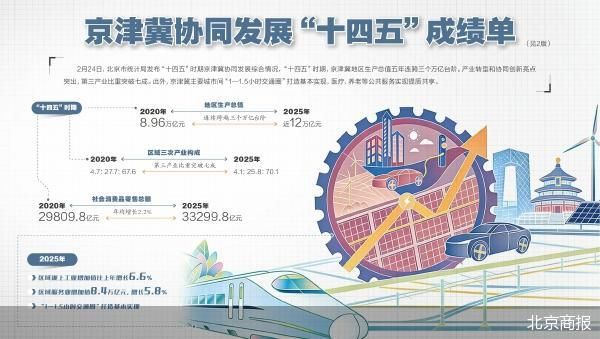
京津冀篇 十二载策马启华章
Xin Lang Cai Jing· 2026-02-24 15:14
Core Insights - The Beijing-Tianjin-Hebei (Jing-Jin-Ji) coordinated development has significantly advanced over the past 12 years, with the regional economy surpassing 11.5 trillion yuan, marking a strong driver for high-quality national development [2] - The initiative aims to create a modernized urban cluster, enhancing collaboration among the three regions while addressing ecological and economic challenges [1][19] Group 1: Strategic Planning and Development - In 2014, President Xi Jinping emphasized the need for coordinated development in Jing-Jin-Ji as a major national strategy to optimize urban layouts and promote ecological civilization [1] - The construction of Xiong'an New Area is highlighted as a historic project, requiring patience and a long-term vision [3] - By 2024, the focus will be on deepening regional integration and innovation in governance mechanisms to enhance the collaboration between Beijing and Tianjin [9] Group 2: Economic Growth and Industrial Transformation - The region's economic output has increased significantly, with traditional industries like steel undergoing transformation, and new industries such as information technology and biomanufacturing rapidly growing [2][4] - Beijing has seen a substantial rise in high-tech industries, with over 30,000 national high-tech enterprises established, and a notable increase in integrated circuit production and electric vehicle manufacturing [13] - Hebei has also expanded its high-tech enterprises to 15,500, with significant growth in advanced manufacturing and technology-driven sectors [14] Group 3: Infrastructure and Connectivity - The completion of major transportation projects, including the "Four Vertical and Three Horizontal" highway network, has improved connectivity across the region [4][5] - High-speed rail connections have been established between all prefecture-level cities and provincial capitals, enhancing regional mobility [6] Group 4: Innovation and Technology - The establishment of innovation centers and the promotion of collaborative projects in technology and research have been prioritized, with significant investments in AI and digital economy sectors [12][15] - The region aims to create a collaborative innovation ecosystem, integrating various sectors to drive economic growth and technological advancement [15] Group 5: Environmental Sustainability - Plans for Xiong'an New Area include establishing a green development model, aiming for a significant improvement in ecological quality by 2030 [16] - The "Beautiful China" initiative outlines goals for ecological restoration and pollution reduction, with specific targets for water quality and carbon emissions by 2030 [18] Group 6: Future Planning and Vision - The "Modern Capital Urban Circle Spatial Coordination Plan" aims to optimize the urban structure and enhance the functional synergy between Beijing, Tianjin, and Hebei [19][20] - The plan emphasizes the importance of high-quality development and the establishment of a world-class urban cluster, focusing on innovation and sustainable growth [19]
探访北京-雄安人才科创走廊先行区
Zhong Guo Xin Wen Wang· 2026-02-24 14:31
Core Viewpoint - The "Qingchuang Village" in Beijing's Fengtai District is a key initiative for fostering innovation and entrepreneurship, serving as a vital starting point for the Beijing-Xiong'an Talent and Technology Corridor, and aims to enhance the collaborative development of the Beijing-Tianjin-Hebei region [1][3]. Group 1: Development of Qingchuang Village - Qingchuang Village has transformed old factories into a vibrant entrepreneurial community, integrating design and technology, and serves as a hub for young entrepreneurs [3][4]. - The area has revitalized over 150,000 square meters of industrial space, attracting 329 high-quality enterprises focused on technological innovation and cultural creativity, generating an annual tax revenue of over 170 million yuan [4]. - By 2030, Qingchuang Village aims to gather 10,000 innovative talents, nurture 1,000 quality enterprises, and create a production value of 10 billion yuan, positioning itself as a core engine for innovation-driven development in Fengtai and southwestern Beijing [4]. Group 2: Ecosystem and Talent Development - Fengtai District is implementing a comprehensive strategy to integrate education, technology, and talent development, establishing ten industry promotion centers to enhance the synergy between innovation, industry, finance, and talent [7]. - The "Qingchuang Belt" links various innovation resources along the Beijing Subway Line 10, fostering a collaborative environment for young talents and providing platforms for innovation and entrepreneurship [8]. - The district's initiatives aim to create a youth-friendly ecosystem, enhancing the attractiveness and cohesion for young people from both Beijing and Xiong'an [8][9]. Group 3: Industrial Collaboration and Growth - The Zhongguancun Fengtai Park has become a significant growth area for technology innovation, housing over 24,000 enterprises and generating substantial revenue, while focusing on key industries such as rail transit and aerospace [11]. - Companies like China Tonghao are leveraging their expertise in rail transit to expand into low-altitude technology, addressing industry challenges and enhancing regional collaboration [12][13]. - The district is also fostering digital technology applications in Xiong'an, with companies like Han Monkey Technology establishing a presence to support smart infrastructure development [14][15].

雄安综合保税区全域封关运营
Sou Hu Cai Jing· 2026-02-24 13:33
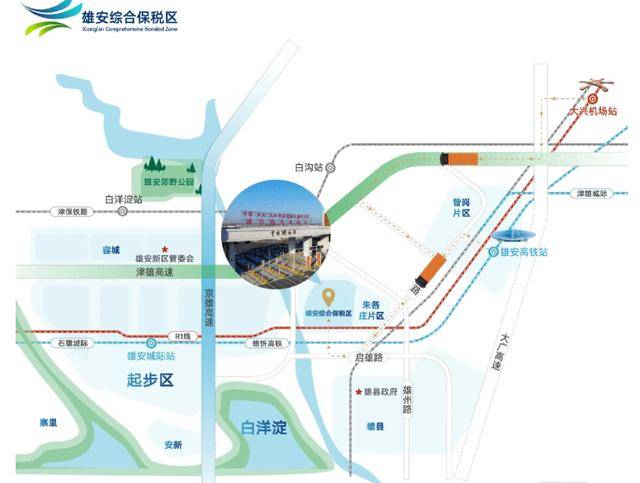
Core Viewpoint - The approval of the Xiong'an Comprehensive Bonded Zone (Phase II) by the General Administration of Customs marks a significant step in promoting high-level opening-up in Xiong'an, enhancing its capacity to support the coordinated development of Beijing-Tianjin-Hebei and the relocation of non-capital functions from Beijing [2][3]. Group 1 - The Xiong'an Comprehensive Bonded Zone has a planned area of 0.63 square kilometers and has achieved "full closure and overall operation" [2]. - The Phase I project, covering 0.42 square kilometers, is set to commence operations in January 2024, demonstrating significant results in customs facilitation reforms and the nurturing of new bonded business models [3][4]. - The total import and export value of the Xiong'an Bonded Zone is projected to reach 60.008 billion yuan by 2025 [3]. Group 2 - The Phase II project, covering 0.21 square kilometers, will focus on high-end manufacturing, smart logistics, research and design, and testing and maintenance, aiming for seamless integration with Phase I [4]. - The Xiong'an Comprehensive Bonded Zone is positioned as the highest level of openness, with optimal policies and flexible operations, serving the coordinated development of the Beijing-Tianjin-Hebei region [4][5]. - The Xiong'an Free Trade Zone Management Committee plans to leverage policy advantages to create a dual-driven open structure of "Bonded Zone + Free Trade Zone," enhancing the development of "bonded +" new business models [4].
不止三个万亿台阶 透视“十四五”时期京津冀协同发展成绩单
Bei Jing Shang Bao· 2026-02-24 13:32
Core Insights - The Beijing-Tianjin-Hebei region's GDP is projected to increase from 8.96 trillion yuan in 2020 to nearly 12 trillion yuan by 2025, crossing three trillion yuan milestones [1][4] - The region is experiencing significant industrial transformation and collaborative innovation, with the tertiary industry accounting for over 70% of the GDP by 2025 [1][7] Economic Growth - The GDP growth rates for the three areas are projected at 5.4% for Beijing, 4.8% for Tianjin, and 5.6% for Hebei, with an average annual growth rate of 5.2% for the region during the 14th Five-Year Plan [4][5] - The annual average growth rate for the GDP in the Tongzhou District, where Beijing's sub-center is located, is expected to exceed 6% [5] Industrial Transformation - The structure of the three industries in the region is shifting from 4.7:27.7:67.6 in 2020 to 4.1:25.8:70.1 by 2025, indicating a significant increase in the tertiary sector [7] - The added value of high-tech manufacturing in Beijing and Tianjin is projected to account for 32.1% and 16.6% of the industrial output, respectively, by 2025 [7] Investment and Consumption - Fixed asset investments in the three areas are expected to grow by 5.5% in Beijing, 1.6% in Tianjin, and 6.1% in Hebei by 2025 [8] - The total retail sales of consumer goods in the region are projected to rise from 29,809.8 billion yuan in 2020 to 33,299.8 billion yuan by 2025, with an average annual growth rate of 2.2% [8] Innovation and Technology - The total value of technology contracts in the region is expected to reach 1.4 trillion yuan by 2025, which is 1.8 times that of 2020 [9] - The number of invention patents in the region is projected to reach 141,000 by 2025, nearly double the amount in 2020 [10] Infrastructure and Public Services - The construction of a "1-1.5 hour traffic circle" among major cities in the region is nearing completion, with significant improvements in public transportation [11] - Collaborative initiatives in healthcare and elderly care are enhancing public service quality, benefiting residents across the three areas [12]

京津冀经济总量5年连跨3个万亿元台阶
Xin Hua She· 2026-02-24 10:26
Core Viewpoint - The Beijing-Tianjin-Hebei region has achieved significant economic growth during the "14th Five-Year Plan" period, with GDP projected to increase from 8.96 trillion yuan in 2020 to nearly 12 trillion yuan by 2025, marking a continuous crossing of three trillion yuan milestones [1] Economic Growth - The average annual growth rates for the region's GDP during the "14th Five-Year Plan" are 5.2%, 4.4%, and 5.4% respectively [1]
截至去年9月底,超万名京籍老年人住进河北养老院
Xin Jing Bao· 2026-02-24 06:09
Group 1 - The core viewpoint of the article highlights the achievements of the Beijing-Tianjin-Hebei coordinated development during the 14th Five-Year Plan period, emphasizing improvements in public services and economic indicators [1] - By 2025, the number of medical settlement visits for insured individuals from Tianjin and Hebei in Beijing is expected to increase by 25.2% compared to the previous year, with these visits accounting for 35.5% of the total medical settlements from outside Beijing [1] - The region has created 774.9 million new urban jobs over five years, with per capita disposable income for residents in 2025 projected to be 89,090 yuan, 55,918 yuan, and 36,439 yuan for Beijing, Tianjin, and Hebei respectively, reflecting annual nominal growth rates of 5.1%, 5.0%, and 6.1% compared to 2020 [1] Group 2 - As of September 2025, over 10,000 elderly residents from Beijing are expected to reside in Hebei's nursing institutions, with over 200 in Tianjin, indicating a collaborative approach to elderly care services across the three regions [2] - In the education sector, by the end of 2025, 314 quality primary and secondary schools in Beijing and Tianjin will collaborate with 496 schools in Hebei, while major universities will provide support to high schools in Hebei, enhancing educational cooperation [2] - Construction of campuses for several universities in Xiong'an is progressing, with specific sites identified for institutions such as Beijing Institute of Technology and Beihang University [2]
五年十倍,京津冀地区国家级“小巨人”企业已超2000家
Xin Jing Bao· 2026-02-24 05:25
Core Viewpoint - The "14th Five-Year Plan" period has seen significant advancements in innovation and collaboration within the Beijing-Tianjin-Hebei region, with substantial growth in R&D investment and patent ownership, indicating a robust development in the regional economy and technology sector [1][2] Group 1: Innovation and R&D - By the end of 2025, the Beijing-Tianjin-Hebei region is expected to have over 2,000 national-level specialized and innovative "little giant" enterprises, nearly ten times the number at the end of 2020 [1] - The R&D expenditure intensity for the region is projected to reach 4.2% in 2024, an increase of 0.4 percentage points from 2020 [1] - The number of invention patents in the region is anticipated to reach 141,000 by 2025, which is 1.9 times the amount in 2020 [1] Group 2: Collaborative Development - The transaction value of technology contracts in the Beijing-Tianjin-Hebei region is expected to reach 1.4 trillion yuan by 2025, 1.8 times higher than in 2020 [1] - The annual average growth rate of technology contract transactions from Beijing to Tianjin and Hebei is projected at 23%, with a total exceeding 320 billion yuan, marking a 1.7 times increase compared to the "13th Five-Year Plan" period [1] - The establishment of national technology innovation centers in Tianjin, Hebei, and Xiong'an has been initiated, with over 10,000 branches of Zhongguancun enterprises set up in Tianjin and Hebei [1] Group 3: Industrial Development - The number of national-level advanced manufacturing clusters in the Beijing-Tianjin-Hebei region is expected to grow from 2 in 2022 to 7 by 2025 [2] - The production of new energy vehicles in the region is projected to reach 1.084 million units by 2025, with an average annual growth rate exceeding 60% during the "14th Five-Year Plan" period [2] - The formation of a "one-hour automotive parts supply circle" is accelerating in the region [2]