房地产市场分化

Search documents
合肥楼市8月榜单出炉!包河16亿领跑,中海拿地31亿称王!安徽土地市场暗流涌动……
Sou Hu Cai Jing· 2025-09-03 14:38
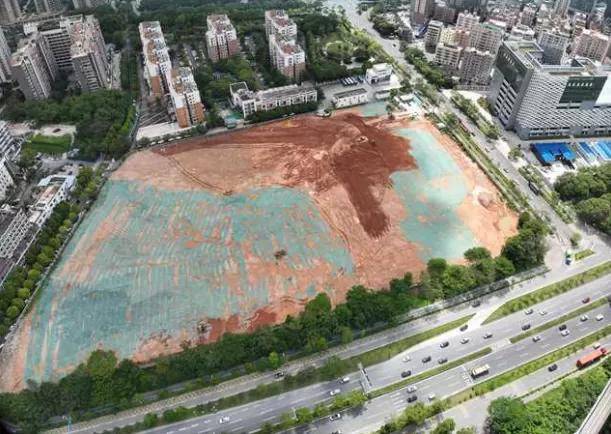
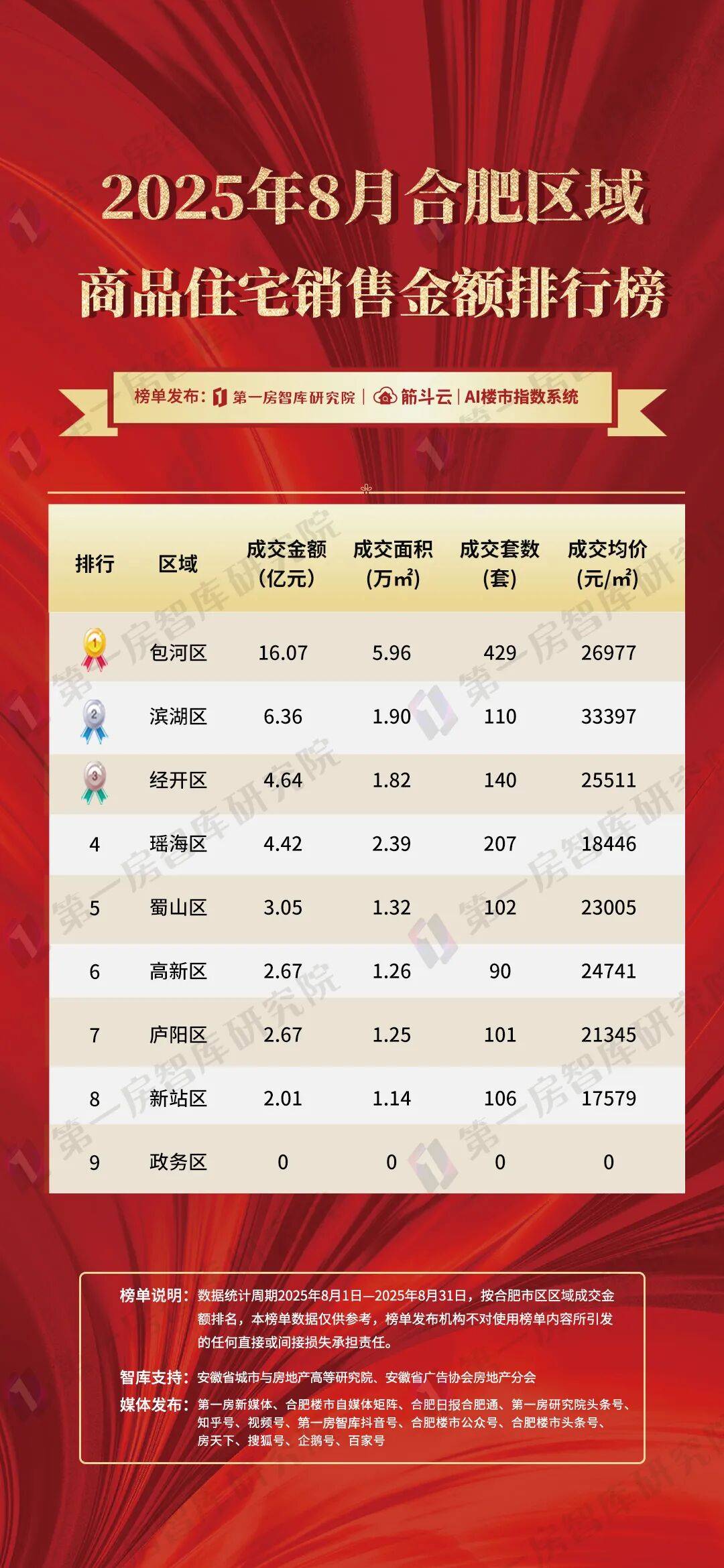
Core Insights - The Anhui real estate market is experiencing significant differentiation, with Hefei leading in land sales and new home transactions, indicating a restructuring of the regional market [1][22] - State-owned and central enterprises dominate both land acquisition and sales rankings, reflecting a concentration of market resources towards leading companies [1][22] Group 1: Land Market Performance - In the first eight months of 2025, Anhui's land market attracted over 35 billion yuan, with Hefei alone accounting for approximately 171.83 billion yuan, representing 48.9% of the total [10][11] - Hefei's land transaction area reached 128.87 million square meters, significantly surpassing other cities in the province [10][11] - The land market shows stark differences in activity levels among cities, with Hefei, Chuzhou, and Bengbu leading, while many cities recorded minimal or no transactions [11][12] Group 2: Residential Sales Performance - In August 2025, Hefei's residential sales reached over 40 billion yuan, with the Baohe District leading at 16.07 billion yuan, followed by the Binhu and Economic Development Districts [2][3] - The average price in the high-end market, particularly in the Binhu District, reached 33,397 yuan per square meter, indicating strong demand for premium properties [2][3] - The top-selling residential projects predominantly located in popular districts reflect the ongoing high demand for quality housing [5][6] Group 3: Developer Performance - The top 20 real estate companies in Hefei accounted for approximately 40 billion yuan in sales, indicating a high concentration of sales among leading firms [9][22] - State-owned enterprises, including Hefei Rail Transit Group and China Merchants Shekou, dominate the sales rankings, highlighting their strong market presence [8][22] - The performance of local enterprises like Hefei Urban Investment and Anhui Qingtian demonstrates the competitive landscape within the region [8][22] Group 4: Market Trends and Future Outlook - The Anhui real estate market is shifting from quantity to quality, with an increasing focus on improving product offerings to meet the demands of the upgrading consumer base [22] - The market is expected to continue concentrating on core cities and regions, with a clear distinction between high-performing and underperforming areas [22] - The ongoing trend of state-owned enterprises leading the market suggests a stable yet competitive environment for future developments [22]






楼市变革下的财富陷阱:三类房产加速贬值,看看你家有吗?
Sou Hu Cai Jing· 2025-08-29 01:18
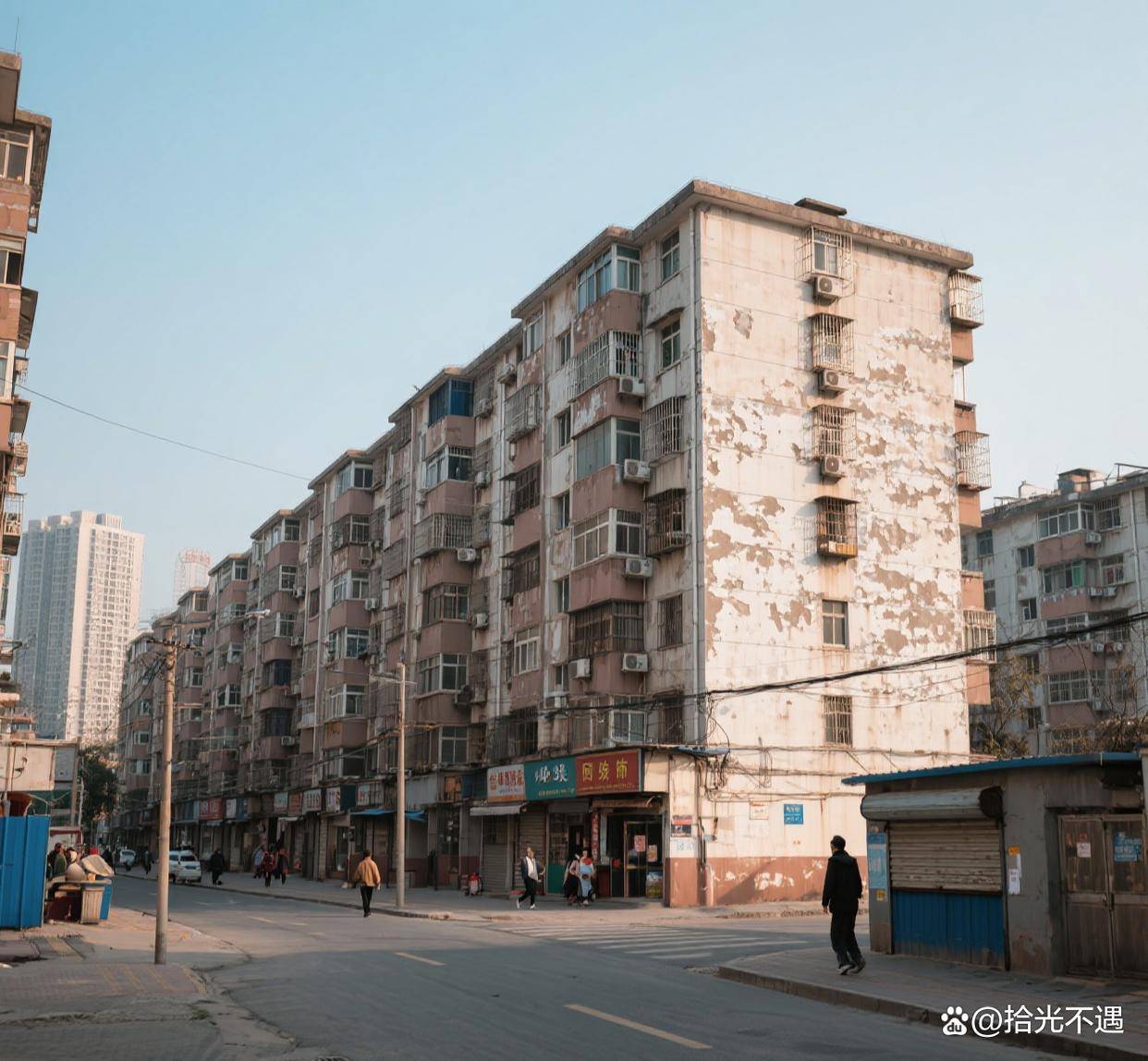
Core Viewpoint - The Chinese real estate market is undergoing a profound transformation, with significant declines in investment and sales, while new financial policies are reshaping the market landscape [1] Group 1: Old and Dilapidated Properties - The investment logic of "old and dilapidated" properties is failing as 80% of buildings over 21 years old will be upgraded rather than demolished, leading to a return to their residential value [3] - Prices for these properties are declining, with some units in Yantai dropping below 6000 yuan per square meter, and banks are increasingly reluctant to lend against them [4] - Core school district properties still maintain high prices, but recent policy changes have led to significant price drops in areas like Hangzhou, where prices fell by 15%-30% [5] Group 2: Suburban Properties - Suburban residential inventory in Shanghai has reached 121,000 units, with a long absorption period of up to 30 months, indicating a significant oversupply [8] - Many suburban areas face a lack of infrastructure and population outflow, leading to poor sales performance and increased financial risks for developers [9] - New policies aimed at stimulating suburban markets may benefit local demand but pose risks for external investors [10] Group 3: Commercial and Office Properties - The average vacancy rate for commercial properties has exceeded 20%, with some second-tier cities seeing rates above 35%, and rental prices have dropped by 15%-20% from 2020 highs [12] - High transfer taxes in cities like Shenzhen are hindering the liquidity of commercial properties, with new regulations further restricting their marketability [13] - Some cities are experimenting with converting office spaces into affordable rental housing, but the lengthy approval processes pose challenges [14] Group 4: Policy Changes and Taxation - The expansion of property tax trials and adjustments in tax rates are expected to significantly increase holding costs for multiple property owners [16] - Local variations in tax policies require investors to optimize their tax structures while being cautious of potential policy risks [17] - A nationwide decline in housing prices is observed, with some cities experiencing extreme cases of properties selling for as low as 30,000 yuan [18] Group 5: Investment Strategies - Investors are advised to focus on core locations and quality properties while considering low leverage strategies [18] - The introduction of streamlined inheritance processes for real estate may provide opportunities for more efficient property transfers [19] - A systematic approach to data verification and policy tracking is recommended to avoid pitfalls in the current market [20]
绿城中国:下半年放缓拿地节奏 全年拿地货值目标在1200亿—1300亿元
Zheng Quan Shi Bao Wang· 2025-08-25 12:44
Core Viewpoint - Greentown China anticipates a slowdown in land acquisition in the second half of the year, with a target land value of between 120 billion to 130 billion yuan for the year, while sales for 2025 are expected to remain comparable to the previous year [1][2][4] Financial Performance - In the first half of the year, Greentown achieved total contract sales of approximately 122.2 billion yuan, ranking second nationally; revenue was about 53.368 billion yuan, with a profit attributable to shareholders of approximately 210 million yuan [1] - The company added 35 new projects with a total construction area of about 3.55 million square meters, expected to have a saleable value of approximately 90.7 billion yuan, ranking third in the industry [1] - As of June 30, 2025, the company's bank deposits and cash amounted to approximately 66.795 billion yuan, which is 2.9 times the balance of short-term borrowings due within one year, marking a historical high [1] Land Acquisition Strategy - The company plans to adopt a more cautious and precise strategy for land acquisition in the second half of the year, focusing on high-quality land parcels that have scarcity and development potential [2][3] - The land acquisition pace will be slowed due to the significant amount of land acquired in the first half of the year, with a dynamic adjustment of the annual land value target based on sales and cash flow conditions [2] Market Outlook - The high-end residential market is expected to maintain its heat due to previously suppressed demand and the recent supply of quality low-density and core land [3] - The company foresees a potential local recovery in the real estate market during the "Golden September and Silver October" period, with a gradual stabilization expected in the overall market [4] - The recovery process is anticipated to be uneven, with first-tier and core second-tier cities likely to stabilize first, while non-core second-tier and third- and fourth-tier cities may take longer to recover [3][4]
国家统计局7月数据发布,一线城市房价环比继续下降,业内称要关注二手房挂牌量
Hua Xia Shi Bao· 2025-08-17 03:57
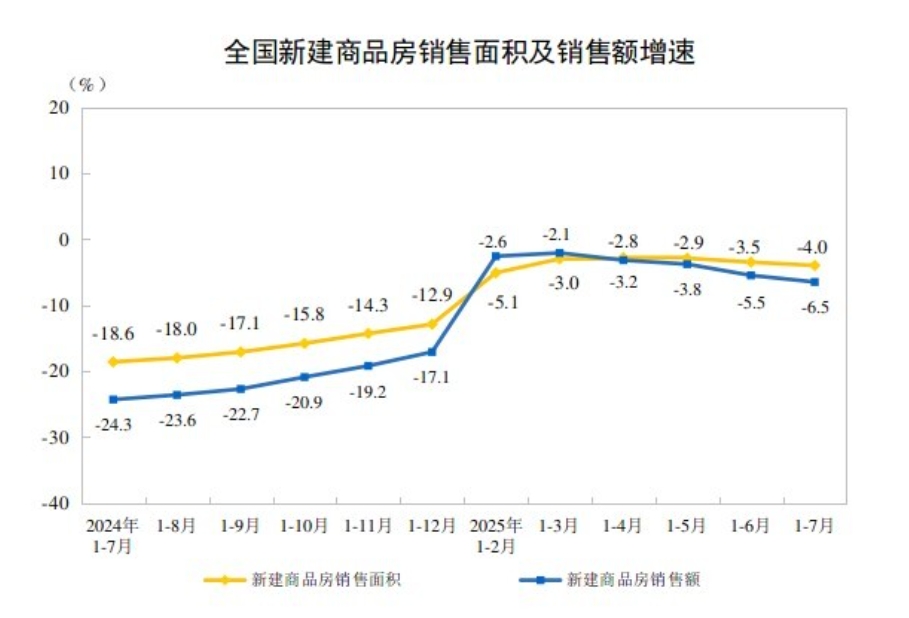
Core Insights - The real estate market in China continues to experience a downward trend in housing prices, with significant declines in both new and second-hand residential properties across various city tiers [1][2][4] Price Trends - In July, the sales prices of new residential properties in first-tier cities decreased by 0.2% month-on-month, with Beijing remaining stable and Shanghai increasing by 0.3%, while Guangzhou and Shenzhen saw declines of 0.3% and 0.6% respectively [2] - Second-hand residential properties in first-tier cities experienced a month-on-month decline of 1.0%, with all major cities reporting decreases [2][3] - Year-on-year, new residential property prices in first-tier cities fell by 1.1%, with Shanghai showing a notable increase of 6.1% [2][3] Investment and Sales Data - From January to July, real estate development investment totaled 535.8 billion yuan, reflecting a year-on-year decrease of 12.0%, with the decline rate widening by 0.8 percentage points [4] - The area of new residential property sales from January to July was 51.56 million square meters, down 4.0% year-on-year, while sales revenue decreased by 6.5% to 495.66 billion yuan [4] Market Dynamics - The large volume of second-hand property listings poses a challenge to improving the supply-demand relationship in the real estate market [1][3] - The market is expected to see continued differentiation between cities, with first-tier cities maintaining some resilience due to favorable policy expectations [1][5] Policy and Future Outlook - Recent policy adjustments in Beijing, including reduced purchase restrictions and increased support for public housing loans, may influence other cities like Shanghai and Shenzhen to follow suit [5] - The core goal of real estate policy remains to stabilize the market, with potential interest rate cuts and other measures aimed at stimulating demand and optimizing supply [6]
7月份各线城市商品住宅销售价格环比下降
Zheng Quan Ri Bao· 2025-08-15 17:25
Core Insights - The real estate market in China is showing signs of stabilization in core cities while continuing to adjust in non-core areas, as indicated by the July housing price data [1][2] Group 1: Housing Price Trends - In July, new residential sales prices in first-tier cities decreased by 0.2% month-on-month, a slight improvement from the 0.3% decline in June [1] - Year-on-year, new residential sales prices in first-tier cities fell by 1.1%, but the decline was less severe than in June, which saw a 0.3% drop [2] - Second-tier cities experienced a month-on-month price decline of 0.4%, with the decline expanding by 0.2 percentage points compared to June [1] Group 2: Market Demand and Policy Impact - The demand for second-hand homes is weakening, as indicated by a decrease in search activity and longer listing durations, reflecting ongoing market fatigue [2] - Recent policy changes, such as the easing of purchase restrictions in Beijing, are expected to boost market activity in August, although the effectiveness of these policies remains to be seen [3] - The focus of real estate policy is on stabilizing the market, with an emphasis on urban renewal and effective implementation of existing policies [2][3] Group 3: Market Outlook - The traditional off-peak season from July to August has led to a seasonal decline in market transactions, but high-quality land auctions in core cities are maintaining market interest [3] - The real estate market is expected to show resilience in core cities due to policy improvements and strong fundamentals, although regional disparities are likely to persist [3]
7月高能级城市房地产价格韧性较强 地方政策频出推升市场热度
Xin Hua Cai Jing· 2025-08-15 14:05
Core Insights - The latest data from the National Bureau of Statistics indicates a mixed performance in the real estate market across different city tiers, with core cities showing signs of stabilization while non-core areas continue to adjust [1][2] Group 1: New Housing Prices - In July, new home prices in first-tier cities decreased by 0.2% month-on-month, a reduction in the decline by 0.1 percentage points compared to the previous month [1] - Beijing's new home prices remained stable, while Shanghai saw an increase of 0.3%. Guangzhou and Shenzhen experienced declines of 0.3% and 0.6%, respectively [1] - Second-tier cities saw a month-on-month decrease of 0.4% in new home prices, with the decline expanding by 0.2 percentage points [1] - Third-tier cities also reported a 0.3% decrease in new home prices, with the decline remaining consistent with the previous month [1] Group 2: Second-Hand Housing Prices - In July, second-hand home prices in first-tier cities fell by 1.0%, with the decline widening by 0.3 percentage points from the previous month [1] - The price drops in Beijing, Shanghai, Guangzhou, and Shenzhen were recorded at 1.1%, 0.9%, 1.0%, and 0.9%, respectively [1] - Second and third-tier cities both experienced a 0.5% decrease in second-hand home prices, but the decline was less severe by 0.1 percentage points [1] Group 3: Market Trends and Insights - The real estate market is showing a divergence between core cities, which are stabilizing, and non-core areas that are still adjusting [1] - High-capacity cities exhibit stronger price resilience, while market sentiment is cooling down, particularly in weaker second-tier and third-tier cities facing significant inventory pressure [2] - The search volume for larger homes (over 144m²) has increased significantly, indicating a potential shift towards improvement-driven demand in the market [2] - Recent policy changes, such as the relaxation of purchase restrictions in Beijing, are expected to bring some heat to the market in August [2] - Ongoing initiatives like trade-in programs and easing of housing fund policies aim to facilitate market transactions, though their effectiveness will need further observation [2]
统计局:前7月全国新房销售4.9万亿
3 6 Ke· 2025-08-15 03:16
Core Insights - The real estate market in China continues to show a downward trend in key indicators such as new home sales area, sales volume, and new construction area for the first seven months of the year [1][3] - Despite the decline in market demand, financing conditions for real estate developers have improved slightly [3][6] Market Performance - From January to July, the sales area of new commercial housing reached 51,560 million square meters, a year-on-year decrease of 4.0%, with residential sales area down by 4.1% [1] - The sales volume of new commercial housing was 49,566 billion yuan, down 6.5%, with residential sales volume decreasing by 6.2% [1] - The total funds available to real estate developers amounted to 57,287 billion yuan, a year-on-year decline of 7.5%, primarily due to weak sales [3] Price Trends - In July, housing prices in first-tier cities continued to decline month-on-month, with Beijing remaining flat, Shanghai increasing by 0.3%, and Guangzhou and Shenzhen decreasing by 0.3% and 0.6%, respectively [4] - Among second-tier cities, Sanya has seen a continuous increase in new home prices for four consecutive months [4] - In the second-hand housing market, only Taiyuan experienced a month-on-month price increase in July, while major cities like Beijing, Shanghai, Guangzhou, and Shenzhen saw declines of 1.1%, 0.9%, 1.0%, and 0.9%, respectively [4] Financing and Investment - From January to July, domestic loans for real estate developers reached 920.7 billion yuan, a slight increase of 0.1%, while self-raised funds decreased by 8.5% [3] - Personal mortgage loans totaled 791.8 billion yuan, down 9.3% [3] - The overall financing environment for developers has shown some signs of improvement despite the ongoing market challenges [6] Market Sentiment and Policy Impact - The market demand remains weak, with a notable decline in buyer confidence reflected in longer listing times and reduced search activity [6] - Recent policy changes, such as the relaxation of purchase restrictions in Beijing and further optimization of regulations in Hainan, have led to a slight increase in market activity in August [6] - The real estate market is experiencing a divergence, with core cities showing resilience while non-core areas face significant challenges [6]
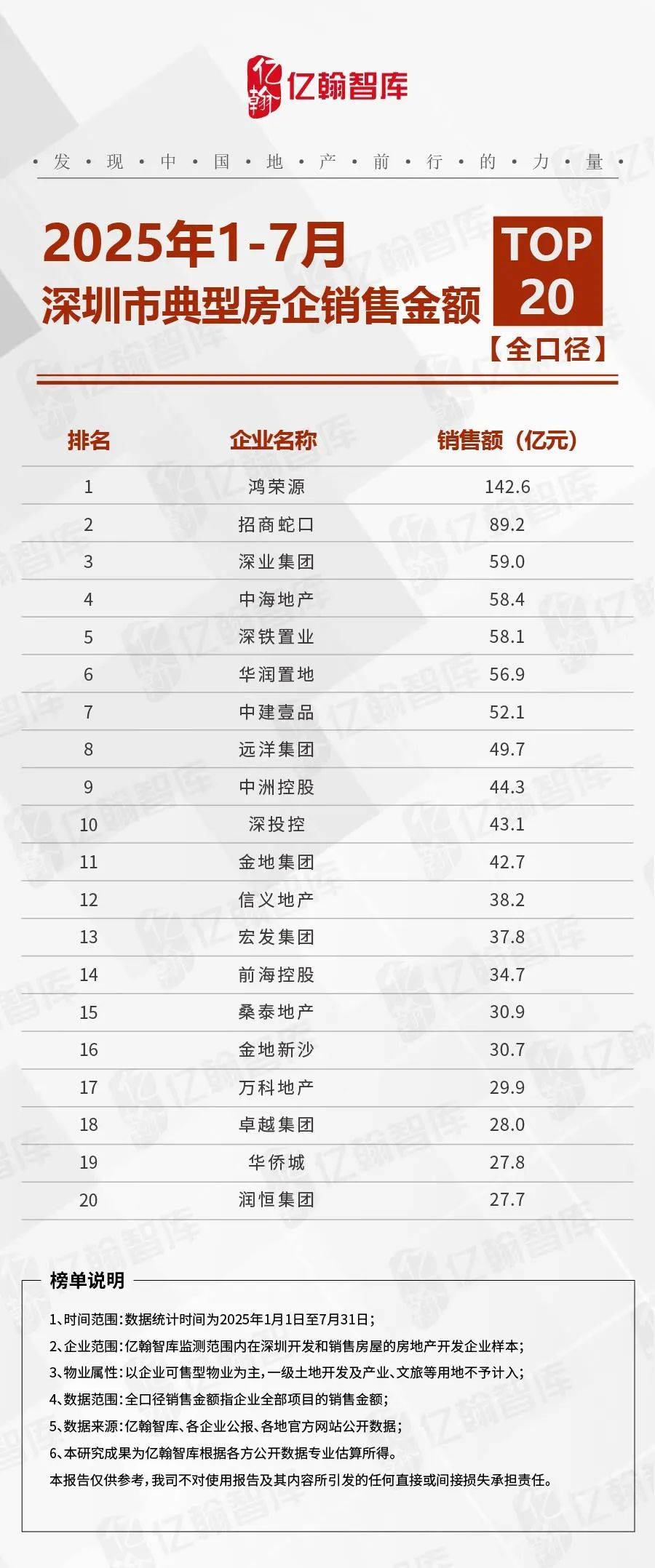
2025年1-7月深圳典型房企销售金额TOP20【全口径】
Sou Hu Cai Jing· 2025-08-13 03:14
Core Insights - The top three real estate companies in Shenzhen for the first seven months of 2025 are Hongrongyuan, China Merchants Shekou, and Shenye Group, with sales of 14.26 billion, 8.92 billion, and 5.90 billion yuan respectively [5][6] - The sales thresholds for the top 5, top 10, and top 20 companies are 5.81 billion, 4.31 billion, and 2.77 billion yuan respectively, indicating a competitive market [5][6] Market Performance - New home transactions have decreased, with approximately 2,660 new residential units sold in July 2025, down 18% from the previous month and 22% year-on-year [6][8] - The second-hand housing market has shown signs of recovery, with 4,656 transactions in July, remaining stable compared to the previous month [6][8] Inventory and Sales Cycle - As of the end of July, the inventory of new residential units in Shenzhen was 27,902, an increase of 2,241 units from June, resulting in an average sales cycle of approximately 8.4 months [8][10] Project Performance - There is significant differentiation among projects, with high-quality and competitively priced developments continuing to sell well. Notable projects include Zhongjian Pengchen Yunzhu, Jiayu Jiuxi, and Zhongzhou Yingxi [10][12] Land Market Activity - The land market is highly competitive, with a new record for land price set by China Merchants Shekou at 2.155 billion yuan for a residential plot in the Qianhai area, reflecting strong confidence in Shenzhen's core real estate market [12][13]



7月百城房价继续分化:新房结构性机会凸显
Mei Ri Jing Ji Xin Wen· 2025-08-08 01:07
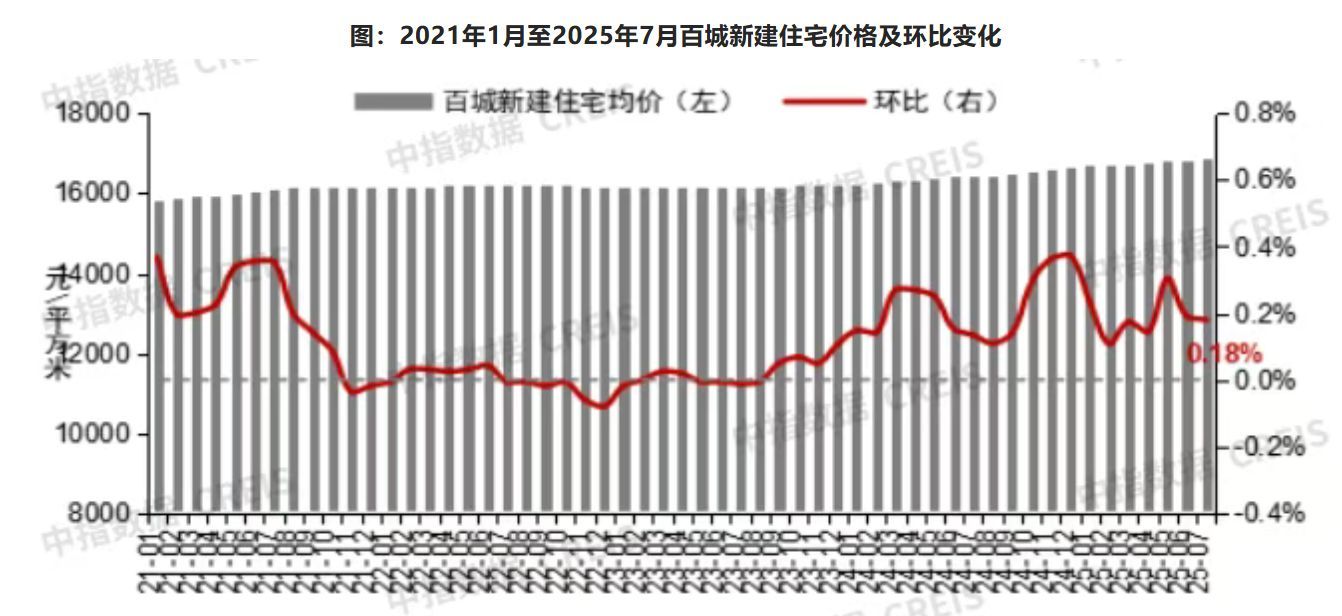
全国百城新房和二手房价格继续分化。 中指研究院最新数据显示,7月份,全国百城新建住宅均价为16877元/平方米,环比上涨0.18%,同比上涨2.64%;百城二手住宅均价为13585元/平方米,环 比下跌0.77%,同比下跌7.32%。 从城市层面来看,一线及部分强二线城市的新房市场表现相对稳健;核心城市二手房市场成交保持一定活跃度,但价格短期仍有压力。 中指研究院研究主管陶淑茹分析指出,短期内,房地产市场仍处于波动调整阶段,城市间的分化行情预计将持续,"好城市 好房子"组合仍具备结构性机 会。 新房价格结构性上涨,一二线城市领涨 新房市场呈现出结构性回暖的趋势。 据中指研究院数据,7月百城新建住宅均价为16877元/平方米,在部分核心城市优质改善项目入市带动下,环比结构性上涨0.18%,同比上涨2.64%。 图片来源:中指研究院 其中,一线城市新房价格表现尤为突出,7月环比上涨0.36%。高端改善项目持续发力,成为拉动房价上涨的重要力量。 二线城市7月新房价格环比上涨0.23%。其中,杭州新房价格环比上涨1.51%,位居榜首;成都紧随其后,环比上涨1.3%。 从新房市场供求来看,据克而瑞监测数据,7月整体楼市 ...
深业集团19.06亿竞得深圳龙华一宗宅地 核心区与次级市场分化明显
Sou Hu Cai Jing· 2025-07-30 23:11
Core Viewpoint - The recent land auction in Longhua District, Shenzhen, reflects a market differentiation where core areas remain hot while secondary areas cool down, indicating developers' varied assessments of real estate value across different regions [1][5]. Land Auction Details - A residential land parcel was sold at a base price of 1.906 billion yuan, with a floor price of 28,050 yuan per square meter [1][4]. - The land area is 21,920.84 square meters, with a total planned construction area of 67,950 square meters and a plot ratio of 3.1 [4]. - The development requirements include residential space of 60,390 square meters, commercial space of 1,400 square meters, a 9-class kindergarten of 4,500 square meters, and community public facilities of 1,500 square meters [4]. Market Trends - The auction results indicate a stark contrast in market activity, with only one bidder for the Longhua land compared to 12 bidders for a previous site in Qianhai, which had an 86% premium [4][5]. - The core area of Longhua is expected to see over 1.5 million square meters of new residential supply by 2026-2027, which may suppress developers' enthusiasm for land acquisition due to inventory pressure [5]. Policy and Market Outlook - Recent policies in Shenzhen aim to increase residential supply through measures like "commercial to residential" conversions and optimizing land sale conditions [5]. - Market data shows a year-on-year increase in new home sales by 24.4% and second-hand home sales by 30.7% in the first half of the year, indicating a gradual market recovery [5]. - The current market is characterized by a focus on high-quality low-density residential land in core areas, with policy optimizations expected to stabilize market expectations [5].