泡沫

Search documents
A股存在泡沫吗?
Hu Xiu· 2025-08-23 02:53
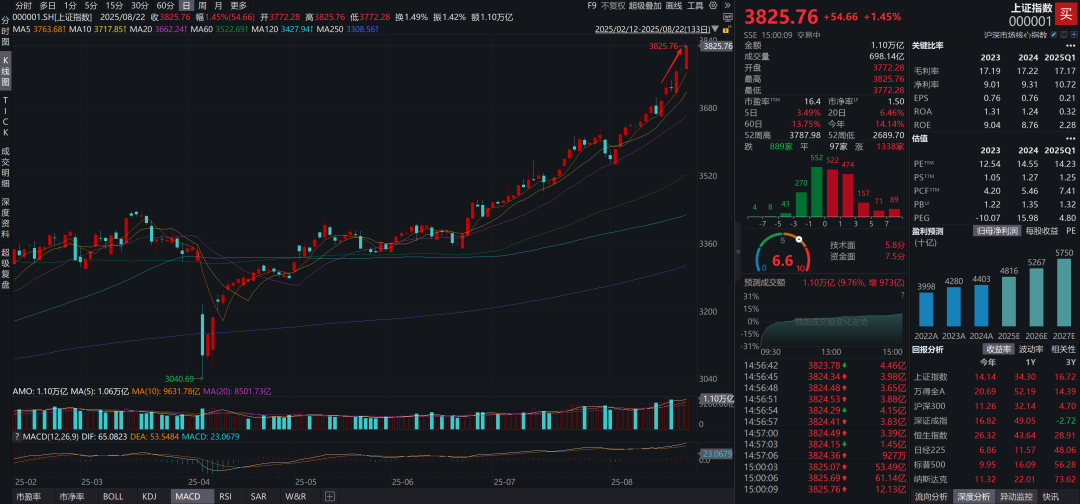
Group 1 - The VIX index is a key indicator for assessing whether market increases are driven by intrinsic value or emotional factors [6][8][33] - A low VIX level suggests that market increases are driven by intrinsic value, indicating a "slow bull" market, while a high VIX level indicates an "emotional-driven" or "fast bull" market [5][6] - The current VIX level is at 20.92, slightly above the warning line of 20, but the upward trend in volatility is not significant [8][10] Group 2 - On August 22, the Shanghai Composite Index saw a significant increase, attributed to intrinsic value-driven factors, suggesting strong continuity in the upward trend [12][20] - The market reacted to comments from Federal Reserve Chair Jerome Powell, indicating potential policy adjustments that could positively impact the market [15][16] - The market's response to undisclosed positive information led to a significant increase in the Shanghai Composite Index, with estimates suggesting a potential 4% increase in intrinsic value from a 25 basis point rate cut [20] Group 3 - The theoretical valuation of the CSI 300 Index is estimated at a PE ratio of 15.69, while the actual dynamic PE is 13.97, indicating an approximate 11% discount to intrinsic value [21][34] - The largest contributor to the valuation uplift is the decrease in foreign exchange pressure, with the forward exchange rate swap points dropping from 3.42% to 2.36%, equating to a 106 basis point rate cut [25] - The improvement in core CPI, from 0.40% to 0.80%, also contributes to the valuation uplift, accounting for approximately 6% of the potential increase [29][30] Group 4 - The analysis concludes that the A-share market is not experiencing irrational growth, as the increases are supported by strong fundamentals, albeit not widely recognized [30][36] - The assessment of intrinsic value deviations indicates that the market is not in a bubble, as the current negative deviation from intrinsic value is around 11% [34][36]

华尔街并不担心人工智能泡沫,奥尔特曼却忧心忡忡
财富FORTUNE· 2025-08-22 13:03
Core Viewpoint - The current AI hype may be experiencing excessive enthusiasm similar to the internet bubble of the late 1990s, as suggested by OpenAI CEO Sam Altman, who warns of potential significant losses for investors as the hype subsides, but believes in the long-term value of AI [1] Group 1: Market Sentiment and Predictions - Wall Street analysts believe there is still room for growth in the AI sector, with Dan Ives from Wedbush Securities stating that the AI revolution will drive the tech bull market for at least the next two to three years [2] - Richard Saperstein, CIO of Treasury Partners, argues that the current market resembles 1996, indicating significant development potential rather than an imminent bubble burst [3] Group 2: Capital Expenditure Trends - Major tech companies like Microsoft, Alphabet, and Meta have reported strong earnings and are increasing capital expenditure to meet the growing demand for AI, with OpenAI planning to invest tens of billions in data center construction [4] - Concerns are rising that AI investments may exceed sustainable growth levels, with industry figures like Joe Tsai and Ray Dalio expressing worries about the current trends [4] Group 3: Historical Comparisons - Ray Dalio has noted that the current market cycle bears a striking resemblance to the period before the internet bubble burst, cautioning against conflating technological success with investment success [4] - Torsten Slok from Apollo Global Management highlighted that the current valuation deviations of top companies in the S&P 500 exceed those seen during the peak of the internet bubble [4]





X @外汇交易员
外汇交易员· 2025-08-21 09:13
Market Overview - Oaktree Capital's Howard Marks warns that the US stock market is in the "early stages" of a bubble [1] - A mean reversion is highly probable, with some tech stocks being "quite highly valued" relative to history [1] Investment Strategy - The US remains the best place to invest globally, despite a "slight deterioration" in the basic investment environment [1] - The US is like "an expensive good car" and is still suitable for defensive investment [1]
经济学家邵宇:超6000点才是严格意义上的牛市,是不是牛市还需要观察
Sou Hu Cai Jing· 2025-08-14 03:41
Group 1 - The current A-share market is experiencing a "slow bull" trend, driven by a shift in policy expectations, particularly due to fiscal policy adjustments [1] - Investment value in technology companies, especially in artificial intelligence, is becoming increasingly evident, showcasing China's potential for technological innovation [1] - The innovative pharmaceutical sector continues to attract market interest, while geopolitical factors are boosting the performance of the military industry sector [1] Group 2 - The market's recent rise is attributed to multiple factors, including improvements in fundamentals, strong policy support, and the rotation of industry hotspots [1] - Market activity has significantly increased, with daily trading volumes approaching 2 trillion yuan, and the Hong Kong stock market showing particularly strong performance [1] - The definition of a "bull market" is discussed, with the observation that the Shanghai Composite Index needs to exceed 6000 points to be considered a true bull market [2]
跳出人形机器人聊泡沫:顶级VC如何预警“非理性繁荣”
Tai Mei Ti A P P· 2025-05-08 11:47
Group 1 - The core discussion revolves around the potential bubble in the humanoid robot industry, sparked by comments from investor Zhu Xiaohu about the need for mass exits from humanoid robot companies [2] - The debate includes various perspectives from entrepreneurs and investors, questioning the existence and definition of a bubble in the humanoid robot sector [2] - The article suggests that the discourse on bubbles should extend beyond the humanoid robot industry to consider the broader implications of bubbles on business and technology [2] Group 2 - The term "bubble" has historical roots, originating from the Latin word "bulla," and was first applied to economic phenomena during the 16th-century Dutch tulip mania [3] - Historical analysis of bubbles shows a pattern of collective cognitive bias leading to inflated asset prices, culminating in significant financial collapses [3] - The article emphasizes that while bubbles often result in wealth destruction and social upheaval, they are also a reflection of human nature's pursuit of speculative gains [3] Group 3 - The significance of bubbles in technology asset valuation differs from traditional asset bubbles, as technological bubbles can lead to substantial advancements despite initial failures [4] - The internet bubble of the late 1990s, for instance, resulted in the emergence of foundational technologies that shaped the digital economy, despite many startups failing [5] - Similarly, the solar energy bubble led to a concentration of patents among leading firms, accelerating technological development in the sector [5] Group 4 - Investors in venture capital face the dual challenge of supporting technological advancements while guarding against speculative excesses that can inflate asset prices [6] - The article outlines the need for venture capitalists to identify and manage bubble risks through various indicators and metrics [6] Group 5 - A set of eight indicators has been developed to assess the emergence of bubbles in industries, including growth rates of company numbers and financing amounts [7] - For example, a significant increase in the number of companies in a sector, such as a 200% annual growth rate, may signal irrational exuberance [8] Group 6 - The financing heat indicator reflects the growth rate of total financing in a sector, which can lead to a rapid increase in asset values [9] - Historical examples illustrate how spikes in financing correlate with the emergence of bubbles, such as the shared economy bubble in 2015 [9] Group 7 - Non-rational pricing indicators, such as price-to-sales (PS) ratios, can highlight discrepancies between startup valuations and established industry leaders, signaling potential bubbles [12] - The article cites instances where PS ratios for unprofitable companies reached unsustainable levels, indicating a bubble [12] Group 8 - Exit channel indicators, such as the high rate of SPACs trading below their initial public offering prices, can signal the onset of a bubble [13] - The influx of traditional industry players into emerging sectors often precedes significant valuation distortions, indicating bubble conditions [13] Group 9 - Talent acquisition indicators, such as inflated salary levels in emerging sectors, can also signal bubble conditions, as seen during the ICO boom [14] - The article notes that excessive salary growth relative to industry revenue can foreshadow a bubble's collapse [14] Group 10 - Media attention and narrative heat can act as accelerators for bubbles, with spikes in media coverage often preceding market corrections [15] - Regulatory behaviors, such as increased scrutiny and guidance, can also indicate the presence of a bubble in certain sectors [16] Group 11 - The article concludes that while historical data can provide insights into bubble dynamics, the unique context of each industry must be considered [17] - The ability to adapt to changing economic conditions and recognize the fluidity of bubble indicators is crucial for investors [17]


中金:美股“泡沫”破裂了吗?——与互联网泡沫的对比
中金点睛· 2025-03-19 00:15
Core Viewpoint - Since 2025, US stocks, particularly tech giants, have underperformed globally, with recent significant declines contrasting sharply with the strong performance of Hong Kong tech stocks, raising investor concerns about the potential bubble risk in US tech stocks [1] Group 1: Current Market Status - The S&P 500 and Nasdaq indices have dropped 10% and 14% from their historical highs, respectively, reaching support levels around 5600 and 17700 [3][23] - The S&P 500's dynamic P/E has decreased to 20 times, down 11% from 22.6 times at the end of 2024, while the Nasdaq's dynamic P/E has fallen to 24.6 times, a 19% drop from 30.2 times [3][23] - The average decline for tech giants exceeds 20%, with Tesla's valuation dropping nearly 50% from its peak [3][23] - The market capitalization of the top seven US tech companies has decreased to 26%, still above the 22% before the internet bubble burst, but their profit share of 21% is significantly higher than the 9% at that time [3][23] Group 2: Historical Context and Comparisons - The current market situation is compared to the internet bubble, indicating that the current bubble level is not extreme and resembles the pre-bubble period of 1997-1998 [4] - Since the launch of ChatGPT at the end of 2022, the AI market has seen a 93% increase in the Nasdaq, with profit contributions at 46% and valuation contributions at 32% [5][25] - The previous internet boom lasted nearly nine years, characterized by distinct phases of growth, with the most significant price increases occurring in the final years driven primarily by valuation rather than earnings [5][25] Group 3: Factors Contributing to Bubble Formation - Macro factors include loose monetary policy and inflows of foreign capital into the US, with the Fed's rate cuts in the mid-1990s and the subsequent financial crisis leading to increased liquidity [6][27] - Current monetary conditions are relatively loose, with expectations of rate cuts emerging since early 2023, despite the Fed's actions to stabilize the banking sector [7][28] - Industry policies have supported investment growth, with significant investments in AI technology driven by government initiatives like the CHIPS Act [9][30] Group 4: Market Behavior and Investor Sentiment - The current investment environment is more rational compared to the late 1990s, with a slowdown in venture capital investments and a lower proportion of tech IPOs [11][36] - The proportion of profitable tech companies at IPO has increased to 23%, compared to 14% during the internet bubble, indicating a more cautious investment approach [11][36] - The proportion of stocks and mutual funds in household assets has risen to 26.3%, nearing historical highs, which may amplify market volatility [37] Group 5: Potential Risks and Future Outlook - The potential for a repeat of the significant market rally seen since 2023 hinges on whether the factors contributing to bubble formation can re-emerge, including breakthroughs in AI trends and renewed monetary easing [19][20] - Current market uncertainties, particularly related to policy changes under the Trump administration, could impact investor confidence and market stability [20][21]