生物育种

Search documents
从两根玉米棒“起家”隆平生物扎根南繁沃土
Hai Nan Ri Bao· 2025-11-05 01:45
Core Insights - The article highlights the growth and development of Longping Biotechnology (Hainan) Co., Ltd. in the field of agricultural biotechnology, particularly in corn breeding at the Sanya Yazhou Bay Science and Technology City [1][3] Company Development - Longping Biotechnology was established in 2019, with initial challenges including temporary office space and rented laboratory equipment [1] - The company has set a five-year plan to build a biological breeding research system and assemble a professional talent team [1] - The team has grown to over 150 members, with more than half holding master's or doctoral degrees, attracting talent from international companies and top domestic universities [3] Technological Advancements - In 2023, the company inaugurated its own innovation platform, the Biological Breeding Innovation Center, which includes eight platforms such as molecular biology laboratories and intelligent breeding platforms [3] - Longping Biotechnology has achieved multiple technological innovations, allowing seeds in the laboratory to progress towards practical application [3] Industry Support - The favorable natural resources in Hainan, along with supportive government policies and services from the Yazhou Bay Science and Technology City, have created a conducive environment for the company's growth [1] - The establishment of supporting facilities such as top-tier hospitals and quality schools has further enhanced the attractiveness of the region for researchers [3] Future Outlook - The company aims for its technological innovations to be industrialized in the next five years, contributing to national food security [3]

粮食稳产高产靠什么丨科技强农粮满仓
Jing Ji Ri Bao· 2025-11-04 02:57
Core Insights - The article emphasizes the rapid development of an agricultural technology innovation system centered on high-quality farmland, seeds, opportunities, and methods, which is crucial for ensuring food supply and promoting high-quality agricultural development [1][2][3][4]. Group 1: Agricultural Technology Innovation - The construction of high-standard farmland is a solid foundation supported by technological innovation, significantly enhancing disaster resistance and overall productivity [1]. - The national coverage rate of quality seeds has exceeded 96%, with over 95% being independently bred, ensuring a stable supply of major grain crops [2]. - The integration of modern information technology with agricultural machinery has led to a comprehensive mechanization rate of over 75% for major crops, improving operational efficiency [3]. Group 2: Technological Integration and Efficiency - The establishment of replicable and promotable technology integration models has upgraded agricultural production towards standardization, scale, and sustainability, benefiting small farmers [4]. - The article highlights the importance of transforming laboratory results into practical agricultural productivity, with significant advancements in breeding technologies and the establishment of innovation platforms [8][9]. Group 3: Regional Agricultural Developments - In Yangling, significant breakthroughs in breeding technology have been achieved, with a focus on developing drought-resistant varieties and enhancing breeding efficiency [9]. - In Pinggu, the area has seen a continuous increase in grain harvest area and total production, with grain harvest area expanding from 88,700 acres to 138,500 acres and production rising from 42,500 tons to 57,100 tons over four years [12][13]. - In Pucheng, the promotion of "one variety, two harvests" for regenerating rice has led to substantial increases in planting area and yield, with the average yield reaching 770.5 kg per acre [14][15].
科技强农粮满仓
Jing Ji Ri Bao· 2025-11-03 23:07
Core Insights - The article emphasizes the accelerated construction of an agricultural technology innovation system centered on high-quality farmland, seeds, opportunities, and methods, which is crucial for ensuring food supply and promoting high-quality agricultural development [1][2][3][4]. Group 1: High-Quality Farmland - The construction of high-standard farmland is a solid foundation supported by technological innovation for food production [1]. - The average grain production capacity per mu (0.067 hectares) of high-standard farmland has increased by approximately 10% [1]. - Modern monitoring techniques such as remote sensing and IoT are utilized for dynamic soil condition assessments, enhancing scientific planting [1]. Group 2: Seed Innovation - Breakthroughs in seed technology are identified as the core engine driving food production [2]. - The national coverage rate of quality seeds has exceeded 96%, with over 95% being independently bred [2]. - Key crops like rice, wheat, and corn have achieved self-sufficiency in seed sources, reinforcing food security [2]. Group 3: Agricultural Machinery Modernization - The total power of agricultural machinery in the country exceeds 11 billion kilowatts, with a comprehensive mechanization rate for major crops surpassing 75% [3]. - The integration of modern information technology with agricultural machinery has led to widespread application of technologies like Beidou navigation and IoT [3]. - The trend towards low-carbon and clean agricultural machinery is being explored through measures such as upgrading emission standards and piloting electric machinery [3]. Group 4: Technology Integration - The establishment of replicable and promotable technology integration models is an effective way to enhance food production [4]. - The implementation of green, high-quality, and efficient actions has covered thousands of major grain-producing counties, promoting standardized technology models [4]. - The focus on long-term agricultural innovation aims to deepen the integration of technology into the entire agricultural production process [4].
郑州:建设具有国际影响力种业大市 预计2027年产业链规模达55亿元
Mei Ri Jing Ji Xin Wen· 2025-11-03 02:34
Core Viewpoint - The Zhengzhou Rural Prosperity Industry Development Three-Year Action Plan (2025-2027) aims to enhance the agricultural seed industry through technological advancements and strategic partnerships, targeting a significant growth in industry scale by 2027 [1] Group 1: Technological Development - Support for seed enterprises to collaborate with research institutions to tackle critical technology issues in seed sources [1] - Application of biological breeding and intelligent breeding technologies to cultivate and promote high-yield, high-quality, and resilient crop varieties [1] Group 2: Industry Promotion - Continuous demonstration and promotion of new varieties of corn, wheat, and vegetables [1] - Development of a modern seed industry chain that integrates technology research and development, production processing, exhibition trading, and leisure tourism [1] Group 3: Economic Goals - The plan aims to establish Zhengzhou as a city with international influence in the seed industry [1] - The industry chain scale is projected to reach 5.5 billion by 2027 [1]
郑州:建设具有国际影响力种业大市 到2027年产业链规模达55亿元
Zheng Quan Shi Bao Wang· 2025-11-03 02:05
Core Viewpoint - The article discusses the issuance of the "Three-Year Action Plan for Rural Prosperity Industry Development in Zhengzhou (2025-2027)", which aims to enhance the agricultural seed industry through technological advancements and strategic partnerships [1] Group 1: Industry Development Goals - The plan supports seed companies collaborating with research institutions to tackle critical technology issues in seed sourcing [1] - It emphasizes the application of biological breeding and intelligent breeding technologies to cultivate and promote new crop varieties that are high-yielding, high-quality, resilient, and specialized [1] - By 2027, the scale of the industry chain is expected to reach 5.5 billion yuan [1] Group 2: Specific Crop Focus - Continuous demonstration and promotion of new varieties of corn, wheat, and vegetables will be conducted [1] - The initiative aims to create a modern seed industry chain that integrates technology research and development, production processing, exhibition trading, and leisure tourism [1] Group 3: Strategic Vision - The goal is to establish Zhengzhou as a city with international influence in the seed industry [1]
生猪养殖持续亏损,产能去化或加速
CAITONG SECURITIES· 2025-11-02 13:13
Core Insights - The report maintains a positive outlook on the agricultural sector, particularly in pig farming, despite ongoing losses in the industry [1][3] - The report highlights a potential acceleration in capacity reduction due to supply pressures and policy guidance [6][19] Group 1: Pig Farming - The number of breeding sows decreased by 0.20% month-on-month in September, with a total of 40.35 million sows reported [20][21] - Pig prices have been on the rise, with the average price for market pigs reaching 12.22 CNY/kg on October 30, reflecting a week-on-week increase of 7.10% [29][30] - The profitability of pig farming remains negative, with losses of 89.33 CNY per head for self-bred pigs and 179.72 CNY per head for purchased piglets as of October 31 [35][37] Group 2: Poultry Farming - The average price for white feather broilers increased to 7.09 CNY/kg on October 31, marking a week-on-week rise of 3.05% [39][42] - The report notes a significant increase in the number of breeding stock, with a 143.18% month-on-month rise in the number of grandparent stock updated in October [39][40] Group 3: Animal Health - The demand for animal health products is expected to rebound, driven by a recovery in breeding cycles and an increase in livestock numbers [48] - The report mentions that several companies are actively developing new products, which may enhance growth prospects for the sector [48] Group 4: Seed Industry - The average prices for wheat, soybean meal, and corn have increased, with wheat and soybean meal rising by 0.9% and 1.3% respectively as of October 31 [52][53] - The report emphasizes the importance of food security and the promotion of biotechnology in the seed industry [52][56] Group 5: Pet Industry - Pet food exports amounted to 823 million CNY in September, showing a year-on-year decline of 6.8% [57][60] - Domestic sales of pet food have continued to grow, with a combined growth rate of 3% across major e-commerce platforms in September [60]


农业农村部推进渔业现代化!农牧渔ETF(159275)下挫1.2%!机构:养殖业产能去化加速
Xin Lang Ji Jin· 2025-10-30 01:57
Group 1 - The agricultural and fishery ETF (159275) showed weak performance with a price drop of 1.2% and a trading volume of 1.748 million yuan, while the fund's latest scale is 205 million yuan [1] - Key stocks such as Yike Food, Meihua Biological, and Luoniushan performed well with increases of 1.01%, 0.64%, and 0.56% respectively, while Jinhe Biological, Tiankang Biological, and Weilan Biological saw declines of 4.46%, 3.59%, and 3.29% [1] - The Ministry of Agriculture and Rural Affairs emphasized the importance of solidifying key work during the 14th Five-Year Plan period to support the modernization of the fishery sector, highlighting the successful construction of the "Haiwei 2" breeding platform in Zhanjiang, Guangdong [1] Group 2 - According to data from Tianfeng Securities, the supply of yellow chickens may contract, with demand being a core variable and production capacity at its lowest since 2018, suggesting that average prices in the second half of the year may outperform the first half [2] - The pig farming sector continues to experience losses, with policy guidance aimed at reducing production leading to ongoing capacity reduction [2] - The poultry industry faces challenges due to avian influenza, with a 21.78% year-on-year decline in the number of breeding stock, but a potential recovery in industry conditions is anticipated after three years of downturn [2]
登海种业20251029
2025-10-30 01:56
Summary of the Conference Call for Denghai Seed Industry Industry Overview - In 2025, the corn seed production area is expected to decrease to 3.6-3.8 million acres, primarily due to high inventory levels and increased demand for variety updates, with a market preference for high-density and disease-resistant varieties, maintaining historical high levels overall [2][7] - The overall industry destocking cycle is uncertain, potentially taking two to three years to recover from the low point, influenced by market trends and policy signals [2][8] Company Insights - Key transgenic varieties include 1,605D, 710D, 533D, and 685D, with 1,605D sales exceeding 1 million acres last year and expected to expand this year [2][9] - The retail price for transgenic varieties is approximately 65-70 yuan per acre, with pricing determined through negotiations with partners like Dabeinong and the Chinese Academy of Agricultural Sciences [2][10][11] - The company is focusing on the demand for high-density and disease-resistant varieties, launching new products like MY73 and developing new high-density varieties such as 997 for production trials [2][15] Financial Performance - The overall cost of corn seeds is trending downwards, with a decrease in per-acre production costs by several hundred yuan, although complete data will be available by the end of the year [5] - The company has seen a reduction in contract liabilities from January to September 2025, attributed to decreased prepayments due to sales issues [20] Market Dynamics - The sales progress for the new season is not fully disclosed yet, with significant sales expected to begin in November, which is typically the peak sales period [13] - The price trend for 2025 shows a decline for conventional corn varieties due to high inventory, while transgenic corn prices remain stable [14] Research and Development - The company has partnered with the Shandong Academy of Agricultural Sciences to develop biosafety certificate transformation bodies, ranking first in the industry, and plans to compete in trait segments [3][18] - There are plans to commercialize newly developed varieties, as self-use alone cannot meet demand [19] - The company has not yet ventured into gene editing but may consider it in the future, supported by local agricultural institutions [21] Future Outlook - The company is optimistic about the future of transgenic varieties like 605D, 685D, and 710D, which will require 1-2 years of trial planting before expanding sales [17] - The overall industry is expected to face changes in supply-demand dynamics, but the potential for conventional varieties with excellent resistance traits remains promising [22] Additional Information - Investors are encouraged to visit the company for further research and discussions [23]

第32届中国杨凌农高会推介大会暨集中签约活动举办
Shan Xi Ri Bao· 2025-10-27 23:05
Group 1 - The 32nd China Yangling Agricultural High-tech Fair was held with the theme "Technology Empowering New Quality Agricultural Productivity," attracting nearly 400 participants from various sectors [1] - A total of 61 projects were signed on-site with a total investment of 16.23 billion yuan, and an additional 61 projects will be signed later, amounting to 8.76 billion yuan, covering areas such as seed industry, smart agriculture, medicine, medical devices, and agricultural cultural tourism [1] - The Vice President of Northwest A&F University released the "2025 China Agricultural Industry Investment Report," highlighting the acceleration of capital inflow into emerging sectors like smart agriculture and biological breeding driven by policy and technology [1] Group 2 - The Secretary-General of the National Agricultural Technology Innovation Investment Consortium presented the "2025 China Agricultural Technology Innovation Investment Report," indicating that agricultural technology venture capital is focusing on sectors such as agricultural biotechnology, smart agriculture, innovative food and nutrition, and green low-carbon initiatives [1] - The Director of the Yangling Demonstration Zone Investment Promotion Bureau introduced the investment environment and invited global partners to collaborate in five key areas: seed industry, deep processing of agricultural products, biomedicine and health, smart agriculture and intelligent equipment manufacturing, and agricultural technology services [1] - Representatives from agricultural companies, including Beijing Dabeinong Technology Group and AgroFresh, shared cutting-edge technologies, new models, and practical cases during the event [2]

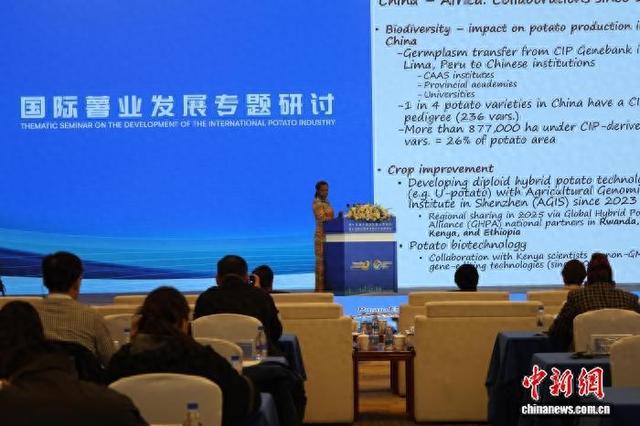
26国代表齐聚山东潍坊 共话薯业高质量发展与全球粮食安全
Zhong Guo Xin Wen Wang· 2025-10-27 12:10
Core Insights - The 15th China International Potato Industry Expo and the 3rd Weifang International Food and Agricultural Products Expo opened in Weifang, attracting 503 exhibitors and 2,623 buyers from 26 countries and 15 provinces in China [1][5] - The potato industry is highlighted as a key pillar for food security and farmer income, with China being one of the richest countries in potato resources [1][3] - The event aims to enhance international cooperation in potato industry through technology sharing and resource integration, promoting deep collaboration with sectors like food, biotechnology, and tourism [1][4] Industry Overview - Shandong province emphasizes the potato industry as a vital part of rural revitalization, with an annual potato production exceeding 7 million tons and processing capacity around 5.5 million tons [2] - Weifang has designated potato cultivation as a potential industry for rural revitalization, with 440,000 acres planted and an annual output of 1.5 million tons, exporting products to 25 countries and regions [2] Technological Innovations - The World Potato Congress chairman acknowledged the contribution of increased potato yields in Asia to poverty reduction and food security, while also addressing challenges in certain regions regarding low yield and productivity [3] - Innovative cultivation methods and practices in water resource management and soil health protection were discussed, promoting global potato industry development through technology sharing [3][4] International Cooperation - Peru's representative highlighted the country's rich potato genetic resources and the potential for agricultural technology collaboration with China, which could enhance living standards and deepen bilateral relations [4] - The International Potato Center's director noted the significance of the 40-year collaboration with China, emphasizing the introduction of over 2,000 potato genetic resources that have contributed to the development of numerous high-quality varieties in China [4] Event Highlights - The expo's theme "Technology Revitalizes Potatoes, Intelligence Leads the Future" aims to create a platform for showcasing, networking, and discussions on potato industry development [4] - The event also included the launch of the Global Agricultural Service Trade Center and the China-ASEAN Specialty Industry Chain Export Platform, along with project signing activities [4]