
跨境投资

Search documents
华泰证券协办印尼投资论坛 把脉市场机遇
Zhong Jin Zai Xian· 2025-10-16 06:46
Group 1 - The investment forum "Capital Dialogue Across the Equator - Understanding Indonesia's Real Economy" was successfully held in Jakarta, Indonesia, led by the Indonesian sovereign fund Danantara, with Huatai Securities and BNI Securities as co-organizers [1] - The forum aimed to deepen the connectivity between the capital markets of China and Indonesia, focusing on macroeconomic trends, emerging industry opportunities, and cross-border investment strategies [1] - Liang Hong, Chair of Huatai Securities' Institutional Business Committee, delivered a keynote speech highlighting China's economic rebalancing and transformation, emphasizing the importance of technological innovation and industrial upgrading as core drivers for long-term growth [1] Group 2 - Discussions at the forum included topics such as restructuring efficiency, risk management strategies, and investment opportunities, featuring insights from representatives of Danantara and the Indonesian Ministry of Finance [2] - Huatai Securities' Chief Analyst for Energy Transition, Liu Jun, engaged in a deep dialogue with representatives from Barito Group regarding low-carbon transition routes and the collaboration paths between Chinese and Indonesian companies in energy transition [2] - Huatai Securities organized core asset research and thematic discussions for investors, covering leading companies in various sectors such as finance, food production, mining, and e-commerce in Indonesia, providing comprehensive local market insights [2]

一键投资巴西市场的创新产品来了!那些投资小众市场的跨境基金今年收益如何?
Sou Hu Cai Jing· 2025-10-14 05:20
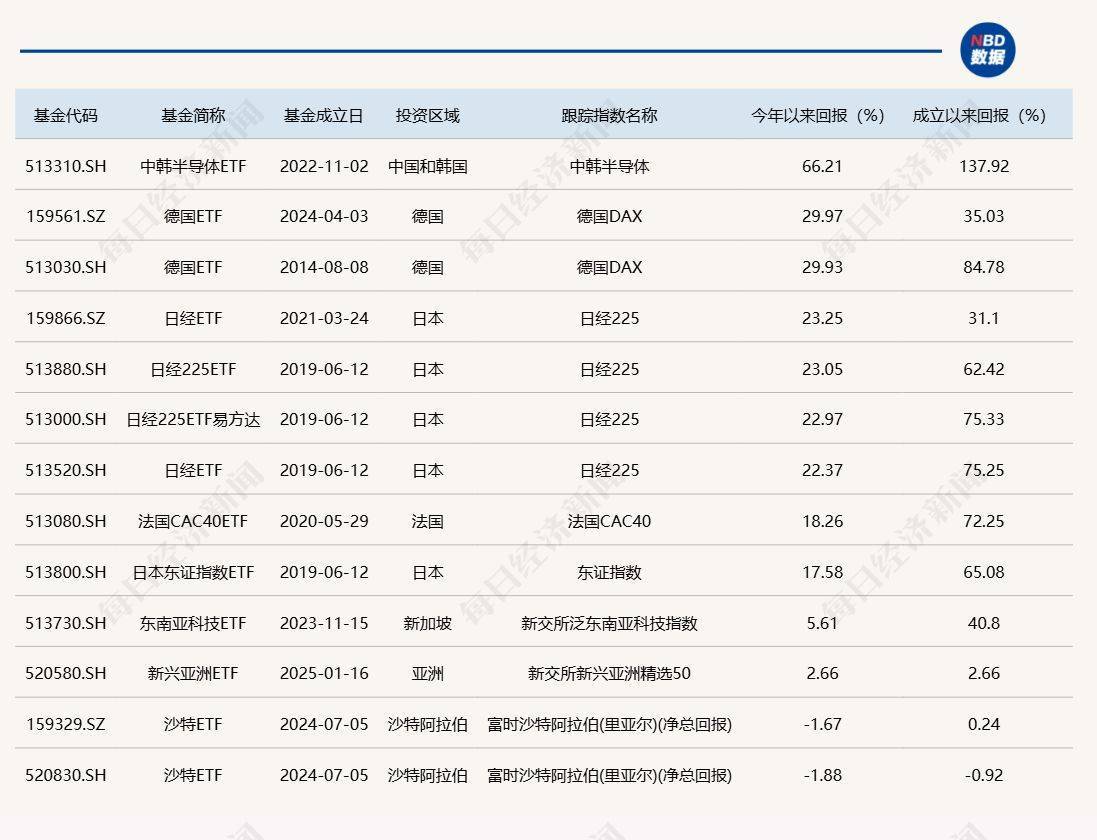
Group 1 - The core viewpoint of the articles is the introduction of new cross-border investment funds, specifically ETFs focused on the Brazilian market, which enhances connectivity between Chinese and Brazilian capital markets [1][3][5] - On October 13, the China Securities Regulatory Commission announced the approval of two new QDII ETFs: the Huaxia Bradesco Brazil Ibovespa ETF and the E Fund Itaú Brazil IBOVESPA ETF, allowing investors to easily access the Brazilian capital market [2][3] - The Brazilian capital market is highlighted as the largest and most influential financial system in Latin America, offering opportunities for global investors to benefit from its resource dividends and economic growth potential, while also being affected by domestic fiscal policies and political dynamics [2][3] Group 2 - The Ibovespa index, which is a key indicator of the Brazilian stock market, has shown an annualized return of over 12% over the past decade, with a year-to-date return of 21.6% as of September [2][3] - The emergence of these Brazilian ETFs is seen as a significant development in the ongoing collaboration between China and Brazil in capital market connectivity, following previous initiatives such as the Bradesco Huaxia ChiNext ETF launched in May [3][4] - The trend of public funds expanding into cross-border investments has led to the creation of various products targeting emerging markets, with many of these funds achieving double-digit returns this year, including the notable performance of the China-Korea Semiconductor ETF, which has risen by 66.21% [4][6] Group 3 - The market has seen a diversification of cross-border funds, with products now available for investment in countries such as South Korea, Germany, France, Japan, and others, indicating a growing interest in emerging markets [5][6] - The introduction of dedicated investment tools for the Brazilian market has garnered significant attention, reflecting the increasing sophistication of public funds in meeting investor demand and the deepening of capital market openness [6][7] - Future expectations include the emergence of more products targeting niche countries or markets, as well as cross-border ETFs focusing on global themes such as renewable energy and healthcare, creating a multi-dimensional product matrix for investors [7][8]

海能投顾:全球化进程的加速为投资市场带来了更多的跨境机会
Sou Hu Cai Jing· 2025-10-10 04:08
Group 1 - The acceleration of globalization is creating more cross-border investment opportunities for investors [1][3] - The advancement of intelligent technologies is transforming the global economy at an unprecedented pace, enhancing production efficiency and creating new business models [3] - Companies leveraging intelligent technologies for business transformation and innovation are likely to become future market leaders, making them attractive to investors [3] Group 2 - The integration of the global economy allows for freer movement of capital, goods, services, and labor, broadening investment horizons [3] - Globalization not only facilitates the expansion of multinational companies but also provides growth momentum for emerging markets [3] - Investors can seek high-growth potential markets and industries globally to achieve diversified asset allocation [3]

红筹架构搭建:37号文与ODI备案的“黄金顺序”指南
Sou Hu Cai Jing· 2025-09-29 04:43
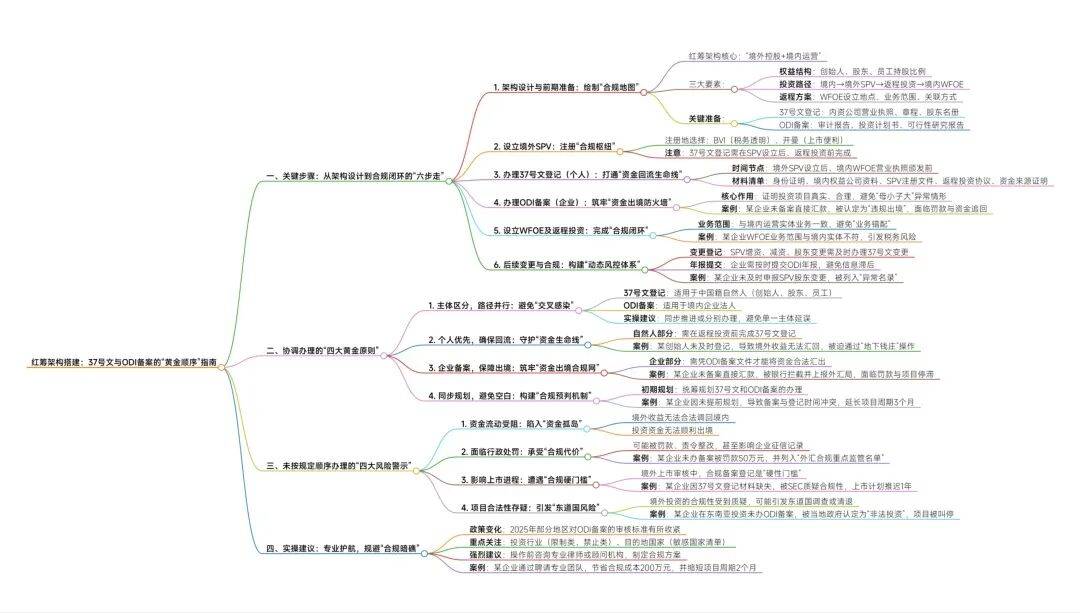
Core Viewpoint - The red-chip structure, due to its flexibility and compliance advantages, has become an excellent choice for companies seeking overseas financing and listing amid globalization. However, the process is complex and requires careful navigation of regulatory requirements to avoid potential pitfalls [1]. Key Steps: "Six Steps" from Structure Design to Compliance Loop - The core of the red-chip structure is "overseas holding + domestic operation," utilizing offshore SPVs (such as BVI or Cayman Islands) to hold equity in domestic WFOEs, ultimately leading to overseas listings [3]. - Three key elements must be clarified in advance: equity structure, investment path, and return plan [6]. - The overseas SPV serves as the "core hub," typically registered in BVI (tax transparency, strong confidentiality) or Cayman (high international recognition, ease of listing) [5]. Coordination Principles: "Four Golden Principles" - The 37th document registration is applicable to Chinese individuals (founders, shareholders, employees) to address compliance issues related to overseas holdings [10]. - ODI registration is required for domestic corporate entities to ensure compliance for overseas direct investments [10]. - It is advisable to synchronize the processing of 37th document registration and ODI registration materials to avoid delays in overall progress [10]. Practical Recommendations: Professional Guidance to Avoid Compliance Pitfalls - The establishment of a red-chip structure and compliance with cross-border investment regulations involves multiple areas, including foreign exchange management, business approvals, and tax planning [20]. - Companies are encouraged to consult professional lawyers or advisory firms to develop compliance plans tailored to their specific situations, potentially saving significant costs and time [20].
百万资金“蒸发”,内地投资者香港遇汇兑骗局
Zheng Quan Shi Bao· 2025-09-27 06:05
Core Viewpoint - The article highlights the risks associated with currency exchange in cross-border investments, particularly focusing on a case where an investor lost over 1.47 million RMB due to fraudulent exchange practices in Hong Kong [1][3][4]. Group 1: Incident Overview - An investor named Jiang encountered a loss of approximately 1.47 million RMB while attempting to exchange currency through a financial institution in Hong Kong, believing it to be a secure process [1][3]. - The involved company’s employee, Zhu, facilitated the exchange by recommending a "reliable" currency exchange channel, which turned out to be fraudulent [3][4]. - After completing the exchange, Jiang discovered that the funds he received were not actual cash but rather a retracted check, leading to a total loss of his investment [3][7]. Group 2: Regulatory and Legal Implications - Zhu's actions are considered a violation of Hong Kong's Securities and Futures Ordinance, as licensed brokers are prohibited from engaging in clients' fund transfers and recommending unofficial exchange channels [6]. - The financial institution may bear responsibility for Zhu's actions, as they are required to manage employee conduct and ensure compliance with regulations [6]. - The case underscores the need for clearer delineation of responsibilities among the involved parties, including the financial institution, the employee, and the currency exchange party [6]. Group 3: Cross-Border Investment Risks - The incident reflects a growing trend of cross-border investment fraud, particularly involving the misuse of checks in currency exchanges, exploiting investors' lack of understanding of banking procedures [7]. - Investors face significant challenges in pursuing legal recourse in cross-border disputes, including difficulties in evidence collection and enforcement of judgments [9]. - The article identifies three major risks for investors: the use of unofficial currency exchange channels, misleading information from brokerage employees, and the inherent risks associated with complex financial products like total return swaps (TRS) and over-the-counter options [9]. Group 4: Regulatory Recommendations - There is a call for enhanced regulatory collaboration between mainland China and Hong Kong to address the increasing number of cross-border investment disputes [10][11]. - Recommendations include establishing a rapid response mechanism for cross-border investment disputes and stricter oversight of licensed brokers' employee conduct [11]. - Investors are advised to utilize formal channels for currency exchange and to be cautious of high-risk financial products, emphasizing the importance of due diligence [11].
百万资金“蒸发”!内地投资者香港遇汇兑骗局
Zheng Quan Shi Bao· 2025-09-27 05:44
Core Viewpoint - The article highlights the risks associated with currency exchange in cross-border investments, particularly focusing on a case where an investor lost over 1 million yuan due to fraudulent exchange practices in Hong Kong [1][2]. Group 1: Incident Overview - An investor named Jiang experienced a loss of approximately 1.47 million yuan after being misled by a financial institution's employee regarding a currency exchange process [2]. - The employee suggested using personal bank accounts for currency exchange, which led to the investor being defrauded through a scheme involving the withdrawal of a check after the investor transferred funds [2][4]. Group 2: Regulatory and Legal Implications - The actions of the employee, who facilitated the exchange, are considered violations of Hong Kong's Securities and Futures Ordinance, as licensed brokers are prohibited from engaging in client fund transfers and recommending unofficial exchange channels [3]. - The financial institution may bear responsibility for the employee's actions, as they are required to manage employee conduct and ensure compliance with regulatory standards [3]. Group 3: Cross-Border Investment Risks - The article identifies multiple risks in cross-border investments, including the use of informal currency exchange methods, misleading advice from brokerage employees, and the complexities associated with high-risk financial products like total return swaps (TRS) and over-the-counter options [5][6]. - It emphasizes the need for investors to utilize formal channels for currency exchange and to be cautious of recommendations from brokers regarding third-party exchange options [6]. Group 4: Recommendations for Investors - Investors are advised to be vigilant about the risks of informal currency exchange, the potential for misleading information from brokerage employees, and the inherent complexities of high-risk financial products [6]. - The article calls for enhanced regulatory cooperation between mainland China and Hong Kong to improve investor protection mechanisms and streamline the resolution of cross-border investment disputes [5].
大成国际旗下中国灵活配置基金规模超60亿港元 成港最大“纯A股基金”
Zhong Zheng Wang· 2025-09-26 08:52
Group 1 - The A-share market is increasingly attracting global capital due to China's economic transformation and industrial upgrading, with the RQFII mechanism providing a convenient channel for foreign investors to access Chinese assets [1] - As of the end of August, Dachen International Asset Management's China Flexible Allocation Fund has become the largest "pure A-share fund" in Hong Kong, with a scale of approximately 61.29 billion HKD (about 56.14 billion RMB) [1] - Dachen International's China Flexible Allocation Fund, established on March 3, 2014, is a strategic product aimed at attracting foreign investment through its strong investment capabilities in Chinese assets [1] Group 2 - Dachen International, founded in 2009, has achieved significant recognition in the Hong Kong capital market, focusing on absolute returns and active management, with multiple awards from reputable institutions since 2016 [2] - The company has accumulated 24 offshore Chinese fund awards over nine years and 12 overseas Golden Bull awards since 2018, reflecting its strong performance and industry recognition [2] Group 3 - Dachen International has been actively developing cross-border and global investment businesses, enhancing cooperation with overseas asset management institutions to facilitate foreign investment in Chinese assets [3] - The recent strategic cooperation agreement with Temasek's Fortis Fund Management marks a new phase in their partnership, aiming to provide richer and higher-quality cross-border investment products [3] - The company aims to offer diversified, global investment services from Hong Kong, attracting long-term foreign capital to invest in Chinese assets [3]
富途、老虎新消息!跨境券商开户再收紧
证券时报· 2025-09-22 23:49
9月22日,有媒体报道称,富途、老虎进一步关闭了中国内地居民的开户通道。 券商中国记者随后从业内了解到,近期相关券商并未收到新的监管指导,但确实针对内地身份居民收紧了开户通 道。 老虎客服提供的信息则仍旧与之前一致:根据监管合规要求,如果是居住在境外的大陆客户,需提供境外工作/生活 的有效证明文件,如当地工作签证、居留许可、纳税凭证等,经严格审核通过后方可办理开户。 需要注意的是,有业内人士告诉券商中国记者,对于此前曾经成功开户但未曾入金的账户,如今可能已经处于休眠 状态,申请激活的要求与新开户同等看待。换言之,若是存量内地投资者的账户长期处于无资产、非活跃状态,亦 有可能失去已有的投资渠道。 此外,据券商中国记者了解,近期相关跨境券商并未收到进一步的监管指导。目前公司仍以2022年12月的"禁止发 展境内新客户、开立新账户,妥善处理存量业务"为指导。 富途客服提供的信息显示,目前富途证券(香港)的开户要求中,要求内地客户需持有海外永居证件,其他海外的 永居身份证明文件暂不支持(系统升级后,将可以支持其他海外的永居身份证明文件)。香港、澳门客户需提供相 应的身份证明文件。 转载与合作可联系证券时报小助理,微信 ...



富途、老虎新消息!跨境券商开户再收紧
券商中国· 2025-09-22 15:10
9月22日,有媒体报道称,富途、老虎进一步关闭了中国内地居民的开户通道。 券商中国记者随后从业内了解到,近期相关券商并未收到新的监管指导,但确实针对内地身份居民收紧了开户通道。 富途客服提供的信息显示,目前富途证券(香港)的开户要求中,要求内地客户需持有海外永居证件,其他海外的永居身份证明文件暂不支持(系统升级后,将可 以支持其他海外的永居身份证明文件)。香港、澳门客户需提供相应的身份证明文件。 老虎客服提供的信息则仍旧与之前一致:根据监管合规要求,如果是居住在境外的大陆客户,需提供境外工作/生活的有效证明文件,如当地工作签证、居留许可、 纳税凭证等,经严格审核通过后方可办理开户。 需要注意的是,有业内人士告诉券商中国记者,对于此前曾经成功开户但未曾入金的账户,如今可能已经处于休眠状态,申请激活的要求与新开户同等看待。换言 之,若是存量内地投资者的账户长期处于无资产、非活跃状态,亦有可能失去已有的投资渠道。 此外,据券商中国记者了解,近期相关跨境券商并未收到进一步的监管指导。目前公司仍以2022年12月的"禁止发展境内新客户、开立新账户,妥善处理存量业 务"为指导。 不过今年以来,内地客户投资港美股的渠道确实 ...

“浦”及金融知识|跨境投资需理性 高额收益多陷阱
Sou Hu Cai Jing· 2025-09-19 00:06
Group 1 - The core theme of the financial education campaign by SPDBank Chongqing Branch is "Protecting Financial Rights and Supporting a Better Life," focusing on the risks associated with high-yield traps in cross-border investment [1][5] - The campaign aims to raise awareness among investors about the common tactics used in illegal cross-border securities investments through case studies [1][5] - The event is part of the 2025 Financial Education Promotion Week, which runs from September 15 to September 21, organized by the National Financial Supervision Administration, the People's Bank of China, and the China Securities Regulatory Commission [3] Group 2 - There has been a rise in illegal securities activities in cross-border investments, with fraudsters exploiting investors' desire for high returns, leading to significant financial losses [5] - Common characteristics of illegal cross-border securities investments include strong disguise, high returns with low risks, and funds being difficult to trace due to transfers through personal accounts [14][15][17][18] - Investors are advised to verify the legitimacy of investment platforms through official channels, avoid transferring funds to personal accounts, and consult with family and friends before making investment decisions [19][20]

