
PPI

Search documents
国家统计局城市司负责人就CPI等价格指数基期轮换有关情况接受专访
Xin Hua Wang· 2026-02-11 01:52
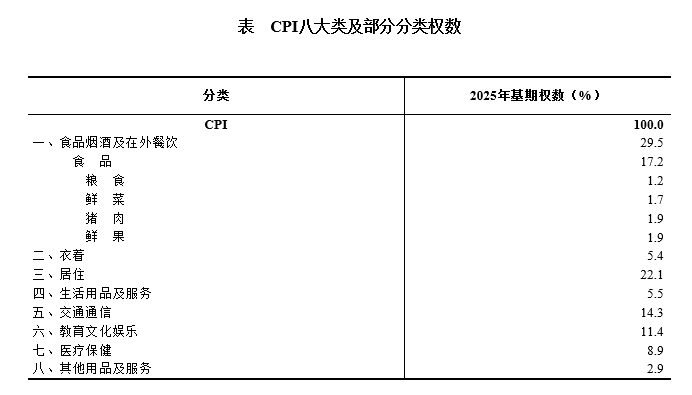
2月11日,国家统计局发布了以2025年为基期的全国居民消费价格指数(CPI)和工业生产者出厂 价格指数(PPI)数据,这是本次基期轮换后的首次数据发布。对此,国家统计局城市司负责人接受了 《中国信息报》专访。 权数测算也是CPI基期轮换的一项重要工作。CPI权数测算遵循客观性、真实性和科学性相统一的 原则,使用国际可比的方法进行测算。CPI权数测算完成后,按照采集好的新基期规格品价格对2025年 指数进行重新计算,作为新的对比基期。 3.如何确定CPI权数?各大类权数是多少?和上一轮基期相比,权数有何变化? 答:CPI权数是指按对比期价格购买"固定篮子"中各类商品或服务的支出占购买整个篮子所需支出 的比重。权数来源以住户收支与生活状况调查中居民消费支出资料为主,部分小类和基本分类通过权数 专项调查细化补充,并结合其他宏观数据、行业统计资料加以完善,确保权数客观真实反映居民消费结 构。具体来看,食品烟酒及在外餐饮、衣着、居住、生活用品及服务、交通通信、教育文化娱乐、医疗 1.为什么要开展价格指数基期轮换? 答:基期轮换是价格指数编制的重要基础性工作,也是国际惯例和通行做法,旨在适应生产、流 通、消费领域商品和 ...

国家统计局:1月CPI同比上涨0.2% PPI环比继续上涨 同比降幅收窄
Guo Jia Tong Ji Ju· 2026-02-11 01:47
Group 1: CPI Analysis - The Consumer Price Index (CPI) increased by 0.2% month-on-month and year-on-year, with the core CPI (excluding food and energy) rising by 0.8% year-on-year [2][3] - The decline in food prices by 0.7% contributed to a decrease in CPI, while fresh vegetable prices rose by 6.9% [3][4] - Energy prices fell by 5.0%, impacting the CPI negatively by approximately 0.34 percentage points [3][4] Group 2: PPI Analysis - The Producer Price Index (PPI) rose by 0.4% month-on-month, marking the fourth consecutive month of increase, with the year-on-year decline narrowing to 1.4% [2][5] - The increase in PPI was driven by the ongoing construction of a unified national market, leading to price rises in sectors such as cement and lithium-ion battery manufacturing [5][6] - The prices in the non-ferrous metal mining sector increased by 22.7%, while energy-related industries continued to see price declines [7]
国家统计局:1月CPI同比涨幅回落主要受春节错月影响,PPI同比降幅收窄
Di Yi Cai Jing· 2026-02-11 01:46
Group 1 - The core CPI excluding food and energy prices increased by 0.8% year-on-year, indicating a moderate inflationary trend in consumer prices [1][2] - In January, the CPI rose by 0.2% month-on-month and year-on-year, reflecting a recovery in consumer demand [1][3] - The PPI increased by 0.4% month-on-month, marking the fourth consecutive month of growth, with a year-on-year decline of 1.4%, which is a narrowing of the decline compared to the previous month [1][4][5] Group 2 - The decline in CPI year-on-year was primarily influenced by the timing of the Spring Festival, which affected the comparison base from the previous year [2][3] - Food prices decreased by 0.7%, contributing to a drop in CPI by approximately 0.11 percentage points, while service prices saw a slight increase of 0.1% [2][3] - Energy prices fell by 5.0% in January, impacting CPI by approximately 0.34 percentage points, with gasoline prices down by 11.4% year-on-year [2][3] Group 3 - The core CPI excluding food and energy prices rose by 0.3% month-on-month, the highest increase in six months, driven by higher prices for air tickets and travel services [3][4] - Industrial consumer goods prices excluding energy saw a year-on-year increase of 2.6%, with significant price rises in gold jewelry and household goods [3][4] - The PPI's month-on-month increase was supported by the ongoing development of a unified national market, leading to price rises in various sectors such as cement and lithium-ion batteries [4][5]
国家统计局城市司首席统计师董莉娟解读2026年1月份CPI和PPI数据
Guo Jia Tong Ji Ju· 2026-02-11 01:39
2026年1月份CPI同比上涨 PPI同比降幅收窄 1月份,居民消费需求持续恢复,居民消费价格指数(CPI)环比上涨0.2%,同比上涨0.2%,扣除 食品和能源价格的核心CPI同比上涨0.8%。受全国统一大市场建设持续推进、部分行业需求增加及国际 大宗商品价格传导等因素影响,工业生产者出厂价格指数(PPI)环比上涨0.4%,同比下降1.4%。 一、CPI同比涨幅回落主要受春节错月影响,核心CPI保持温和上涨 CPI同比涨幅有所回落,主要有以下两方面原因:一是春节错月影响。上年1月份为春节月份,食 品和部分服务价格上涨较多,导致上年同期对比基数较高,带动本月同比涨幅回落较多。分类别看,食 品价格下降0.7%,影响CPI同比下降约0.11个百分点,而上月对CPI的影响为上拉约0.21个百分点。食品 中,鲜菜价格上涨6.9%,涨幅比上月回落11.3个百分点,对CPI同比的上拉影响比上月回落约0.27个百 分点;鲜果价格上涨3.2%,涨幅比上月回落1.2个百分点;猪肉和鸡蛋价格分别下降13.7%和10.6%。服 务价格上涨0.1%,影响CPI同比上涨约0.05个百分点,对CPI同比的上拉影响比上月减少约0.20个百分 ...
国家统计局:本次基期轮换对CPI和PPI各月同比指数的影响平均约为0.06和0.08个百分点 总体较小
Guo Jia Tong Ji Ju· 2026-02-11 01:36
(文章来源:国家统计局) 国家统计局2月11日发布了以2025年为基期的全国居民消费价格指数(CPI)和工业生产者出厂价格指 数(PPI)数据,这是本次基期轮换后的首次数据发布。对此,国家统计局城市司负责人表示,基期轮 换后,调查分类目录、调查网点和代表规格品、权数等变动均会对价格指数产生一定影响,但这些因素 的影响方向和幅度各不相同,综合起来才是对总指数的影响。经测算,本次基期轮换对CPI和PPI各月同 比指数的影响平均约为0.06和0.08个百分点,总体较小。 ...
中国1月CPI同比 0.2%,前值 0.8%。中国1月PPI同比 -1.4%,前值 -1.9%
Hua Er Jie Jian Wen· 2026-02-11 01:34
风险提示及免责条款 市场有风险,投资需谨慎。本文不构成个人投资建议,也未考虑到个别用户特殊的投资目标、财务状况或需要。用户应考虑本文中的任何 意见、观点或结论是否符合其特定状况。据此投资,责任自负。 中国1月CPI同比 0.2%,前值 0.8%。 中国1月PPI同比 -1.4%,前值 -1.9%。 ...
国家统计局:1月CPI同比上涨0.2% PPI同比下降1.4%
Guo Jia Tong Ji Ju· 2026-02-11 01:32
(文章来源:国家统计局) 国家统计局:1月CPI同比上涨0.2%,PPI同比下降1.4%。 ...
今日看点|1月CPI、PPI数据将公布
Jing Ji Guan Cha Wang· 2026-02-11 01:13
今日看点 2月11日重点关注的财经要闻与资本市场大事: 1、1月CPI、PPI数据将公布 2月11日,国家统计局将公布2026年1月份CPI(居民消费价格指数)和PPI(工业生产者出厂价格指数)数据。 2、国新办将举行新闻发布会 介绍2026"乐购新春"春节特别活动、保障春节市场供应有关情况 2月11日上午10时,国新办将举行新闻发布会,商务部副部长盛秋平和文化和旅游部、金融监管总局、广电总局、体育总局有关负责人介绍2026"乐购新 春"春节特别活动、保障春节市场供应有关情况,并答记者问。 4、124.51亿元市值限售股今日解禁 2月11日,共有7家公司限售股解禁,合计解禁量为7.3亿股,按最新收盘价计算,合计解禁市值为124.51亿元。 从解禁量来看,海联讯、青松建化、麦澜德解禁量居前,解禁股数分别为4.26亿股、2.26亿股、6317.32万股。从解禁市值来看,海联讯、麦澜德、青松建化 解禁市值居前,解禁市值分别为76.96亿元、28.18亿元、10.3亿元。 5、11家公司披露回购进展 2月11日,11家公司共发布11个股票回购相关进展。其中,2家公司首次披露股票回购预案,1家公司回购方案获股东大会通过 ...
中物联: 2026年1月中国大宗商品价格指数为125.3点 同比上涨12.7%
智通财经网· 2026-02-05 01:53
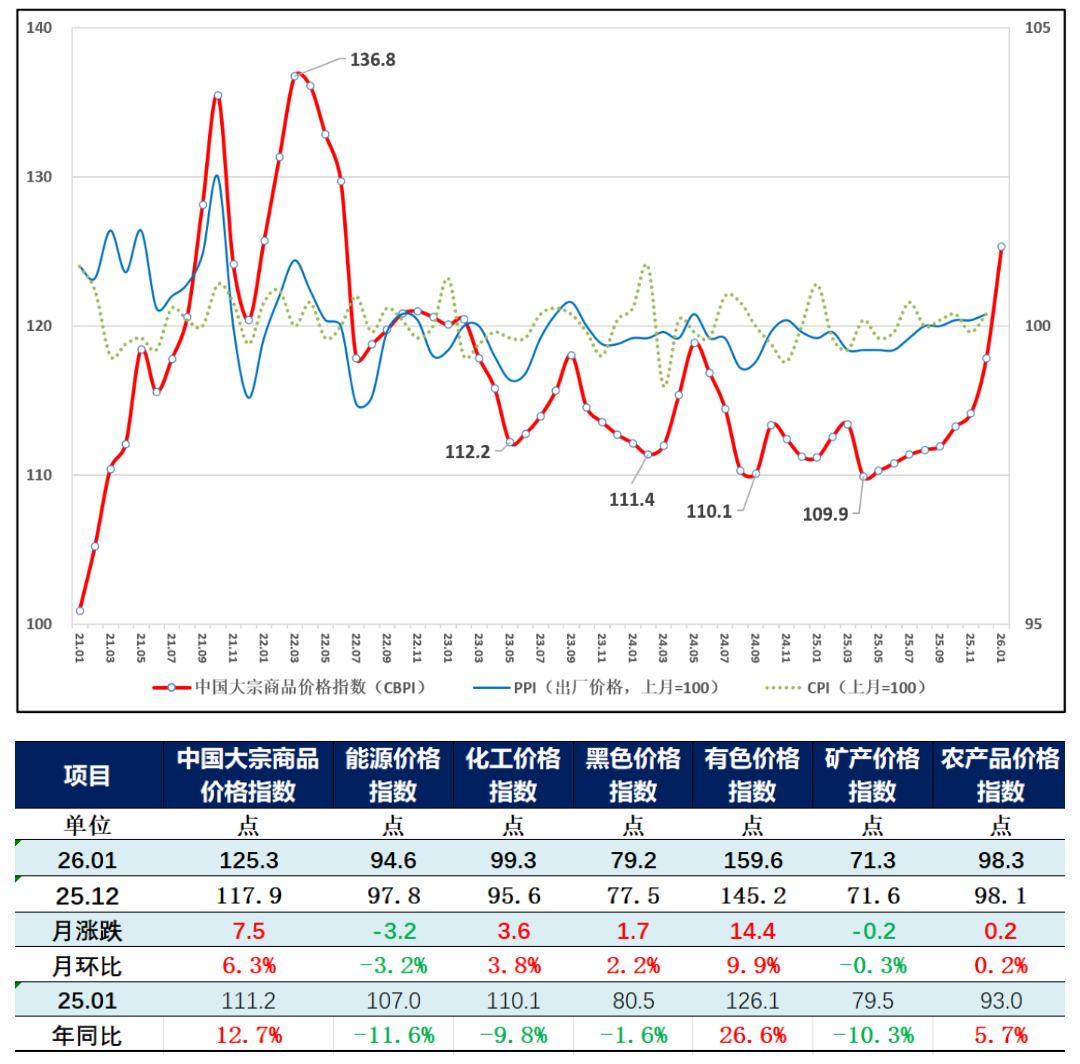
Core Insights - The China Commodity Price Index (CBPI) for January 2026 reached 125.3 points, marking a month-on-month increase of 6.3% and a year-on-year increase of 12.7%, the highest since July 2022 [1][3] - The increase in the index is attributed to optimistic business expectations and ongoing production expansion, supported by government policies [1] - However, challenges arise from international geopolitical changes, loose monetary policy expectations, and volatile commodity futures prices, necessitating careful risk assessment and macroeconomic policy adjustments [1] Price Index Summary - The CBPI increased to 125.3 points from 117.9 points in December 2025, with significant contributions from various sectors [3] - The energy price index decreased to 94.6 points, down 3.2% month-on-month and down 11.6% year-on-year [3] - The chemical price index rose to 99.3 points, up 3.8% month-on-month but down 9.8% year-on-year [3] - The black metal price index increased to 79.2 points, up 2.2% month-on-month and down 1.6% year-on-year [3] - The non-ferrous metal price index surged to 159.6 points, up 9.9% month-on-month and up 26.6% year-on-year [3] - The agricultural product price index slightly increased to 98.3 points, up 0.2% month-on-month and up 5.7% year-on-year [3] - The mineral price index fell to 71.3 points, down 0.3% month-on-month and down 10.3% year-on-year [3] Commodity Price Movements - Among 50 monitored commodities, 33 (66%) saw price increases while 17 (34%) experienced declines [4] - The top three commodities with the highest month-on-month price increases were lithium carbonate (up 48.4%), refined tin (up 20.2%), and refined nickel (up 19.5%) [4] - The commodities with the largest month-on-month price declines were corrugated paper (down 13.1%), caustic soda (down 7%), and coke (down 6.9%) [4] Comparative Analysis - The CBPI trends align with the Producer Price Index (PPI) and Consumer Price Index (CPI) for December, which saw a month-on-month increase of 0.2% [5] - The CBPI has shown a consistent upward trend alongside international commodity indices such as CRB and S&P GSCI [5] - Geopolitical tensions in North America and the Middle East, along with a weakening US dollar, have contributed to rising international oil prices and record highs in copper prices [5] - January saw historical highs in gold and silver prices, although significant declines occurred later in the month due to margin adjustments and Federal Reserve announcements [5]
国信证券晨会纪要-20260205
Guoxin Securities· 2026-02-05 01:06
Macro and Strategy - The report discusses the "anti-involution" policy aimed at addressing overcapacity and disorderly competition, marking a significant shift in the construction of a unified national market [6][8] - The policy evolution is divided into three phases, with the current phase focusing on systematic implementation to eliminate local protectionism and market segmentation [6][7] - The report emphasizes the need for administrative coordination to break down local protection and industry barriers, while also advocating for a long-term focus on reasonable profit margins for enterprises [8][9] Industry and Company - The electronic industry report highlights the rapid emergence of AI applications, with a focus on the computing power chain becoming a central investment theme [16] - The automotive industry report notes that the penetration rate of NOA (Navigation on Autopilot) in urban areas has exceeded 20%, with significant investments in autonomous driving technologies [23][24] - The agricultural sector report indicates a rise in potassium fertilizer contract prices and increased demand for phosphate rock driven by energy storage needs [3] - The real estate sector in Hong Kong shows signs of recovery, with a 21% increase in private residential transaction volume in 2025, marking the second-highest level since 2013 [33][34] - The report on public REITs indicates a continued divergence in performance across different asset types, with a strong long-term allocation value expected as the market matures [10][11] Investment Strategies - The report suggests focusing on sectors benefiting from policy support and strong fundamentals, such as affordable housing and new infrastructure related to digital economy upgrades [10][11] - In the automotive sector, recommendations include investing in companies with strong new product cycles and those involved in intelligent driving technologies [26][29] - The report advises on maintaining a balanced asset allocation strategy, particularly in light of potential market volatility and economic recovery signals [12][13]