
基础化学原料制造

Search documents
港股、海外周聚焦(3月第2期):HALO叙事能否指导A股投资
GF SECURITIES· 2026-03-08 13:48
Group 1 - The HALO framework (Heavy Assets & Low Obsolescence) emphasizes the revaluation of assets based on "physical scarcity," focusing on business models anchored in high-cost, long-cycle, and heavily regulated physical capital [2][7] - The framework is driven by three structural forces: rising real interest rates leading to a convergence of long-duration growth stock valuations, geopolitical fragmentation incorporating "sovereign security" into pricing, and the dual impact of the AI revolution compressing light asset moats while elevating heavy asset industries [2][11][14] - China is one of the most concentrated markets for HALO assets globally, with manufacturing value added accounting for about 30% of the world, and A-shares having a high proportion of tangible assets, providing strong credit backing and volatility resistance [2][17] Group 2 - The HALO narrative in China translates into four main lines: energy and public utilities as dividend bases, non-ferrous metals and chemicals as inflation assets, power grid infrastructure as the core of investment cycles, and AI hardware manufacturing as growth options [2][37] - Energy and public utilities are characterized by stable profitability due to enhanced pricing mechanisms, with coal and hydropower assets exhibiting bond-like attributes [2][38] - Non-ferrous metals and chemicals are positioned as inflation assets, with supply rigidities and AI demand elasticity driving their appeal [2][43] Group 3 - The investment strategy based on the HALO framework involves selecting A and H shares with high capital intensity and low obsolescence, aiming to capture excess returns from the revaluation of physical assets while balancing cyclical offensiveness and dividend defensiveness [2][49] - The selection criteria include evaluating companies based on six capital intensity metrics, ensuring that selected firms exceed market medians in these areas [2][50] - The resulting HALO stock portfolio includes companies like China Mobile, China Shenhua, and Huaneng Power, which align with the heavy asset, low obsolescence characteristics [2][52] Group 4 - The report highlights that the current PPI turning positive enhances the logic for inflation trades, suggesting that cyclical sectors can achieve excess returns [2][22] - High dividend and high ROE characteristics of HALO assets indicate their ability to withstand market volatility and provide stable returns over time [2][31] - The report emphasizes that the majority of HALO assets are cyclical and dividend stocks, which are expected to perform well in the current economic environment [2][21]
广西元本新材料科技有限公司成立,注册资本3000万人民币
Sou Hu Cai Jing· 2026-02-26 06:15
Company Overview - Guangxi Yuanben New Materials Technology Co., Ltd. has been established with a registered capital of 30 million RMB [1] - The legal representative of the company is Yang Zhuang [1] - The company is located in Nanning, Guangxi, specifically at the Nanning East New City Liujing Industrial Park [1] Shareholding Structure - Guangdong Lieran Chemical Group Co., Ltd. holds a 60% stake in the company [1] - Guangzhou Zongbao Investment Co., Ltd. owns a 40% stake [1] Business Scope - The company is engaged in the research and development of new materials technology [1] - It also involves the production of chemical products (excluding licensed chemical products) and the manufacturing of basic chemical raw materials (excluding hazardous chemicals) [1] - The manufacturing of specialized chemical products and synthetic materials (excluding hazardous chemicals) is also part of its business activities [1]
科思创聚合物(山东)有限公司成立,注册资本500万人民币
Sou Hu Cai Jing· 2026-02-25 03:49
Core Viewpoint - Recently, a new company named Covestro Polymer (Shandong) Co., Ltd. has been established, focusing on the manufacturing and research of new materials and chemical products [1] Company Summary - Company Name: Covestro Polymer (Shandong) Co., Ltd. [1] - Legal Representative: Ma Kun [1] - Registered Capital: 5 million RMB [1] - Shareholder: Weifang Botong Enterprise Management Co., Ltd. holds 100% [1] - Business Scope: Includes research and development of new materials technology, manufacturing of specialized chemical products (excluding hazardous chemicals), production of chemical products (excluding licensed chemical products), technology import and export, goods import and export, and internet data services [1] - Company Type: Limited liability company (wholly owned by a natural person) [1] - Business Duration: Until February 24, 2026, with no fixed term [1] - Registration Authority: Weifang High-tech Industrial Development Zone Market Supervision Administration [1] Industry Summary - Industry Classification: Manufacturing > Chemical Raw Materials and Chemical Products Manufacturing > Basic Chemical Raw Materials Manufacturing [1] - Location: Shandong Province, Weifang High-tech Zone, New City Street, Chongde Community, Health East Street 10179, Software Park [1]
2026年1月物价数据点评:春节错期带动1月CPI涨幅回落,PPI降幅继续收窄
Dong Fang Jin Cheng· 2026-02-24 06:45
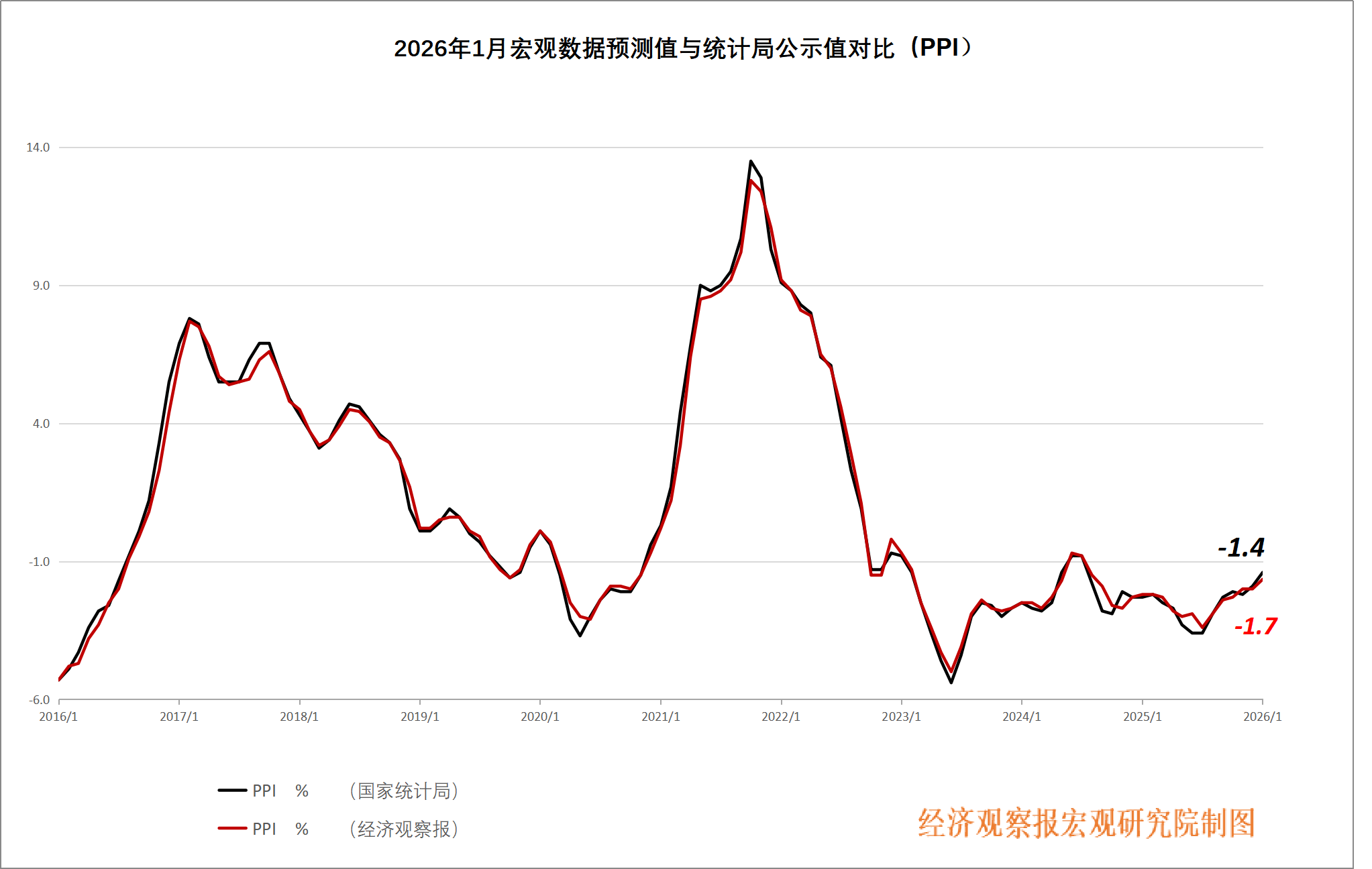
CPI Analysis - In January 2026, the CPI increased by 0.2% year-on-year, down from 0.8% in December 2025, with a cumulative year-on-year CPI of 0.0% for 2025[1] - The significant drop in CPI growth is primarily due to the high base effect from the 2025 Spring Festival, which fell in January[2] - Increased vegetable supply led to a decline in food prices, contributing to the overall CPI trend[3] - The core CPI, excluding volatile food and energy prices, was 0.8%, down 0.4 percentage points from the previous month[4] PPI Analysis - The PPI decreased by 1.4% year-on-year in January 2026, an improvement from a 1.9% decline in December 2025, marking the smallest year-on-year decline since August 2024[5] - The PPI increased by 0.4% month-on-month, marking the fourth consecutive month of increase[6] - Key drivers for the PPI increase include improved supply-demand dynamics in certain industries and rising international prices for non-ferrous metals[7] - The PPI for production materials rose by 0.5% month-on-month, while the PPI for living materials increased by 0.1%[8] Future Outlook - The CPI is expected to rise significantly in February 2026, potentially reaching around 1.0% due to the reversal of the Spring Festival base effect[9] - The overall CPI for January and February combined is projected to be around 0.6% year-on-year, indicating a continuation of the price recovery trend from the second half of 2025[10]
PPI同比降幅收窄至-1.4%,国际金属价格上涨成主要推手
Xin Lang Cai Jing· 2026-02-20 05:14
Core Viewpoint - The January 2026 economic data indicates a narrowing of the Producer Price Index (PPI) year-on-year from -1.9% to -1.4%, primarily influenced by rising international metal prices [1] Group 1: PPI Trends - The PPI increased by 0.4% month-on-month in January, with the growth rate expanding, indicating stronger input factors driving prices [1] - The rise in international non-ferrous metal prices has led to significant increases in domestic prices for the non-ferrous metal mining and selection industry, as well as the non-ferrous metal smelting and rolling industry, with month-on-month price increases of 5.7% and 5.2% respectively [1] - Specific price increases for smelting include silver up by 38.2%, copper by 8.4%, gold by 4.8%, and aluminum by 2.3% [1] Group 2: External Influences - Geopolitical risks have intensified, pushing up international oil prices, which in turn has led to month-on-month price increases of 0.6% in basic chemical raw material manufacturing and 0.4% in chemical fiber manufacturing [1] - The strong upward trend in international metal prices, particularly for copper, gold, and silver, combined with geopolitical risks affecting oil prices, suggests that short-term input factors may continue to support PPI [1] Group 3: Future Outlook - The annual PPI year-on-year central tendency is expected to rise, but maintaining a trend of recovery will require more policy efforts, such as subsidies, to promote sustained improvement in domestic demand [1]

天津中合贸易有限责任公司成立,注册资本1000万人民币
Sou Hu Cai Jing· 2026-02-13 02:19
Core Viewpoint - Tianjin Zhonghe Trade Co., Ltd. has been established with a registered capital of 10 million RMB, fully owned by Xinjiang Zhongke Energy Technology Co., Ltd. [1] Group 1: Company Overview - The legal representative of Tianjin Zhonghe Trade Co., Ltd. is Yu Kuangshi [1] - The company is registered with a capital of 10 million RMB [1] - The business scope includes sales of coal and products, graphite and carbon products, specialized chemical products (excluding hazardous chemicals), high-quality special steel materials, metal structures, and various metal materials [1] Group 2: Shareholding Structure - Xinjiang Zhongke Energy Technology Co., Ltd. holds 100% of the shares in Tianjin Zhonghe Trade Co., Ltd. [1] Group 3: Business Operations - The company is involved in a wide range of activities including technical services, supply chain management, domestic trade agency, and sales agency [1] - The registered address is located in the southwest corner of the intersection of Jiangxi Road and Hefei Road, Hexi District, Tianjin [1] - The company operates under the manufacturing industry, specifically in the chemical raw materials and chemical products manufacturing sector [1]
2026年1月物价数据点评:“反内卷”与新质生产力发展并进
BOHAI SECURITIES· 2026-02-12 10:11
Group 1: CPI Analysis - In January 2026, the CPI increased by 0.2% year-on-year, a decrease from the previous value of 0.8%[11] - Core CPI's month-on-month growth reached its highest level in six months, driven by increased travel demand and rising international gold prices[4] - Food prices remained stable month-on-month, with fresh vegetable prices decreasing by 4.8%[14] Group 2: PPI Analysis - In January 2026, the PPI's year-on-year decline narrowed, while the month-on-month increase expanded[5] - Prices in the upstream raw materials sector turned from decline to increase due to the "anti-involution" effect, with basic chemical raw materials rising by 0.7%[25] - The month-on-month increase in production materials prices expanded, while living materials prices shifted from stable to rising[25] Group 3: Future Outlook - The CPI is expected to increase in February 2026, influenced by sufficient pig supply and potential price rises in fresh vegetables before the Spring Festival[16] - The PPI is projected to maintain a similar month-on-month increase in February, with a further narrowing of the year-on-year decline to around -1.0%[5] - Input inflation may rise in February, driven by ongoing "anti-involution" and the rapid development of new productive forces[26]
【新华解读】PPI环比加速上涨 多方面因素或将促成工业生产持续复苏
Xin Hua Cai Jing· 2026-02-12 01:49
Core Viewpoint - The Producer Price Index (PPI) in China showed a positive trend in January, with a month-on-month increase of 0.4%, marking the fourth consecutive month of growth, while the year-on-year decline narrowed to 1.4% [1] Group 1: PPI Trends - The PPI reflects a gradual improvement in industrial production demand and market vitality, indicating a potential positive cycle of "production recovery - demand increase - stable prices" [1] - Key industries such as cement manufacturing and lithium-ion battery production saw a month-on-month price increase of 0.1%, continuing their upward trend for four months [1] - The price of photovoltaic equipment and components shifted from a 0.2% decrease to a 1.9% increase, while basic chemical raw materials saw a price increase of 0.7% [1] Group 2: Sector-Specific Insights - The digital economy sector is experiencing strong growth, with prices in computer communication and other electronic device manufacturing rising by 0.5% due to increased demand for digital technologies [2] - Seasonal demand ahead of the Spring Festival contributed to price increases in the arts and crafts sector (4.1%) and agricultural products processing (0.3%) [2] - The price of winter clothing and down products also increased due to heightened demand for cold weather apparel [2] Group 3: International Influences - International prices of non-ferrous metals have remained strong, significantly impacting domestic prices in the non-ferrous metal industry, with PPI for this sector rising by 5.7% month-on-month [3] - Specific increases in metal refining prices were noted, with silver refining up by 38.2% and copper refining by 8.4% [3] - The rise in oil prices is expected to have a more pronounced effect on domestic PPI in February, with a notable reduction in the decline of petroleum product manufacturing prices [4] Group 4: Future Outlook - The PPI is expected to continue rising in February, but at a slower rate of around 0.2%, with a year-on-year decline projected to narrow to approximately 1.0% [3] - Marginal upward momentum for basic raw materials and industrial prices may weaken, as indicated by the slower growth in January compared to December [3] - Domestic demand is anticipated to become a more significant factor influencing PPI trends moving forward, with expectations of narrowing declines in the coming months [4]
1月物价走势保持平稳 核心CPI温和上涨态势不变
Xin Lang Cai Jing· 2026-02-11 20:52
Group 1 - In January, the Consumer Price Index (CPI) increased by 0.2% year-on-year and month-on-month, primarily influenced by the Spring Festival's timing, leading to a high comparison base from the previous year [1] - The Producer Price Index (PPI) decreased by 1.4% year-on-year, but the decline narrowed by 0.5 percentage points compared to the previous month, while it increased by 0.4% month-on-month, marking the fourth consecutive month of growth [1][3] - Energy prices fell by 5.0% year-on-year, contributing approximately 0.34 percentage points to the CPI decline, with gasoline prices down 11.4% [1] Group 2 - Core CPI showed a mild increase, with a month-on-month rise of 0.3%, the highest in six months, indicating a continuous recovery in consumer demand [1] - Prices for air tickets and travel agency services rose by 5.7% and 2.0% respectively, while prices for household services, hairdressing, and entertainment tickets increased between 0.4% and 2.8% [2] - Excluding energy, industrial consumer goods prices rose by 2.6% year-on-year, with significant increases in gold jewelry prices (77.4%) and household goods [2] Group 3 - The PPI's month-on-month increase of 0.4% reflects positive changes driven by the ongoing construction of a unified national market and increased demand in certain industries [3] - Prices in the raw materials and processing industries rose by 0.7% and 0.5% month-on-month, with year-on-year declines narrowing by 0.6 and 1.2 percentage points respectively [3] - The trend of "anti-involution" is expected to continue influencing the prices of basic raw materials and industrial products in the future [3]
1月份CPI同比上涨 PPI同比降幅收窄
Zheng Quan Ri Bao· 2026-02-11 16:29
Group 1: Consumer Price Index (CPI) Insights - In January, the Consumer Price Index (CPI) increased by 0.2% month-on-month and year-on-year, indicating a moderate recovery in consumer demand [1][2] - The core CPI, excluding food and energy, rose by 0.3% month-on-month, marking the highest increase in six months [3] - Food prices decreased by 0.7%, contributing to a decline in the CPI year-on-year by approximately 0.11 percentage points, while service prices increased by 0.1% [2][3] Group 2: Producer Price Index (PPI) Insights - The Producer Price Index (PPI) rose by 0.4% month-on-month, marking the fourth consecutive month of increase, with a year-on-year decline of 1.4% [4] - Key industries showed price increases due to improved supply-demand structures and the effects of capacity governance [4][5] - Domestic prices in the non-ferrous metal and petroleum sectors exhibited divergence due to international price fluctuations, with non-ferrous metal mining prices increasing significantly [6]