算力

Search documents
理解算力,才能理解数字社会
Ren Min Ri Bao· 2025-12-11 21:56
Core Insights - Computing power has become a buzzword, with its potential to change societal rhythms being compared to the steam engine and the electric grid [1] - The discourse around computing power includes terms like "East Data West Calculation," "supercomputing centers," and "AI chips," indicating its growing importance in corporate decision-making [1] - The computing power ecosystem is characterized by interdependence and evolution, relying on various factors such as energy support, institutional participation, commercial investment, talent cultivation, and data supply [1] Industry Perspective - The book aims to provide a problem-oriented discussion on how computing power integrates into societal operations, shapes industrial logic, and participates in public decision-making [1] - The focus is on the process of trend formation rather than specific product updates, emphasizing structural changes and relational reorganization [1] - Key considerations include the fairness, efficiency, and security of computing power access, which are crucial for the operational baseline of society [1] Audience Engagement - The book is designed for a broader audience, not just programmers or managers, offering an entry point into the "computational society" [2] - Readers are encouraged to interpret the content through their own perspectives and experiences, validating the logical structure presented [2] - Understanding the computing power-driven society is essential for individuals to better comprehend their own positions and directions within it [2]
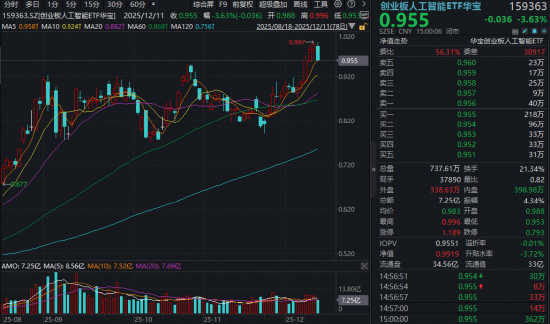
光模块突发调整,创业板人工智能ETF(159363)回踩五日线,资金果断加仓!机构:中长期需求逻辑不改
Xin Lang Cai Jing· 2025-12-11 11:39
Core Insights - The AI sector experienced a significant adjustment, with a notable decline in optical module CPO and other computing hardware, leading to a drop of over 3.5% in the ChiNext AI index after reaching a new high [1][6] - Major stocks such as Zhishang Technology fell over 13%, while others like Changxin Bochuang and Liante Technology saw declines exceeding 5% [1][6] - Despite the short-term pullback, the long-term demand for optical modules driven by AI remains strong, supported by ongoing investments from overseas AI giants [3][8] Market Analysis - The recent weakness in the optical module CPO sector is attributed to two main factors: prior excessive gains leading to profit-taking and reduced capital expenditure expectations, particularly following a significant drop in Oracle's stock [3][8] - According to TrendForce, the demand for optical transceivers over 800G is projected to grow significantly, with an estimated 24 million units in 2025 and nearly 63 million units by 2026, representing a growth rate of 2.6 times [3][8] - Leading optical communication manufacturers are noted to have significant advantages in R&D barriers, material and capacity reserves, and new technology solutions, suggesting a stable outlook for the sector [3][8] Investment Opportunities - The first ChiNext AI ETF (159363) is highlighted as a key investment opportunity, with over 56% of its holdings in optical modules, and a significant portion of its portfolio allocated to computing and AI applications [4][9] - As of December 8, the ChiNext AI ETF has a total size exceeding 3.3 billion, with an average daily trading volume of over 600 million in the past month, ranking first among seven ETFs tracking the ChiNext AI index [4][9]


公辅设备反内卷:EK的“高效+零碳+算力”解法
高工锂电· 2025-12-11 11:10
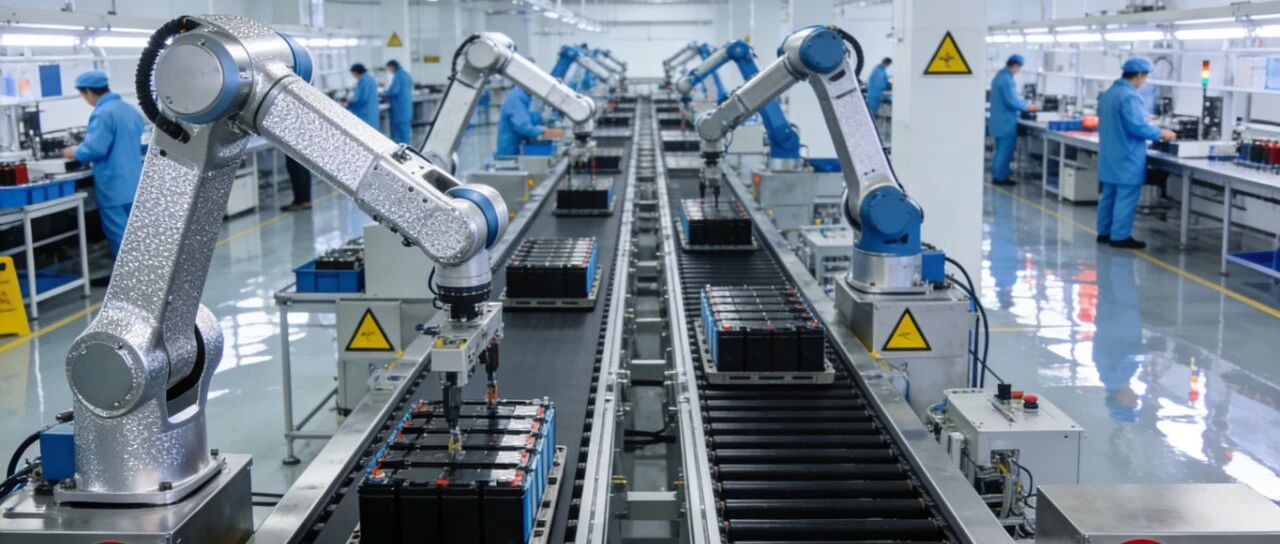
Core Viewpoint - The integration of digital intelligence technology and zero-carbon concepts will transform auxiliary equipment from a bottleneck in the lithium battery industry to a key driver for green transformation and efficiency upgrades [1][25]. Group 1: Industry Transformation Necessity - The industrial air conditioning sector must undergo transformation as traditional production methods are no longer viable. Digitalization is essential, and "dumb" equipment must become intelligent to escape the cycle of internal competition [2]. - The industrial auxiliary equipment has historically been viewed as a "supporting actor" in the lithium battery industry, focusing on core components like battery materials and production processes. However, under the zero-carbon vision, high energy consumption issues persist, necessitating a reevaluation of auxiliary equipment's role [5][6]. Group 2: Three Pillars of Digital Transformation - The "high efficiency, zero carbon, and computing power" framework is not merely a collection of technologies but a cohesive solution that addresses industry pain points through energy efficiency, low carbon strategies, and intelligent operations [8]. - High efficiency is achieved through productization, which enhances overall process efficiency and reduces project timelines. EK has introduced integrated solutions like distributed cooling stations and industrial heat stations to upgrade traditional systems [10]. - The zero-carbon approach focuses on optimizing energy use and reducing carbon emissions through advanced technologies such as variable frequency drives and heat recovery systems [11]. - Computing power serves as the "brain" of the solution, enabling intelligent operations and proactive energy management through the EK-AIoT platform, transforming equipment from passive to active [12]. Group 3: Practical Validation of Solutions - The effectiveness of the proposed solutions is validated through real-world applications, showcasing the industrial value of the "three-dimensional reconstruction" approach. Successful projects demonstrate significant reductions in energy consumption and carbon emissions [13][19]. - Specific examples include the DP5 low-temperature direct expansion dehumidification technology, which has achieved international leadership in energy-saving modifications for lithium battery auxiliary equipment [15]. - The HEAD integrated cooling station exemplifies efficiency in new projects, simplifying installation and maintaining energy-saving performance over time [17]. Group 4: Value Innovation in a Competitive Landscape - The lithium battery industry is experiencing intense competition, with auxiliary equipment facing low-level homogenization. Companies often compete on price rather than addressing core customer needs such as cost reduction and compliance with zero-carbon standards [20]. - EK's "high efficiency, zero carbon, and computing power" framework offers a path for value innovation, moving beyond mere equipment sales to provide comprehensive lifecycle services that create long-term value for clients [20]. - This shift in focus from scale competition to value competition is gaining industry recognition, with EK's energy-saving solutions being adopted by leading companies and included in various industry recommendation directories [20]. Group 5: Future Directions - The future of auxiliary equipment development will be characterized by the deep integration of efficiency, zero-carbon, and computing power. As the lithium battery industry demands higher production environment standards, systemic digital solutions will become mainstream [22]. - EK plans to deepen its core strategies in energy efficiency and low carbon, expand product offerings, and enhance the EK-AIoT platform for better energy analysis and operational management [23].
300265!突发低位“20cm”涨停!
Xin Lang Cai Jing· 2025-12-11 10:44
Core Viewpoint - The commercial aerospace sector is experiencing significant growth, driven by favorable policies and market dynamics, leading to a surge in stock prices of related companies [5][12][13]. Group 1: Market Performance - On December 11, multiple mid-to-low priced stocks, including Tongguang Cable, hit the 20% daily limit up, indicating strong buying interest from major funds [1][9]. - The commercial aerospace sector saw a notable increase, with the index rising over 1%, ranking among the top four sectors, despite overall market fluctuations [9][10]. - Since November 24, the commercial aerospace sector has cumulatively increased by approximately 14%, reflecting a bullish trend in the secondary market [6][13]. Group 2: Key Drivers - The Federal Reserve's recent interest rate cut of 25 basis points to a target range of 3.50%-3.75% is expected to enhance liquidity and risk appetite, positively impacting technology and growth sectors [2][9]. - The National Space Administration's recent action plan aims for high-quality development of the commercial aerospace sector by 2027, contributing to the sector's upward momentum [5][12]. - Recent achievements, such as the successful launch of satellites and record-setting rocket launches, have further stimulated investor interest in the commercial aerospace sector [5][12]. Group 3: Stock Highlights - Notable stocks in the commercial aerospace sector include Aerospace Development, which has seen a price increase of over 60% since November 24, with significant net buying from margin trading [6][13]. - Other companies like Huagong Technology, Aerospace Electronics, and Aerospace Power have also experienced substantial price increases and net buying activity, indicating strong market interest [6][14]. - The stock performance of these companies reflects a combination of long-term growth potential and short-term trading opportunities, driven by both market sentiment and fundamental developments [6][13].

科技 - 2026展望:算力高景气延续,关注端侧AI创新机遇
Xin Lang Cai Jing· 2025-12-11 10:17
Core Insights - The global technology industry is expected to experience a dual trend of differentiated end-user demand and accelerated AI innovation by 2026, driven by rapid iterations of AI large models [1][4] - The demand for computing power and the innovation cycle of edge AI products (AI smartphones, AI PCs, AI glasses) will be the main growth drivers, while low-end consumer electronics demand is anticipated to face short-term pressure due to macroeconomic uncertainties and rising storage costs [1][4] AI Computing Infrastructure - The global server market will be dominated by AI infrastructure investments, with AI server shipments expected to grow by 50% year-on-year to 2.32 million units in 2026 [2][6] - The market will exhibit a "GPU/ASIC dual-drive" pattern, with GB/VR iterations driving specification upgrades and self-developed ASICs enhancing value [2][6] - ODM leaders and core component suppliers with "mechatronics" capabilities are expected to benefit, including companies like Luxshare Precision, Hongteng Precision, and BYD Electronics [2][6] Smartphone Market - Global smartphone shipments are projected to decline by 5% year-on-year to 1.18 billion units in 2026, primarily affecting low-end models due to macro uncertainties and rising storage costs [2][6] - The high-end market remains resilient, driven by AI innovations, with Apple expected to launch significant upgrades including the iPhone 18 and the first foldable iPhone [2][6] - Opportunities in optical components, structural parts, and thermal management are highlighted, with companies like Luxshare Precision, AAC Technologies, and Xiaomi Group being key players [2][6] AR/VR Market - The global AI glasses market is expected to exceed 10 million units by 2026, marking a new era for smart glasses [2][6] - Major tech companies are accelerating their investments, with Meta focusing on social ecosystems and Google building an ecosystem through the open Android XR platform [2][6] - Companies with core optical technologies and assembly capabilities are likely to benefit from industry growth, including Sunny Optical, AAC Technologies, and Q Tech [2][6] PC and Automotive Electronics - The global PC market is projected to see a slight decline of 2% year-on-year to 275 million units, influenced by the end of the Windows 11 upgrade cycle and rising storage costs [2][6] - AI PCs are expected to penetrate the market significantly, with their share projected to exceed 50% by 2026 [2][6] - The commercialization of L4-level autonomous driving is expected to accelerate, with opportunities in high-voltage connectors, automotive optics, and smart cockpit displays, benefiting companies like Luxshare Precision, Hongteng Precision, BYD Electronics, Sunny Optical, AAC Technologies, and BOE Technology Group [2][6]




黑天鹅突袭!千亿巨头午后暴跌,紧急回应来了!
Ge Long Hui· 2025-12-11 07:56
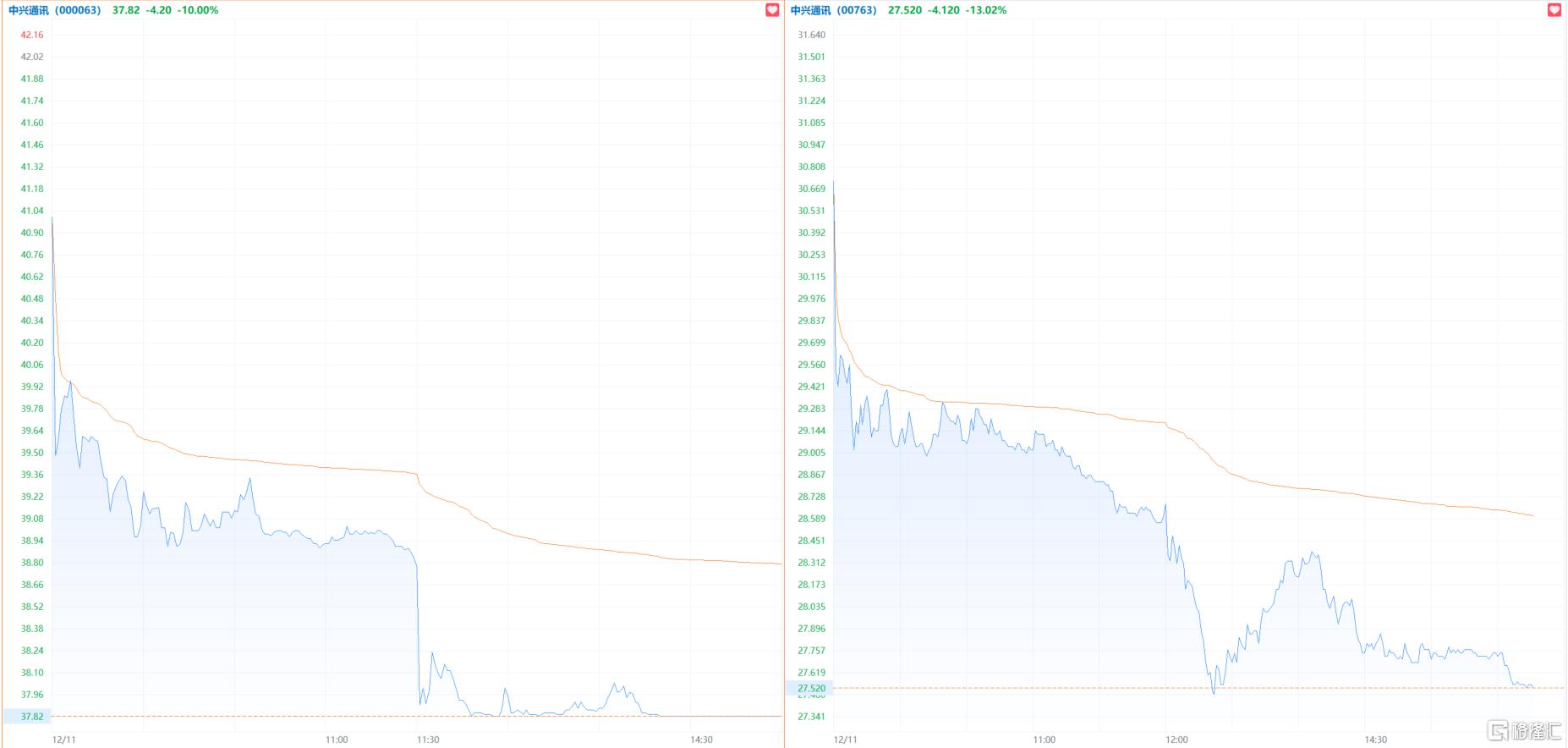
Core Viewpoint - ZTE Corporation's stock has experienced significant declines due to negative overseas news, particularly regarding potential payments to the U.S. to resolve overseas bribery allegations [1][3] Stock Performance - ZTE's A-shares closed at 37.82 yuan, hitting the daily limit down, with a market capitalization of 180.91 billion yuan [1] - H-shares fell over 13% to 27.46 HKD, with a total market value of 131.36 billion HKD [1] - The company's stock has seen a turbulent period, with A-shares down nearly 10.14% month-to-date and down approximately 4.93% year-to-date [9] Financial Performance - In Q3, ZTE reported revenue of 28.967 billion yuan, a year-on-year increase of 5.11%, but net profit dropped 87.84% to 264 million yuan [10] - For the first three quarters, total revenue reached 100.52 billion yuan, up 11.63% year-on-year, while net profit fell 32.69% to 5.322 billion yuan [11] Business Segments - ZTE's computing power business has seen explosive growth, with revenue increasing by 180% year-on-year, accounting for 25% of total revenue [12] - Revenue from servers and storage grew by 250%, and data center product revenue increased by 120%, becoming key drivers of revenue growth [13] R&D Investment - The company invested 17.81 billion yuan in R&D in the first three quarters, representing about 18% of total revenue, with a significant portion allocated to computing power-related technologies and products [14] Market Outlook - Tianfeng Securities views ZTE as a leading player in the domestic ICT sector, adapting to the digital economy and expanding into IT and AI computing power [15] - The firm has adjusted its profit forecasts for 2025-2027, projecting net profits of 7.725 billion yuan, 9.029 billion yuan, and 10.459 billion yuan, with corresponding EPS of 1.61 yuan, 1.89 yuan, and 2.19 yuan, maintaining a "buy" rating [15]

科技2026展望:算力高景气延续,关注端侧AI创新机遇
Zhao Yin Guo Ji· 2025-12-11 05:30
Investment Rating - The report suggests a positive outlook for the technology sector, particularly focusing on AI computing infrastructure and end-side AI innovations [1][24]. Core Insights - The global technology industry is expected to experience a dual trend of differentiated terminal demand and accelerated AI innovation by 2026, driven by rapid iterations of AI large models [1][24]. - The report highlights two main investment themes: 1) AI computing infrastructure, where VR/ASIC architecture upgrades will drive growth in ODM and component suppliers; 2) End-side AI innovations, particularly in AI smartphones, PCs, and glasses, with companies like Luxshare Precision, Hontai Precision, BYD Electronics, Sunny Optical, AAC Technologies, and Xiaomi Group being key players [1][24]. Summary by Sections Server Market - The global server market is projected to be dominated by AI infrastructure investments, with AI server shipments expected to grow by 50% year-on-year to 2.32 million units in 2026 [2][25]. - The market will see a "GPU/ASIC dual-drive" pattern, with VR/ASIC architecture reshaping value and driving demand for connectors, cables, and power supply components [2][25]. Smartphone Market - Global smartphone shipments are anticipated to decline by 5% year-on-year to 1.18 billion units in 2026, primarily affecting low-end models due to macro uncertainties and rising storage costs [2][25]. - However, the high-end market remains resilient, with Apple expected to launch innovative products, including the first foldable iPhone and AI-driven devices [2][25]. AR/VR Market - The report forecasts that global AI glasses shipments will exceed 10 million units by 2026, marking a significant growth in the wearable technology sector [2][25]. - Major tech companies are accelerating their investments in AR/VR, with advancements in optical technologies expected to unlock further potential in the coming years [2][25]. PC and Automotive Electronics - The global PC market is expected to face challenges, with a projected 2% decline in shipments to 275 million units in 2026, influenced by the end of the Windows 11 upgrade cycle and rising storage costs [2][25]. - AI PCs are expected to penetrate the market significantly, with projections indicating that they will account for over 50% of shipments by 2026 [2][25]. Memory Price Impact - The report discusses the impact of rising memory prices on the technology supply chain, predicting that short-term pressures will affect mid-to-low-end consumer markets while high-end products may buffer the cost increases [27][30].




每日投资策略-20251211
Zhao Yin Guo Ji· 2025-12-11 03:09
Macro Economic and Industry Outlook - The report indicates that China's economic deflationary pressure is expected to ease, but the momentum remains weak. Consumer inflation (CPI) rose from 0.2% to 0.7% in November, driven by food price increases and a low year-on-year base, marking a two-year high. Core CPI remained unchanged, while PPI showed a slight decline due to a high base last year, but month-on-month growth has increased for two consecutive months since 2023 [4][3] - The report forecasts that the CPI and PPI will recover from 0% and -2.7% in 2025 to 0.7% and -0.5% in 2026, respectively, indicating a gradual easing of deflationary pressures [4] Industry Outlook Technology - The global technology industry is expected to experience a dual trend of differentiated terminal demand and accelerated AI innovation by 2026. The report highlights that the demand for computing power will continue to be a core growth driver, with a focus on AI infrastructure and end-side AI innovations [4][5] - The report suggests monitoring two main lines: 1) AI computing infrastructure, where upgrades in VR/ASIC architecture will drive growth in ODM and component prices; 2) End-side AI innovations, particularly in AI smartphones and devices, with companies like Luxshare Precision, Hontai Precision, BYD Electronics, Sunny Optical, and Xiaomi Group being highlighted as key players [4][5] Servers - The global server market is projected to be dominated by AI infrastructure investments, with AI server shipments expected to grow by 50% year-on-year to 2.32 million units in 2026. The market will see a "GPU/ASIC dual-drive" pattern, with significant advancements in interconnects, cooling, and power supply components [5] Smartphones - The report anticipates a 5% decline in global smartphone shipments to 1.18 billion units in 2026, primarily affecting low-end models. However, the high-end market is expected to remain resilient due to AI innovations, with Apple set to launch several new products, including the first foldable iPhone [6] AR/VR - The report predicts that global AI glasses shipments will exceed 10 million units by 2026, marking the beginning of the smart glasses 2.0 era. Major tech companies are accelerating their investments in this sector, with a long-term outlook suggesting that AR glasses will gain significant market traction by 2030 [7] PC and Automotive Electronics - The global PC market is expected to face pressure due to the end of the Windows 11 upgrade cycle and rising storage costs, with a slight decline in shipments. However, AI PCs are projected to penetrate the market significantly, with over 50% of shipments being AI PCs by 2026. The report also highlights opportunities in the L4+ autonomous driving sector, particularly in high-voltage connectors and smart cockpit displays [8]
A股延续结构性行情 海南自贸港与地产板块领涨
Shang Hai Zheng Quan Bao· 2025-12-10 17:57
◎记者 徐蔚 12月10日,A股市场呈现指数分化的结构性走势。截至收盘,上证指数微跌0.23%,报3900.50点,险守 3900点整数关口;深证成指午后翻红,逆势上涨0.29%,报13316.42点;创业板指微跌0.02%,报 3209.00点。全市场成交额为1.79万亿元,较前一个交易日缩量1260亿元,超2400只个股上涨,板块轮动 特征显著。 中银证券研报表示:基本面承压叠加"十五五"规划建议表态偏向积极,未来地产优化政策落地的空间打 开。对未来地产行业的修复有一定信心。从地产标的来看,一方面,流动性安全、重仓高能级城市、产 品力突出的房企或更具备α属性;另一方面,在新消费时代下,提前布局新业态、新模式、新场景的商 业地产公司,有望率先走出重围。 此外,零售板块延续强势表现,永辉超市、中央商场、茂业商业等多只个股涨停。消息面上,全国零售 业创新发展大会12月9日至10日在北京举行。商务部副部长盛秋平表示,"十五五"时期,要把零售业作 为培育完整内需体系、做强国内大循环的关键着力点,推动行业转向品质驱动、服务驱动,实现高质量 发展。 数据显示,"十四五"以来,零售业对促进消费和投资的贡献巨大。2024年 ...

【公告全知道】商业航天+人形机器人+航空发动机+军工+低空经济!公司承接火箭卫星等航天装备的零件制造任务
财联社· 2025-12-10 15:15
Group 1 - The article highlights significant announcements related to the stock market, including "suspensions and resumption of trading, shareholding changes, investment wins, acquisitions, performance reports, unlocks, and high transfers" [1] - Important announcements are marked in red to assist investors in identifying investment hotspots and preventing various black swan events [1] - The article emphasizes the importance of timely information for investors to discern and find suitable listed companies [1] Group 2 - A company involved in commercial aerospace, humanoid robots, aircraft engines, military industry, and low-altitude economy is noted for undertaking manufacturing tasks for rocket and satellite components, as well as participating in the development of lunar exploration satellites [1] - Another company is recognized for its work in quantum technology, commercial aerospace, chips, military industry, and state-owned enterprise reform, possessing products related to miniaturized quantum satellite ground stations [1] - A company developing "brain" chip products to accelerate perception and reasoning tasks in humanoid robots is also mentioned, focusing on humanoid robots, chips, and computing power [1]