
AGI

Search documents
Greg Brockman: AGI, Sora 2, Bottlenecks, White Collar, Proactive AI, and more!
Matthew Berman· 2025-10-08 18:48
AI Trends & Future Predictions - Discussion on scaling Sora, indicating the industry's focus on improving AI model capabilities [1] - Exploration of transformer models' future relevance in AI development [1] - Consideration of proactive AI and compressing intelligence as key areas of advancement [1] - Speculation on the potential of fully generated software and its implications [1] - Examination of Agentic Commerce Protocol, suggesting a move towards AI-driven commercial interactions [1] - Predictions for 2026, including the possibility of Artificial General Intelligence (AGI) [1] Technology & Infrastructure - Analysis of building with AMD and other kinds of compute, highlighting the importance of hardware infrastructure [1] - Identification of bottlenecks in AI development, suggesting areas needing improvement [1] - Discussion on decoupling of the internet, potentially related to data sovereignty or decentralized technologies [1] Job Market & Industry Impact - Addressing concerns about job security in the face of AI advancements [1] - Exploration of building on top of OpenAI, indicating the platform's significance in the AI ecosystem [1] - Consideration of the role of humans in the loop, emphasizing the importance of human-AI collaboration [1]


炸裂!刚刚出炉 OpenAICEO Altman专访:OpenAI的统一愿景与未来赌局,无代码革命,零人公司将至,新的社会契约
美股IPO· 2025-10-08 11:18
Core Insights - The rapid development of AI is outpacing societal adaptation, leading to a demand for faster and better AI solutions [1][5] - ChatGPT is emerging as a significant distribution platform for developers, enabling new application development through its Apps SDK [1][9] - The introduction of Agent Builder signifies a no-code revolution, lowering the barriers for AI application development [1][12] - The concept of "Zero-Person Companies" is gaining traction, with the potential for AI to autonomously operate billion-dollar companies in the near future [1][20] - AI agents are improving in task handling duration, with expectations for them to manage a week's worth of work soon [1][21] - The current generation of 20-year-olds is presented with unprecedented opportunities in entrepreneurship and innovation [1][22] - Building a unique competitive advantage requires finding the right combination of product, technology, market, and timing [1][23] - GPT-5's performance in benchmark tests has been outperformed by Claude Opus, highlighting the competitive landscape [1][25] - The definition of AGI includes surpassing human capabilities in economically valuable tasks and making novel scientific discoveries [1][26] - AI can produce "work waste," which is a common issue with all tools when misused, emphasizing the need for efficient AI utilization [1][29] Group 1 - The rapid advancement of AI has led to milestones like passing the Turing Test, which society quickly adapted to, demanding further improvements [5][1] - The launch of ChatGPT has resulted in 800 million active users, indicating its potential as a new distribution platform for applications [1][8] - The Agent Builder allows users to create complex AI agents without coding, significantly enhancing the software ecosystem and innovation cycles [1][12][18] Group 2 - The emergence of "Zero-Person Companies" suggests that AI's autonomy is increasing, with expectations for fully AI-operated companies in the future [1][20] - AI agents are progressing towards handling longer tasks autonomously, with improvements in model intelligence and memory capabilities [1][21][22] - The current generation of young individuals is positioned to leverage AI knowledge for entrepreneurial ventures, marking a golden age for innovation [1][22] Group 3 - Establishing a unique competitive advantage is crucial, requiring a tailored approach to product and market fit [1][23][24] - Benchmark tests show GPT-5 lagging behind Claude Opus, emphasizing the importance of competition in driving AI advancements [1][25] - AGI is defined by its ability to exceed human performance in valuable tasks and contribute to scientific breakthroughs [1][26][27] Group 4 - AI's potential to generate "work waste" highlights the importance of effective tool usage, as inefficiencies can arise from misuse [1][29][30] - OpenAI's focus on creating a global AI safety framework is essential to mitigate risks associated with powerful AI models [1][41][42] - The development of Sora as an independent application aims to differentiate its entertainment features from ChatGPT's functionalities [1][43]

云知声入通迎估值重估:借Sora2东风,AGI龙头前景可期
Sou Hu Cai Jing· 2025-10-08 07:46
Core Insights - Cloud Wisdom, known as the "first AGI stock in Hong Kong," successfully listed on the Hong Kong Stock Exchange on June 30, 2025, and was included in the Hang Seng Composite Index in September, indicating strong market recognition of its value [1] - The company reported a revenue of 405 million yuan in the first half of 2025, a year-on-year increase of 20.2%, with revenue from large model-related businesses surging by 457.4% to 98.76 million yuan, accounting for nearly 25% of total revenue [1] - The launch of OpenAI's Sora2 has revolutionized the AI video generation industry, aligning with Cloud Wisdom's strategic direction in multi-modal technology [2] Financial Performance - In the first half of 2025, Cloud Wisdom achieved a revenue of 405 million yuan, reflecting a 20.2% year-on-year growth [1] - Revenue from large model-related businesses increased by 457.4% to 98.76 million yuan, highlighting the effectiveness of its technology commercialization [1] - The company is expected to achieve a compound annual growth rate of 25% in revenue from 2022 to 2024, with a focus on long-term growth over short-term profitability [4] Technological Advancements - Cloud Wisdom's "Cloud Brain" integrates multi-modal perception and generation, knowledge graphs, and IoT platforms, achieving high performance and low latency in edge deployment [2] - The company's medical industry-specific large model, UniGPT-Med-U1, ranked first in the MedBench evaluation, showcasing its capability to integrate medical imaging, clinical texts, and voice diagnostic data [3] - The combination of Cloud Wisdom's existing voice interaction system with Sora2's scene generation technology can enhance user experience in smart cockpit scenarios [3] Strategic Positioning - The release of the "AI+" policy by the State Council provides clear guidance for the integration of AI technology with various industries, aligning with Cloud Wisdom's business layout [3] - The company is pursuing a dual strategy of deepening domestic market presence while expanding internationally, evidenced by partnerships with the Guangxi Health Commission and the Vanuatu government [3] - Cloud Wisdom's approach of "investing in R&D for growth" aims to build long-term competitiveness, with a focus on achieving a profitability inflection point as multi-modal technology commercializes [4] Market Outlook - The market recognizes Cloud Wisdom's long-term potential as a leader in the AGI era, with a current market valuation of 60 billion HKD [4] - The company's unique barriers formed by its technological reserves and industry know-how position it favorably for future growth [4] - The combination of policy support and international expansion opens new market opportunities for Cloud Wisdom [4][5]
重生之在《我的世界》做山姆·奥特曼:网友在线手搓ChatGPT
创业邦· 2025-10-08 03:20
Core Insights - A user has successfully created a version of ChatGPT within the game Minecraft, showcasing the potential of in-game programming and logic circuits [4][10][12] - The model consists of approximately 5 million parameters and is capable of engaging in basic conversations, demonstrating the feasibility of building complex AI systems using simple game mechanics [6][19][22] Technical Details - The model has 5,087,280 parameters, trained using the TinyChat dataset, with an embedding dimension of 240 and a vocabulary of 1,920 tokens [19][21] - It features 6 layers and 5 attention heads, with a context window size of 64 tokens, allowing for short dialogues [21][22] - The construction of the model occupies a volume of 1020×260×1656 blocks in Minecraft, indicating the scale of the project [24] Construction Process - The process involved training a small GPT model on a personal computer, compressing weights to low precision, and translating calculations into Minecraft's redstone circuitry [26][30] - A "compiler" script was used to map the trained model to redstone modules, facilitating the construction of the circuit [29][30] Broader Implications - The success of this project highlights the capabilities of Minecraft as a platform for digital logic experimentation, where players can build complex systems from basic binary signals [32][34] - The community has also explored various computational projects within Minecraft, including building CNNs and even simulating internet-like structures [38][46]

Every AI Founder Should Be Asking These Questions
Y Combinator· 2025-10-07 14:00
Welcome to this this talk. I'm extremely confused. Uh I think maybe more confused than I've ever been in my entire life. Probably definitely more confused than I've ever been in my entire life. Uh and I want to talk about that because I think I don't know when you're confused. That's the start of something interesting. If you're trained as a scientist, that's like the thing you want to pay most attention to is that moment where you're confused like, "Oh, this is interesting. I don't know what's about to hap ...

中国AI旅游应用分化加剧:谁在领跑?谁陷停滞?
Sou Hu Cai Jing· 2025-10-06 02:30
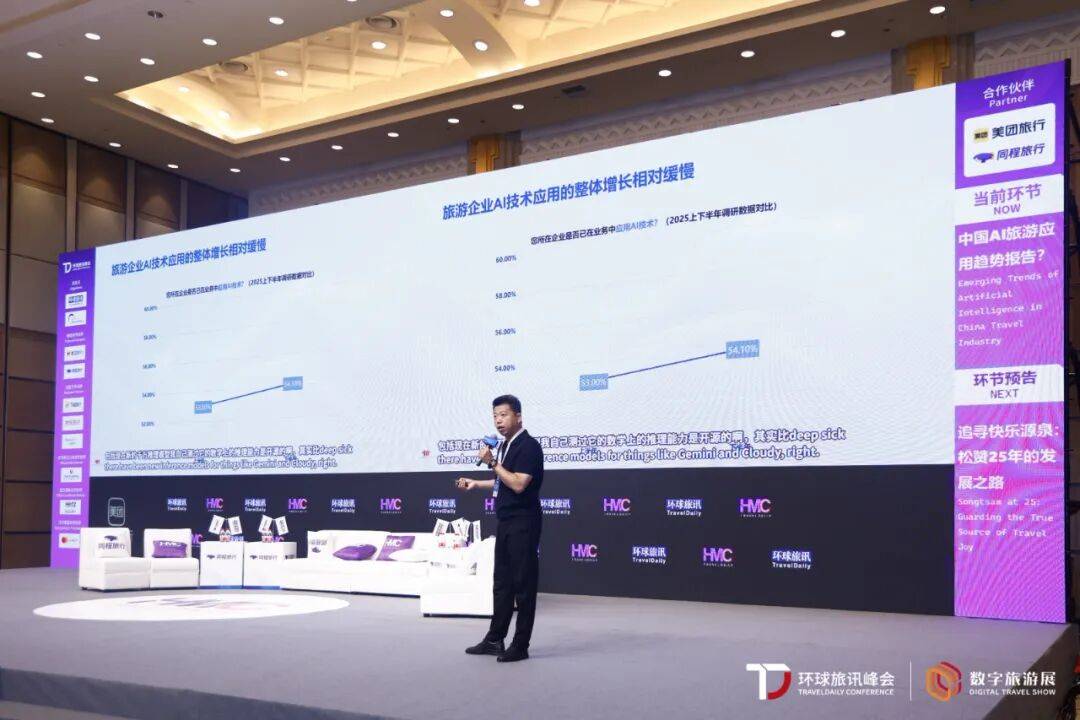
Core Insights - The application of AI in China's tourism industry is evolving from conceptual discussions to practical implementations, significantly transforming operational methods for both travelers and tourism companies [2][3] - A report presented at the 2025 Global Travel Summit highlights the challenges and trends of AI adoption within tourism enterprises, emphasizing the role of grassroots employees over CEOs in driving AI integration [4][5] AI Adoption Trends - In the first half of 2024, 53% of surveyed companies reported using AI, with a slight increase to 54.1% in the second half, indicating a slow adoption rate in B2B contexts despite frequent media coverage of new models [5][6] - Large enterprises (1,000+ employees) saw a decline in AI usage from 80.6% to 74.4%, while medium-sized enterprises (200-500 employees) increased their usage from 38.5% to 53.3% [6][7] Sectoral Disparities - The AI application rates among tourism companies show a clear three-tier differentiation: - The first tier includes technology-intensive sectors like airlines, which have a high AI penetration rate - The second tier consists of business travel companies and travel tech firms, known for their quick adoption of new technologies - The third tier includes OTAs, tourism boards, and scenic spots, which are lagging behind [7][8][9] Organizational Challenges - Despite individual employees using AI, many companies have not established end-to-end AI workflows, indicating a gap in organizational integration [11] - Over 50% of companies believe that external policies and market conditions significantly impact AI technology applications, highlighting the uncertainty in the current environment [12] Application Focus - 76.3% of companies are prioritizing AI for internal operational efficiency, although some application rates, such as store management and personalized recommendations, have decreased due to perceived cost-benefit issues [12][13][14] - A significant portion of companies (46.8%) believes AI will mature within one to two years, reflecting an overly optimistic outlook on AI capabilities [16][18] Key Recommendations for AI Integration - Companies need to redefine their understanding of generative AI, moving beyond viewing it as a mere IT project aimed at replacing human roles [19] - Successful AI implementation requires overcoming three capability bridges: organizational questioning ability, data leadership, and human-machine collaboration [19][20] - Establishing dedicated AI project management offices and cultural performance metrics can facilitate better integration of AI into business processes [20][23]
喜娜AI速递:今日财经热点要闻回顾|2025年10月4日
Sou Hu Cai Jing· 2025-10-04 11:20
Group 1 - The Asia-Pacific markets experienced a significant surge, with the South Korea Composite Index rising by 3% and the Nikkei Index increasing by over 1%, driven by enhanced expectations of a Federal Reserve rate cut and breakthroughs in AI technology [2] - OpenAI launched two major products, "Instant Checkout" and the Sora App, aiming to alleviate financial losses and achieve a revenue target of $13 billion, although these moves have sparked internal and external debates regarding the company's direction [2] - The U.S. stock market reached new historical highs, with all three major indices closing at record levels, as investors remained optimistic about the short-term impact of the government shutdown on the economy [2] Group 2 - The Federal Reserve's monetary policy outlook has become more complex due to the delay in the September non-farm payroll report caused by the government shutdown, leading to increased uncertainty regarding future rate cuts [3] - China's solid-state battery production is accelerating, with companies like CATL and Guoxuan High-Tech making significant advancements, while Japanese automakers like Toyota and Honda are falling behind in this technology [3] - The gold market experienced significant volatility, with spot gold prices fluctuating nearly 2% in a single day, although Goldman Sachs maintains a positive long-term outlook for gold prices [3] Group 3 - Berkshire Hathaway announced a structural change, separating the roles of Chairman and CEO, with Greg Abel set to succeed Warren Buffett as CEO in early 2026 [4] - Berkshire also revealed a $9.7 billion acquisition of Occidental Petroleum's chemical business, OxyChem, indicating a strategic expansion in its portfolio [5] Group 4 - The Hong Kong stock market saw some sectors rise against the trend, particularly public utility stocks and nuclear energy stocks, with significant gains attributed to recent positive developments in the nuclear sector [5] - A wave of share reduction announcements from 103 companies, including notable firms like Tonghuashun and Dongfang Caifu, has raised market concerns about potential adjustments in related sectors [5]
盯上AI版抖音的奥特曼,先要搞定皮卡丘
3 6 Ke· 2025-10-02 07:24
Core Insights - The launch of AI short video applications by Meta and OpenAI marks the beginning of a new era in social media, reminiscent of TikTok [2][15] - OpenAI's Sora 2 model has improved capabilities compared to its predecessor, allowing for more realistic video generation and user engagement [3][28] - Meta's Vibes aims to enhance creativity and community sharing, but has faced criticism for being less innovative compared to OpenAI's offerings [17][22] Group 1: OpenAI's Sora 2 - OpenAI has released Sora 2, which is said to better adhere to physical world rules and can generate synchronized audio [3] - The Sora application allows users to create videos featuring themselves and friends, utilizing a feature called "Cameo" [8][10] - Initial user feedback indicates that Sora 2's performance is impressive, with realistic motion and consistency in video generation [12][28] Group 2: Meta's Vibes - Meta's Vibes is designed to help users find creative inspiration and share AI-generated videos, with a focus on community engagement [17] - Despite its potential, Vibes has been criticized as an "AI garbage machine," reflecting user dissatisfaction [22][23] - Meta's advertising revenue from short videos is significant, with projections indicating Instagram's ad revenue will surpass Facebook's by 2025 [17][18] Group 3: Market Implications - The competition between OpenAI and Meta in the AI short video space could reshape the landscape of social media and advertising [2][15] - OpenAI's entry into the social market is seen as a strategic move to diversify revenue streams amid financial challenges [27] - The success of these applications may depend on user engagement and the ability to address challenges such as computational demands and copyright issues [29]


盯上AI版抖音的奥特曼,先得搞定皮卡丘
Hu Xiu· 2025-10-02 07:20
Core Insights - The launch of AI-driven short video applications by Meta and OpenAI marks the beginning of a new era in social media, reminiscent of the "AI version of TikTok" [3][6][51] - OpenAI's Sora 2 model and its standalone application have generated excitement and criticism, with users eager to explore its innovative features [5][8][40] - Meta's Vibes aims to enhance user creativity and engagement, but faces skepticism regarding its effectiveness compared to TikTok [28][29][37] Group 1: OpenAI's Sora 2 - OpenAI has released Sora 2, an upgraded video model that better adheres to physical world rules and can generate audio simultaneously [7][8] - The Sora application allows users to create videos featuring themselves and friends, utilizing a feature called "Cameo" for deepfake-like experiences [15][21][49] - User experience with Sora 2 has been described as impressive, with realistic motion and visual fidelity [21][22] Group 2: Meta's Vibes - Meta's Vibes is designed to help users find creative inspiration and share AI-generated videos, integrating with existing platforms like Instagram [28][29] - Despite its potential, Vibes has been criticized as a "garbage machine" for AI content, reflecting a broader skepticism about AI-generated media [37][38] - Meta's advertising revenue from short videos is significant, with projections indicating continued growth in this area [29][30] Group 3: Industry Implications - The emergence of AI video applications raises questions about content quality, user engagement, and potential monetization strategies for both OpenAI and Meta [45][49][52] - The competition between OpenAI and Meta in the AI video space could reshape the landscape of social media and advertising [30][51] - Concerns about computational resources and copyright issues are likely to challenge the scalability of these AI applications [52][53]

阿里巴巴-W(09988.HK):AI技术领先加码投入 打造全球领先AI服务商
Ge Long Hui· 2025-10-02 03:08
Core Viewpoint - Alibaba demonstrates rapid advancements in AI technology and a strong strategic commitment to "All in AI" at the 2025 Yunqi Conference, solidifying its leading position in large language models and showing significant progress in multimodal models [1] - The company is optimistic about its sustained leadership in large model capabilities and the strong dual-end penetration ability under its open-source strategy, leading to an upward adjustment in revenue growth expectations for Alibaba Cloud, with a target price of HKD 205.34 and a "Buy" rating [1] Group 1 - Alibaba's CEO, Wu Yongming, highlighted two main points regarding AI development: rapid technological progress and the swift increase in global AI investment and user penetration [1] - AI technology has advanced from high school level to PhD level in less than three years, with a high certainty of achieving AGI and ASI in the future [1] - Global AI investment is projected to grow from USD 400 billion in the past year to over USD 4 trillion in the next five years, with AI chatbots seeing the fastest user penetration [1] Group 2 - Alibaba Cloud aims to become one of the few global super cloud computing platforms, with plans to significantly increase its global data center energy consumption by tenfold by 2032 [1] - The company has released three large language models and four multimodal models, maintaining a leading position in the LLM arena, with Qwen 3 max ranking third globally [2] - The new Qwen 3Next architecture shows strong technical potential, with training resources significantly lower than comparable models while achieving similar performance [2] Group 3 - The open-source strategy has led to a substantial increase in the Qwen ecosystem, with over 1 million service customers and more than 170,000 derivative models [2] - The usage of Alibaba Cloud's services has seen a 15-fold increase in the past 12 months, with the MoDa community becoming the largest open-source community in China [2] - The company’s open-source strategy is seen as a key to capturing model market share and enhancing application ecosystems, particularly in the B-end market [3] Group 4 - The company forecasts revenue for FY2026-2028 to be CNY 10084 billion, CNY 11391 billion, and CNY 12482 billion, reflecting an upward adjustment due to deeper AI strategy and model technology advancements [3] - Adjusted net profit estimates for FY2026-2028 are CNY 1412 billion, CNY 1878 billion, and CNY 2166 billion, driven by accelerated AI revenue growth [3] - The estimated market value of the company is CNY 35757 billion, corresponding to a per-share value of HKD 205.34 [3]
