
外汇储备

Search documents
波黑2025年11月外汇储备达182.8亿马克,同比增幅6.3%
Shang Wu Bu Wang Zhan· 2026-01-27 15:57
从年度增速观察,去年11月贷款总额同比增长10.7%,净增27.3亿马克。其中居民部门贷款增加 15.1亿马克(11.8%),私营企业增加8.71亿马克(8.2%),政府机构增加9030万马克(7%),非金融 公共企业增加1.616亿马克(28.1%),其他国内部门则增长9500万马克(32.2%)。(驻波黑使馆经商 处) 波黑国家台1月26日报道。根据波黑中央银行公布的数据,截至2025年11月底,波黑国家外汇储备 规模为182.8亿马克,环比持平,同比增长10.8亿马克(涨幅6.3%)。 同期,国内各部门贷款总额达283亿马克,环比增加2.845亿马克。从月度增长结构看:居民部门贷 款增长1.015亿马克(0.7%),私营企业增长1.67亿马克(1.5%),政府机构增长2000万马克 (1.5%),其他国内部门增长230万马克(0.6%),而非金融类公共企业贷款则减少630万马克 (0.8%)。 (原标题:波黑2025年11月外汇储备达182.8亿马克,同比增幅6.3%) ...
柬埔寨外汇储备攀升至275亿美元
Shang Wu Bu Wang Zhan· 2026-01-27 12:25
近日,柬埔寨国家银行(NBC)发布报告显示,截至2025年,柬埔寨外汇储备已增长至275亿美元。这 一数据标志着柬埔寨应对外部经济风险的能力显著增强,储备水平足以保障未来约8个月的商品与服务 进口。 回顾过去五年的数据,柬埔寨外汇储备呈现出明显的"V型"反弹态势:2020年储备超过210亿美元,可 支撑13.4个月进口;2021-2022年受全球新冠疫情及供应链冲击影响,储备分别调至200亿美元及170亿 美元以上;2023年经济开启复苏模式,储备回升至190亿美元以上;2024年增长至逾220亿美元;2025年 达到275亿美元新高,展现了柬埔寨经济在后疫情时代的强劲韧性与增长活力。 对于柬埔寨等发展中国家,国际通用标准建议外汇储备至少应满足3个月的进口需求。目前柬埔寨约8个 月的储备水平已大幅超越该安全警戒线。IMF采用此指标,旨在评估一国在面临外部经济冲击时,对外 部经济资源的保障能力。 ...
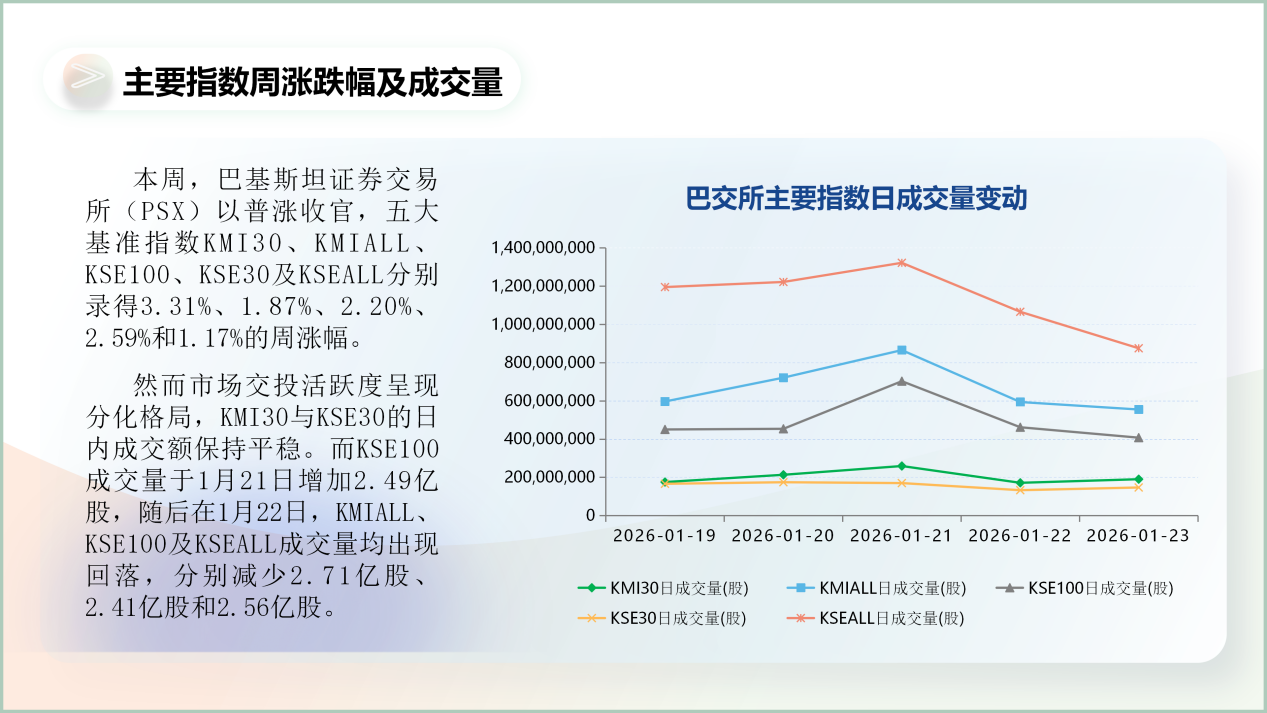
中经资料:巴基斯坦证券市场一周回顾(2026.01.19 - 2026.01.23)
Zhong Guo Jing Ji Wang· 2026-01-26 07:57
Group 1: Economic Indicators - Pakistan's current account recorded a deficit of $244 million in December 2025, a shift from a surplus of $98 million in November, primarily due to a significant increase in imports [8] - In December 2025, Pakistan's total exports of goods and services amounted to $3.69 billion, a nearly 20% month-on-month increase, while imports reached $7.04 billion, up nearly 24% [8] Group 2: Agricultural Investment - A Pakistan-China agricultural investment conference was held, with participation from 116 Chinese companies and 165 Pakistani companies, resulting in 79 memorandums of understanding worth a total of $4.5 billion [9] Group 3: Telecommunications Growth - As of December 2025, Pakistan's total mobile phone users surpassed 200 million, increasing from 197 million in November, with 3G and 4G users rising from 148 million to 151 million [9] - The mobile penetration rate increased slightly from 79% in November to 80% in December [9] Group 4: Foreign Aid and Loans - In the first half of the fiscal year 2025-2026, Pakistan received $4.51 billion in new foreign loans and grants, which is 22.66% of the annual borrowing target [9] Group 5: Cement Export Performance - Despite a decline in total cement export volume by 5.84% to approximately 4.42 million tons, the export value increased by 3.40% from $1.67 billion to $1.73 billion in the first half of the fiscal year [10] Group 6: Trade Balance - In the first half of the fiscal year 2025-2026, Pakistan's total goods exports reached 4.27 trillion rupees (approximately $15.29 billion), a decrease of about 7.78% compared to the same period last year, while imports rose by 13.12% to 9.72 trillion rupees [10] Group 7: Maritime Sector Performance - The maritime sector in Pakistan reported a profit of 100 billion rupees (approximately $360 million) in 2025, with record cargo handling at Karachi port reaching 54 million tons [10] - Improvements in coordination among port management, customs, and other agencies reduced average vessel docking time by 24 to 36 hours, with an average turnaround time of five days [10]

澳门金管局:2025年12月底外汇储备资产总额初步统计为2456亿澳门元 环比上升2.0%
智通财经网· 2026-01-21 01:55
Core Insights - The total foreign exchange reserves of the Macao Special Administrative Region reached 245.6 billion Macao Patacas (approximately 30.64 billion USD) by the end of December 2025, marking a 2.0% increase from the revised total of 240.8 billion Macao Patacas (approximately 30.05 billion USD) at the end of November 2025 [1] Group 1 - The foreign exchange reserves as of December 2025 are equivalent to 11 times the currency in circulation in Macao at the end of November 2025 [1] - The Macao Patacas portion of the broad money supply (M2) accounts for 91.8% of the total [1]
startrader:印度央行或区间抛美元 守护卢比91关口
Sou Hu Cai Jing· 2026-01-20 06:19
Core Viewpoint - The Reserve Bank of India (RBI) is likely to intervene in the foreign exchange market by selling dollars to curb the depreciation of the Indian Rupee, reflecting the pressures from both internal and external factors [1][3]. Group 1: RBI's Intervention Strategy - The RBI plans to sell dollars in the range of 91.02 to 91.05 to stabilize the Rupee, which has recently hit a two-month low due to a strong US dollar and foreign capital outflows [3][4]. - The intervention range of 91.02 to 91.05 is critical for the Rupee and has been a reference point for previous RBI interventions, indicating the central bank's commitment to defend the 90 level [3][4]. - The RBI's actions are aimed at balancing exchange rate volatility with economic growth, as a breach of the 91.05 level could lead to imported inflation, particularly affecting energy costs [3][4]. Group 2: Foreign Exchange Reserves - India's foreign exchange reserves have increased to $687 billion as of January 9, providing a solid foundation for the RBI's intervention, despite a recent drop due to dollar sales [4]. - The current reserves are sufficient to cover nearly 12 months of import needs, indicating a strong position in terms of international safety levels [4]. Group 3: Market Reactions and Predictions - There is a divergence in market expectations regarding the effectiveness of the RBI's intervention, with some analysts believing that it may not fundamentally change the Rupee's trajectory if external conditions do not improve [4][5]. - Optimistic views suggest that the RBI's clear intervention strategy could stabilize market expectations and prevent panic selling, especially given the robust domestic economic fundamentals [5]. - Key variables influencing future trends include the US Federal Reserve's policy direction, the progress of US-India trade negotiations, and the RBI's intervention pace, all of which will determine whether the Rupee can maintain the critical 91 level [6].

外储重回3.35万亿创十年新高,是单纯有钱了还是在憋大招?
Sou Hu Cai Jing· 2026-01-17 04:39
Core Viewpoint - The recent data from the State Administration of Foreign Exchange indicates that China's foreign exchange reserves have exceeded $1.3 trillion in the first three quarters of this year, marking a year-on-year increase of 22.4%, which is significantly higher than the previous year's growth of 13.1% and the annual forecast of 8% [1][4]. Group 1 - The foreign exchange reserves have reached a new peak of $3.3579 trillion, with five consecutive months of growth, reflecting a robust recovery from past financial challenges [4]. - The accumulation of foreign reserves is not merely a result of increased account balances but represents a decade-long effort to stabilize and strengthen the financial position [4][6]. - The shift in strategy from a rigid approach to allowing currency fluctuations has contributed to the stabilization and gradual increase of foreign reserves, demonstrating regained control over the financial situation [6][10]. Group 2 - The substantial foreign currency assets serve as a "munition depot" for responding to international market risks, ensuring stability in domestic prices and supply amidst external uncertainties [8][10]. - The recent increase in foreign reserves is attributed to three main factors: strong export performance, orderly capital flows, and the appreciation of foreign assets due to a weaker dollar [10][12]. - The diversification of foreign reserves, including increased investments in gold and silver, reflects a strategic shift towards a more resilient and flexible asset management approach [12]. Group 3 - The experience of past financial crises has led to a proactive strategy in managing foreign reserves, transitioning from risk aversion to preparing for future complexities in the global financial landscape [12]. - The current level of foreign exchange reserves is viewed as a critical asset for enhancing China's negotiating power in international affairs and ensuring economic stability [12].

国家外汇局:2025年来华直接投资呈现净流入
Zhong Guo Xin Wen Wang· 2026-01-15 14:08
Group 1 - The core viewpoint of the article is that China's direct investment has shown a net inflow since 2025, with significant growth in outbound investments by domestic entities [1][2] - In 2025, total cross-border income and expenditure reached $15.6 trillion, marking a nearly 10% increase compared to 2024 [1] - The net inflow of cross-border funds for the year was $302.1 billion, with a bank settlement surplus of $196.6 billion [1] Group 2 - By the end of September 2025, China's foreign assets and liabilities reached historical highs of $11.5 trillion and $7.5 trillion, respectively [1] - The foreign exchange reserves remained stable, with a year-end balance of $3357.9 billion [1] - The Chinese yuan exchange rate maintained basic stability at a reasonable equilibrium level [1] Group 3 - The government plans to introduce policies for overseas lending and domestic foreign exchange loan management to better support Chinese enterprises in international expansion and foreign trade development [2] - There will be a nationwide implementation of cross-border fund management policies for multinational companies to enhance fund turnover efficiency and reduce financial costs for enterprises [2] - Support will be provided for the construction of international financial centers in Shanghai and Hong Kong, along with the optimization of foreign exchange management policies in high-level open platforms such as free trade zones and Hainan Free Trade Port [2]
国家外汇局:2025年来华直接投资呈现净流入,境内主体对外投资较快增长
Sou Hu Cai Jing· 2026-01-15 07:58
Core Insights - The press conference held by the State Council Information Office on January 15 highlighted the effectiveness of monetary and financial policies in supporting high-quality development of the real economy [1] Group 1: Foreign Exchange Market - The foreign exchange market maintained a basic balance in supply and demand over the past year, with overall expectations remaining stable and demonstrating strong resilience and vitality [3] - In 2025, total cross-border income and expenditure for enterprises and individuals is projected to reach $15.6 trillion, representing an increase of nearly 10% compared to 2024 [3] - Cross-border capital shifted from a net outflow at the beginning of the year to a net inflow, with a total net inflow of $302.1 billion and a bank settlement surplus of $196.6 billion for the year [3] Group 2: Direct Investment and Foreign Assets - By the end of September 2025, foreign direct investment in China is expected to show a net inflow, while domestic entities are experiencing rapid growth in outward investment [3] - China's foreign assets and liabilities reached historical highs of $11.5 trillion and $7.5 trillion, respectively, by the end of September 2025 [3] - Foreign exchange reserves remained stable, with a year-end balance of $335.79 billion, and the RMB exchange rate maintained basic stability at a reasonable and balanced level [3]
2025年新增社融35.6万亿元 12月末M2同比增长8.5%
Zhong Guo Jing Ji Wang· 2026-01-15 07:48
Group 1 - The total social financing scale increased by 3.34 trillion yuan in 2025, reaching a cumulative total of 35.6 trillion yuan compared to the previous year [4] - The balance of broad money (M2) at the end of December was 340.29 trillion yuan, reflecting an 8.5% year-on-year growth [5] - The balance of narrow money (M1) was 115.51 trillion yuan, with a year-on-year increase of 3.8% [5] Group 2 - By the end of 2025, the total social financing stock was 442.12 trillion yuan, showing an 8.3% year-on-year growth [2] - The balance of RMB loans to the real economy was 268.4 trillion yuan, increasing by 6.3% year-on-year [2] - The balance of foreign currency loans to the real economy, converted to RMB, was 1.05 trillion yuan, which represented an 18% year-on-year decline [2] Group 3 - The balance of government bonds reached 94.92 trillion yuan, marking a 17.1% year-on-year increase [2] - The net financing of corporate bonds was 2.39 trillion yuan, which was an increase of 4.825 trillion yuan compared to the previous year [4] - The balance of non-financial corporate domestic stock was 12.2 trillion yuan, reflecting a 4.1% year-on-year growth [2] Group 4 - The total increase in RMB deposits for the year was 26.41 trillion yuan, with household deposits rising by 14.64 trillion yuan [6] - The balance of foreign currency deposits at the end of December was 1.07 trillion USD, showing a year-on-year growth of 25% [7] - The total increase in RMB loans for the year was 16.27 trillion yuan, with corporate loans increasing by 15.47 trillion yuan [8] Group 5 - The average weighted interest rate for interbank RMB market lending in December was 1.36%, lower than the previous month and the same period last year [10] - The total transaction volume in the interbank RMB market for the year was 2180.31 trillion yuan, with a daily average transaction volume of 8.79 trillion yuan [10] - The balance of foreign exchange reserves at the end of December was 3.36 trillion USD [11] Group 6 - The total amount of cross-border RMB settlements under the current account was 17.86 trillion yuan in 2025, with direct investment cross-border RMB settlements amounting to 8.46 trillion yuan [12] - The breakdown of current account settlements included 13.72 trillion yuan for goods trade and 4.14 trillion yuan for service trade and other current items [12]
2025全年金融数据出炉!人民币贷款增加16.27万亿元,全年人民币存款增加26.41万亿元
Jin Rong Jie· 2026-01-15 07:24
Group 1: Financial Data Overview - In December, the total RMB loans increased by 16.27 trillion yuan for the year, with household loans rising by 441.7 billion yuan and corporate loans increasing by 15.47 trillion yuan [1][8] - The broad money supply (M2) reached 340.29 trillion yuan at the end of December, reflecting an 8.5% year-on-year growth [5] - The total social financing scale stock at the end of 2025 was 442.12 trillion yuan, showing an 8.3% year-on-year increase [2] Group 2: Loan Composition - By the end of 2025, the balance of RMB loans to the real economy was 268.4 trillion yuan, up 6.3% year-on-year, while foreign currency loans decreased by 18% [2][3] - The increase in RMB loans to the real economy for the year was 15.91 trillion yuan, which was a decrease of 1.13 trillion yuan compared to the previous year [4] - The corporate bond balance reached 34.24 trillion yuan, marking a 6% year-on-year increase [2] Group 3: Deposits and Currency - The total deposits in both RMB and foreign currencies reached 336.14 trillion yuan at the end of December, with RMB deposits increasing by 26.41 trillion yuan for the year [6][7] - The foreign currency deposit balance was 1.07 trillion USD at the end of December, reflecting a 25% year-on-year growth [7] - The net cash injection for the year was 1.31 trillion yuan [5] Group 4: Interest Rates and Market Activity - The average weighted interest rate for interbank RMB market lending was 1.36% in December, lower than the previous month and the same period last year [9] - The total transaction volume in the interbank RMB market reached 218.03 trillion yuan for the year, with daily average transactions increasing by 2.1% year-on-year [8]