
实体经济

Search documents
央广财评|结构性货币政策“降价加量” 精准滴灌实体经济
Yang Guang Wang· 2026-01-17 08:17
Group 1 - The People's Bank of China has introduced a monetary policy package aimed at supporting the real economy, particularly in key areas and weak links, to ensure a strong start for the 14th Five-Year Plan [1][2] - The policy includes a reduction in the interest rates of various structural monetary policy tools, with the one-year re-lending rate decreased from 1.5% to 1.25%, which is expected to lower financing costs and stimulate credit growth in priority sectors [1] - The new measures will increase the re-lending quota for technological innovation and technological transformation to 1.2 trillion yuan, and an additional 500 billion yuan will be allocated for supporting agriculture and small enterprises, addressing funding gaps in these critical areas [1] Group 2 - The policy also expands the scope of structural tools to include dedicated re-lending for private enterprises and high R&D investment private SMEs, enhancing financial support for these sectors and fostering a more vibrant market for economic transformation [2] - New support areas include carbon reduction financing tools and re-lending for consumer services and elderly care, aligning with China's goals for green transformation and boosting domestic demand [2] - The targeted approach of the policy aims to lower financing costs while directing financial resources towards high-quality development, thereby enhancing the effectiveness of financial services for the real economy [2]
清远“十四五”成果丰硕:经济总量破两千亿,融湾崛起加速
Nan Fang Du Shi Bao· 2026-01-16 16:28
Core Viewpoint - The "14th Five-Year Plan" period has seen significant economic and social development in Qingyuan, with a GDP surpassing 200 billion yuan, effectively responding to challenges such as the pandemic and major floods [1] Economic Development - Qingyuan focuses on the real economy, with a modern industrial system structured as "14321". The city's GDP grew by 19.5% over the first four years, with industrial output increasing by an average of 7.5% annually and foreign trade growing by 10.5% [2] - The number of large-scale industrial enterprises increased from 790 at the end of 2020 to 1,188 by 2025 [2] - The proportion of advanced and high-tech manufacturing industries rose to 53.6%, while the share of high-energy-consuming industries decreased [2] - Agricultural sectors, including Qingyuan chicken and Yingde black tea, saw annual output growth exceeding 25%, with several agricultural industries surpassing 10 billion yuan in total output [2] - The tourism industry thrived, with annual visitor numbers and tourism revenue growing by 13.9% and 23%, respectively, following the opening of the Qingyuan Changlong [2] Urban-Rural Integration and Regional Coordination - The "Hundred Million Project" aims to address the urban-rural dual structure, with significant improvements in county-level development and industrial park coverage [3] - The urban-rural income ratio improved to 1.71, better than national and provincial averages [3] - Infrastructure connectivity was enhanced, with the completion of the Guangqing Intercity North Extension Line, making Qingyuan the only non-Bay Area city with intercity rail access to the Greater Bay Area [3] - The establishment of the Guangqing Economic Cooperation Zone has attracted significant investment, with planned projects exceeding 210 billion yuan [3] Reform and Innovation - Key reforms have been implemented, including significant improvements in administrative efficiency, reducing business setup time to within one working day [4] - R&D investment intensity increased to 1.07%, ranking first in the region, with a notable rise in high-tech enterprises [4] - Qingyuan became the first city in the region to achieve "Gigabit City" status in information technology [4] Environmental Sustainability - Qingyuan's ecological environment quality remains high, with water quality indices ranking well in the province and forest coverage exceeding 70% [5] - Energy consumption intensity decreased significantly, surpassing provincial targets by 131% [5] - The city is advancing in green energy, with non-fossil energy accounting for over 60% of installed capacity [5] Social Progress - Nearly 80% of fiscal spending is allocated to social welfare, with urban employment exceeding 190,000 and per capita disposable income growing by an average of 6.1% annually [7] - Significant investments in education and healthcare, including the addition of over 105,000 public school places and three new top-tier hospitals [7] - Qingyuan has achieved recognition as a national civilized city and a model city for dual-support [7]
兴业银行天津分行:金融助力畅通现代化产业体系血脉
Sou Hu Cai Jing· 2026-01-16 10:16
Group 1 - The "14th Five-Year Plan" emphasizes the construction of a modern industrial system and the strengthening of the real economy as a primary strategic task, highlighting key directions such as "solid foundation upgrade, innovation nurturing, capacity expansion and quality improvement, and efficiency enhancement" [1] - Tianjin is accelerating the establishment of a "1+3+4" modern industrial system, focusing on advanced manufacturing with a competitive edge nationwide, while the Industrial Bank Tianjin Branch integrates its development into the regional industrial evolution [1] - The Tianjin Branch aims to inject continuous financial support into the construction of the modern industrial system by leveraging its comprehensive service capabilities in both commercial and investment banking, particularly in the digital economy sector [1] Group 2 - In the commercial logistics sector, the Tianjin Branch focuses on cold chain logistics as a critical link for ensuring the supply of fresh produce, exemplified by the Yuhu Cold Chain Logistics (Tianjin) Co., Ltd. project [3] - The branch has formed a specialized service team to provide comprehensive financial support, aiding in the construction of high-standard cold chain facilities and the introduction of advanced international supply chain management systems [3] - By extending financial services to key enterprises in the supply chain, the Tianjin Branch aims to enhance the efficiency and safety of regional fresh agricultural product circulation, thereby solidifying the supply chain foundation for the modern industrial system [3]


两大重磅会议同日召开!专家详解2026年银行业政策红利与发展机遇
Jin Rong Jie· 2026-01-16 09:09
Core Insights - The People's Bank of China and the National Financial Regulatory Administration have outlined their monetary policy and regulatory framework for 2026, emphasizing the importance of these policies for the banking sector's development path [1] Group 1: Monetary Policy Initiatives - The central bank's monetary policy focuses on precise measures, including interest rate cuts, increased quotas, and expanded scope, to inject strong momentum into the banking sector's support for the real economy [2] - The central bank has lowered the one-year re-lending rate from 1.5% to 1.25%, a reduction of 0.25 percentage points, which expands the available funds for banks and reduces funding costs [2] - A new quota of 500 billion yuan for re-lending to support agriculture and small enterprises has been established, along with a 1 trillion yuan quota specifically for private enterprises [2] - The re-lending quota for technological innovation and transformation has increased from 800 billion yuan to 1.2 trillion yuan, ensuring sufficient funding for tech enterprises and traditional industry upgrades [2] - The down payment ratio for commercial housing has been reduced to 30%, aiding the health and elderly care industries and addressing real estate market inventory issues [2] Group 2: Banking Sector Stability - The net interest margin for the banking sector has stabilized at 1.42%, providing ample room for future policy adjustments [3] - The potential implementation of a reserve requirement ratio cut could further enhance liquidity, supporting both the real economy and maintaining a reasonable net interest margin for banks [3] Group 3: Regulatory Framework - The National Financial Regulatory Administration has set three core tasks for 2026: risk prevention, strong regulation, and promoting development, creating a three-pronged approach [4] - Risk management for small financial institutions is prioritized, with ongoing reforms aimed at improving quality while reducing quantity [4] - A coordinated mechanism for real estate financing will continue to support the completion of housing projects, with over 70 trillion yuan in loans already provided [4] - A four-tier regulatory system has been established, enhancing regulatory capabilities through financial technology and smart regulation [4] Group 4: Focus on High-Quality Development - The banking sector is encouraged to focus on differentiated guidance in five key areas, including inclusive finance, pension finance, green finance, and technology finance, to achieve high-quality development [5] - Financial institutions are advised to leverage their unique strengths rather than pursuing a one-size-fits-all approach, particularly in the context of the upcoming 15th Five-Year Plan [5] - The policies released by the two major departments are expected to provide substantial policy dividends and clear development directions for the banking sector [5]
下调再贷款利率,增加再贷款额度……央行出台一批重磅政策
Sou Hu Cai Jing· 2026-01-16 06:16
Core Viewpoint - The People's Bank of China announced eight new financial policies to support the high-quality development of the real economy, indicating potential for further monetary easing in 2023 [1] Group 1: Monetary Policy Adjustments - The central bank lowered the interest rates of various structural monetary policy tools by 0.25 percentage points, with the one-year re-lending rate reduced from 1.5% to 1.25% [2] - There is still room for further reductions in the required reserve ratio, currently averaging 6.3% for financial institutions [1][2] Group 2: Support for Specific Sectors - The quota for re-lending to support agriculture and small enterprises has been increased by 500 billion yuan, with a separate quota of 1 trillion yuan designated for private enterprises [2] - The quota for re-lending aimed at technological innovation and technological transformation has been raised from 800 billion yuan to 1.2 trillion yuan, expanding support to high R&D investment private small and medium-sized enterprises [2] Group 3: Risk Management and Financial Services - The commercial property loan down payment ratio has been lowered to 30% to support the destocking of the commercial real estate market [2] - Financial institutions are encouraged to enhance their foreign exchange risk management services, providing cost-effective and flexible tools for enterprises [2]
从2025全年数据看金融政策“组合拳”持实体经济高质量发展成效显著
Yang Shi Wang· 2026-01-16 03:54
Core Viewpoint - The People's Bank of China (PBOC) has reported significant effectiveness of monetary and financial policies in supporting the high-quality development of the real economy in 2025, with notable growth in financial metrics and a reduction in financing costs [1][3]. Financial Metrics - As of December 2025, the total social financing stock increased by 8.3% year-on-year, while the broad money supply (M2) grew by 8.5%, significantly outpacing nominal GDP growth [3]. - The weighted average interest rates for newly issued corporate loans and personal housing loans were approximately 3.1%, marking a decline of 2.5 and 2.6 percentage points respectively since the second half of 2018 [3]. Monetary Policy Adjustments - The average statutory deposit reserve ratio for financial institutions is currently 6.3%, indicating room for further reserve requirement cuts [5]. - The PBOC has lowered various relending rates, creating additional space for interest rate reductions [5]. Economic Outlook - The PBOC emphasizes that China, as a responsible major country, does not intend to devalue its currency for competitive trade advantages, supported by a robust domestic market and innovation [7]. - The central bank plans to implement policies to enhance the structure of the economy, including lowering interest rates on structural monetary policy tools and increasing support for key sectors [8][10]. Specific Policy Measures - Starting January 19, 2026, the interest rates on various structural monetary policy tools will be reduced by 0.25 percentage points, with the one-year relending rate decreasing from 1.5% to 1.25% [10]. - The PBOC will merge and increase the relending quota for agricultural and small business support by 500 billion yuan, establishing a 1 trillion yuan relending quota for private enterprises [10]. - An additional 400 billion yuan will be allocated to support technological innovation and transformation, raising the total quota to 1.2 trillion yuan [10]. - The minimum down payment ratio for commercial property loans will be reduced to 30% [12].
《经济日报》金观平:坚持把实体经济作为发展着力点
Jing Ji Ri Bao· 2026-01-16 02:49
Group 1 - The core focus of economic development should be on the real economy, emphasizing the optimization and upgrading of traditional industries while nurturing emerging and future industries [1] - As of 2024, China's manufacturing sector has maintained its position as the largest in the world for 15 consecutive years, providing a solid foundation for economic stability [1] - The real economy serves as a major channel for job creation, providing billions of jobs and reinforcing social stability [1] Group 2 - The development of the real economy faces significant challenges, including pressure on traditional industries to upgrade, resource and environmental constraints, and a lag in high-end and intelligent manufacturing [2] - There is a notable gap in core technology capabilities, with weak basic research and low patent conversion rates, alongside high financing costs for small and medium-sized enterprises [2] - To strengthen the foundation of the real economy, it is essential to optimize traditional industries through technological innovation, digital transformation, and a focus on green and low-carbon development [2] Group 3 - Strengthening the real economy also involves the development of emerging and future industries, which can drive collaborative upgrades across the industrial chain and create new demand [3] - The service sector is a crucial component of the real economy, and its efficient development can facilitate manufacturing upgrades and enhance employment opportunities [3] - Ultimately, the goal is to establish a modern industrial system centered on advanced manufacturing, balancing domestic and international markets while promoting quality and brand transformation in Chinese products [3]
金融支持实体经济力度更大结构更优(权威发布)
Ren Min Ri Bao· 2026-01-16 01:28
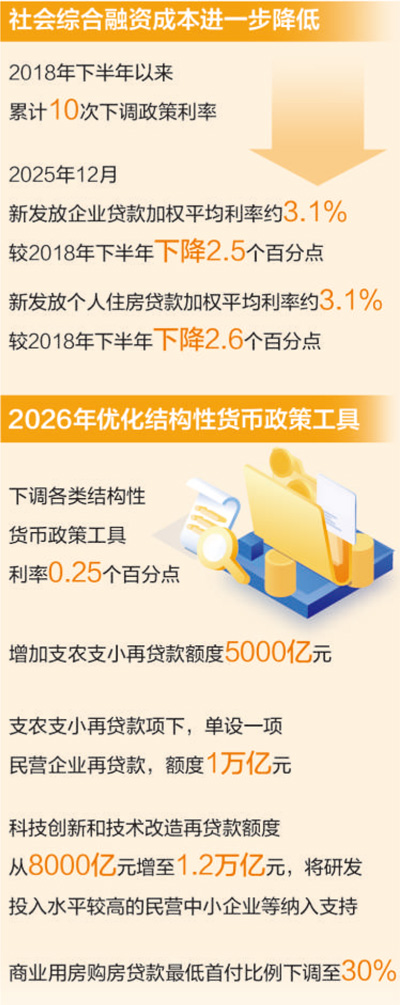
Core Insights - The overall financing cost in society has decreased significantly, with new corporate and personal housing loan rates at approximately 3.1%, down 2.5 and 2.6 percentage points respectively since the second half of 2018 [1][3] - The People's Bank of China (PBOC) has implemented a series of monetary policy tools to support the real economy, resulting in a notable increase in social financing scale and a stable growth in loans [2][3] - The PBOC plans to continue a moderately accommodative monetary policy in 2026, with potential for further rate cuts and liquidity support [4][10] Financing Cost Reduction - Since the second half of 2018, the PBOC has lowered policy rates 10 times, leading to a steady decline in financing costs [1][3] - By December 2025, the weighted average interest rates for new corporate and personal housing loans were both around 3.1% [1][3] Monetary Policy Tools - In 2025, the PBOC increased the quota for agricultural and small enterprise re-loans by 500 billion yuan and raised the quota for technology innovation and transformation re-loans from 800 billion yuan to 1.2 trillion yuan [1][6] - The PBOC is optimizing structural monetary policy tools by reducing interest rates by 0.25 percentage points and enhancing support for key sectors [5][6] Financial Market Stability - The foreign exchange market has remained stable, with the RMB appreciating by 4.4% against the USD in 2025 [4][8] - The PBOC has implemented measures to maintain balance in the foreign exchange market and enhance risk management for enterprises [8][9] Support for Key Sectors - Loans for technology, green initiatives, inclusive finance, and digital economy sectors have shown double-digit growth, significantly outpacing overall loan growth [3][10] - The PBOC aims to enhance financial support for consumption and the health industry, with a focus on improving the effectiveness of financial services [7][10] Direct Investment and Cross-Border Financing - In 2025, cross-border income and expenditure totaled 15.6 trillion USD, reflecting a nearly 10% increase from 2024 [8][9] - The PBOC is promoting high-level institutional openness in direct investment, securities investment, and cross-border financing [9][10]
侯喜保:实体经济“大树”根深叶茂
Jing Ji Ri Bao· 2026-01-16 00:05
Core Viewpoint - The "14th Five-Year Plan" emphasizes the importance of consolidating and strengthening the foundation of the real economy as a strategic task, highlighting its critical role in China's modernization efforts [1]. Group 1: Modern Industrial System - Building a modern industrial system is a strategic choice to strengthen the foundation of the real economy and is essential for promoting high-quality development [2]. - The focus should be on intelligent, green, and integrated development, promoting deep integration of technological and industrial innovation [2]. - Traditional industries need optimization and enhancement, while emerging industries should focus on cultivation and growth in sectors like new energy and aerospace [2]. Group 2: Manufacturing Sector - The manufacturing sector is fundamental to national strength and the core of the modern industrial system, with China's manufacturing value added accounting for nearly 30% of the global total [3]. - China has maintained its position as the world's largest manufacturer for 15 consecutive years, producing the majority of 504 major industrial products globally [3]. - The goal is to strengthen and optimize the manufacturing sector, ensuring it remains a backbone of the modern industrial system [3]. Group 3: Service Industry - The modern service industry is a crucial support for the modern industrial system, but it faces structural and systemic challenges [3]. - There is a need to promote high-quality development in the service sector, enhancing the integration of productive services with manufacturing [3]. - The focus should be on improving the quality and diversity of life services while advancing the digitalization of the service industry [3]. Group 4: Infrastructure Development - Infrastructure is essential for industrial development and must be optimized to support the real economy [4]. - A modern infrastructure system should leverage China's large market and existing facilities, focusing on new infrastructure construction and the digital transformation of traditional infrastructure [4]. - The goal is to enhance the resilience and adaptability of infrastructure to support China's modernization efforts [4].
金融支持实体经济力度更大结构更优(权威发布) 下调各类结构性货币政策工具利率和各类再贷款一年期利率
Ren Min Ri Bao· 2026-01-15 22:08
1月15日,国务院新闻办举行新闻发布会,介绍货币金融政策支持实体经济高质量发展成效。"2025年12 月末,社会融资规模存量同比增长8.3%;人民币贷款余额272万亿元,同比增长6.4%。"中国人民银行 新闻发言人、副行长邹澜介绍,人民银行通过综合运用多种货币政策工具,保持流动性充裕,引导金融 机构充分满足实体经济有效融资需求,货币金融政策支持实体经济效果明显。 今年降准降息还有一定空间 "2025年,人民银行实施适度宽松的货币政策,5月宣布实施了一揽子金融支持举措,巩固经济回升向好 势头。"邹澜介绍,全年金融呈现总量增、成本降、结构优等特征。 金融总量较快增长。2025年12月末,社会融资规模存量同比增长8.3%,广义货币供应量M2同比增长 8.5%,明显高于名义GDP增速;人民币贷款余额272万亿元,同比增长6.4%,还原地方化债影响后,增 速在7%左右,信贷支持力度持续较强。 社会综合融资成本进一步降低。2018年下半年以来,人民银行累计10次下调政策利率,促进社会综合融 资成本稳步下行。2025年12月,新发放企业贷款加权平均利率和新发放个人住房贷款加权平均利率都在 3.1%左右,自2018年下半年以 ...