海洋新质生产力

Search documents
“耕海牧渔”有新解
Ren Min Ri Bao· 2025-10-07 05:20
Core Viewpoint - The development of marine economy in China is gaining momentum, with innovative technologies and projects enhancing the potential of ocean resources, leading to a new era of "farming the sea" and economic growth [1][2][3] Group 1: Technological Innovations - The "Nankun" floating wave energy generator, the world's first megawatt-level device, can produce an average of 10,000 kWh daily, sufficient for approximately 1,500 households [1] - The integration of IoT, big data, and AI into modern marine ranching is transforming traditional fishing practices into data-driven operations [2] - The "Guoxin 1" smart fishery vessel can produce around 3,600 tons of high-quality fish annually using an innovative "onboard compartment breeding" model [1][2] Group 2: Resource Utilization - The establishment of a commercial underwater data center in Hainan has effectively reduced energy consumption by utilizing seawater for cooling [1] - The "Cold Spring Ecosystem Research Facility" in Guangzhou aims to explore the potential of methane and biological resources in cold spring areas [2] - The combination of offshore wind power and marine ranching has generated over 2 billion kWh and nearly 100 million yuan in annual income from aquaculture [2] Group 3: Policy and Strategic Goals - The Chinese government emphasizes the importance of high-quality development in the marine economy, aiming to create industrial hubs in oceanic regions [3] - There is a call for innovation in marine technology to achieve self-reliance and to avoid the pitfalls of pollution associated with resource development [3] - The focus is on developing new productive forces in the marine sector and constructing a modern marine industry system to contribute to national strength [3]
“耕海牧渔”新解(新知)
Ren Min Ri Bao· 2025-09-29 22:33
Core Insights - The development of marine economy in China is gaining momentum, with innovative technologies and projects enhancing the utilization of ocean resources [1][2][3] Group 1: Technological Innovations - The first megawatt-level floating wave energy generator, "Nankun," has been developed, capable of generating an average daily output of 10,000 kWh, sufficient for approximately 1,500 households [1] - The integration of IoT, big data, and AI into modern marine ranching is transforming traditional fishing practices into data-driven operations, enhancing efficiency and sustainability [2] - The establishment of the "Cold Spring Ecosystem Research Facility" in Guangzhou aims to explore the potential of cold spring methane and biological resources [2] Group 2: Industry Developments - The launch of the "Guoxin 1" smart fishery vessel, designed for high-quality fish production, and the "Suhai 1" salmon farming ship equipped with advanced monitoring systems, exemplifies the modernization of marine aquaculture [1][2] - The first marine wind power and marine ranch integration project has generated over 2 billion kWh and achieved nearly 100 million yuan in annual income from aquaculture [2] - The development of marine pharmaceuticals, including a new anti-tumor drug entering clinical trials, highlights the diversification of marine-related industries [2] Group 3: Strategic Goals - The Chinese government emphasizes the importance of high-quality development in the marine economy, aiming to create industrial hubs in oceanic regions [3] - There is a call for innovation and self-reliance in marine technology to explore uncharted territories and ensure sustainable development [3] - The focus is on balancing development and environmental protection, promoting a harmonious relationship between humans and the ocean [3]
深耕平台沃土 推动“研发优势”转为“产业胜势”
Xin Hua Ri Bao· 2025-09-28 06:47
Core Insights - The Jiangsu Marine Biological Resource Innovation Center is focusing on the high-value utilization of marine biological resources, developing products such as Antarctic krill chips and algae-based meal replacement shakes [1][3] - The center is part of Jiangsu Coastal Development Group, a state-owned enterprise, and aims to align with the Jiangsu Provincial Marine Industry Development Action Plan to enhance research and application transformation [1][2] Group 1: Research and Development - The center has established a comprehensive R&D laboratory of 1,700 square meters, equipped with over 300 research instruments, and has invested nearly 40 million yuan in R&D projects [2] - It has undertaken 16 research projects, including 3 provincial-level projects, and has applied for 36 invention patents, with 2 technical achievements recognized as domestically leading [2] Group 2: Talent Development - The center has recruited 11 dedicated R&D personnel, including 6 PhDs and 1 provincial talent, covering various disciplines such as biology, chemistry, materials, and food engineering [2] - A mentorship and project training model is implemented to enhance core capabilities and create a well-rounded technology innovation team [2] Group 3: Industry Collaboration and Innovation - The center has achieved the first artificial mass breeding of silver pomfret in Jiangsu, addressing a significant gap in the local aquaculture industry [3] - Collaborations with major entities like Charoen Pokphand Group and Ningbo University have provided technical support for factory-based aquaculture trials [3] - The center is committed to transforming scientific research outcomes into industrial applications, exemplified by the launch of the "Haiqiqu" brand for marine health foods [3]
瞭望·治国理政纪事|把海南打造成海洋强省
Xin Hua She· 2025-09-27 08:23
Core Viewpoint - Hainan is actively pursuing the development of a modern marine economy, focusing on high-quality growth, technological innovation, and ecological protection, aiming to become a strong marine province by leveraging its marine resources and enhancing its marine industry [1][3][4]. Group 1: Marine Economic Development - Hainan aims to increase the marine production value's share of GDP from 33.8% in 2023 to 40% by 2026 [6]. - The "Deep Sea No. 1" gas field has reached its maximum production capacity, with an expected annual gas output of over 4.5 billion cubic meters [11][12]. - Hainan is focusing on deep-sea energy development, including the promotion of key equipment manufacturing and industrialization, particularly underwater oil trees [20][21]. Group 2: Technological Innovation - Hainan is establishing a complete chain from experimental research to industrial application for key marine equipment, such as underwater oil trees, with a target of achieving 85% localization rate for 1500-meter deep underwater oil trees by 2026 [20][21]. - The province is also developing the world's first underwater data center, which integrates marine resources with digital technology, enhancing the efficiency of marine resource utilization [7][8]. Group 3: Ecological Protection - Hainan has implemented strict ecological protection measures, achieving a water quality excellence rate of 99.9% in nearshore waters, with key ecosystems like coral reefs and seagrass beds in healthy condition [4][29]. - The province has established a comprehensive ecological protection and pollution prevention mechanism, including the first local ban on single-use plastics in China [23][24]. - Hainan's efforts in ecological restoration have led to the return of rare marine species, showcasing the success of its environmental protection initiatives [29]. Group 4: Marine Industry Transformation - Hainan is promoting the transformation and upgrading of modern marine industries, focusing on new energy sources like offshore wind power and deep-sea oil and gas production [12][21]. - The province is also developing marine ranching, integrating tourism and aquaculture to create a new business model that enhances local livelihoods [13][14]. Group 5: Research and Development - Hainan is positioning itself as a national marine science and technology innovation hub, leveraging its natural resources and institutional innovations to support marine research and development [15][16]. - The establishment of the Sanya Yazhou Bay Science and Technology City aims to attract marine-related enterprises and foster collaboration between research institutions and businesses [16]. Group 6: Community Engagement - Hainan is encouraging community participation in marine conservation efforts, with initiatives like "fishing boats collecting garbage" gaining traction among local fishermen [28]. - Educational programs are being implemented to raise awareness about marine protection among the younger generation, fostering a culture of environmental stewardship [28].

2025全球滨海论坛在盐城开幕杨震出席开幕式并致辞 信长星关志鸥诺里斯·卡尔米特李金华致辞许昆林主持
Xin Hua Ri Bao· 2025-09-24 23:17
Core Viewpoint - The 2025 Global Coastal Forum emphasizes the importance of ecological protection and sustainable development in coastal areas, guided by the "Two Mountains" concept proposed by President Xi Jinping, which aims to harmonize development and environmental conservation [1][2]. Group 1: Forum Highlights - The forum was attended by key officials including Yang Zhen, Vice Chairman of the National Committee of the Chinese People's Political Consultative Conference, and various ministers from China and Vanuatu, highlighting international cooperation in coastal resource management [1][2]. - The theme of the forum is "Beautiful Coast: Ecological Priority and Green Development," focusing on enhancing ecological protection and promoting green transformation in coastal regions [3]. Group 2: Initiatives and Agreements - The forum released the "Global Coastal Ecosystem Status Report" and the "International Case Collection on Coastal Ecological Disaster Reduction," showcasing collaborative efforts in ecological governance [3]. - New partnerships were formed during the forum, with agreements signed to enhance cooperation in sustainable coastal development [3]. Group 3: Future Directions - Jiangsu Province aims to strengthen ecological barriers and develop marine new productive forces, promoting a closer relationship between people and the ocean [2]. - The forum seeks to build a global consensus on harmonious coexistence between humans and nature, fostering open cooperation and mutual benefits in coastal ecological civilization [2].
工行荣成支行发放山东工行系统内首笔海带养殖项目贷款
Qi Lu Wan Bao Wang· 2025-09-23 08:26
Core Insights - The successful issuance of a project loan by the Industrial and Commercial Bank of China (ICBC) to a seaweed farming enterprise marks the first financing specifically aimed at supporting large-scale and modern seaweed cultivation in Shandong Province [1][3] - This initiative aligns with Shandong's "14th Five-Year Plan" to deepen marine development and build a strong marine province, showcasing ICBC's proactive approach to tapping into new opportunities in the marine economy [1][2] Group 1 - The loan was efficiently disbursed in early July, addressing the financing challenges faced by the enterprise during a critical project construction phase, thereby injecting strong financial momentum into the high-quality development of the marine economy in Rongcheng City [1][3] - ICBC Rongcheng Branch established a specialized service team to ensure seamless coordination and efficient communication throughout the project evaluation and approval process, significantly enhancing decision-making efficiency and accuracy [2][3] Group 2 - The project financing reflects ICBC's commitment to implementing the national marine power strategy and supporting local real economy, effectively meeting the financing needs of enterprises and providing robust support for the modernization and scaling of Rongcheng's marine industry [3] - The successful loan issuance has opened new pathways for ICBC's Weihai Branch to deepen its engagement in the marine economy sector, accumulating valuable experience in servicing new marine business models [3]

青岛国信集团与中国华电山东公司签订战略合作协议,打造海洋产业“央地合作”新模式
Da Zhong Ri Bao· 2025-09-20 03:26
Core Points - Qingdao Guoxin Group and China Huadian Shandong Company signed a strategic cooperation agreement to collaborate in marine renewable energy, marine equipment, financial services, and urban operations, aiming to create a new model of "central-local cooperation" in major project investments and technological innovation [1][2] Group 1: Company Overview - Qingdao Guoxin Group is the only municipal enterprise in Qingdao that incorporates marine industry into its main business, focusing on the modern marine industry "4+4+2" system [2] - China Huadian Group is a large central enterprise under the supervision of the State-owned Assets Supervision and Administration Commission, consistently ranked among the world's top 500 companies for 14 consecutive years [1] Group 2: Project Details - Huadian Shandong Company has a complete energy industry layout including coal power, wind power, solar energy, heating, and port logistics, with an installed capacity of 2.38 million kilowatts in Qingdao [1] - The company plans to invest in a 2 million kilowatt offshore wind power project in Jimo, which is expected to generate an annual electricity output of 6.1 billion kilowatt-hours [1] Group 3: Strategic Initiatives - Qingdao Guoxin Group is establishing a marine science and technology innovation center and a marine equipment industry alliance, planning to build a marine equipment industrial park to enhance the local supply chain [2] - The collaboration with Huadian on offshore wind power projects aims to strengthen industry-academia-research cooperation and attract upstream and downstream enterprises in the wind power equipment sector [2] - The company is implementing an "innovation-driven + internationalization" strategy to position itself as a world-class enterprise in marine leadership, financial support, and efficient operations [2]
长三角是“一条船”,打造船舶海工集群应“一盘棋”左右逢源,南通牵手沪泰扬发力“世界级”
Xin Hua Ri Bao· 2025-09-18 23:34
Core Insights - The 2025 High-tech Shipbuilding and Offshore Equipment National Advanced Manufacturing Cluster Development Conference and Exhibition was held in Nantong, showcasing the growing significance of the shipbuilding and offshore engineering industry in China [1][2] - The event attracted over 500 enterprises from the shipbuilding and offshore engineering supply chain, including major state-owned enterprises and international participants, marking a record in both quantity and quality of exhibitors [1][2] - A strategic cooperation agreement was signed to create a world-class shipbuilding and offshore engineering industrial cluster centered in Nantong, linking it with neighboring cities [1][2] Industry Performance - The "Tongtaiyang" region's shipbuilding and offshore engineering industry achieved a total output value of 329.08 billion yuan last year, with shipbuilding manufacturing accounting for over 40% of the national total and offshore equipment over 25% [2] - The Chongming District's shipbuilding and offshore engineering output reached 80 billion yuan, representing 65% of Shanghai's total [2] - The shipbuilding industry in Jiangsu province is the largest in China, with significant market shares projected for 2024, including 55.7% of global shipbuilding completions and 74.1% of new orders [2] Strategic Developments - The collaboration between Nantong, Taizhou, and Yangzhou has led to a 41% increase in total output value and an 84.6% rise in new orders compared to 2022 [3] - Nantong's shipbuilding and offshore equipment industries account for 10% and 25% of the national totals, respectively, with over 420 enterprises and numerous industry leaders emerging from the region [3] - The "Hutongtaiyang" industrial cluster is expected to enhance the integration and competitiveness of the shipbuilding and offshore engineering sectors across the Yangtze River Delta [4] Future Outlook - The development plans for high-tech shipbuilding and offshore equipment aim to establish a world-class advanced manufacturing cluster, with various initiatives already underway to enhance production capabilities [4][5] - Nantong's leadership emphasizes the importance of leveraging regional advantages to contribute to high-quality development in the province and beyond [5]
沪通携手,国企赋能 共同打造世界级船舶海工产业集群
Yang Zi Wan Bao Wang· 2025-09-16 12:12
Core Viewpoint - The event held on September 16 focused on the development of a world-class shipbuilding and marine engineering industry cluster in Nantong, highlighting the city's commitment to high-quality development in the maritime sector [1][5]. Group 1: Industry Development - The theme of the event was "Developing New Marine Productivity, Building World-Class Industrial Clusters," featuring discussions on technology, education, talent, and investment in the shipbuilding and marine engineering sectors [3]. - Nantong's shipbuilding output accounts for approximately 10% of the national total, while marine engineering equipment production represents about 25% of the national scale [3]. - The city has established a technology innovation system centered around leading enterprises, filling several domestic gaps in the construction of specialized ships and new marine engineering equipment [3][5]. Group 2: Strategic Initiatives - Nantong aims to enhance its maritime industry by focusing on high-end, intelligent, green, and nationalized development, creating a manufacturing belt along the river and a new marine equipment manufacturing belt [5]. - The Jiangsu province's shipbuilding market share exceeds 45% nationally, with marine engineering equipment construction accounting for about one-third of the national total [5]. - Nantong, Taizhou, and Yangzhou collectively hold over 80% of the province's shipbuilding capacity, emphasizing the importance of regional collaboration in enhancing industrial capabilities [5]. Group 3: Global Context and Performance - The global shipbuilding and marine engineering industry is experiencing a rapid development phase, with China maintaining a leading position in the sector, holding 51.8% of the world's completed shipbuilding volume and 70.2% of new orders as of July [7]. - The overall industry profitability has reached a historical high of over 9%, demonstrating the resilience and vitality of China's shipbuilding and marine engineering sector [7]. - Nantong has signed cooperation agreements with various organizations to promote coordinated development across the entire industry chain, focusing on key technologies and green transformation [7]. Group 4: Innovations and Guidelines - The China Classification Society released the "Offshore Hydrogen Production Facility Guidelines 2025," which aims to promote the development of the offshore hydrogen energy industry in line with national green energy strategies [8]. - The guidelines will take effect on October 1 and are expected to accelerate the standardization, safety, and scalability of China's offshore hydrogen energy industry [8].

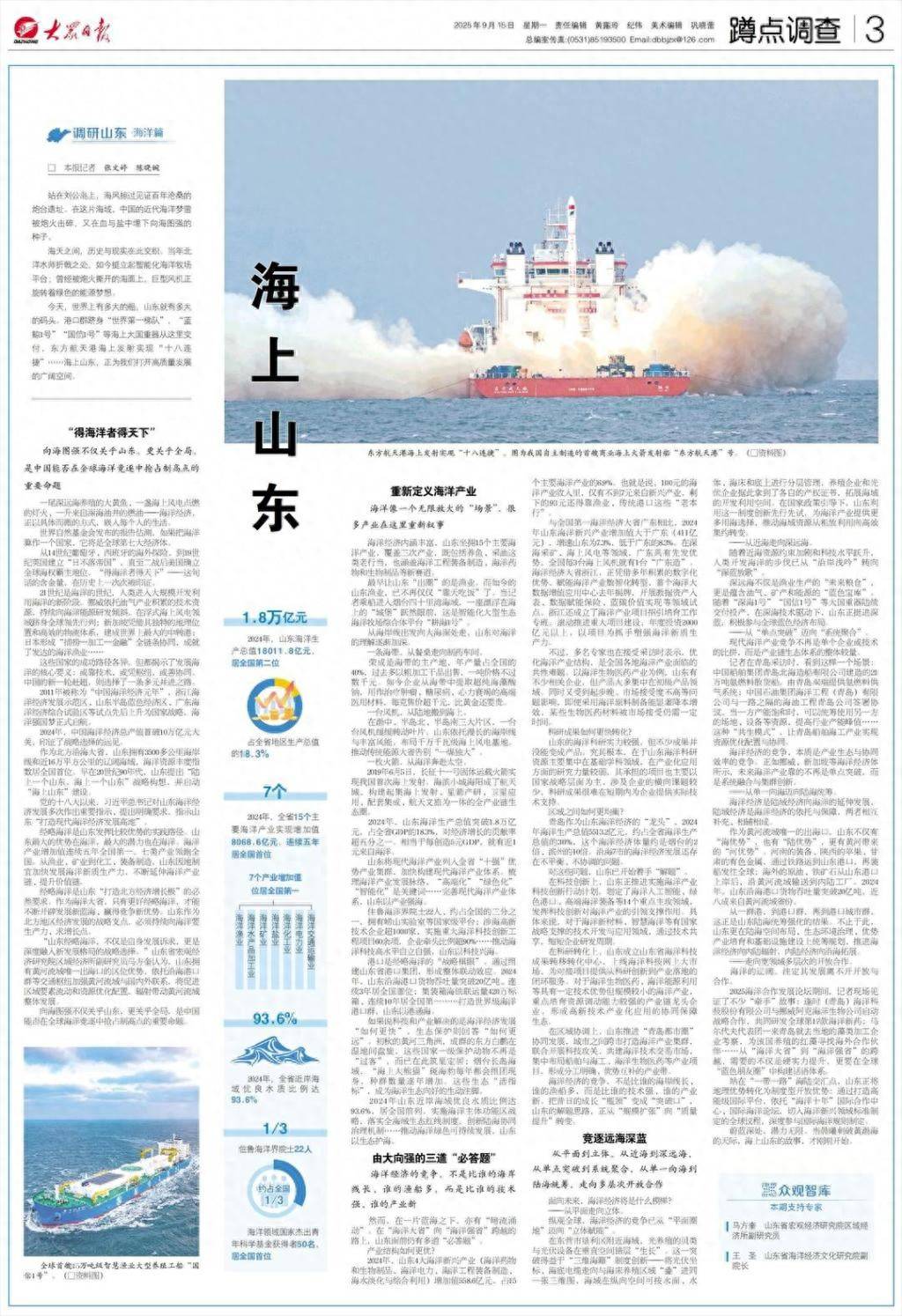
蹲点调查|海上山东
Sou Hu Cai Jing· 2025-09-15 02:53
Group 1 - The article emphasizes the importance of marine economy development for Shandong province, highlighting its strategic significance for both local and national growth [10][15][16] - Shandong has a coastline of over 3,500 kilometers and a vast marine area of nearly 160,000 square kilometers, making it a leader in marine resources in China [14][15] - The marine economy in Shandong is projected to exceed 10 trillion yuan by 2024, contributing significantly to the province's GDP [12][24] Group 2 - The marine economy encompasses various industries, including traditional sectors like fishing and oil extraction, as well as emerging fields such as marine engineering, marine pharmaceuticals, and offshore wind power [17][21] - Shandong's marine production value is expected to surpass 1.8 trillion yuan in 2024, accounting for 18.3% of the province's GDP [24][25] - The province aims to enhance its marine industry structure by focusing on high-end, green, and intelligent development [25][30] Group 3 - Shandong is facing challenges in optimizing its industrial structure, with only 6.9% of its marine industry revenue coming from emerging sectors [27][28] - The province's marine scientific research capabilities are strong, but there is a need for faster commercialization of research outcomes [28][29] - There is an imbalance in marine economic development among coastal cities in Shandong, with Qingdao being the leading city [29] Group 4 - The article discusses the shift from nearshore to deep-sea development, highlighting the potential of deep-sea resources for future economic growth [39][40] - Shandong is focusing on creating a collaborative ecosystem among marine industries to enhance overall efficiency and competitiveness [41][42] - The integration of land and sea economies is crucial for Shandong's development, leveraging its geographical advantages [44][45]