物价回升

Search documents
国债期货日报-20250818
Rui Da Qi Huo· 2025-08-18 11:24
Report Summary 1. Report Industry Investment Rating No investment rating information is provided in the report. 2. Core View of the Report The current bond market lacks a new main - line driver, and the strengthening of the equity market has significantly increased market risk appetite, suppressing bond market sentiment, especially with increased selling pressure on the ultra - long end of interest - rate bonds, leading to a continuous widening of the spread between 10 - year and 30 - year bonds. In this context, the "strong stock, weak bond" linkage effect may intensify, and in the short term, liquidity factors may become the core logic guiding bond market trading. It is recommended to focus on opportunities for the expansion of term spreads brought about by curve steepening [2]. 3. Summary by Related Catalogs 3.1 Futures Market Data - **Futures Closing Prices and Volumes**: T主力收盘价108.015, down 0.29%; TF主力收盘价105.455, down 0.21%; TS主力收盘价102.304, down 0.04%; TL主力收盘价116.090, down 1.33%. All contract volumes increased, with T主力成交量 at 20962, TF主力成交量 at 14257, TS主力成交量 at 5008, and TL主力成交量 at 47329 [2]. - **Futures Spreads**: Most spreads showed changes, such as TL2512 - 2509价差 down 0.13 to - 0.60, T09 - TL09价差 up 1.11 to - 8.08 [2]. - **Futures Positions**: T主力持仓量 decreased by 12157 to 107322; TF主力持仓量 increased by 357 to 86134; TS主力持仓量 decreased by 4546 to 61412; TL主力持仓量 decreased by 7726 to 61613. The net positions of the top 20 traders also had various changes [2]. 3.2 CTD Bond Data The net prices of the top two CTD bonds all decreased, for example, 220010.IB(6y) decreased by 0.3457 to 106.5921, and 250007.IB(6y) decreased by 0.2601 to 99.0955 [2]. 3.3 Treasury Bond Active Bond Yields The yields of treasury bond active bonds increased, with the 1 - year yield up 0.20bp to 1.3600%, the 5 - year yield up 1.75bp to 1.5825%, the 7 - year yield up 1.20bp to 1.6850%, and the 10 - year yield up 1.30bp to 1.7450% [2]. 3.4 Short - term Interest Rates All short - term interest rates increased, such as the silver - pledged overnight rate up 6.76bp to 1.4776%, the Shibor overnight rate up 3.80bp to 1.4360%, etc. [2]. 3.5 LPR Rates The 1 - year LPR rate remained at 3.00%, and the 5 - year LPR rate remained at 3.5% [2]. 3.6 Open Market Operations The issuance scale of reverse repurchase operations was 2665 billion, the maturity scale was 1120 billion, and the interest rate was 1.4% for 7 - day operations [2]. 3.7 Industry News - **Monetary Policy**: The central bank will implement a moderately loose monetary policy, maintain liquidity, promote a reasonable recovery of prices, and support key areas through structural monetary policy tools [2]. - **Economic Data**: In July, the industrial added value of large - scale industries increased by 5.7% year - on - year, and social consumer goods retail总额 increased by 3.7% year - on - year. From January to July, national fixed - asset investment increased by 1.6% year - on - year, while real estate development investment decreased by 12% [2]. - **Housing Prices**: In July, the sales prices of commercial residential buildings in all tiers of cities decreased month - on - month, and the year - on - year decline generally narrowed. The number of cities with month - on - month increases in new - home prices decreased, and only one city had a month - on - month increase in second - hand home prices [2]. 3.8 Key Events to Watch - August 20, 17:00: Eurozone July CPI annual rate final value. - August 21, 02:00: The Federal Reserve releases the minutes of its monetary policy meeting [3].
牛市早报|央行报告:把促进物价合理回升作为把握货币政策的重要考量
Sou Hu Cai Jing· 2025-08-18 00:25
Market Data - As of August 15, the Shanghai Composite Index rose by 0.83% to 3696.77 points, the Sci-Tech Innovation 50 Index increased by 1.43% to 1101.29 points, the Shenzhen Component Index climbed by 1.6% to 11634.67 points, and the ChiNext Index surged by 2.61% to 2534.22 points [1] - On the same day, the US stock market showed mixed results, with the Dow Jones Industrial Average up by 0.08%, the Nasdaq down by 0.4%, and the S&P 500 declining by 0.29% [2] Economic Indicators - The People's Bank of China released the "2025 Q2 China Monetary Policy Implementation Report," emphasizing the need for a balanced approach to monetary policy, ensuring liquidity remains ample, and aligning social financing and money supply growth with economic growth and price level expectations [3] - From January to July, China's fixed asset investment (excluding rural households) reached 288229 billion yuan, marking a year-on-year increase of 1.6%, although this represents a decline compared to the first half of the year [3] - In July, the consumer price index (CPI) showed positive changes, with a month-on-month increase of 0.4%, reversing a previous decline. The core CPI, excluding food and energy, rose by 0.8% year-on-year, indicating a steady upward trend in the market [4] - The National Bureau of Statistics reported that in July, the sales prices of residential properties in 70 large and medium-sized cities showed a month-on-month decline, but the year-on-year decline narrowed overall [4] Corporate Developments - China Shenhua (601088) announced a transaction plan to acquire assets from its controlling shareholder, the State Energy Group, involving 13 target companies across coal, coal power, and coal chemical sectors, aimed at enhancing resource reserves and optimizing the industrial chain [6] - Western Securities (002673) received approval for its acquisition of Guorong Securities, with the China Securities Regulatory Commission confirming the transfer of 11.51 billion shares, representing 64.5961% of Guorong Securities [7] - Huahong Semiconductor announced plans to address competition issues related to its IPO by acquiring a controlling stake in Shanghai Huali Microelectronics through a share issuance and cash payment, with the transaction not expected to constitute a major asset restructuring [8]
央行二季度报告释放1万亿流动性,同比GDP增5.3%成稳增长信号
Sou Hu Cai Jing· 2025-08-17 08:35
Group 1 - The People's Bank of China (PBOC) released the monetary policy execution report for Q2 2025, indicating a stable economic performance with a GDP growth of 5.3% year-on-year in the first half of the year [1] - The central bank maintains a moderately accommodative monetary policy stance, utilizing various tools to create a favorable monetary environment for sustained economic recovery [1] Group 2 - The report emphasizes the importance of promoting a reasonable rebound in prices as a key consideration for monetary policy, highlighting the focus on price trends [2] - In May, the PBOC lowered the reserve requirement ratio by 0.5 percentage points, injecting approximately 1 trillion yuan of long-term liquidity into the market, and also reduced policy interest rates [2] - The new corporate and personal housing loan rates decreased by approximately 45 and 60 basis points year-on-year, respectively, from January to June [2] Group 3 - The report provides a clearer stance on exchange rate policies, emphasizing a managed floating exchange rate system based on market supply and demand [3] - The RMB exchange rate remained stable, with the midpoint against the USD at the end of June being roughly the same as at the end of the previous year [3] - The PBOC aims to prevent excessive fluctuations in the exchange rate and maintain it at a reasonable and balanced level, demonstrating a strong commitment to exchange rate stability [3]
货币政策执行报告的三个关注点
SINOLINK SECURITIES· 2025-08-16 13:34
Group 1: Monetary Policy and Economic Outlook - The second quarter monetary policy report reflects a more positive outlook on price levels, stating "moderate recovery in price levels with increasing positive factors" compared to previous reports[5] - The report emphasizes the need to implement existing policies in detail, focusing on structural monetary policy tools rather than rate cuts or reserve requirement ratio reductions[7] - The year-on-year growth rate of PPI is expected to bottom out and recover, aided by a low base from the previous year and the impact of "anti-involution" on commodity prices[5] Group 2: Economic Risks and Challenges - Domestic economic conditions are showing signs of weakness, with potential for greater-than-expected economic downturns[4] - Ongoing US-China trade tensions and geopolitical uncertainties may disrupt exports, posing risks to China's economic fundamentals[4] - July economic data showed a significant decline, with fixed asset investment growth dropping by 1.2 percentage points to 1.6% and retail sales growth falling by 1.1 percentage points to 3.7%[5] Group 3: Structural Support and Credit Allocation - The report highlights increased structural support for small and micro enterprises, technological innovation, credit structure optimization, and consumer spending[14] - Approximately 70% of new loans are allocated to the technology sector, with double-digit growth rates, indicating a focus on fostering innovation[14] - The report mentions a 1 percentage point fiscal subsidy for personal consumption loans and service industry loans, showcasing the collaboration between monetary policy and fiscal measures[14]
二季度货政报告强调了什么?(国金宏观孙永乐)
雪涛宏观笔记· 2025-08-16 08:41
Core Viewpoint - The article emphasizes the need for a stable monetary policy in response to ongoing economic challenges, highlighting the importance of implementing a moderately loose monetary policy and utilizing structural monetary policy tools [4]. Group 1: Monetary Policy Execution Report Highlights - The second quarter monetary policy execution report shows a more positive outlook on price recovery, indicating that the Consumer Price Index (CPI) is expected to see a moderate rebound due to various positive factors [5]. - The report notes that the Producer Price Index (PPI) may reach a bottom and start to recover, aided by a low base from the previous year and the impact of "anti-involution" on commodity prices [5]. - However, July economic data showed a significant decline, with fixed asset investment growth dropping by 1.2 percentage points to 1.6% and retail sales growth falling by 1.1 percentage points to 3.7% [5]. Group 2: Policy Tools and Measures - The report indicates that there will be no reduction in reserve requirements or interest rates, maintaining a "quantity-wide and price-stable" monetary policy approach [7]. - The average interest rate on new RMB loans decreased by 15 basis points to 3.29%, with net interest margins for commercial banks reaching historical lows [7]. - The central bank emphasizes the need to improve the efficiency of fund usage and prevent capital from flowing into the capital market at low prices, which could inflate asset prices [8]. Group 3: Structural Support Initiatives - The report highlights four key areas for structural support: small and micro financial services, financial support for technological innovation, credit structure optimization, and financial support for consumption [12]. - Approximately 70% of new loans are allocated to the technology sector, with double-digit growth rates, indicating a focus on promoting the development of the technology bond market [14]. - The report also mentions the importance of coordinating monetary credit policies with fiscal measures, such as providing interest subsidies for personal consumption loans and loans to service industry entities [14].

中国央行:把促进物价合理回升作为把握货币政策的重要考量
Zhong Guo Xin Wen Wang· 2025-08-15 16:22
Group 1 - The core viewpoint of the report emphasizes the importance of promoting a reasonable recovery in prices as a key consideration for monetary policy, aiming to maintain prices at a reasonable level [1][2] - The report highlights that effectively managing low-price disorderly competition among enterprises can help balance supply and demand in the economy, positively impacting price recovery [1] - Analysts note that recent policies aimed at addressing "involution" and promoting the orderly exit of outdated production capacity have led to noticeable increases in the prices of bulk commodities such as coking coal, coke, hot-rolled sheets, and glass [1] Group 2 - The report also mentions the implementation of a moderately loose monetary policy, ensuring that liquidity remains ample and that the growth of social financing and money supply aligns with economic growth and price level expectations [2]
央行报告:把促进物价合理回升作为把握货币政策的重要考量
Guan Cha Zhe Wang· 2025-08-15 14:47
Core Viewpoint - The People's Bank of China emphasizes the importance of promoting a reasonable recovery in prices as a key consideration for monetary policy, aiming to maintain prices at a reasonable level [1][6]. Summary by Sections Economic Performance - Under the leadership of the Central Committee, macroeconomic policies have been actively implemented, resulting in a stable economic operation with major indicators showing strong vitality and resilience. The GDP grew by 5.3% year-on-year in the first half of the year [2]. Monetary Policy Measures - The central bank has adopted a moderately loose monetary policy, utilizing various tools to support high-quality economic development. This includes a 0.5 percentage point reduction in the reserve requirement ratio in May, providing approximately 1 trillion yuan in long-term liquidity [3]. - The policy interest rates were lowered by 0.1 percentage points, and structural monetary policy tool rates were reduced by 0.25 percentage points in May, aiming to decrease overall financing costs [3]. Financial Stability and Risk Management - The monetary policy has shown effective counter-cyclical adjustments, with the social financing scale and broad money supply (M2) growing by 8.9% and 8.3% year-on-year, respectively, by the end of June. The balance of RMB loans reached 268.6 trillion yuan [4]. - The central bank aims to maintain the stability of the RMB exchange rate and has implemented measures to prevent systemic financial risks [5][7]. Future Outlook - The central bank plans to continue implementing a moderately loose monetary policy, ensuring that the growth of social financing and money supply aligns with economic growth and price level expectations. It will also enhance the interest rate adjustment framework and support key areas such as technology innovation and consumption [6].
央行最新报告:整治“内卷”有助于物价回升
Zheng Quan Shi Bao· 2025-08-15 13:48
Core Viewpoint - The People's Bank of China (PBOC) emphasizes the need for a moderately loose monetary policy to support economic recovery and maintain reasonable price levels, with a focus on optimizing credit structure and enhancing financial support for high-quality economic development [1][2][9]. Group 1: Monetary Policy and Economic Environment - The PBOC has implemented a series of monetary policy measures to boost confidence and stabilize expectations, resulting in noticeable effects from counter-cyclical adjustments [2]. - The report highlights the importance of maintaining ample liquidity and aligning social financing scale and money supply growth with economic growth and price level expectations [1][9]. - The global economic recovery remains uncertain, with risks from U.S. tariff policies and potential financial market volatility [2]. Group 2: Credit Structure Optimization - The credit structure in China is continuously improving, with loans in technology, green, inclusive, elderly care, and digital sectors accounting for about 70% of new loans [1][5]. - Over the past decade, the focus of credit allocation has shifted from heavy asset industries to high-quality development sectors, with corporate loans now making up 79% of new loans [5]. - The proportion of medium to long-term loans in the manufacturing sector has increased significantly, indicating a shift towards supporting sustainable economic growth [5]. Group 3: Price Level and Competition - The report anticipates a moderate recovery in price levels, driven by efforts to regulate low-price competition and enhance consumer spending [3][9]. - The recent revision of regulations to ensure timely payments from large enterprises to suppliers aims to mitigate excessive competition and improve cash flow in the supply chain [3]. - The rise in prices of major commodities suggests a potential for positive supply-demand dynamics, contributing to price recovery [3]. Group 4: Support for Service Consumption - The PBOC plans to enhance financial support for service consumption, which is crucial for economic growth, as the current share of service consumption in household spending is below 50% [7][8]. - Financial policies will focus on improving the supply of high-quality services and reducing financing costs to stimulate consumer demand [7]. - The collaboration of monetary policy with fiscal and social policies is essential to boost the consumption capacity and willingness of residents [7][8].
央行重磅报告!强调货币政策的重要考量→
Zheng Quan Shi Bao· 2025-08-15 13:46
Core Viewpoint - The People's Bank of China (PBOC) released the "2025 Q2 Monetary Policy Implementation Report," summarizing the monetary policy execution in the first half of the year and outlining future policy directions [1] Monetary Policy Execution - The report highlights the optimization of credit structure and increased financial support for high-quality economic development, with loans in technology, green, inclusive, elderly care, and digital sectors accounting for approximately 70% of new loans [2][8] - The PBOC emphasizes the need for a moderately accommodative monetary policy, ensuring liquidity remains ample and aligning social financing scale and money supply growth with economic growth and price level expectations [3][12] Economic Outlook - The report indicates that the PBOC's counter-cyclical adjustment measures have been effective, with a series of monetary policy measures implemented in May to boost confidence and stabilize expectations [4] - It projects stable growth in the second half of the year, supported by ongoing improvements in the national economic cycle and high-quality development [5] Price Level and Competition - The report anticipates a moderate recovery in price levels in the second half of the year, driven by regulatory measures against disorderly low-price competition and the promotion of consumption [6][11] - It addresses the issue of "involution" in competition, where excessive competition has led to financial inefficiencies, and outlines recent regulatory changes aimed at improving payment terms for suppliers [6][7] Credit Structure Optimization - The report notes a significant shift in the credit structure over the past decade, with loans now more aligned with the direction of economic transformation, moving from real estate and infrastructure to sectors supporting high-quality development [8] - The proportion of medium to long-term loans in manufacturing has increased, with the share of corporate loans rising to 79% of new loans [8] Support for Innovation and Service Consumption - The PBOC plans to enhance credit support for technology-driven small and medium enterprises and develop a financial ecosystem that supports technological innovation [9] - The report emphasizes the importance of service consumption as a key driver for economic growth, proposing measures to improve the supply of high-quality services and enhance consumer spending [10][11]
央行重磅报告!强调货币政策的重要考量→
证券时报· 2025-08-15 13:40
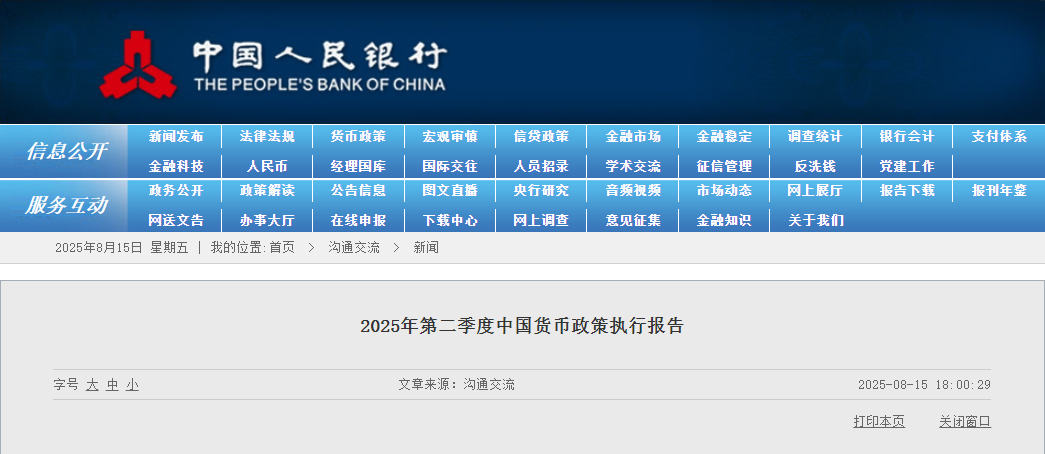
中国人民银行(下称"央行")8月15日发布《2025年第二季度中国货币政策执行报告》(下称《报告》),总结上半年货币政策执行情况,分析当前经济 金融形势,明确下一阶段政策取向。 | | | | 中国人民银行 THE PEOPLE'S BANK OF CHINA | | | | | | | | | --- | --- | --- | --- | --- | --- | --- | --- | --- | --- | --- | | | 新闻发布 | 深集活通 | 货币政策 | 宏观审慎 | 信贷政策 | 金融市场 | 金融稳定 | 调查绞计 | 银行会计 | 支付体系 | | 信息公开 | | | | | | | | | | | | | 金融科技 | 人民币 | 经理国库 | 国际交往 | 人员招录 | 学术交流 | 征信管理 | 反洗钱 | 党建工作 | | | 服务互动 | 政务公开 | 政策解读 | 公告信息 | 图文直播 | 央行研究 | 音頻视頻 | 市场动态 | 网上展厅 | 报告下载 | 报刊年鉴 | | | 网送文告 | 办事大厅 | 在线申报 | 下载中心 | 网上调查 | 意见征集 | 金融 ...