电动汽车

Search documents
全球矿业股狂飙 或开启新一轮超级周期
Xin Lang Cai Jing· 2026-01-25 12:35
Core Viewpoint - Global mining stocks have become a top buy for fund managers, with the MSCI Global Metals and Mining Index surging nearly 90% since early 2025, outperforming sectors like semiconductors and banks, marking it as one of the best-performing asset classes this year [1] Group 1: Market Performance - The price of copper has skyrocketed by 50% during the same period, with prices of aluminum, silver, nickel, and platinum also rising significantly [1] - A monthly survey by Bank of America indicates that European fund managers have a net overweight position in the mining sector of 26%, the highest in four years [1] Group 2: Changing Dynamics - The recent performance of mining stocks contrasts sharply with their previous years of neglect, driven by a weakening correlation between commodities like copper and aluminum with economic cycles [1] - These commodities are evolving from being viewed as "short-cycle trading assets" influenced by global economic growth to "structural investment assets" [1] Group 3: New Demand Drivers - New pillars of demand for key minerals such as copper and aluminum are emerging from sectors like artificial intelligence data centers, electric vehicle adoption, and the expansion of the robotics industry [1] - Investors are increasingly allocating to metals to engage with long-term themes like AI, leading to a surge in buying whenever mining stocks face weak data [1] Group 4: Strategic Shift - Mining stocks have transitioned from being seen as a dull defensive sector to a strategic anchor that can capitalize on changes in monetary policy and geopolitical fluctuations [1]
Tesla Stock Is a Chronic Underperformer. What That Means for Investors.
Barrons· 2026-01-23 21:20
Core Viewpoint - Tesla is recognized as one of the most valuable companies globally, yet it is characterized as a chronic underperformer [1] Company Performance - As of the latest trading session, Tesla's stock is flat for the year and has increased by 8% over the past 12 months [1]

见证历史!白银突破100美元大关 年内飙涨40%
2 1 Shi Ji Jing Ji Bao Dao· 2026-01-23 15:28
Group 1 - Silver prices have surged to a historic high of $100, marking a 40% increase year-to-date, significantly outperforming gold [1] - The primary driver of this price increase is the industrial demand for silver, which is expected to grow due to sectors like photovoltaics, AI, and electric vehicles [1] - The global silver market has been in a structural deficit for five consecutive years, with physical inventories rapidly depleting [1] Group 2 - Speculative trading has emerged as a major driver of the recent silver price increase, although its sustainability is questioned [2] - Short-term forecasts suggest that silver may experience high volatility and fluctuations, influenced by ongoing geopolitical issues [2] - Long-term predictions indicate that silver prices could reach $200 by 2026, with expectations of significant increases in gold prices as well [2]
白银首次突破100美元,年内飙涨40%
21世纪经济报道· 2026-01-23 15:19
Core Viewpoint - Silver prices have surged, reaching a historic high of $100 on January 23, 2026, with a year-to-date increase of 40%, significantly outperforming gold [1]. Supply and Demand Analysis - According to Fangzheng Securities, the industrial properties of silver create a long-term rigid demand. Supply has remained relatively stable, but demand has been increasing. The primary supply source is mined silver, which is experiencing a declining output, while recycled silver is becoming the second-largest source [3]. - Industrial demand dominates silver consumption, driven by the green economy, with projections indicating that global industrial demand for silver will continue to grow over the next five years due to surges in sectors like photovoltaics, AI, and electric vehicles [4]. - The World Silver Association reports that in 2025, global silver supply will be 321,000 tons, while demand will reach 357,000 tons, with industrial silver accounting for 60% of total demand. The market has been in a structural deficit for five consecutive years, leading to rapidly depleting physical inventories [4]. Investment Demand and Market Dynamics - There is a strong demand for silver ETFs, with significant amounts of silver being extracted and locked away. The market is currently facing a real-time supply squeeze, rather than just an increase driven by risk aversion [4]. - Analysts suggest that speculative fervor has become a major driver of the recent price increase, although this may not be sustainable. The recent surge in prices is difficult to explain from a fundamental perspective, indicating a fear of missing out among buyers [4]. Future Outlook - Short-term projections indicate that silver may experience high volatility and fluctuations at elevated levels, with ongoing risks related to Greenland's issues [4]. - In the medium term, Wenkang Futures advises investors to buy on dips, anticipating that the Federal Reserve will significantly increase its easing measures following the new chair's appointment in May, which could impact the Fed's independence [4]. - Notably, economist Jim Rickards predicts that both gold and silver will see explosive growth in 2026, with silver potentially reaching $200 per ounce [5].


破百在即!现货白银冲上99美元,月内狂飙逾38%
Ge Long Hui· 2026-01-23 06:39
1月23日,现货白银价格延续强劲涨势,今日盘中接连突破多道整数关卡,首次站上99美元/盎司,最高 涨至99.4美元/盎司,创下历史新高,今年迄今累计涨超38%,离100美元心理大关仅一步之遥,交易商 最新指出,白银已经成功突破主要阻力区,令100美元大关触手可及。分析人士指出,近期白银矿商与 现货价格同步走强,是多方势头延续的有力佐证。 美国知名贵金属交易商Money Metals Exchange的CEO Stefan Gleason从供应链内部角度剖析当前市况 称,此轮涨势主要由新进场投资者推动,长期持有者则趁机部分获利了结。虽然出现一定抛售压力,但 却被大量因新闻话题与价格波动而入市的新买盘吸收。值得注意的是,美国以外市场,特别是伦敦与亚 洲,已出现明显的供需失衡与流动性紧缩,溢价攀升反映当地供应更为吃紧。 世界白银协会最新发布的一份报告显示,由于光伏、AI、电动汽车等领域需求激增,全球白银工业需 求未来五年将持续增长。数据显示,2025年全球白银供应量为3.21万吨,全球白银需求量为3.57万吨, 其中工业用银在白银总需求中的占比达到60%。专家表示,伦敦市场白银库存近期降到10年来低位。 责任编辑: ...
白银供需缺口持续扩大 伦敦银多头势头强劲
Jin Tou Wang· 2026-01-23 06:28
Group 1: Silver Market Overview - The London silver price is currently trading above $98.39, with a recent high of $99.20 and a low of $96.19, indicating a short-term oscillating trend [1] - The World Silver Association reports that global industrial demand for silver will continue to grow over the next five years due to surging demand from sectors like photovoltaics, AI, and electric vehicles [1] - By 2025, global silver supply is projected to be 32,100 tons, while demand is expected to reach 35,700 tons, with industrial silver accounting for 60% of total demand [1] Group 2: Industrial Demand and Risks - Silver is the best conductor of electricity and has extensive applications in the industrial sector, particularly in photovoltaic manufacturing, where demand has surged to over 5,000 tons annually, representing one-sixth of global silver production [2] - There is a risk of substitution in industrial demand, as record silver prices are prompting downstream industries to seek alternatives, with companies like LONGi Green Energy planning to replace silver paste with base metals in solar cells [2] Group 3: Technical Analysis of Silver Prices - The price of silver has shown strong bullish momentum, reaching a key resistance level of $98.00, indicating a dominant buying position [3] - A breakout above the $98.00 resistance could lead to a rise towards the next resistance level of $102.00, with a trading range expected between $94.00 support and $102.00 resistance [3]
实物白银库存正在迅速枯竭 大量白银被提取锁仓
Ge Long Hui· 2026-01-22 14:42
Core Insights - The World Silver Association's latest report indicates that global industrial demand for silver will continue to grow over the next five years due to surging demand in sectors such as photovoltaics, AI, and electric vehicles [1] - By 2025, global silver supply is projected to be 32,100 tons, while demand is expected to reach 35,700 tons, with industrial silver accounting for 60% of total demand [1] - The global silver market has been in a structural deficit for five consecutive years, leading to a rapid depletion of physical inventories [1] - There is strong investment demand for silver ETFs, resulting in significant amounts of silver being extracted and locked away [1] - The market is currently facing a real-time supply squeeze, driven by factors beyond just safe-haven sentiment [1]
港股异动 | 敏实集团(00425)再涨超10% 公司受益欧洲电动车放量 积极切入人形机器人、液冷等赛道
智通财经网· 2026-01-22 02:25
Core Viewpoint - Minth Group (00425) has seen a significant stock price increase, rising over 10% and currently trading at 37.34 HKD, with a transaction volume of 248 million HKD. This surge is attributed to the upcoming German government subsidy policy for electric vehicles, which aims to allocate 3 billion euros by 2029 to support low- and middle-income families in purchasing zero-emission vehicles [1] Group 1: Electric Vehicle Market - The German government plans to restart its electric vehicle subsidy policy, which is expected to boost the adoption of electric vehicles and aid the recovery of Germany's automotive market [1] - Minth Group's battery box business is projected to achieve a year-on-year revenue growth of approximately 50% in both 2024 and the first half of 2025, benefiting from orders covering popular electric vehicle platforms from European automakers such as Volkswagen, Stellantis, and Renault [1] Group 2: Emerging Business Ventures - Minth Group is actively entering new sectors such as humanoid robots, liquid cooling, and low-altitude economy, leveraging its expertise in automotive manufacturing [1] - The company has signed a strategic cooperation agreement with Zhiyuan Robotics to jointly develop components like joint modules and electronic skin, with small-scale samples already completed and a demonstration production line established [1] - Minth Group's AI server liquid cooling business has secured orders from leading Taiwanese manufacturers, integrating into the global semiconductor supply chain, and plans to establish a joint factory with Fuman Technology, aiming for mass production capabilities by the end of 2025 [1] - The new business ventures are expected to synergize with the company's core technologies, enhancing long-term growth potential [1]

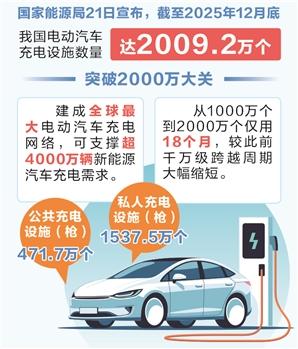
我国已建成全球最大的充电网络,支撑超4000万辆电动汽车充电需求
Huan Qiu Wang· 2026-01-22 01:04
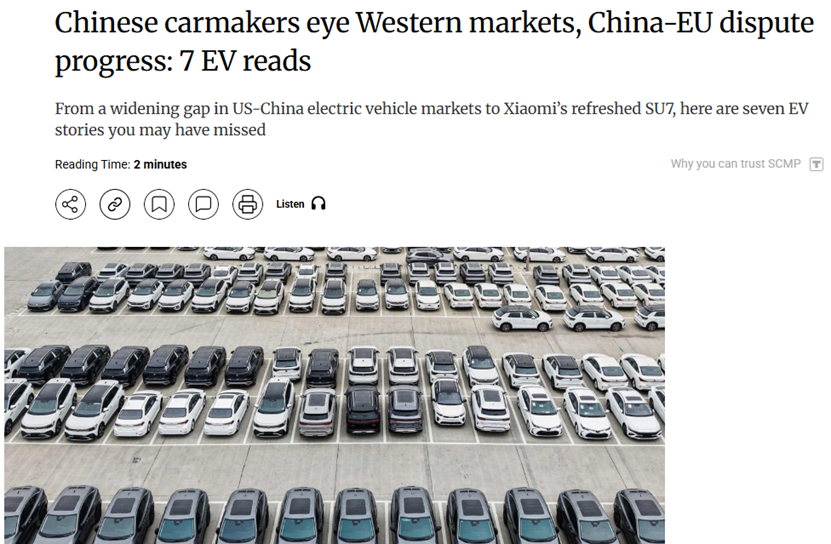
Core Insights - China's electric vehicle (EV) charging infrastructure is projected to reach 20.092 million units by December 2025, supporting over 40 million new energy vehicles [1] - The development of charging facilities in China is characterized by rapid growth, improved efficiency, and wider coverage [1] Group 1: Charging Infrastructure Growth - The scale of charging facilities is growing rapidly, with the number of charging stations increasing from 1 million to 10 million in just five years, and from 10 million to 20 million in only 18 months [1] - The average charging power of public charging stations has reached 46.5 kW, with charging efficiency improving by 33% year-on-year [1] Group 2: Coverage and Accessibility - A total of 71,500 charging piles have been built in highway service areas, covering over 98% of service areas nationwide, with 19 provinces achieving "full coverage" of charging facilities [1] - The EU's upcoming guidelines to address anti-dumping tariffs on Chinese electric vehicles by 2026 indicate significant progress in resolving long-standing trade disputes [4] Group 3: Global Market Position - The U.S. is perceived to be lagging in the electric vehicle sector after years of competition, while more Western countries are opening their markets to Chinese high-end electric vehicles [4] - The year 2026 is anticipated to be a pivotal year for Chinese electric vehicle manufacturers in achieving key advancements in the global market [4]