
美股

Search documents
X @Bloomberg
Bloomberg· 2025-11-24 23:26
今日必读🥇中美元首上月会晤之后再通话🥈部分华尔街大行继续看好美股🥉中国回应日本在西南诸岛部署武器获取免费中文电子报《彭博财经早茶》,洞悉全球市场动态。Catch up on what's moving China's markets in our free Chinese language newsletter. https://t.co/kLijqx6OOV ...
美股盘初拉升,纳指涨超1.5%
Xin Lang Cai Jing· 2025-11-24 15:13
Group 1 - The core viewpoint of the article highlights a significant upward movement in the U.S. stock market, with the Nasdaq rising over 1.5% and the S&P 500 index increasing by 1% [1] - Tesla's stock experienced a notable increase, rising by over 5% during the early trading session [1]

美股三大股指集体高开
第一财经· 2025-11-24 14:40
11月24日,美股三大股指集体高开,道琼斯指数涨0.17%,标普500指数涨0.60%,纳斯达克综合指 数涨0.93%。 | 名称 | 现价 | 涨跌 | 涨跌幅 | 年初至今 | | --- | --- | --- | --- | --- | | 道琼斯工业平均 | 46325.27 | 79.86 | 0.17% | 8.89% | | 纳斯达克指数 | 22481.10 | 208.02 | 0.93% | 16.42% | | 标普500 | 6642.93 | 39.94 | 0.60% | 12.94% | 大型科技股集体上涨,谷歌涨超3%,特斯拉、博通涨逾2%。 中概股普涨,纳斯达克中国金龙指数盘初涨超2%,禾赛科技涨超9%,哔哩哔哩、文远知行涨逾6%, 百度涨超5%, 网易、阿里巴巴涨超4%, 爱奇艺涨超3%。 编辑 | 钉钉 ...


和讯投顾刘阳:下周行情预测
Sou Hu Cai Jing· 2025-11-23 12:41
Core Viewpoint - The recent decline in the Chinese stock market is not indicative of systemic risk, as macroeconomic data remains stable, and the drop is attributed to external market conditions and emotional factors [1] Group 1: Market Analysis - The market pullback is characterized as a short-term phenomenon influenced by geopolitical factors and the futures settlement date, leading to a stronger emotional release than usual [1] - A significant number of investors are exiting the market, but once the current matrix stabilizes, a substantial rebound is anticipated [1] Group 2: External Influences - Following a significant drop in U.S. stocks, relevant authorities quickly intervened to stabilize market expectations [1] - The probability of a Federal Reserve interest rate cut in December has risen to over 50%, which positively impacted U.S. stocks and led to a rebound in Chinese concept stocks [1] Group 3: Future Outlook - The end of the interest rate hike and balance sheet reduction cycle began in September, indicating that future monetary policy will focus on the timing and amount of liquidity injected into the market [1] - A weekly-level rebound is expected in the upcoming week, suggesting a positive outlook for the market [1]
美股信心崩溃?别急,真正的恐慌还未降临!大跌何时触底?一大信号判断真正熊市!
美投讲美股· 2025-11-23 02:56
Service Overview - Meitou Pro offers professional stock research for Chinese investors, providing a 7-day free trial for new users [1] - The platform includes Pro Stocks for tracking popular stocks, Pro Market for macro reports, Pro ETF for passive income opportunities, Pro News for daily summaries, Pro Academy for systematic learning, Pro Q&A for investment insights, and Pro Trading for real-time trade sharing [1] - Meitou Pro features over 500 in-depth analysis videos and over 10,000 text analyses [1] Content Focus - The platform offers content on various investment topics, including postmodern cycles, electric vehicle investment, strategies to "beat Wall Street," and the "endgame" of US Treasury bonds [1] - Risk quantification is addressed, along with popular works series, ETF investing from beginner to expert, and the ceiling of AI investment [1] - Content also covers topics like avoiding bank savings, identifying ETFs that survive bull and bear markets, and avoiding common bull market traps [1] - Investment planning, reasons for financial struggles, emotional vs rational investing, inflation strategies, and asset allocation are also covered [1] Options Trading Education - Meitou provides options trading education, including a series of tutorials covering the basics, practical demonstrations, and strategies for using traditional stocks for options [1] - The platform also offers insights on how to trade options during earnings season and how to interpret financial reports [1] Investment Strategies - The platform provides insights into value investing, risk management, wealth accumulation, dividend stock investing, and the utility of technical analysis [1] Investment Psychology - Content addresses investment psychology, including becoming an unemotional investor and using psychology to succeed in investing [1] - The platform also explores the psychology of losing money in the stock market [1] Industry Analysis - Meitou offers industry-specific analyses covering sectors like payment processing, cloud computing, healthcare, streaming, Chinese stocks, cannabis, the metaverse, and AI [1] YouTube Channels - Meitou has additional YouTube channels: "Meitou Kan News" and "Meitou Jiang Options" [1] Contact Information - Business cooperation inquiries can be sent to meitouinvesting@gmailcom [1] - The WeChat public account is Meitou_Investing, and the WeChat ID is meitoujiangmeigu [1]

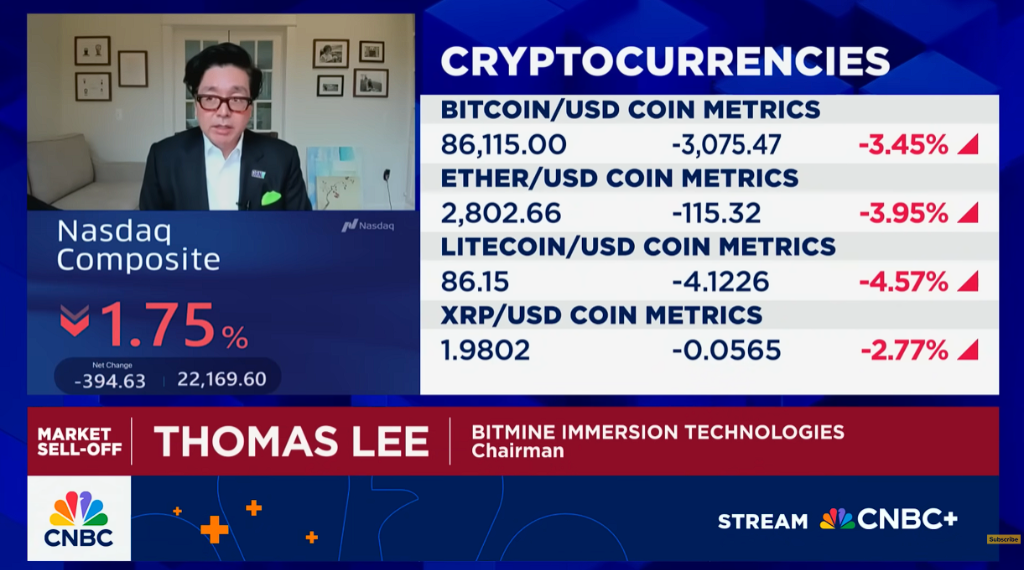
华尔街大佬Tom Lee:加密市场调整可能接近尾声,比特币正在成为美股的领先指标
Hua Er Jie Jian Wen· 2025-11-21 10:11
Core Insights - The cryptocurrency market, which has been weak since October 10, is nearing the end of its adjustment phase, with Bitcoin and Ethereum acting as leading indicators for the U.S. stock market [1][9] - The recent market turmoil is attributed to a significant liquidation event that severely impacted market makers, who play a crucial role in providing liquidity [1][5] Market Conditions - The October 10 liquidation event caused a major disruption, with a stablecoin's price dropping from $1 to $0.65, triggering an automatic liquidation mechanism that affected approximately 2 million crypto accounts [5][6] - Market makers, likened to a central bank for the crypto market, have faced substantial capital losses, leading to a reduction in their balance sheets and exacerbating liquidity issues [7][9] Historical Context - The current market situation is compared to past crises, such as the 1987 market crash and the 2009 financial crisis, with a recovery timeline of approximately eight weeks based on previous experiences [8] - As of now, six weeks have passed since the October 10 event, suggesting that the adjustment period may soon conclude [8] Market Dynamics - Bitcoin has shown a tendency to decline before the stock market, indicating its role as a leading indicator and reflecting the tight liquidity conditions in the crypto market [3][9] - The ongoing decline in cryptocurrency prices is a result of the damaged state of market makers, which has created a vicious cycle of reduced trading activity and further price pressure [7][9]
美国9月非农远超预期,12月降息前景不明
Dong Zheng Qi Huo· 2025-11-21 05:44
1. Report Industry Investment Rating - The rating for the US dollar is "oscillating" [2] 2. Core View of the Report - The US September non - farm payrolls far exceeded expectations, and the prospect of a December interest rate cut is unclear. The employment market has not significantly deteriorated, and the urgency for a rate cut is not strong. The December interest rate meeting is more likely to result in no rate cut and a dovish stance on the future rate - cut path [3][4][37] 3. Summary by Relevant Catalogs 3.1 US September Non - farm Payrolls and Interest Rate Outlook - **Employment Data**: The US added 119,000 non - farm jobs in September, far exceeding the market expectation of 50,000. The unemployment rate rose to 4.4%, higher than expected, and the labor participation rate slightly rebounded to 62.4%. Hourly wage growth was 0.2% month - on - month and 3.8% year - on - year, with the month - on - month rate down from the previous value [3][10] - **Industry Breakdown**: New jobs mainly came from education and healthcare (59,000), leisure and hospitality (47,000), construction (19,000), and retail (14,000). Sectors such as transportation and warehousing, professional and business services, manufacturing, and the federal government continued to lay off workers [3] - **Interest Rate Meeting Outlook**: As the last employment report before the December interest rate meeting, the data's lag reduces its reference value. Market expectations for a rate cut have slightly increased [4][37] 3.2 Investment Recommendations - With a cumulative 50bp rate cut in 2025 and no further acceleration of the economic slowdown, most Fed officials prefer to pause the rate - cut rhythm. Precious metals will continue to consolidate, US Treasury yields will oscillate at recent highs, the US dollar index will oscillate with a slight upward bias, and high - valuation pressure on US stocks will be prominent, with short - term volatility remaining high [5][42]
比特幣仍狂跌!市場開始投降,不要接飛刀!去更低?
提阿非羅大人TiaBTC· 2025-11-20 19:39
Market Analysis - The cryptocurrency market is currently experiencing a downtrend, with Bitcoin showing predominantly negative price action on the daily chart [1] - Bybit's Bitcoin USD perpetual funding rates are high, historically indicating limited potential for a significant upward reversal [1] - A substantial market rebound is not anticipated unless a period of intensely negative funding rates occurs, potentially signaling a short-term or medium-term buying opportunity [1] - From a weekly perspective, Bitcoin's price movement suggests a longer-term downward trajectory, potentially extending to lower price levels [1] - The analysis suggests that the current price action may represent the initial phase of a multi-wave downward correction [1] Trading Strategy - Short-term long positions should only be considered if smaller timeframe market structures shift favorably, accompanied by a pullback [1] - Scalping long positions are the only viable option for short-term trades in the absence of a broader market structure shift [1] - A potential support level exists at a lower price point, but a period of consolidation and market structure change is necessary before considering long positions [1] - A false breakout followed by a decline at a key resistance level could present an opportunity to add to short positions [1] Risk Assessment - Altcoins are likely to continue declining towards zero, emphasizing the importance of focusing on Bitcoin [1] - The U S stock market may be facing challenges, potentially exacerbating the downward pressure on Bitcoin [1]

美股持续回落,三大指数全线转跌
Xin Lang Cai Jing· 2025-11-20 17:04
Core Viewpoint - The U.S. stock market continues to decline, with all three major indices turning negative after a period of gains, including the Nasdaq which briefly rose over 2.5% [1] Group 1 - The U.S. stock market is experiencing a downturn, with all major indices showing a downward trend [1] - The Nasdaq index had a momentary increase of more than 2.5% before reversing direction [1]