
银行资产质量

Search documents
瑞丰银行(601528):核心营收能力增强,不良生成边际改善
Huachuang Securities· 2025-08-27 08:03
Investment Rating - The report maintains a "Recommend" rating for Ruifeng Bank with a target price of 6.86 CNY [2][7]. Core Views - Ruifeng Bank's core revenue capacity has strengthened, with marginal improvement in non-performing loan generation. The bank reported a 3.91% year-on-year increase in operating income for the first half of 2025, reaching 2.259 billion CNY, and a 5.59% increase in net profit attributable to shareholders, totaling 890 million CNY [2][7]. - The non-performing loan ratio slightly increased by 1 basis point to 0.98%, while the provision coverage ratio rose significantly by 14 percentage points to 340% [2][7]. Financial Performance Summary - In the first half of 2025, the bank's net interest income and non-interest income showed positive growth, with net interest income increasing by 4.2% and non-interest income improving significantly by 232.5% year-on-year [7]. - The bank's total assets increased by 9.5% year-on-year, with loans and bond investments growing by 9.5% and 10.3%, respectively [7]. - The bank's asset quality remains stable, with a slight increase in the non-performing loan ratio and a decrease in the net generation rate of non-performing loans [7][11]. Future Projections - The report forecasts revenue growth rates of 5.4%, 8.1%, and 11.9% for 2025, 2026, and 2027, respectively, with net profit growth rates of 8.4%, 10.7%, and 11.1% for the same years [7][8]. - The bank's price-to-book ratio is currently at 0.56x for 2025, with a target price set at 0.67x [7][8].
成都银行(601838):规模效益齐升,资产质量优异
Dongguan Securities· 2025-08-27 05:47
Investment Rating - The report maintains a "Buy" rating for Chengdu Bank [1][7]. Core Views - Chengdu Bank's performance in the first half of 2025 shows steady growth, with a significant increase in net interest income and a strong asset quality [4][7]. - The bank's total assets reached 1.37 trillion yuan, reflecting a year-on-year growth of 14.32%, with loans increasing by 18.30% [7]. - The net interest margin improved to 1.62%, while the non-performing loan ratio remained stable at 0.66% [7][10]. - The report highlights the bank's advantageous location and its ability to achieve double-digit growth in both deposits and loans [7]. Summary by Sections Financial Performance - Chengdu Bank achieved an operating income of 12.27 billion yuan in the first half of 2025, up 5.91% year-on-year, with a net profit of 6.617 billion yuan, an increase of 7.29% [4][7]. - The bank's net interest income rose by 7.59% year-on-year, with a notable increase of 11.59% in Q2 2025 [7]. Asset Quality - The non-performing loan ratio stood at 0.66%, unchanged from the previous year, with a provision coverage ratio of 452.65%, indicating strong asset quality [7][10]. Growth Prospects - The report projects that Chengdu Bank's earnings per share will reach 21.51 yuan by 2025, with the current stock price corresponding to a price-to-book ratio of 0.83 [7][9].
成都银行(601838):息差稳,不良优
ZHESHANG SECURITIES· 2025-08-27 00:17
Investment Rating - The investment rating for Chengdu Bank is "Buy" with a target price of 21.12 CNY per share, indicating an upside potential of 18% from the current price of 17.86 CNY [5][7]. Core Insights - Chengdu Bank's H1 2025 earnings growth has improved, with revenue and net profit attributable to shareholders increasing by 5.9% and 7.3% year-on-year, respectively [2][5]. - The bank's asset quality remains strong, with a non-performing loan (NPL) ratio stable at 0.66% and a provision coverage ratio of 453% as of the end of Q2 2025 [4][5]. - Future growth is supported by strong regional economic vitality and robust credit demand, which is expected to sustain rapid profit growth [3][5]. Summary by Sections Earnings Performance - Chengdu Bank's revenue and net profit for H1 2025 increased by 5.9% and 7.3% year-on-year, with quarter-on-quarter growth rates improving by 2.7 percentage points and 1.6 percentage points, respectively [2][5]. - The bank's total assets grew by 14.3% year-on-year, with loans increasing by 18.0% [2][5]. Interest Margin and Cost of Deposits - The net interest margin for Q2 2025 slightly decreased by 2 basis points to 1.58%, but improved by 1 basis point year-on-year, primarily due to a reduction in deposit costs [3][4]. - The cost of deposits improved to 1.96% in H1 2025, down from 2.16% in 2024, benefiting from interest rate cuts [3][4]. Asset Quality - The NPL ratio remained stable at 0.66%, while the attention loan ratio increased slightly to 0.44% [4][5]. - The TTM generation rate for NPLs and attention loans decreased by 14 basis points to 0.27%, indicating continued improvement in asset quality [4][5]. Profit Forecast and Valuation - Chengdu Bank's net profit is projected to grow by 7.95%, 7.35%, and 9.52% for 2025, 2026, and 2027, respectively, with corresponding book values per share of 21.12, 23.60, and 26.35 CNY [5][12]. - The target valuation for 2025 is set at a price-to-book (PB) ratio of 1.0x [5].
一上市银行被员工举报周末无偿加班 “领导不来 全体员工坐一天”
Di Yi Cai Jing· 2025-08-25 06:54
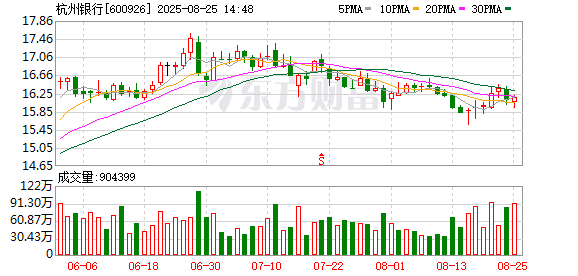
Core Viewpoint - Recent allegations of unpaid overtime at Hangzhou Bank have sparked discussions about employee workload and management practices within the banking sector [6] Company Performance - Hangzhou Bank reported a revenue of 20.093 billion yuan for the first half of 2025, a year-on-year increase of 3.89% [7] - The net profit attributable to shareholders for the same period was 11.662 billion yuan, reflecting a growth of 16.67% compared to the previous year [7] - As of June 30, 2025, the total assets of Hangzhou Bank reached 2235.595 billion yuan, up 5.83% from the end of the previous year [7] - The total loan amount was 1009.418 billion yuan, increasing by 7.67% from the previous year-end [7] - Total deposits amounted to 1338.282 billion yuan, a growth of 5.17% from the previous year-end [7] - The non-performing loan ratio stood at 0.76%, with a provision coverage ratio of 520.89% [7] - The core Tier 1 capital adequacy ratio and total capital adequacy ratio were 9.74% and 14.64%, respectively, both showing improvements from the previous year [7] Industry Context - The banking sector is facing performance growth pressures, with the net interest margin for commercial banks dropping to 1.42% in Q2 2025, a decrease of 0.01 percentage points from the previous quarter [5] - The net profit for commercial banks in the current year totaled 1.2423 trillion yuan, marking a year-on-year decline of 1.2% [5]


江苏银行(600919):信贷投放强劲,资产质量优质
Guoxin Securities· 2025-08-24 09:03
Investment Rating - The investment rating for the company is "Outperform the Market" [5] Core Views - The company demonstrated strong credit growth and maintained high asset quality, with a revenue of 44.86 billion yuan and a net profit of 20.24 billion yuan for the first half of 2025, reflecting year-on-year growth of 7.8% and 8.0% respectively [1] - The net interest income increased by 19.1% year-on-year, while non-interest income saw a decline of 20% due to market fluctuations [1][2] - The company’s asset quality indicators improved, with a non-performing loan ratio of 0.84%, marking a historical low [3] Financial Performance Summary - For the first half of 2025, the company achieved a revenue of 448.6 billion yuan and a net profit of 202.4 billion yuan, with a year-on-year growth of 7.8% and 8.0% respectively [1] - The annualized ROE was 15.64%, placing the company among the industry leaders [1] - The total assets reached 4.79 trillion yuan, with a loan balance of 2.43 trillion yuan and a deposit balance of 2.54 trillion yuan, reflecting growth rates of 21.2%, 16.0%, and 20.2% respectively compared to the beginning of the year [2] Asset Quality and Risk Management - The company reported a non-performing loan ratio of 0.84%, down 5 basis points from the beginning of the year, indicating improved asset quality [3] - The provision coverage ratio stood at 331%, demonstrating strong risk mitigation capabilities [3] - The company’s credit impairment losses increased by 48.2% year-on-year, with a specific increase of 22.56% in loan credit impairment losses [3] Earnings Forecast and Valuation - The forecasted net profit for 2025-2027 is 35.4 billion yuan, 40.2 billion yuan, and 45.5 billion yuan respectively, with corresponding year-on-year growth rates of 11.2%, 13.5%, and 13.2% [3] - The current stock price corresponds to a PB ratio of 0.79x for 2025, 0.71x for 2026, and 0.63x for 2027 [3]

江苏银行(600919):规模加速扩张,零售资产质量边际改善
Yin He Zheng Quan· 2025-08-24 07:09
Investment Rating - The report maintains a "Recommended" rating for Jiangsu Bank [1][4]. Core Views - Jiangsu Bank has shown steady performance with an increase in revenue growth, achieving operating income of 44.864 billion yuan in H1 2025, a year-on-year increase of 7.78%, and a net profit attributable to shareholders of 20.238 billion yuan, up 8.05% year-on-year [4]. - The bank's asset quality is improving, with a non-performing loan ratio of 0.84% as of June 2025, a decrease of 2 basis points from the previous quarter, marking a historical low [4]. - The bank's net interest income reached 32.939 billion yuan in H1 2025, reflecting a robust growth of 19.1% year-on-year, driven by strong asset scale growth [4]. - The bank is focusing on expanding its retail business and wealth management, with retail assets under management (AUM) increasing by 14.39% year-to-date [4]. Summary by Sections Financial Performance - Jiangsu Bank's H1 2025 operating income was 44.864 billion yuan, with a year-on-year growth of 7.78%. The net profit attributable to shareholders was 20.238 billion yuan, up 8.05% year-on-year. The annualized weighted average ROE was 15.64%, down 0.78 percentage points year-on-year [4]. - In Q2 2025, revenue and net profit attributable to shareholders grew by 9.38% and 7.95% year-on-year, respectively [4]. Asset Quality - The non-performing loan ratio was 0.84% as of June 2025, down 2 basis points from the previous quarter. The ratio of loans under scrutiny was 1.24%, down 9 basis points [4]. - The bank's provision coverage ratio stood at 331.02%, indicating a strong risk mitigation level [4]. Business Expansion - The bank's total loans increased by 15.98% year-to-date, with corporate loans growing by 23.3% and retail loans by 3.07% [4]. - The bank's deposits increased by 19.86% year-to-date, with corporate and personal deposits growing by 22.2% and 15.25%, respectively [4]. Investment Outlook - The report forecasts a steady growth trajectory for Jiangsu Bank, with projected BVPS of 14.16 yuan, 15.67 yuan, and 17.29 yuan for 2025, 2026, and 2027, respectively, indicating a favorable price-to-book ratio [4][42].
平安银行(000001):2025 年中报点评:收入利润降幅收窄,资产质量稳定
Guoxin Securities· 2025-08-23 15:30
Investment Rating - The investment rating for the company is maintained at "Neutral" [5][3]. Core Views - The company's overall performance meets expectations, with a narrowing decline in revenue and profit. The forecast for net profit from 2025 to 2027 is projected at 421/425/430 million yuan, with year-on-year growth rates of -5.5%/1.1%/1.2% [3][4]. - The annualized weighted average ROE for the first half of 2025 is 10.7%, a decrease of 1.1 percentage points year-on-year [1]. - The company's total assets grew by 2.1% year-on-year to 5.87 trillion yuan, with retail AUM increasing by 0.4% year-to-date [1][2]. Financial Performance Summary - Revenue for the first half of 2025 was 69.4 billion yuan, a year-on-year decline of 10.0%, which is a 3.0 percentage point improvement compared to the first quarter [1]. - Net profit attributable to shareholders for the same period was 24.9 billion yuan, down 3.9% year-on-year, with a 1.7 percentage point improvement from the first quarter [1]. - The average net interest margin for the first half of 2025 was 1.80%, a decrease of 16 basis points year-on-year, primarily due to falling market interest rates and loan structure adjustments [2]. - Non-interest income decreased by 2.0% year-on-year, mainly due to a decline in management fee income from wealth management products [2]. Asset Quality Summary - The non-performing loan generation rate for the first half of 2025 was 2.21%, a slight decrease of 0.01 percentage points year-on-year, indicating stable asset quality [2]. - The non-performing loan ratio at the end of the second quarter was 1.05%, down 0.01 percentage points from the beginning of the year [2]. - The coverage ratio for provisions was 238% at the end of the second quarter, a decrease of 13 percentage points from the beginning of the year [2].

平安银行上半年营收净利降幅收窄,零售业务依然承压
Di Yi Cai Jing· 2025-08-22 14:19
Core Viewpoint - The performance decline of Ping An Bank is primarily attributed to the contraction of net interest margin, decline in non-interest income, and significant reduction in retail business profits [1][2][6]. Financial Performance - For the first half of the year, Ping An Bank reported a 10% year-on-year decline in operating income and a 3.9% decrease in net profit, although the rate of decline has slowed compared to previous quarters [2][3]. - The bank's total assets reached 5.87 trillion yuan, a 1.8% increase year-on-year, with loan and deposit balances growing by 10% and 4.6%, respectively [3][4]. - The net interest margin and net profit margin were recorded at 1.8% and 1.76%, down by 16 and 15 basis points year-on-year [2][7]. Income Sources - Interest income fell by 15.6% to 879.3 billion yuan, while net interest income decreased by 9.3% to 445.07 billion yuan [7]. - Non-interest income also saw a significant decline, with a total of 248.78 billion yuan, down 11.3% year-on-year, largely due to a 28.7% drop in wealth management fees [7][8]. Retail Business Impact - The retail business revenue dropped by over 20%, amounting to 310 billion yuan, with net profit from this segment falling to approximately 10 billion yuan, representing only 4% of total net profit [8]. - The contribution of retail business to net profit has decreased significantly, from 34.1% two years ago to a current level that is 27 percentage points lower [8]. Asset Quality and Cost Management - The bank's non-performing loan ratio stood at 1.05%, slightly down from the previous year, with an increase in the recovery of non-performing assets [4][5]. - Management and operational costs have decreased, totaling 192.06 billion yuan, a 9% reduction year-on-year [5].
中泰证券:银行Q2净息差基本稳定 净利润增速边际向上
智通财经网· 2025-08-18 23:37
Core Viewpoint - The banking sector is showing signs of stability with a slight decrease in net interest margin and improving profit growth, while different segments of banks are experiencing varying levels of performance [1][2][3][4]. Asset Quality - The total non-performing loans (NPL) in the banking sector decreased to 3.43 trillion yuan, down by 2.4 billion yuan from the previous quarter, with a non-performing loan ratio of 1.49%, down 2 basis points [2][3]. - The provision coverage ratio improved to 211.97%, an increase of 3.84 percentage points from the previous quarter [2][4]. Net Interest Margin - The industry net interest margin remained stable at 1.42%, with a slight decrease of 1 basis point [1][2]. - Different types of banks showed varied changes in net interest margin, with state-owned banks at 1.31%, joint-stock banks at 1.55%, city commercial banks at 1.37%, and rural commercial banks at 1.58% [2][3]. Scale - The banking sector's total assets grew by 8.9% year-on-year, with credit growth at 7.5% [3]. - New credit issuance for the quarter reached 3.19 trillion yuan, an increase of 720 billion yuan year-on-year [3]. Net Profit - The overall net profit of commercial banks decreased by 1.2% year-on-year in the first half of 2025, showing a slight improvement from a 2.3% decline in the first quarter [3][4]. - State-owned banks maintained positive profit growth, while joint-stock banks and rural commercial banks faced challenges due to asset quality pressures [3][4]. Capital - The capital adequacy ratio continued to rise, with core tier one capital adequacy ratio at 10.93%, tier one capital adequacy ratio at 12.46%, and total capital adequacy ratio at 15.58%, all showing increases from the previous quarter [4]. Investment Recommendations - The banking sector is recommended for investment, focusing on city and rural commercial banks with regional advantages and high dividend yields from large banks [1][4].

25年2季度银行业主要监管指标数据点评:银行内部持续分化,资产质量整体提升
Ping An Securities· 2025-08-17 13:42
Investment Rating - The industry investment rating is "Outperform the Market" which indicates that the industry index is expected to perform better than the market by more than 5% over the next six months [16]. Core Viewpoints - The report highlights a continuous internal differentiation within the banking sector, with an overall improvement in asset quality [3][5]. - The net profit growth rate for commercial banks in the first half of 2025 has turned negative at -1.2%, but the decline in profit has narrowed compared to the previous quarter [5]. - The net interest margin for commercial banks has decreased slightly to 1.42%, showing resilience despite the decline [5]. - The non-performing loan ratio has improved, decreasing to 1.49%, indicating a manageable risk level [5][3]. - The report suggests a strategic shift towards reallocation rather than trading, driven by changes in funding structures and stable inflows from passive indices [5]. Summary by Sections Regulatory Indicators - As of the end of Q2 2025, the total assets of banking institutions reached 403 trillion yuan, reflecting a year-on-year growth of 8.9% [3]. - The non-performing loan ratio decreased by 2 basis points from the previous quarter to 1.49%, with a provision coverage ratio of 212% [3]. Profitability Analysis - The net profit growth rate for large banks, joint-stock banks, and city commercial banks improved compared to Q1, while rural commercial banks saw a decline of 7.9% [5]. - The report notes that the profitability of large banks is stabilizing, while rural banks are facing increased credit costs due to ongoing reforms [5]. Asset Quality - The report indicates a continuous improvement in asset quality, with the non-performing loan ratio decreasing across various bank types [5]. - The provision coverage ratio has increased by 3.84 percentage points to 212%, indicating a stable risk mitigation capacity [5][3]. Investment Recommendations - The report recommends focusing on the A-share joint-stock bank sector and certain high-quality regional banks, while also considering Hong Kong-listed large banks for their dividend advantages [5].