
科技金融

Search documents
金融活水浇灌科技之花 贷款供给更有耐心
Jing Ji Ri Bao· 2025-12-05 00:35
Core Viewpoint - The enhancement of self-reliance and strength in technology is a major goal for economic and social development during the "14th Five-Year Plan" period, with a focus on financial support for building a strong technological nation [1] Group 1: Financial Support for Technology Enterprises - The "Zhe Ke United Loan" service model was introduced to address the financing needs of technology enterprises, providing tailored services for startups, growth, and mature stages [2][3] - The model allows multiple banks to jointly provide credit, mitigating risks and enhancing the sustainability of technology finance [3] - As of now, 27 banks in Zhejiang have participated in the "Zhe Ke United Loan," issuing loans totaling 10.87 billion yuan to 197 enterprises [4] Group 2: Digital Credit and Financial Services - Suzhou has developed a comprehensive financial service system for small and medium-sized technology enterprises, including a digital credit foundation and various financial products [5][6] - The "Science and Technology Innovation Score" model helps financial institutions assess the operational status of innovative enterprises, leading to customized financial services [6] - By October 2025, Suzhou aims to provide nearly 700 billion yuan in financing support to 13,800 technology SMEs through this system [6] Group 3: Support for Biomedicine Sector - The Nanjing Biomedicine Regional Technology Transfer Center has created a financial support system for technology transfer, addressing challenges faced by early-stage projects [8] - The "Technology Achievement Transformation Loan" is designed to support the commercialization of research outcomes from universities, offering favorable terms to reduce financing barriers [9] - As of the third quarter of this year, Jiangsu has provided 4.94 billion yuan in intellectual property pledge financing and 3.87 billion yuan in investment-loan linkage loans, with significant year-on-year growth [9]
参与科创板网下打新,上周两家理财公司9只产品获配摩尔线程
Cai Jing Wang· 2025-12-05 00:00
Group 1 - The core viewpoint of the articles highlights the active participation of wealth management companies in offline IPO subscriptions, with notable success in acquiring shares of the high-performance GPU chip company, Moore Threads [1][2][3] - From November 24 to November 30, the bank wealth management market saw the issuance of 1,166 new RMB wealth management products, a decrease of 46 products compared to the previous week, with 877 closed-end products and 289 open-end products [1] - Wealth management subsidiaries are the main players in the current bank wealth management market, with 31 companies issuing 997 products, accounting for over 85% of the total [1] Group 2 - Ningyin Wealth Management successfully acquired shares of Moore Threads through six products, with a total allocation of 34,400 shares and a total investment amount of 3.9288 million yuan, leading among bank wealth management companies [2] - Ningyin Wealth Management has participated in 25 IPO subscriptions this year, achieving a success rate of 96% with total allocations exceeding 10 million yuan [3] - The company emphasizes its commitment to supporting technological innovation and the real economy, issuing various themed wealth management products focused on smart manufacturing and technology innovation [3]


广东金融“含科量”持续跃升
2 1 Shi Ji Jing Ji Bao Dao· 2025-12-04 23:03
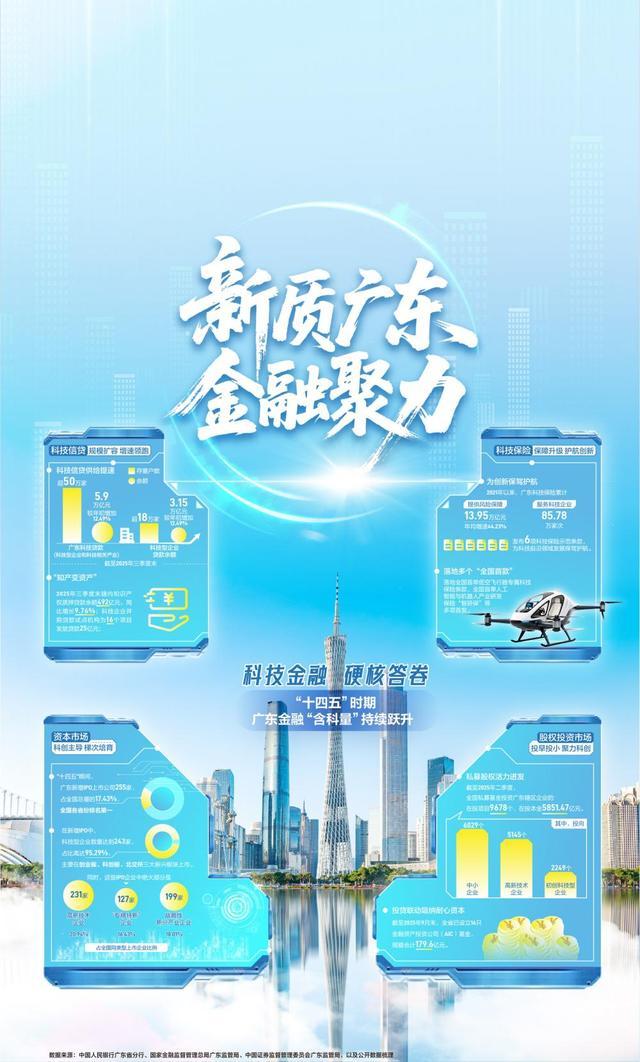
截至2025年9月末,广东科技型企业贷款余额达到3.15万亿元,实现从"不敢贷"到"敢贷愿贷能贷会 贷"的深刻转变。 ...
新质广东 金融聚力
2 1 Shi Ji Jing Ji Bao Dao· 2025-12-04 23:00
Core Insights - Guangdong's technology finance development during the "14th Five-Year Plan" period showcases a systematic and deeply integrated approach to fostering innovation and economic growth [1] Group 1: Banking Sector Transformation - The transformation of the banking sector is fundamental to the construction of a technology finance ecosystem, with policies like loan interest subsidies for manufacturing and high-tech enterprises significantly enhancing lending willingness [3] - A risk-sharing mechanism has been established to support technology loans, with provincial funds compensating up to 90% of losses for cooperating banks [3] - By September 2025, the loan balance for technology enterprises in Guangdong is projected to reach 3.15 trillion yuan, marking a shift from reluctance to a proactive lending environment [3] Group 2: Capital Market Reforms - Structural reforms in the capital market have created efficient growth platforms for technology enterprises, with the registration system reform enhancing the precision of multi-tiered capital market positioning [4] - Guangdong has seen a surge in IPOs, with 255 new companies listed in five years, 95.29% of which are technology enterprises, indicating a significant increase in "technology content" [4] - The bond market has also seen innovation, with a yearly growth rate of over 120% in the issuance of technology bonds, providing low-cost, long-term funding for technological advancements [4] Group 3: Growth of Equity Investment - The development of equity investment has established Guangdong as a source of industrial innovation, with government-led funds and industry capital playing a crucial role in supporting "hard technology" [5] - A comprehensive policy framework has been introduced to facilitate the entire investment cycle, promoting a virtuous cycle of investment, exit, and reinvestment [5] - The integration of banking, capital markets, and equity investment has created a multi-layered service system that fosters a positive cycle among technology, industry, and finance, positioning Guangdong as a leader in venture capital activity and technology enterprise listings [5]
广东资本市场五年蝶变 “科技叙事”逻辑日益清晰
2 1 Shi Ji Jing Ji Bao Dao· 2025-12-04 22:40
过去五年,对于广东资本市场而言,是一段"含科量"持续跃升、产融结合深度推进、"科技叙事"逻辑日 益清晰的蝶变历程。 "十四五"期间,广东新增IPO上市公司255家,其中科技型企业占比超95%;融资金额超过2400亿元,占 全国总融资额近15%;"首单""首例"密集涌现,标杆示范效应持续放大……广东资本市场以服务新质生 产力为核心,推动科技与资本深度融合,IPO向新兴板块集聚,债券融资规模稳步增长,私募股权精准 滴灌,制度赋能科技金融生态体系加速成型。 从"硬科技"企业的上市培育到未来产业的超前布局,从落实制度保障再到创新金融工具,广东正以一场 静水流深的变革,书写着资本市场支持科技创新自立自强的"广东样本"。 资本市场"含科量"加速提升 "含科量"成为衡量广东资本市场成色的关键指标。"十四五"期间,广东新增IPO上市公司255家,占全国 总量的17.43%,全国各省市排名第一,体现了其资本市场的活跃度和规模。 然而,更为关键的指标是其结构优化,注册制改革的深入推进,使得多层次资本市场体系的定位愈发精 准,新兴板块成为承载广东"硬科技"的主战场。在新增IPO中,科技型企业数量达到243家,占比高达 95.29% ...
从信贷支持到生态赋能:广东银行业科技金融的万亿级探索
2 1 Shi Ji Jing Ji Bao Dao· 2025-12-04 22:40
Core Viewpoint - The banking industry in Guangdong plays a crucial role in supporting technological innovation, with significant growth in technology-related loans over the past five years, reflecting the effectiveness of banking services in this sector [1][3][10]. Group 1: Financial Landscape and Growth - Guangdong has approximately 15,700 banking institutions, leading the nation in key financial metrics [1]. - As of September this year, the number of technology-related enterprises and related industry loan accounts reached 505,500, with a total balance of 5.9 trillion yuan, marking a 12.49% increase from the previous year [1]. - Loans specifically for technology enterprises reached 3.15 trillion yuan, with a 15.83% increase year-on-year [1]. Group 2: Policy Framework - The "Fourteen Five" plan emphasizes creating a "willing to lend" ecosystem for technology enterprises, addressing the inherent conflicts between high-risk, asset-light characteristics of these enterprises and the cautious nature of commercial banks [2][3]. - The "Science and Technology Finance Integration Implementation Opinions" (referred to as "Science and Technology Finance Fifteen Articles") introduced last year aims to enhance credit scale, improve assessment mechanisms, and establish risk-sharing systems [3]. Group 3: Risk Mitigation and Support Mechanisms - The introduction of the "Guangdong Province Science and Technology Credit Risk Compensation Management Measures" established a risk-sharing mechanism, allowing for up to 90% compensation for qualifying projects [3][4]. - The implementation of an innovation scoring system for enterprises helps banks assess innovation capabilities, facilitating better resource allocation [4]. Group 4: Service Capability Enhancement - Guangdong banks have established over 200 specialized branches focused on technology finance, enhancing their service capabilities for technology enterprises [5]. - A new evaluation mechanism for technology branches aims to improve service quality and efficiency over the next two years [6]. Group 5: Collaborative Ecosystem Development - The People's Bank of China in Guangdong is promoting a new five-party collaborative service model, integrating equity investment, banking, guarantees, insurance, and financial leasing to provide comprehensive support for technology enterprises [7]. Group 6: Expansion of Investment Opportunities - The expansion of AIC (Asset Investment Company) equity investment trials in Guangdong is seen as a key breakthrough for banks to enhance their technology financial services [8][9]. - Recent announcements from banks like CITIC and China Merchants Bank indicate a commitment to developing equity investment capabilities and enhancing collaboration with technology enterprises [9]. Group 7: Future Outlook - As the "Fifteen Five" period approaches, the banking sector in Guangdong is expected to further strengthen its capacity to support technological innovation, contributing to a virtuous cycle of technology, industry, and finance [10].
聚生态之力 筑科创高地 广东中行打造科技金融创新发展新范式
2 1 Shi Ji Jing Ji Bao Dao· 2025-12-04 22:40
Core Viewpoint - The article emphasizes the importance of building a strong technological nation in China, with Guangdong province playing a crucial role in fostering technological innovation and financial support for early-stage enterprises [1] Group 1: Financial Support for Innovation - Guangdong Bank has focused on technology finance as a key area for high-quality development, addressing the financing challenges faced by innovative enterprises, particularly in their early stages [1][3] - The bank has developed a comprehensive financial service system that covers the entire lifecycle of technology enterprises, from initial funding to growth and maturity [4][6] Group 2: Innovative Financial Products - Guangdong Bank has introduced various innovative financial products tailored to the needs of early-stage technology companies, such as "Tech Innovation Loans" and "Knowledge Benefit Loans," which allow for rapid digital processing of applications [4][7] - The bank has also launched the "Mid-Stage Loan" to support technology transfer during critical phases, utilizing contracts and intellectual property as collateral [5] Group 3: Ecosystem Collaboration - The development of a high-quality technology finance ecosystem requires collaboration among government, research institutions, industry players, and financial entities [8][9] - Guangdong Bank has established strategic partnerships with various governmental departments and industry leaders to create a collaborative ecosystem that integrates technology, industry, and finance [9][10] Group 4: Lifecycle Financial Services - The bank has structured its services to adapt dynamically to the different stages of a technology enterprise's development, ensuring comprehensive support from research and development to market entry [6][7] - A multi-tiered service organization has been established to provide direct support to technology enterprises across the province [6] Group 5: Integrated Financing Solutions - Guangdong Bank is exploring integrated financing solutions that combine equity investment, bank credit, and guarantee financing to support technology enterprises facing short-term liquidity challenges [10] - The bank's innovative approach aims to provide a seamless support system for early-stage technology companies, enhancing their growth potential [10]
金融活水浇灌科技之花
Jing Ji Ri Bao· 2025-12-04 22:08
Core Viewpoint - The enhancement of self-reliance and strength in technology is a major goal for economic and social development during the "14th Five-Year Plan" period, with a focus on financial support for building a strong technological nation [1] Group 1: Financial Support for Technology Enterprises - The establishment of a technology finance system that aligns with technological innovation is essential for promoting a virtuous cycle among technology, industry, and finance [1] - Hangzhou Yundong Technology Co., Ltd. received a 5 million yuan credit loan from Hangzhou Bank after a thorough assessment of its technology capabilities, which later increased to 80 million yuan as the company expanded [2] - The "Zheke United Loan" service model was introduced to address the financing needs of technology enterprises, providing tailored services for startups and established companies [2][3] Group 2: Innovations in Financing Mechanisms - The "Zheke United Loan" allows multiple banks to jointly provide credit, mitigating risks while enhancing support for technology enterprises [3] - The program has three innovations: promoting proactive financial services, increasing credit limits for growing enterprises, and diversifying risk among participating banks [3][4] - As of now, 27 banks in Zhejiang Province have participated in the "Zheke United Loan," issuing loans totaling 10.87 billion yuan to 197 enterprises [4] Group 3: Comprehensive Financial Services - The financial system faces the challenge of providing funding to technology-oriented small and medium-sized enterprises (SMEs), which often have weaker qualifications and higher risks [5] - Suzhou has developed a "1+5+N" comprehensive financial service system to support the digital credit needs of small enterprises, enhancing the efficiency of financing services [5][6] - The "Kechuang Index Loan" was created to help financial institutions better understand the operational status of innovative enterprises, providing tailored financial services throughout their lifecycle [6] Group 4: Regional Developments in Technology Financing - Jiangsu Province has the highest number of technology SMEs and high-tech enterprises in China, with a technology loan balance exceeding 5 trillion yuan, reflecting a 16% year-on-year increase [7] - The "Technology Achievement Transformation Loan" was introduced to support the transformation of university research projects into marketable products, addressing the challenges faced by early-stage projects [8][9] - By the end of Q3 2023, Jiangsu's knowledge property pledge financing and investment-loan linkage loans reached 49.4 billion yuan and 38.7 billion yuan, respectively, showing significant growth [9]
“耐心资本”作答时代课题 险资详解长期投资实践
Zheng Quan Shi Bao· 2025-12-04 17:49
证券时报记者 刘敬元 邓雄鹰 "十五五"即将开篇,在培育壮大新兴产业与未来产业的进程中,37万亿元险资如何更好发挥"耐心资本"作用,仍是 亟待解答的时代课题。 近日,在"第十九届深圳国际金融博览会暨2025中国金融机构年会"分论坛"2025中国保险业资产负债管理年会"上, 四位保险资管高管以"壮大耐心资本,赋能新质生产力"为主题展开了圆桌讨论,分享不同业务条线的实践和思 考。 这四位高管包括新华资产总裁陈一江,太保资产副总经理、董事会秘书赵峰,中意资产总经理助理陈伍斌,中邮 资管首席风险管理执行官张超。 长期投资试点 是"上下结合"的成果 自去年鸿鹄基金入市以来,保险资金长期投资试点改革在资本市场上受到高度关注,今年试点规模进一步扩围到 2220亿元。 张超表示,中邮资管获得第三批试点资格,在投资思路上,基金将发挥"耐心资本"的核心优势,坚持长期投资、 价值投资、责任投资的理念,重点围绕服务国家战略、科技等领域,展开深入研究和投资。 做好支持科技的"耐心资本" 科技创新的金融支持是当前重要命题,保险资金凭借"耐心资本"属性,正积极投身"科技金融"实践,相关领域已积 累诸多经验认识。 陈一江表示,对于险资这类大 ...

光大银行济南分行:“阳光科创”品牌助力科技型企业高质量发展
Qi Lu Wan Bao· 2025-12-04 15:05
Core Viewpoint - The Central Financial Work Conference prioritizes technology finance as the foremost area in financial development, emphasizing the need to allocate more financial resources to promote technological innovation [1] Group 1: Company Initiatives - China Everbright Bank places significant importance on the technology finance sector, striving to actively promote related business development and play a positive role in supporting national strategic initiatives [1] - The bank is focused on developing technology innovation finance as a key business direction, further integrating branch resources to establish the "Sunshine Technology Innovation" brand in the Qilu region [1] Group 2: Product Development - The Jinan branch of China Everbright Bank promotes three product systems—Moxing Series, Xinxing Series, and Juxing Series—targeting the lifecycle of technology-based enterprises, including their startup, growth, and maturity phases [2] - The bank aims to support the construction of the "Sunshine Technology Innovation" brand through these product offerings [2] Group 3: Addressing Challenges - The Jinan branch addresses challenges faced by technology enterprises, such as risk assessment difficulties, information asymmetry, uncertain profit models, and complex regulations, by deepening financial supply-side reforms [2] - The bank enhances its marketing of key products through a comprehensive product matrix that includes equity, loans, bonds, trusts, and private placements, ensuring a full lifecycle service approach [2] - A layered and categorized service mechanism is established to meet the diverse needs of technology-based SMEs, focusing on providing comprehensive solutions that allow these enterprises to concentrate on innovation and achieve high-quality development [2]
