
大数据

Search documents
数字金融“由大到强”的中国路径
Guo Ji Jin Rong Bao· 2025-12-27 03:56
Core Insights - Digital finance is a key component of China's financial power blueprint, with a complete structure already formed. The core industry value added of the digital economy grew by 9.2% year-on-year in the first three quarters of 2025, and the banking sector's digital investment accounted for 15.3% [1] Group 1: Structural Challenges - Structural contradictions are evident, including lagging institutional supply, with regulatory sandboxes covering only 8.7% of prefecture-level cities, and limited promotion of cross-border innovative products [1] - Data factor allocation is inefficient, with less than 30% of quality data, leading to difficulties in rights confirmation and token circulation, creating "data islands" [1] - Cross-border scenarios are insufficiently penetrated, with digital RMB cross-border transactions accounting for only 3.2%, and reliance on the SWIFT system limiting currency diversity [1] - Financing obstacles exist for small and medium-sized tech enterprises, which often have data without assets or assets without financing, resulting in inadequate valuation and risk control systems [1] Group 2: Proposed Solutions - To break the deadlock, it is suggested to open up the system by establishing a nationwide unified regulatory sandbox, covering core cities in 31 provinces by the end of 2026, led by the National Financial Regulatory Administration [1] - Aiming for full coverage of public data rights confirmation by 2026, a national unified registration platform will be built, clarifying data ownership and processing rights for enterprises and operational rights for personal data after desensitization [2] - A three-dimensional valuation model will be developed to assess "data quality + scenario value + market demand," and the entire pledge registration process will be streamlined to three working days [2] Group 3: Cross-Border Enhancements - The digital RMB's cross-border application will be deepened, with plans to connect with over 10 payment systems of economic entities by 2027, enabling multi-currency real-time settlement [3] - A cross-border data trusted exchange system will be established, breaking the reliance on SWIFT, with 29 countries connected to CIPS [3] - The establishment of offshore RMB bonds and core scenarios for cross-border supply chain finance will be concentrated in Hainan Free Trade Port and Shanghai Free Trade Zone by 2028 [3] Group 4: Collaborative Mechanisms - A joint inter-ministerial meeting will be established to coordinate cross-departmental regulation and data sharing, with biannual meetings [3] - Policy support will be provided for financing related to IoT and blockchain verification, with risk compensation up to 50% modeled after the US SBA [3] - Talent cultivation will be enhanced by adding courses on data compliance and offshore finance in universities, along with tax and housing guarantees for high-end talent [3] Group 5: Strategic Transition - China's digital finance is transitioning from "scale expansion" to "structural optimization," focusing on institutional innovation to resolve bottlenecks, empowering potential through data, and expanding space through cross-border breakthroughs [4]
让金融供给与科创规律更匹配
Sou Hu Cai Jing· 2025-12-26 22:56
Core Viewpoint - The recent meeting held by the People's Bank of China and the Ministry of Science and Technology emphasizes the importance of deepening financial supply-side structural reforms to support the construction of a technology-driven nation, highlighting the strategic position of technological self-reliance during the 14th Five-Year Plan period [1] Group 1: Financial and Technological Integration - The integration of finance and technology is crucial for addressing challenges and stimulating high-quality development, with financial services aimed at precisely supporting technological innovation [1] - The transition from "single-point breakthroughs" to "ecological symbiosis" in technology finance emphasizes collaboration among various stakeholders, including government, financial institutions, technology companies, and research institutions [2] Group 2: Government and Financial Institutions' Roles - Governments play a dual role as guides and service providers, implementing forward-looking strategies and optimizing the business environment while also using market-oriented methods to attract social capital into technology innovation [2] - Financial institutions are evolving from mere fund providers to comprehensive financial service integrators, with innovations like intellectual property pledge financing addressing the financing challenges faced by technology enterprises [2] Group 3: Current State and Challenges of Technology Finance - China's technology finance scale ranks among the world's top, characterized by systematic policy innovation and large-scale mobilization of market resources [3] - There are structural contradictions between the risk-averse nature of finance and the high uncertainty of technological innovation, necessitating a rethinking of financial supply logic to align with the long cycles and high risks of technology innovation [3] Group 4: Evaluation and Risk Management - Establishing a multi-dimensional evaluation system that includes technology maturity and team stability is essential, with a focus on integrating non-financial indicators into credit decision-making [4] - The introduction of standardized data interfaces and intelligent assessment tools can help overcome financing difficulties for light-asset enterprises by transforming dormant patents into standardized financial assets [4] Group 5: Capital Market Support and Long-term Funding - Strengthening the capital market's support for the entire chain of technology achievement transformation and broadening long-term funding channels is critical [5] - Enhancing tax incentives and exit mechanisms for private equity and venture capital, along with increasing government fund contributions to early-stage technology funds, will promote investment in technology [5]
如何贡献“基金力量”?这家“个人系”公募最新发声
券商中国· 2025-12-26 13:33
党的二十届四中全会围绕全面建成社会主义现代化强国、实现第二个百年奋斗目标,审议通过了"十五五"规划 建议。全会对加快建设金融强国和资本市场高质量发展、推进文化强国建设等作出战略部署,并将坚持党的全 面领导作为"十五五"时期经济社会发展的首要原则,为资本市场未来五年发展提供了根本遵循和行动指南。 站在新的历史起点,泓德基金认为,公募基金作为资本市场的重要参与主体,肩负着服务实体经济、助力居民 财富管理的核心使命,应为资本市场高质量发展、为全面建设社会主义现代化强国贡献基金力量。 编者按: 三十余载砥砺前行,中国资管行业从初步探索到如今跻身全球前列,与经济的蓬勃发展和制度的日趋完善密不可 分。在此期间,公募与私募协同发展的多元生态为资本市场的鼎新革故注入了核心动力,二者的发展始终与国家 改革同频共振,与经济发展浪潮同向而行,与产业升级齐头并进。 站在"十五五"开启的历史节点,二十届四中全会明确的"高质量发展取得显著成效、科技自立自强水平大幅提高"等 目标,为资本市场赋予了更重使命。中国证券投资基金业协会与证券时报·券商中国携手推出本次联名报道,特别 邀请多家国内头部公私募基金高管,从制度创新、市场演进、投资实践等 ...


高效理赔显担当 专业服务暖人心——中国人寿快速处理理赔案件获赞誉
Xin Lang Cai Jing· 2025-12-26 12:21
Core Viewpoint - China Life Insurance's efficient claims service has successfully processed claims, providing warmth and hope to families in distress, highlighting the insurance industry's role as a "social stabilizer" [1][3] Claims Processing - In a recent case, a client diagnosed with lung cancer received a claim payment of 20,000 yuan within a day of submitting the claim, exemplifying the "critical illness one-day claim" commitment [4][1] - The company has optimized internal approval processes and enhanced inter-departmental collaboration to expedite claims payments, alleviating financial pressure on families [5][2] Industry Standards - The "critical illness one-day claim" initiative not only aids families but also sets a positive example for the insurance industry, emphasizing a customer-centric service philosophy [6][2] - The company has integrated advanced technologies such as big data and artificial intelligence to streamline claims processing, significantly improving efficiency and customer experience [6][2] - Recent data indicates that the company has reduced claims processing times and increased customer satisfaction, having provided claims services to millions and paid out hundreds of billions in claims [6][3] Future Commitment - The company aims to continue enhancing service levels and claims capabilities, adhering to the core philosophy of "helping others to achieve oneself," thereby safeguarding the quality of life for its clients [6][3]

【前瞻分析】2025年中国煤矿机械行业进口及出口外贸情况分析
Sou Hu Cai Jing· 2025-12-26 12:13
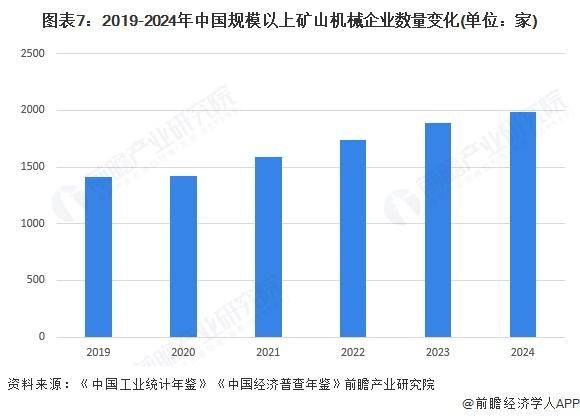
Industry Overview - The number of large-scale mining machinery enterprises in China has shown a growth trend, with 1,887 enterprises in 2023 and an estimated 1,987 enterprises in 2024 [1] - Coal mining machinery, as a core segment of mining machinery, holds a significant proportion of the total number of mining machinery enterprises [1] Market Outlook - The coal mining machinery industry serves as an upstream provider for coal enterprises, ensuring their healthy and stable development [3] - Despite a gradual decline in the proportion of coal energy consumption, the total coal consumption continues to increase annually, maintaining coal's foundational role in China's energy security [3] - The domestic coal mining machinery market is expected to grow steadily, driven by factors such as new coal mine capacity, equipment upgrades, and the integration of advanced technologies like AI and big data [3] - The market for coal mining machinery is projected to grow at a compound annual growth rate (CAGR) of 5.3% from 2025 to 2030, reaching approximately 176.7 billion yuan by 2030 [3] Import and Export Overview - The total import and export value of the coal mining machinery industry is expected to increase to $4.396 billion in 2024, representing a year-on-year growth of 12.0% [5] - The import value is projected to be $658 million, while the export value is expected to reach $3.739 billion, resulting in a trade surplus of $3.081 billion [5] - For the period of January to September 2025, the total import and export value and trade surplus are estimated at $3.815 billion and $2.977 billion, respectively [5] Export Trends - From 2021 to 2024, the export value of coal mining machinery products has shown an upward trend, with an expected export value of $3.739 billion in 2024, marking a year-on-year increase of 22.6% [7] - For the period of January to September 2025, the export value is projected to be $3.396 billion [7]
宇信科技荣获第十四届金融界“金智奖”投资价值上市公司
Sou Hu Cai Jing· 2025-12-26 10:52
Group 1 - The "Qihang·2025 Financial Summit" was successfully held in Beijing, focusing on the theme of "New Starting Point, New Momentum, New Journey," gathering hundreds of leaders and guests from regulatory bodies, industry associations, financial institutions, listed companies, and media [1] - The "Jinzhi Award" aims to establish benchmarks for high-quality development, guiding listed companies to focus on their core businesses, continue innovation, and fulfill social responsibilities, thereby promoting capital to gather towards quality enterprises [3] - The evaluation of the "Investment Value Listed Company" award is based on capital value and development potential, focusing on financial health, industry prospects, core competitiveness, governance standards, and sustainable development capabilities [3] Group 2 - Yuxin Technology has been a leader in the domestic financial technology sector for over 20 years, focusing on the digital transformation needs of core financial institutions such as banks, insurance, and securities [4] - The company has a comprehensive business system covering consulting planning, software products, development services, operation maintenance, system integration, and business operations, with a long-term stable client base across 13 types of licensed financial institutions [4] - Yuxin Technology is increasing its R&D investment in cutting-edge technologies such as AI, big data, cloud computing, and blockchain, launching several industry-leading digital products and solutions to help financial institutions optimize business processes and enhance service experiences [4] - The company's AI products and solutions have reached various banking clients, and it aims to validate and accumulate the effects of AI applications in business scenarios, integrating AI capabilities into more technical services [4] - Yuxin Technology's overseas expansion strategy has shown initial success, having won multiple overseas projects and formed strategic partnerships with several global fintech companies [4] - The company plans to continue focusing on its core business, deepening technological innovation, and expanding its business boundaries to inject lasting momentum into the digital transformation of the financial industry [5]


金融监管总局:加大人工智能与大数据技术的应用力度,丰富穿透式监管工具箱
Xin Lang Cai Jing· 2025-12-26 10:27
Core Viewpoint - The Financial Regulatory Administration has released the "Implementation Plan for High-Quality Development of Digital Finance in the Banking and Insurance Industries," which emphasizes the integration of digital and intelligent transformation into key regulatory work, outlining major initiatives to enhance digital regulatory capabilities [1][3]. Group 1: Process Optimization - The plan aims to significantly enhance the digital and intelligent levels of key regulatory processes such as market access, off-site supervision, on-site inspections, and administrative penalties, leveraging data technology to maximize the value of data elements and support the construction of "five major regulatory" capabilities [1][3]. Group 2: Technological Empowerment - There will be an increased application of artificial intelligence and big data technologies, enriching the toolbox for penetrating supervision, improving the foresight of financial risk monitoring and early warning, and enhancing the ability to identify, warn, expose, and address risks early [1][3]. Group 3: Regulatory Big Data Construction - The plan includes the establishment of a unified standard, collection, and management of regulatory data through the "one table for all" approach, improving the completeness, accuracy, and timeliness of regulatory data; it also aims to diversify big data sources to strengthen risk monitoring and dynamically capture abnormal behaviors of market entities [1][3]. Group 4: Regulatory Infrastructure - The plan emphasizes the integration and strengthening of computing resources, optimization of network architecture, and establishment of security protection and intelligent operation and maintenance systems to provide a safe and reliable infrastructure for the digital and intelligent transformation of regulation [2][4]. Group 5: Talent System Support - The digital transformation of regulation requires a supporting talent system, focusing on cultivating composite talents who understand technology, data, and regulatory business, enhancing regulatory personnel's data modeling and analysis capabilities through systematic training, and building a talent team for intelligent regulation [2][4].
政策东风起,财富新赛道:绿色积分与消费商引领新型消费革命
Sou Hu Cai Jing· 2025-12-26 10:26
Core Viewpoint - The Chinese government is initiating a new phase of consumption development through policies that establish a "consumption rebate points" system, promoting green consumption and digital economy, creating significant market opportunities for ordinary people [1] Policy Support - The development of green consumption points is backed by continuous government policies, starting from the 2016 guidelines to the recent 2025-2027 action plan, which emphasizes the full implementation of the green points system [3] - The legal framework for consumption points has been established, enabling various incentive methods such as point redemption and discounts to expand the green consumption market [3] - Pilot programs in cities like Beijing and Shanghai demonstrate the practical benefits of green consumption, with projections indicating that the energy-saving and environmental protection industry will reach a scale of 15 trillion yuan by 2030 [3] Core Logic - Green consumption points are evolving from simple rewards to a recognized value of consumers' environmentally friendly behaviors, covering a wide range of low-carbon consumption activities [4][5] - Unlike traditional points, green points can be converted into vouchers or even equity shares, allowing consumers to become stakeholders in the companies they support [5][7] Consumption Business Model - The consumption business model allows ordinary people to participate without significant investment, through green consumption rebates and social sharing of green products [7] - The rise of digital consumption service providers supports this model by matching green products with consumer needs, facilitating monetization through data services and carbon asset management [7] Online and Offline Integration - Green consumption points are integrated into various consumption scenarios, creating a seamless online and offline ecosystem that enhances consumer experience [9] - Consumers can earn points through purchases in both physical stores and online platforms, promoting a lifestyle centered around green consumption [9] Action Guidelines - To capitalize on the emerging market, individuals are encouraged to join government-backed green consumption platforms, learn about digital tools, and incorporate green consumption into their daily lives [10]

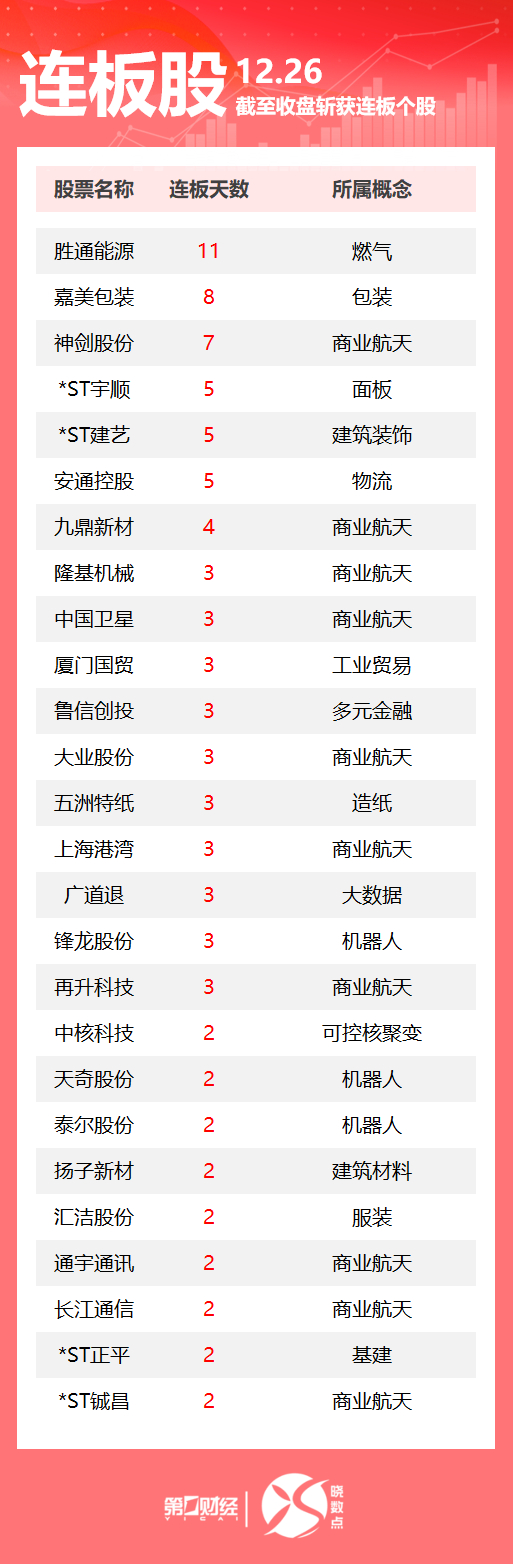
连板股追踪丨A股今日共92只个股涨停 胜通能源11连板
第一财经网· 2025-12-26 08:25
Group 1 - The core focus of the news is on the performance of stocks in the A-share market, highlighting significant gains in specific sectors, particularly gas and commercial aerospace [1] - Shengtong Energy achieved an impressive 11 consecutive trading limit-ups, indicating strong investor interest and confidence in the gas sector [1] - Other notable stocks include Jianjian Co., which recorded 7 consecutive limit-ups in the commercial aerospace sector, and Jiuding New Materials with 4 consecutive limit-ups, also in commercial aerospace [1] Group 2 - A total of 92 stocks reached their daily limit-up on December 26, showcasing a broad market enthusiasm [1] - The list of stocks with consecutive limit-ups includes various sectors, such as packaging, logistics, and construction, indicating diverse investment opportunities [2] - The performance of stocks like *ST Yushun and *ST Jianyi, both with 5 consecutive limit-ups, reflects ongoing interest in panel and construction decoration sectors [1][2]

信息发展(300469.SZ):公司的大数据分析技术能够对大量的空天数据进行实时分析和智能处理
Ge Long Hui· 2025-12-26 07:21
Core Viewpoint - The company emphasizes its commitment to the commercial aerospace sector as a strategic emerging industry, focusing on market-driven activities with profitable business models [1] Group 1: Industry Insights - Commercial aerospace aims to promote the widespread application of aerospace technology through market-oriented approaches [1] - The industry leverages advanced technologies such as Beidou, big data, blockchain, and artificial intelligence for various applications [1] Group 2: Company Capabilities - The company has developed high-precision positioning and data processing capabilities essential for the aerospace information industry [1] - Beidou's precise positioning technology can significantly support satellite navigation, spatial surveying, and drone remote sensing [1] - The company’s technology can achieve centimeter-level positioning accuracy, suitable for complex environments in aerospace data collection and processing [1] - The big data analysis technology enables real-time analysis and intelligent processing of vast amounts of aerospace data, providing comprehensive technical support for the industry [1] Group 3: Current Status - The company currently has no related collaborations in the commercial aerospace sector [1]
