
通用人工智能(AGI)

Search documents
马斯克值不值万亿美元薪酬 | 财经峰评 | 巴伦精选
Sou Hu Cai Jing· 2025-09-08 01:10
Core Viewpoint - The article discusses a new compensation plan for Tesla CEO Elon Musk, which could potentially reward him with stock worth approximately $1 trillion if he meets ambitious performance targets over the next decade [2][3]. Compensation Plan Details - The compensation plan proposes to grant Musk about 423 million shares of Tesla stock, which will be unlocked in 12 tranches upon achieving specific market and operational milestones [4]. - The market goal requires Tesla's market value to grow from approximately $1.1 trillion to $8.5 trillion, nearing the $10 trillion mark [4]. - Operational targets include delivering 20 million Tesla vehicles, achieving 1 million Robotaxi operations, delivering 1 million Optimus humanoid robots, obtaining 10 million Full Self-Driving (FSD) subscriptions, and increasing adjusted EBITDA to $400 billion [5][6][7][8]. Strategic Focus Areas - The targets highlight Tesla's focus on three main areas: Full Self-Driving (FSD), Robotaxi, and Optimus [9]. - The Robotaxi app has already surpassed Uber in the Apple Store, indicating strong market anticipation for Tesla's FSD technology commercialization [10]. - Tesla's cost advantage in Robotaxi operations is significant, being 37% cheaper than traditional ride-hailing services due to savings from fully autonomous operations and low energy consumption [10]. Competitive Landscape - Tesla is seen as a frontrunner in achieving large-scale autonomous driving applications, with industry consensus favoring its potential success over competitors like Waymo [11]. - Key competitors in the intelligent driving sector include Huawei and BYD, each with unique approaches and strengths [12][13]. Future Outlook - Achieving the outlined operational goals would enable Tesla to create a distributed network of vehicles equipped with FSD, transforming it from a leading electric vehicle manufacturer to an integrated AI giant [14]. - The potential market for humanoid robots like Optimus could be vast, possibly reaching valuations of $20 trillion to $30 trillion if successfully integrated into households and service sectors [14]. - The timeline for achieving these goals and whether Tesla will emerge as the winner remains uncertain, but Musk's leadership is deemed crucial for the company's morale and innovation pace [16][18]. Shareholder Support and Criticism - Shareholders are generally supportive of the compensation plan, viewing it as an opportunity for significant stock value increase [17]. - Critics argue that such a massive compensation could exacerbate wealth inequality and question the appropriateness of governance structures, suggesting that Tesla's reliance on Musk may be overstated [18][19].



通用人工智能(AGI)已经来了
3 6 Ke· 2025-09-08 00:21
Core Viewpoint - The concept of Artificial General Intelligence (AGI) is not a distant future but is already present, evolving through recursive processes that enhance its depth and scope [1][9][39] Group 1: AI and Organizational Transformation - The recent government document emphasizes the importance of "intelligent native enterprises," which represent a blend of technology and organizational models that transform production processes [3][5] - The challenge lies in bridging the gap between understanding AI technology and organizational operations, which is crucial for the implementation of AGI [8][18] - The emergence of "unmanned companies" signifies a shift towards AI-driven organizational structures, where AI becomes the primary agent of value creation [11][17] Group 2: Speed of Change and Value Creation - The rapid evolution of AI technologies is reshaping industries at an unprecedented pace, making previous models of operation obsolete [9][23] - Companies must adapt to the accelerated pace of AI development, as traditional business cycles may not align with the speed of technological advancements [26][28] - The focus should shift from merely using AI tools to redefining business models that maximize AI's potential [29][30] Group 3: New Paradigms and AI Thinking - The concept of "intelligent priority" suggests a need for new thinking patterns that prioritize virtual solutions and scalable experimentation [34][36] - The relationship between AI and human roles is being redefined, necessitating a shift in how companies approach collaboration between humans and AI [35][36] - The idea of "unmanned companies" raises questions about the future of business structures in a world where intelligence is evenly distributed, leading to potential economic stagnation [37][39]

从AI上下半场切换看后续产业投资机会
2025-09-07 16:19
Summary of Key Points from the Conference Call Industry Overview - The AI industry is transitioning from deep learning to large language models, focusing on intelligent emergence, which includes understanding, generation, memory, and logic capabilities, reshaping user experience and production efficiency [1][3][4] Core Insights and Arguments - The development of the AI industry relies on three key elements: computing power, algorithms, and data, creating a flywheel effect that drives continuous improvement [5] - The AI technology development is divided into two phases: the first phase focuses on exploring the limits of model intelligence with computing power as the priority, while the second phase emphasizes system capability enhancement and application [6] - The widespread application of the Transformer framework has led to a qualitative change in AI capabilities, paving the way towards AGI (Artificial General Intelligence) and generating new paradigms in text, image, and video fields [7] - In the short term, the upgrade of large models is approaching a ceiling, shifting the focus towards application effectiveness, with key development paths including efficiency enhancement, reasoning improvement, and multimodal models [8] Notable Trends and Developments - Major overseas tech companies, such as Meta, are significantly increasing capital expenditures, with expectations of over 50-60% growth in 2025 compared to 2024, indicating a strong investment in computing power to support the transition from the first to the second phase of AI development [9] - AI's impact on job replacement is categorized into three stages: assistance, replacement, and surpassing human capabilities, with current applications already replacing lower-level jobs in programming and content review [10] Market Dynamics and Future Outlook - The AI industry has experienced three major waves of development, with the latest wave driven by machine learning and deep learning since 2000, leading to significant advancements in various fields [2] - The long-term logic of AI development is based on the substantial growth of the computing power industry and the diversification of application scenarios, with potential exponential acceleration once AI reaches human-level intelligence [12] - AI-native applications are expected to see significant growth, with a projected increase in computing power demand as these applications proliferate, particularly by 2025 [17] Investment Opportunities - Companies to watch include infrastructure firms like Alibaba and Shenxinfu, as well as computing power-related companies like Hangji and Haiguang. Additionally, companies with strong business models and potential for future breakthroughs, such as PetroChina and Meitu, are highlighted as key players [18]
OpenAI,开始对马斯克“猎巫”
Sou Hu Cai Jing· 2025-09-07 13:25
Core Viewpoint - The ongoing legal battle between Musk and OpenAI highlights a significant conflict over the future ownership and direction of AI technology, with OpenAI taking aggressive legal actions against organizations that support Musk's stance [2][8][28] Group 1: Legal Actions and Responses - OpenAI has begun issuing a series of subpoenas to nonprofit organizations that have publicly supported Musk, demanding access to communications and documents related to Musk [3][5][6] - The legal actions are perceived as a form of intimidation, akin to a witch hunt, targeting those who have questioned OpenAI's transition from a nonprofit to a for-profit entity [7][15] - The organization Encode, which submitted a "friend of the court" brief in support of Musk, was among those targeted by OpenAI's legal maneuvers [4][6] Group 2: Historical Context of the Dispute - Musk's lawsuit against OpenAI, initiated in March 2024, accuses the company of betraying its original mission to create AGI for the benefit of humanity and not for profit [8][9] - OpenAI's response to Musk's accusations includes claims that Musk himself sought to control the organization for personal gain during his initial investment [9][10] - The dispute has escalated into a broader philosophical debate about who has the right to define the direction of AGI and what constitutes AI for the benefit of humanity [14][28] Group 3: OpenAI's Strategic Shift - OpenAI has evolved from a nonprofit reliant on Musk's funding to a well-organized entity capable of engaging in political and legal battles [16][18] - The establishment of a political action committee named "Leading the Future" indicates OpenAI's intent to influence political discourse and protect its interests [17][20] - OpenAI's tactics now include monitoring social media and public comments to identify and target critics, framing opposition as a threat to U.S. AI competitiveness [21][26] Group 4: Broader Implications - The conflict between Musk and OpenAI reflects deeper issues within the AI industry regarding funding, governance, and ethical considerations in the development of AGI [14][28] - The legal battle has transformed from a personal dispute into a significant power struggle over the future of AI governance and the role of various stakeholders in shaping its trajectory [28][29]

23岁“神童”被OpenAI扫地出门后,募集15亿美元专投AI,半年收益率47%
Xin Lang Cai Jing· 2025-09-07 09:23
Core Insights - Leopold Aschenbrenner, a 23-year-old from Germany, founded the Situational Awareness fund in San Francisco, achieving an impressive return of 47% in the first two quarters of the year, managing over $1.5 billion in assets [1][4][6] Group 1: Fund Performance - The Situational Awareness fund's return of 47% significantly outperformed the S&P 500 index, which rose approximately 6% during the same period, and the average return of major tech hedge funds at around 7% [4] - The fund's strategy focuses on investments in companies likely to benefit from advancements in artificial intelligence (AI), with a commitment to a "100% All In AI" approach [6] Group 2: Founder Background - Aschenbrenner graduated from Columbia University at the age of 19 and has been recognized as a prodigy, previously involved in research initiatives at Oxford University [4] - He joined OpenAI in 2023, working on a project related to aligning future superintelligent AI with human values, but was later dismissed due to internal conflicts [5] Group 3: Industry Context - Aschenbrenner's insights on artificial general intelligence (AGI) suggest that it could be achieved by 2027, with AI potentially surpassing human intelligence in various fields [5] - The fund has attracted notable investors from the tech industry, indicating strong confidence in Aschenbrenner's vision and strategy [6]

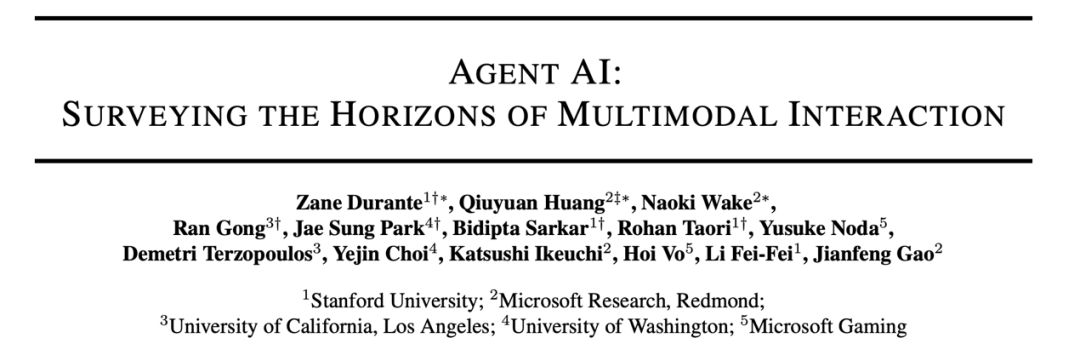
李飞飞的答案:大模型之后,Agent向何处去?
虎嗅APP· 2025-09-07 02:51
Core Viewpoint - The article discusses the emergence of Agent AI, highlighting its potential to revolutionize various fields through a new cognitive architecture that integrates perception, cognition, action, learning, and memory [4][9][10]. Summary by Sections Introduction to Agent AI - 2025 is anticipated to be the year of Agent AI, with increasing interest in concepts like AI Agents and Agentic AI [4]. - A significant paper led by Fei-Fei Li titled "Agent AI: Surveying the Horizons of Multimodal Interaction" has sparked widespread discussion in the industry [4][6]. Framework of Agent AI - The paper establishes a clear framework for Agent AI, integrating various technologies into a unified perspective [6][7]. - It outlines five core modules: Environment and Perception, Cognition, Action, Learning, and Memory, which together form a dynamic cognitive loop [10][12][14][16][17]. Core Modules Explained - **Environment and Perception**: Agents actively perceive information from their surroundings, incorporating task planning and skill observation [12]. - **Cognition**: Acts as the processing center, utilizing large language models (LLMs) and visual language models (VLMs) for reasoning and strategy formulation [14]. - **Action**: Converts cognitive decisions into executable commands, affecting the environment [15]. - **Learning**: Emphasizes continuous learning through various mechanisms, allowing agents to adapt based on feedback [16]. - **Memory**: Features a structured system for long-term knowledge retention, enabling agents to leverage past experiences [17]. Role of Large Models - The development of Agent AI is driven by the maturity of foundation models, particularly LLMs and VLMs, which provide agents with extensive knowledge and planning capabilities [20]. - The paper addresses the challenge of "hallucination" in models, emphasizing the importance of environmental interaction to mitigate this issue [21][22]. Application Potential - The paper explores Agent AI's applications in three key areas: - **Gaming**: Agent AI can create dynamic NPCs that interact meaningfully with players, enhancing immersion [24][25]. - **Robotics**: Robots can execute complex tasks based on natural language commands, improving user interaction [27]. - **Healthcare**: Agent AI can assist in preliminary diagnostics and patient monitoring, increasing efficiency in healthcare delivery [29][31]. Conclusion - The paper recognizes that Agent AI is still in its early stages, facing challenges in integrating multiple modalities and creating general agents for diverse applications [32]. - It proposes new evaluation benchmarks to guide the development and measure progress in the field [32].

李飞飞的答案:大模型之后,Agent 向何处去?
创业邦· 2025-09-05 11:12
Core Insights - The article discusses a significant paper led by Fei-Fei Li that establishes a clear framework for the emerging field of Agent AI, outlining its capabilities and potential applications [5][6][9] - The paper presents a comprehensive cognitive architecture for Agent AI, consisting of five core modules: Environment and Perception, Cognition, Action, Learning, and Memory, which together form a dynamic and iterative closed-loop system [11][12][18] Summary by Sections Agent AI Framework - The new Agent AI paradigm is not merely a combination of existing technologies but represents a forward-thinking approach to the development of Artificial General Intelligence (AGI) [12] - The framework integrates various technological strands, including dialogue models, visual-language models, and reinforcement learning, into a unified perspective on multimodal agents [9][12] Core Modules of Agent AI - **Environment and Perception**: This module allows agents to actively perceive information from the physical or virtual world, incorporating task planning and skill observation [13] - **Cognition**: Defined as the processing center of the agent, this module utilizes large language models (LLMs) and visual-language models (VLMs) to interpret sensory information and develop strategies [14] - **Action**: This module generates specific operational commands based on cognitive decisions, enabling interaction with both physical and virtual environments [15] - **Learning**: Emphasizes the agent's ability to continuously learn and evolve through various mechanisms, including reinforcement learning and imitation learning [16] - **Memory**: Unlike traditional models, this module provides a structured and persistent memory system that allows agents to leverage past experiences for future tasks [17][18] Role of Large Models - Large foundational models, particularly LLMs and VLMs, serve as the cognitive backbone of Agent AI, enabling agents to perform complex tasks with minimal predefined rules [20] - The paper highlights the challenge of "hallucination," where models generate inaccurate content, and proposes environmental interaction as a solution to mitigate this issue [21] Ethical and Regulatory Considerations - The article stresses the importance of inclusivity and ethical considerations in the design of Agent AI, advocating for diverse training data and bias detection mechanisms [22] - It also addresses the need for clear regulations and frameworks to ensure data privacy and security, especially in sensitive applications [22] Application Potential - **Gaming**: Agent AI can revolutionize non-player character (NPC) behavior, allowing for dynamic interactions and personalized experiences in gaming environments [25][26] - **Robotics**: Agents can autonomously plan and execute complex physical tasks based on natural language commands, enhancing user interaction with robots [28] - **Healthcare**: Agent AI can assist in preliminary medical consultations and patient monitoring, significantly improving healthcare delivery, especially in resource-limited settings [30][32] Future Directions - The article acknowledges that Agent AI is still in its early stages and faces challenges in achieving deep integration across various modalities and domains [33] - It emphasizes the need for standardized evaluation metrics to assess agent intelligence and guide future research [33]

马斯克的官司还没打完,OpenAI 已经开始“动刀”了
3 6 Ke· 2025-09-05 08:30
Core Viewpoint - The ongoing legal battle between Musk and OpenAI represents a significant dispute over the future ownership and direction of artificial intelligence, highlighting the tension between profit motives and ethical considerations in AI development [1][7][26] Group 1: Legal Actions and Responses - OpenAI has initiated a series of legal actions against organizations that have publicly supported Musk, including sending subpoenas to gather communications and documents related to Musk [2][6][13] - The legal actions are perceived as a form of intimidation, targeting those who have criticized OpenAI's transition from a non-profit to a for-profit entity [2][6][19] Group 2: Historical Context of the Dispute - The conflict began when Musk filed a lawsuit against OpenAI in March 2024, accusing the organization of betraying its original mission to develop AGI for the benefit of humanity [7][9] - OpenAI's response to Musk's accusations included claims that Musk had previously sought to control the organization for his own interests, thus undermining his current position [9][10][11] Group 3: Broader Implications for the AI Industry - The lawsuit has raised critical questions about who has the authority to define the direction of AGI and the ethical implications of its development, particularly in the context of significant financial pressures [12][26] - The conflict illustrates a shift in OpenAI's strategy, as it has evolved from a non-profit reliant on public trust to a more aggressive entity capable of political maneuvering and legal intimidation [14][15][24] Group 4: Power Dynamics and Public Discourse - The dispute has transformed from a personal conflict into a broader power struggle over the narrative surrounding AI, with OpenAI attempting to control the discourse and marginalize dissenting voices [26] - The situation reflects a growing concern that the voices of ordinary individuals and organizations are being sidelined in the debate over AI governance and ethics [26]

李飞飞的答案:大模型之后,Agent向何处去?
Hu Xiu· 2025-09-05 00:34
Core Insights - The article discusses the rising prominence of Agent AI, with 2025 being viewed as a pivotal year for this technology [1][2] - A significant paper led by Fei-Fei Li titled "Agent AI: Surveying the Horizons of Multimodal Interaction" has sparked extensive discussion in the industry [3][6] Summary by Sections Overview of the Paper - The paper, consisting of 80 pages, provides a clear framework for the somewhat chaotic field of Agent AI, integrating various technological strands into a new multimodal perspective [5][6] - It emphasizes the evolution from large models to agents, reflecting the current strategies of major players like Google, OpenAI, and Microsoft [6] New Paradigm of Agent AI - The paper introduces a novel cognitive architecture for Agent AI, which is not merely a compilation of existing technologies but a forward-thinking approach to the development of Artificial General Intelligence (AGI) [9] - It defines five core modules: Environment and Perception, Cognition, Action, Learning, and Memory, which together form an interactive cognitive loop [10][26] Core Modules Explained - **Environment and Perception**: Agents actively perceive information from their surroundings in a multimodal manner, incorporating various data types [12][13] - **Cognition**: Acts as the processing center for agents, enabling complex activities such as reasoning and empathy [15][16] - **Action**: Converts cognitive decisions into specific operational commands, affecting both physical and virtual environments [18][19] - **Learning**: Highlights the continuous learning and self-evolution capabilities of agents through various mechanisms [20][21] - **Memory**: Offers a structured system for long-term knowledge retention, allowing agents to leverage past experiences for new tasks [23][24] Role of Large Models - The framework's feasibility is attributed to the maturity of large foundational models, particularly LLMs and VLMs, which provide essential cognitive capabilities for agents [28][29] - These models enable agents to decompose vague instructions into actionable tasks, significantly reducing the complexity of task programming [30][31] Challenges and Ethical Considerations - The paper identifies the issue of "hallucination" in models, where they may generate inaccurate content, posing risks in real-world interactions [32][33] - It emphasizes the need for inclusivity in designing Agent AI, addressing biases in training data and ensuring ethical interactions [36][39] - The importance of establishing regulatory frameworks for data privacy and security in Agent AI applications is also highlighted [38][39] Application Potential - The paper explores the vast application potential of Agent AI in gaming, robotics, and healthcare [40] - In gaming, Agent AI can create dynamic NPCs that interact meaningfully with players, enhancing immersion [42][43] - In robotics, agents can autonomously execute complex tasks based on simple verbal commands, streamlining user interaction [48][49] - In healthcare, Agent AI can assist in preliminary diagnostics and patient monitoring, improving efficiency in resource-limited settings [54][57] Future Directions - The paper acknowledges that Agent AI is still in its early stages, facing challenges in integrating multiple modalities and creating general-purpose agents [58][60] - It proposes new evaluation benchmarks to measure agent intelligence and guide future research [61]
生成式AITop100展现全球竞争新格局,中国公司在移动应用领域更具优势
Huan Qiu Shi Bao· 2025-09-04 22:45
Group 1 - The core viewpoint of the article highlights the rise of Chinese AI applications, which are competing strongly with American counterparts, leading to a significant shift in the global AI landscape [1][5][4] - The recent report by a16z ranks the top 100 consumer-grade generative AI applications, showing that while the US remains a leader, Chinese companies excel particularly in mobile applications [1][2] - The report indicates a trend towards a more decentralized market, with no single company dominating across all platforms, and highlights the narrowing gap between ChatGPT and Google's Gemini [1][3] Group 2 - In the web application rankings, five Chinese companies made it to the top 20, with DeepSeek ranked third and Quark ranked ninth, showcasing the strength of Chinese AI products [2][3] - The mobile platform has become the primary usage method for AI applications, with Chinese apps occupying 22 out of the top 50 spots, including Doubao at fourth and Baidu AI Search at seventh [3][2] - The competition in the generative AI ecosystem is stabilizing, with fewer new entrants and a concentration of successful products from a limited number of countries, including the US and China [3][5] Group 3 - The article notes that Chinese companies are increasingly recognized for their technological innovation and market understanding, leading to a growing acceptance of their products both domestically and internationally [4][5] - The contrasting development strategies of the US and China in AI are emphasized, with the US focusing on general artificial intelligence (AGI) and China prioritizing practical AI applications to enhance economic efficiency [5][6] - Looking ahead, analysts predict a shift towards a competitive landscape with multiple strong players emerging, each focusing on unique ecosystems and market segments [6]

