云计算

Search documents
新股消息 | 澜起科技(688008.SH)通过港交所聆讯 全球内存互连芯片市场份额达36.8%
智通财经网· 2026-01-05 13:38
Core Viewpoint - The company, Lanke Technology Co., Ltd. (澜起科技), is a leading global fabless integrated circuit design firm focused on providing innovative, reliable, and high-performance interconnect solutions for cloud computing and AI infrastructure [3]. Company Overview - Lanke Technology specializes in interconnect chips, including memory interconnect chips and PCIe/CXL interconnect chips, serving a wide range of end applications such as data centers, servers, and computers [3]. - The company is projected to be the largest supplier of memory interconnect chips globally in 2024, with a market share of 36.8% according to Frost & Sullivan [3]. Product Lines - The company has two main product lines: interconnect chips and Zindai products, with interconnect chips including memory interface chips, memory module supporting chips, PCIe/CXL interconnect chips, and clock chips [4]. - The interconnect solutions are strategically positioned to address critical market demands, serving as a foundation for cloud computing, data centers, and AI infrastructure [4]. Market Growth - The global high-speed interconnect chip market is expected to grow significantly from $15.4 billion in 2024 to $49 billion by 2030, with a compound annual growth rate (CAGR) of 21.2% [4]. - The memory interconnect chip market is projected to increase from $1.2 billion in 2024 to $5 billion by 2030, with a CAGR of 27.4% [5]. - The PCIe and CXL interconnect chip market is anticipated to grow from $2.3 billion in 2024 to $9.5 billion by 2030, with a CAGR of 26.7% [5]. Financial Performance - The company's revenue for the fiscal years ending December 31 for 2022, 2023, 2024, and the nine months ending September 30, 2025, are approximately RMB 3.67 billion, RMB 2.29 billion, RMB 3.64 billion, and RMB 4.06 billion respectively [5][6]. - The net profit for the same periods is approximately RMB 1.30 billion, RMB 0.45 billion, RMB 1.34 billion, and RMB 1.58 billion respectively [5][6].


国投证券港股晨报-20260105
国投证券(香港)· 2026-01-05 08:53
Core Insights - The report highlights a strong start for the Hong Kong stock market in 2026, with the Hang Seng Index rising by 2.76% and the Hang Seng Tech Index increasing by 4% on the first trading day, driven by positive market sentiment and broad sector gains [2][3] - The semiconductor sector is noted as a key driver in the US market, with significant gains in companies like Nvidia and Micron Technology, while software stocks showed weakness [4] - The report discusses the geopolitical impact of US military actions in Venezuela, suggesting potential long-term implications for oil prices and market stability [5] Company Overview - The specific company under review, 精锋医疗 (Jingfeng Medical), was established in 2017 and specializes in surgical robots, being the first in China and the second globally to receive regulatory approval for multiple types of surgical robots [7] - Financial projections indicate revenues of 48.04 million yuan in 2023, 160 million yuan in 2024, and 150 million yuan in the first half of 2025, with net losses projected at 210 million yuan, 220 million yuan, and 89.09 million yuan respectively [7] Industry Status and Outlook - The surgical robot market in China is projected to grow from 2.71 billion yuan in 2019 to 7.18 billion yuan by 2024, reflecting a compound annual growth rate of 21.5%, with expectations to reach 102.02 billion yuan by 2033 [8] Advantages and Opportunities - The company holds a unique position as the first in China and second globally to gain approval for various types of surgical robots, which enhances its competitive edge [9] - The product portfolio is comprehensive, allowing for strong synergies and collaboration within the company [9] - The company has robust research and development capabilities and has attracted significant cornerstone investors, indicating strong industry recognition and support [9] Fundraising and Use of Proceeds - The IPO is set to raise funds with approximately 42% allocated for the research and development of core products, 20% for commercialization, and 10% for capacity expansion, among other uses [13] Investment Recommendation - The report suggests that the company, with its leading position and strong investor backing, has a projected market capitalization of approximately 16.8 billion HKD at the IPO price, with a price-to-sales ratio of about 50 times, comparable to its peers [14]
特发信息涨2.04%,成交额3.90亿元,主力资金净流入64.57万元
Xin Lang Cai Jing· 2026-01-05 06:24
Core Viewpoint - The stock price of TeFa Information has shown a slight increase of 2.04% this year, but has experienced a decline of 4.01% over the last five trading days and 8.34% over the last twenty days, while it has increased by 17.34% over the last sixty days [2]. Group 1: Company Overview - TeFa Information, established on July 29, 1999, and listed on May 11, 2000, is located in Nanshan District, Shenzhen, Guangdong Province [2]. - The company specializes in the research, production, and sales of various communication and power cable products, including optical fibers, communication equipment, and military aviation communication devices [2]. - The revenue composition of TeFa Information is as follows: cable segment 78.94%, smart services segment 9.91%, integration segment 6.81%, material sales and others 2.45%, and property asset management segment 1.89% [2]. Group 2: Financial Performance - As of September 30, 2025, TeFa Information reported a total revenue of 3.184 billion yuan, a year-on-year decrease of 10.04%, while the net profit attributable to shareholders was 7.9961 million yuan, reflecting a year-on-year increase of 80.75% [3]. - The company has distributed a total of 255 million yuan in dividends since its A-share listing, with no dividends distributed in the last three years [4]. Group 3: Shareholder Information - As of September 30, 2025, the number of shareholders for TeFa Information reached 97,400, an increase of 83.95% from the previous period, while the average circulating shares per person decreased by 45.64% [3]. - Among the top ten circulating shareholders, Hong Kong Central Clearing Limited is the fourth largest shareholder with 3.9673 million shares, marking its entry as a new shareholder [4].

中贝通信涨2.02%,成交额1.51亿元,主力资金净流入159.23万元
Xin Lang Cai Jing· 2026-01-05 05:59
Core Viewpoint - Zhongbei Communication's stock price has shown a slight increase of 2.02% this year, with a market capitalization of 9.436 billion yuan, indicating a stable performance amidst fluctuations in the market [1]. Group 1: Stock Performance - As of January 5, Zhongbei Communication's stock price reached 21.73 yuan per share, with a trading volume of 1.51 billion yuan and a turnover rate of 1.61% [1]. - The stock has increased by 2.02% year-to-date, with a 1.68% rise over the last five trading days, a 2.51% decline over the last 20 days, and a 12.31% drop over the last 60 days [1]. Group 2: Financial Performance - For the period from January to September 2025, Zhongbei Communication reported a revenue of 2.317 billion yuan, reflecting a year-on-year growth of 5.05%. However, the net profit attributable to shareholders decreased by 41.14% to 85.0419 million yuan [2]. - The company has distributed a total of 324 million yuan in dividends since its A-share listing, with 145 million yuan distributed over the past three years [3]. Group 3: Shareholder Information - As of September 30, 2025, Zhongbei Communication had 66,100 shareholders, a decrease of 13.03% from the previous period, with an average of 6,571 circulating shares per shareholder, which is an increase of 14.98% [2]. - Among the top ten circulating shareholders, Hong Kong Central Clearing Limited holds 5.2545 million shares, an increase of 3.2048 million shares compared to the previous period [3].

第一创业晨会纪要-20260105
First Capital Securities· 2026-01-05 05:57
Macro Economic Group - The manufacturing PMI for December in China is 50.1%, an increase of 0.9 percentage points from the previous month, indicating a recovery in manufacturing activity [4] - The production index rose to 51.7%, up 1.7 percentage points, while new orders increased to 50.8%, reflecting improved domestic demand [4] - The non-manufacturing PMI for December is 50.2%, indicating a shift from contraction to expansion, with the construction sector showing significant growth at 52.8% [6] Industry Comprehensive Group - Blue Arrow Aerospace's IPO on the Sci-Tech Innovation Board has been accepted, aiming to raise 7.5 billion yuan, which is expected to positively impact the aerospace and military-related stocks [8] - The State Council's solid waste management action plan is anticipated to enhance the garbage treatment industry, particularly benefiting the construction waste sector and promoting prefabricated building development [8] - Shengyi Technology announced a project investment of approximately 4.5 billion yuan for high-performance copper-clad laminates, driven by demand from AI, cloud computing, and 6G communications [9] Advanced Manufacturing Group - The National Energy Administration released a new guideline for distributed power access, which is expected to facilitate a more refined development of distributed photovoltaics, benefiting leading companies with advanced technology and smart capabilities [11] Consumer Group - During the New Year holiday, domestic tourism saw 142 million trips and total spending of 84.789 billion yuan, reflecting a year-on-year increase of 5.2% and 6.3% respectively, indicating a robust recovery in the tourism sector [13] - The policy emphasis on enhancing tourism quality and expanding cultural tourism supply is expected to further benefit the cultural service and tourism sectors [13]

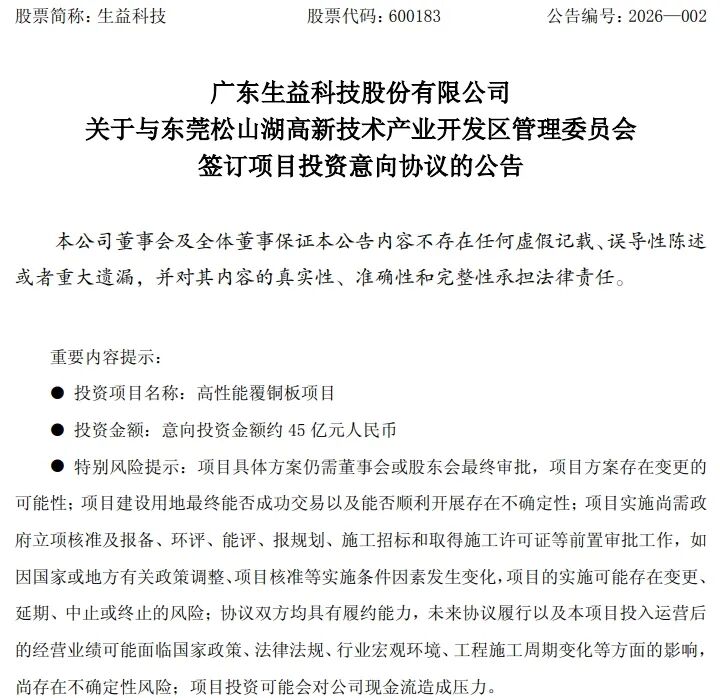
拟投资45亿元扩产,1700亿生益科技加码高性能覆铜板
Huan Qiu Lao Hu Cai Jing· 2026-01-05 03:51
Core Viewpoint - Shengyi Technology has signed an investment intention agreement with the Dongguan Songshan Lake High-tech Industrial Development Zone Management Committee to invest approximately 4.5 billion RMB in a high-performance copper-clad laminate project, responding to the strong global demand for high-performance materials in advanced technologies such as AI and 6G [1][2] Group 1: Investment and Project Details - The project will cover an area of approximately 198,667.66 square meters with a usage period of 50 years, funded by the company's own or self-raised funds [1] - This strategic investment is aimed at supporting key technologies in AI, cloud computing, 6G communication, and smart automotive electronics [1] Group 2: Market Demand and Growth - TrendForce forecasts that global capital expenditure for the eight major CSPs will grow by 40% to over 600 billion USD by 2026, driving demand for high-end PCB materials and technological upgrades in the supply chain [1] - The global shipment of AI servers is expected to increase by 20.9%, leading to higher requirements for AI hardware products [1] Group 3: Company Performance and R&D Investment - Shengyi Technology plans to increase its R&D expenditure to 1.157 billion RMB in 2024, a year-on-year increase of 37.57%, with further increases in the first half of 2025 [2] - The company’s core business, copper-clad laminates, accounts for over 60% of its revenue, with sales of 76.2753 million square meters in the first half of 2025, up 8.82% year-on-year [2] - Shengyi Technology ranks second globally in rigid copper-clad laminate sales with a market share of 13.7% [2] Group 4: Financial Performance - For the first three quarters of 2025, Shengyi Technology reported revenue of 20.614 billion RMB, a year-on-year increase of 39.80%, and a net profit attributable to shareholders of 2.443 billion RMB, up 78.04% [2] - In the third quarter alone, the company achieved revenue of 7.934 billion RMB, a 55.10% increase year-on-year, and a net profit of 1.017 billion RMB, reflecting a 131.18% growth, both setting historical records [2]
齐心集团涨2.21%,成交额6919.94万元,主力资金净流出939.32万元
Xin Lang Cai Jing· 2026-01-05 02:10
Core Viewpoint - Qixin Group's stock price has shown a modest increase of 2.21% year-to-date, with fluctuations in recent trading days indicating mixed performance in the market [2]. Group 1: Stock Performance - As of January 5, Qixin Group's stock price reached 7.85 CNY per share, with a trading volume of 69.19 million CNY and a turnover rate of 1.25%, resulting in a total market capitalization of 5.662 billion CNY [1]. - The stock has increased by 2.21% since the beginning of the year, with a 0.64% rise over the last five trading days, a 1.26% decline over the last 20 days, and a significant 23.80% increase over the last 60 days [2]. Group 2: Company Overview - Qixin Group, established on January 12, 2000, and listed on October 21, 2009, is located in Shenzhen, Guangdong Province, and specializes in the research, production, and sales of office supplies, including document management products and office equipment [2]. - The company's revenue composition is primarily from office supplies (99.18%), with minor contributions from other segments (0.46%) and enterprise-level SaaS software and services (0.36%) [2]. - Qixin Group is classified under the light industry manufacturing sector, specifically in cultural products, and is associated with concepts such as artificial intelligence, cloud computing, digital economy, Tencent concepts, and online office solutions [2]. Group 3: Financial Performance - For the period from January to September 2025, Qixin Group reported a revenue of 7.729 billion CNY, reflecting a year-on-year decrease of 7.94%, while the net profit attributable to shareholders was 140 million CNY, down 11.45% year-on-year [2]. - The company has distributed a total of 614 million CNY in dividends since its A-share listing, with 159 million CNY distributed over the past three years [3]. Group 4: Shareholder Information - As of September 30, 2025, Qixin Group had 36,500 shareholders, a decrease of 9.03% from the previous period, with an average of 19,650 circulating shares per shareholder, which is an increase of 9.93% [2]. - Notably, Hong Kong Central Clearing Limited has exited the list of the top ten circulating shareholders [3].

盘前公告淘金:中微公司拟购杭州众硅64.69%股权复牌,生益科技45亿投高性能覆铜板项目
Jin Rong Jie· 2026-01-05 01:33
Important Matters - Zhongwei Company plans to acquire 64.69% equity of Hangzhou Zhonggui, with stock resuming trading on January 5 [1] - Yushu Technology has not applied for any "green channel" related matters [1] - Luxshare Precision reports that its core business is progressing smoothly and there are no abnormal situations affecting normal operations [1] - Yanjing Co. intends to acquire control of high-frequency circuit board manufacturer Yongqiang Technology, with stock suspended; the latter's high-end products have been certified by Intel and Huawei [1] - Fangda Carbon has terminated its participation in the substantive merger and reorganization of Shanshan Group and its wholly-owned subsidiary [1] Investment Operations - China Nuclear Power's Unit 2 of the Fujian Zhangzhou Nuclear Power Plant is ready for commercial operation [1] - Guoxin Technology's newly developed neural network processor DPNPU has successfully passed internal testing [1] - Zhongmin Resources has commenced trial operation of its 30,000 tons per year high-purity lithium salt technical transformation project [1] - Longpan Technology plans to invest 2 billion yuan in a high-performance lithium battery cathode material project [1] - Greeenme has shipped over ton-level products of high nickel ternary cathode materials and lithium-rich manganese-based cathode materials [1] - Zhongjian Technology plans to develop a collaborative project in intelligent robotics [1] - Qinchuan Machine Tool's humanoid robot main products have been supplied in bulk [1] - Xingqi Eye Medicine's application for atropine sulfate eye drops has been approved [1] - Jincai Hulin intends to acquire 51% equity of Wuxi Sanli Robot Parts Company for 63.43 million yuan [1] - Shengyi Technology has signed a 4.5 billion yuan investment intention agreement for a high-performance copper-clad laminate project, targeting AI, cloud computing, and 6G communication fields [1] - Tianlong Co. plans to acquire 54.87% equity of Suzhou Haomibo for 232 million yuan, entering automotive intelligent driving, low-altitude flight, and robotics sectors [1] - Kexin Electromechanical is exploring potential market opportunities in commercial aerospace based on its technology accumulation in special materials welding [1] Partnerships and Collaborations - Mengwang Technology has signed a 60 million yuan cooperation agreement for the research and production of drones with Shenzhou Liuhe [2] - Shengyi Technology has signed a 4.5 billion yuan investment intention agreement for a high-performance copper-clad laminate project [2] - Tenglong Co. plans to establish a joint venture for a liquid cooling computing power center and has signed an investment intention agreement [2] Capital Operations - CATL has repurchased a total of 15.99 million A-shares, with a total transaction amount of 4.386 billion yuan [2] - Nova Star Cloud has established a participating fund and completed an investment in Blue Arrow Aerospace, holding 0.8189% of its shares [2] Performance - SAIC Group expects to sell 1.643 million new energy vehicles in 2025, a year-on-year increase of 33.1% [3] - Changan Automobile anticipates sales of 2.913 million vehicles in 2025, a year-on-year increase of 8.5% [3] - BYD projects cumulative sales of 4.6 million new energy vehicles in 2025, a year-on-year increase of 7.73% [3] - Bailong Oriental expects a year-on-year increase in net profit of 46.34%-70.73% for 2025 [3]
千亿覆铜板龙头,大动作
Zhong Guo Zheng Quan Bao· 2026-01-04 23:28
Core Viewpoint - Company plans to invest approximately 4.5 billion yuan in a high-performance copper-clad laminate project to meet the growing demand in the market [1][4][5] Investment Details - The investment agreement was signed with the Dongguan Songshan Lake High-tech Industrial Development Zone Management Committee, and the project is not classified as a related transaction or a major asset restructuring [1][4] - The project will cover an area of approximately 198,667.66 square meters and will be funded through the company's own or self-raised funds [4] - The land will be publicly auctioned according to relevant policies, and the company will be responsible for engineering design, construction, and facility development [4] Market Performance - In 2025, the company's stock price increased significantly, with a total annual growth of 205.82%, closing at 71.41 yuan per share on December 31, 2025, with a total market capitalization of 173.5 billion yuan [3][6] Product and Industry Position - Copper-clad laminates are critical materials for the new generation of information technology, supporting sectors like AI, cloud computing, 6G communication, and smart automotive electronics [5][10] - The company has maintained its position as the second-largest global seller of rigid copper-clad laminates since 2013, with products certified by major international brands [9] Financial Performance - For the third quarter of 2025, the company reported a revenue of 7.933 billion yuan, a year-on-year increase of 55.10%, and a net profit of 1.017 billion yuan, up 131.18% [9] - The first three quarters of 2025 showed a revenue of 20.614 billion yuan, a 39.80% increase year-on-year, and a net profit of 2.443 billion yuan, up 78.04% [9] Industry Outlook - The demand for AI servers is expected to drive the company's performance, with a projected 40% increase in capital expenditure from major cloud service providers in 2026 [10][11] - The expansion of computing power demand is anticipated to lead to a growth phase for the PCB and server supply chains, including upstream materials [11]
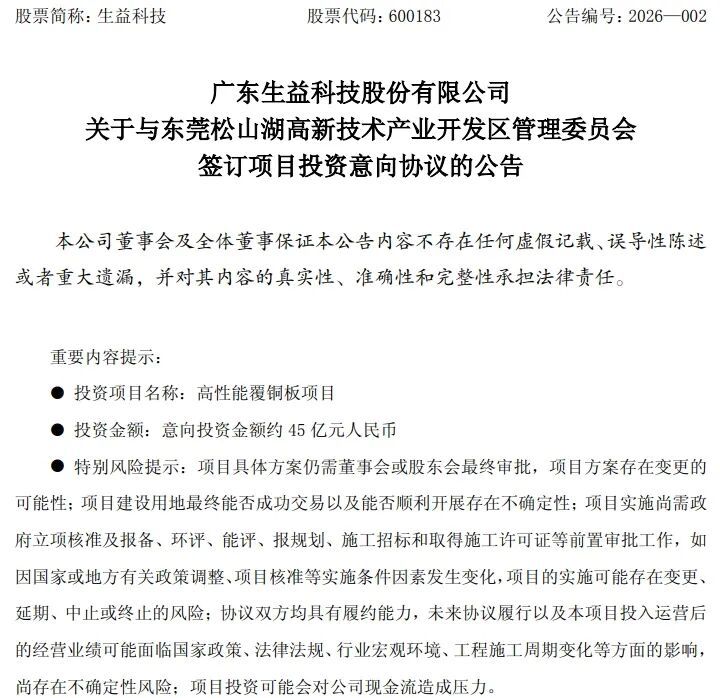
千亿覆铜板龙头,大动作!
Zhong Guo Zheng Quan Bao· 2026-01-04 23:24
Core Viewpoint - Company Shengyi Technology (600183) has signed an investment intention agreement with the Dongguan Songshan Lake High-tech Industrial Development Zone Management Committee to invest approximately 4.5 billion yuan in a high-performance copper-clad laminate project, which is not classified as a related transaction or a significant asset restructuring [1][4][6]. Group 1: Investment Details - The investment amount for the high-performance copper-clad laminate project is approximately 4.5 billion yuan, aimed at meeting the growing demand for high-performance copper-clad laminates [1][4]. - The project will cover a total area of approximately 198,667.66 square meters and will be implemented using the company's own or self-raised funds [6]. - The project is expected to have a usage period of 50 years and will not significantly impact the company's total assets, net assets, or net profit for the year 2025 [6]. Group 2: Market Performance - In 2025, Shengyi Technology's stock price increased significantly, with a cumulative growth of 205.82%, closing at 71.41 yuan per share on December 31, 2025, resulting in a total market capitalization of 173.5 billion yuan [3][7]. - The company has established a strong competitive advantage in the high-end electronic materials market, producing various products including copper-clad laminates, which are widely used in AI servers, 5G antennas, and other advanced technologies [7][8]. Group 3: Financial Performance - For the third quarter of 2025, Shengyi Technology reported a revenue of 7.933 billion yuan, a year-on-year increase of 55.10%, and a net profit attributable to shareholders of 1.017 billion yuan, up 131.18% [8]. - The company's revenue for the first three quarters of 2025 reached 20.614 billion yuan, reflecting a year-on-year growth of 39.80%, with a net profit of 2.443 billion yuan, an increase of 78.04% [8]. Group 4: Industry Outlook - The demand for AI servers is expected to drive Shengyi Technology's performance, as the growth in AI applications is anticipated to lead to a 40% increase in capital expenditures among the top eight global cloud service providers, reaching over 600 billion dollars by 2026 [9]. - The PCB and server industry, along with related upstream materials, are projected to enter a high-growth phase due to expanding computing power demands [9].