
战略性新兴产业

Search documents
第十五届河南投洽会初步达成合作项目268个总金额2196亿元
Zhong Guo Xin Wen Wang· 2025-09-26 08:29
Group 1 - The 15th China Henan International Investment and Trade Fair has initiated with 268 cooperation projects, totaling 219.6 billion RMB, focusing on high-end equipment manufacturing, new materials, and electronic information industries, with over 80% of projects in advanced manufacturing and strategic emerging industries [1] - The event, hosted by the Henan provincial government, attracted over 1,600 participants, including representatives from foreign embassies, international organizations, and well-known business associations [1] - A total of 80 projects were signed on-site during the opening ceremony, including significant projects in new energy vehicles and low-carbon digital industries [1] Group 2 - Shenzhen International Holdings Limited has invested a total of 3.1 billion RMB in Henan in recent years, with plans to actively pursue further investment opportunities [2] - Malaysia's Sabah state, represented by a delegation of about 100 officials and businesspeople, aims to strengthen cooperation with Henan in commerce, tourism, and education [2]
陈文辉:IPO退出承载能力有限,并购退出是今后主要培育方向
Sou Hu Cai Jing· 2025-09-26 08:01
Group 1 - The current capacity for IPO exits is limited, and mergers and acquisitions (M&A) will be the main focus for future development [1] - There is a significant amount of existing assets that need to be addressed through M&A, which is crucial for revitalizing these assets and promoting economic transformation [1] - The optimization of exit channels is essential for the high-quality development of equity investment funds, with exit being the most challenging aspect of the investment process [1] Group 2 - The demand for M&A is driven by changes in economic development requirements, including the succession of private enterprises and policy adjustments [2] - The State-owned Assets Supervision and Administration Commission (SASAC) is encouraging state-owned enterprises to increase investments in strategic emerging industries, with venture capital funds established by these enterprises nearing 100 billion [2] - Regulatory support, such as the encouragement from the China Securities Regulatory Commission for equity investment funds to acquire listed companies, is expected to broaden exit opportunities [2]
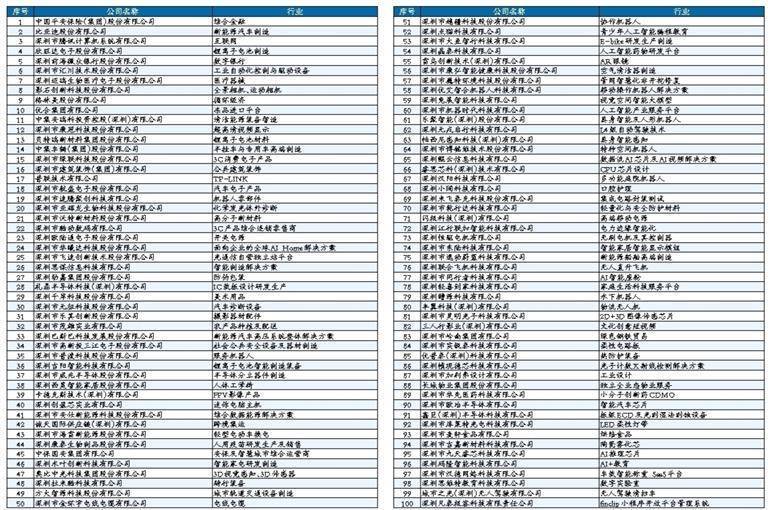
“链主”与“小巨人”共赴深圳产业“冠军矩阵”
Sou Hu Cai Jing· 2025-09-26 00:17
| 信号 | 公司求称 | | 行业 | 18 | 公司名称 | 行业 | | --- | --- | --- | --- | --- | --- | --- | | 1 | 中国平安保险(集团)及份有限公司 | 世令会社 | | 51 | 母心理教会官系家庭家生公司 | 文明風景人 | | 2 | 此是连股份发展企公司 | 新能源汽车制设 | | 52 | 母心里斯坦斯坦克里会 | 青少年人工智能铸组教育 | | 3 | 深刻布感欲计算机系统有限公司 | 更新闻 | | 55 | 深刹市大量留行杆技有限公司 | 官区人参观市官公司 | | 4 | 原原达电子股份有限公司 | 但属于岛光刺设 | | 54 | 深圳品熟科技有限公司 | 人工智能药物研发平台 | | 5 | 深利官海拔火银行股份有限公司 | 新字体料 | | 55 | 合乌创新技术《深圳》有限公司 | AR 眼线 | | ર | 吸制市记川技术股份有限公司 | 工业自动化控制与就验设备 | | 56 | 深圳市最弘智能被原科技股份有限公司 | 文气流水器刺波 | | 7 | 或利亚高生物理中心子服务有限公司 | 高端文画 | | 57 | 深圳 ...

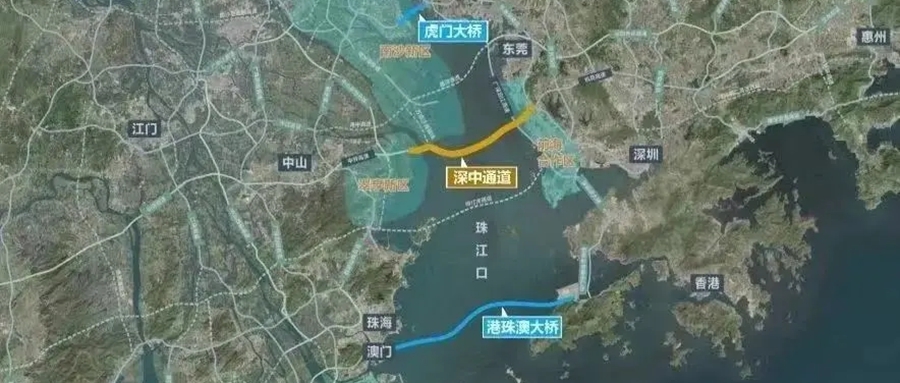
城市24小时 | 大湾区又一“超级通道”,要来了?
Mei Ri Jing Ji Xin Wen· 2025-09-24 16:00
Group 1 - The Shenzhen-Zhuhai Channel project has made significant progress with the release of a public consultation for the preliminary research project, indicating a step forward in this major transportation infrastructure [1] - The project has a budget of 20.8 million yuan and aims to provide key technical support for the channel's inclusion in national planning [1] - The channel will connect Shenzhen and Zhuhai, featuring a dual eight-lane highway, high-speed rail with a design speed of 350 km/h, and intercity rail with a design speed of 200 km/h, potentially reducing travel time between the two cities to 30 minutes [1] Group 2 - The Shenzhen-Zhuhai Channel is positioned as a "middle ring" transportation route, enhancing connectivity within the Guangdong-Hong Kong-Macao Greater Bay Area and promoting industrial integration between the two sides of the Pearl River Estuary [2] - The channel's development is being accelerated, with the Guangdong Provincial Development and Reform Commission including it in the 2025 budget, and the Shenzhen government emphasizing its importance in local development plans [3] Group 3 - The anticipated completion of the Shenzhen-Zhuhai Channel is expected to significantly boost the transfer of industries from Shenzhen to the western side of the Pearl River, particularly benefiting Zhuhai [4] - The integration of Shenzhen's technological innovation resources with Zhuhai's manufacturing base is expected to create a collaborative model of "Shenzhen R&D + Zhuhai Manufacturing," facilitating the transformation of technological achievements and the integration of industrial chains [4]
中证金融研究院首席经济学家潘宏胜:“并购六条”推动产业升级和高水平科技自立自强初步显现
Zheng Quan Ri Bao Wang· 2025-09-24 11:06
Core Viewpoint - The implementation of the "Six Opinions on Deepening the Reform of Mergers and Acquisitions of Listed Companies" has significantly increased the activity in the mergers and acquisitions market, with over 2,100 asset restructuring disclosures in the past year, including more than 230 major asset restructurings [1] Group 1: Market Activity and Trends - The past year has seen a high level of mergers and acquisitions focused on industry integration, with over 70% of major asset restructurings aimed at industry consolidation [2] - State-owned enterprises have accelerated their mergers, accounting for about 30% of major asset restructurings, while companies in the "Two Creation" sectors have disclosed over 100 major asset restructurings, with around 80% being industry integrations [2] - Emerging industries and future industries have become key targets for mergers and acquisitions, reflecting a strategic shift towards enhancing technological innovation and industrial upgrading [2][3] Group 2: Payment Tools and Efficiency - The use of diverse payment tools has increased, with companies employing convertible bonds, acquisition loans, and acquisition funds to enhance transaction flexibility and efficiency [4] - The "Six Opinions" support the phased issuance of shares and convertible bonds as payment methods, which has led to a significant reduction in transaction time and cost [4][5] - The introduction of simplified review procedures for restructuring projects has improved the efficiency of the review process, encouraging more companies to engage in mergers and acquisitions [5] Group 3: Future Trends - The future of the mergers and acquisitions market is expected to show four major trends: increased focus on strategic emerging industries, improved resource allocation efficiency, enhanced market vitality, and stricter regulatory oversight [7] - There will be a growing trend of acquiring unprofitable but technologically advanced small and medium-sized enterprises, providing them with greater exit channels and financing options [7] - The emphasis on legal regulation and accountability for financial advisors and accountants will ensure the quality of mergers and acquisitions, protecting investor interests [7]
新形势下的市场化母基金:突围与进阶
母基金研究中心· 2025-09-24 09:45
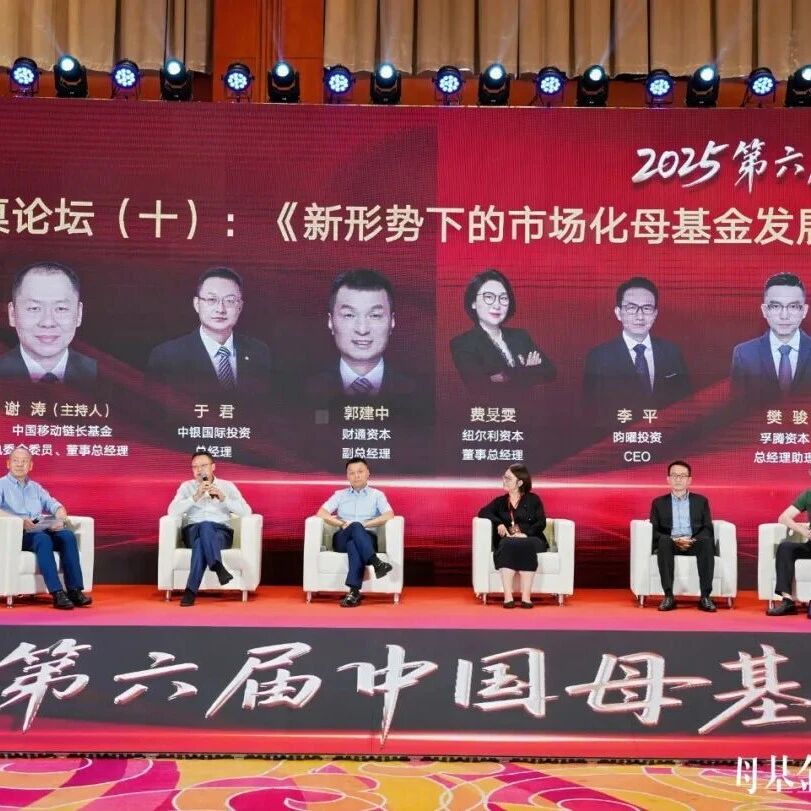
Core Viewpoint - The 2025 Sixth China Fund of Funds Summit highlighted the evolving landscape of market-oriented mother funds, emphasizing the need for differentiation and strategic positioning in a tightening fundraising environment and diverse exit channels [1][2][6]. Group 1: Market Environment and Challenges - The current market for mother funds and direct investment funds is characterized by new opportunities and challenges, particularly in the context of tightening fundraising and diverse exit strategies [2][5]. - Local governments are increasingly seeking partnerships with market-oriented institutions to drive industrial upgrades, despite facing challenges in balancing profitability with local development needs [5][6]. - The policy environment is becoming more aligned for market-oriented mother funds, with a focus on strategic emerging industries and technological innovation [6]. Group 2: Strategic Positioning and Development - Market-oriented mother funds need to rethink their positioning and development logic, particularly in terms of investment strategies and collaboration with government-guided funds [7]. - Fund managers must adapt to market trends and maintain flexibility in their investment strategies to create differentiated competitive advantages [7][8]. - Emphasis on financial returns, particularly IRR and DPI, is crucial for market-oriented mother funds, which should focus on existing quality projects rather than new investments [9]. Group 3: Collaboration and Learning - There is a growing recognition of the advantages of state-owned capital in the current environment, prompting private funds to learn from state-owned experiences in selecting GPs and managing investments [8][9]. - Strategic collaboration with state-owned funds is seen as a way to enhance investment outcomes, especially when GPs receive government allocations [9].
报告称去年北京数字经济等战略性新兴产业薪酬水平持续领跑
Zhong Guo Xin Wen Wang· 2025-09-24 08:53
Core Insights - The report indicates that in 2024, Beijing's strategic emerging industries, including integrated circuits, new generation information technology, intelligent/high-end manufacturing, digital economy, new energy, and intelligent connected vehicles, will continue to lead in salary levels [1][2] - The survey data for the report is based on 2024 salary sampling from Beijing enterprises, covering 1.57 million individual positions and 289,000 recent college graduates, with a consistent increase in sample size over the past seven years [1] Salary Trends - The salary levels across various industries in Beijing are showing differentiated growth, with stable increases in the transportation/logistics and catering/accommodation sectors [1] - Key districts such as Haidian, Chaoyang, and the Economic and Technological Development Zone maintain a leading advantage in salary growth, ranking in the top three [1] Focus on Emerging Occupations - The report emphasizes the importance of monitoring salary levels for new occupational groups, particularly in digital and green professions, and provides salary data for recent college graduates to assist in job selection and talent cultivation [2] - It also highlights the salary conditions of workers in new business formats reliant on internet platforms and skilled talent, enhancing the salary database for key sectors [2] Public Service Enhancement - As part of improving public services, the Beijing Human Resources and Social Security Department has introduced a "Mapping Table" that aligns job classifications with market job titles, aimed at optimizing public salary data access and usage [2]
北京发布薪酬数据报告,人工智能工程技术人员年薪中位值超31万
Xin Jing Bao· 2025-09-24 04:58
Group 1 - The core viewpoint of the report indicates that the salary levels across various industries in Beijing are showing differentiated growth, with strategic emerging industries leading the way [1][2] - In the emerging industries, the median annual salary for artificial intelligence engineering technicians is 312,684 yuan, for big data engineering technicians is 316,388 yuan, for automotive application engineering technicians is 296,955 yuan, and for artificial intelligence trainers is 181,023 yuan [1] - The report is based on a survey of 1.57 million individual positions and 289,000 fresh graduates, with the sample size increasing for seven consecutive years [1] Group 2 - The Haidian District, Chaoyang District, and Economic and Technological Development Zone maintain their leading salary growth, while other special functional areas show salary growth in line with the overall level in Beijing [2] - The report emphasizes the importance of monitoring salary levels for new occupations, particularly in digital and green professions, and provides salary data for fresh graduates to assist in job seeking and talent cultivation [2] - A new mapping table for commonly used positions and occupations has been released to enhance public access to salary data, improving the quality of public services provided by the Beijing Human Resources and Social Security Bureau [3]
兰石中科:以纳米新材料撬动产业升级,冲刺科创板引领绿色转型
Jing Ji Wang· 2025-09-23 09:58
Group 1 - The core viewpoint emphasizes the strategic importance of new materials in driving the green transformation of traditional industries and fostering new productive forces, with Lanzhou Lanshi Zhongke Nano Technology Co., Ltd. emerging as a notable player in this field [1] - The company has achieved a breakthrough in the continuous and large-scale preparation of nano materials at normal temperature and pressure, overcoming the limitations of traditional batch production methods in terms of efficiency, cost, and environmental impact [2] - Lanzhou Lanshi Zhongke has established multiple production lines, including an annual output of 4,000 tons of nano magnesium hydroxide, 4,000 tons of magnesium-aluminum hydrotalcite, 5,000 tons of nano zinc oxide, and 1,500 tons of nano lithium iron phosphate precursor materials, achieving industry-leading standards in particle size control, dispersion, and batch stability [2] Group 2 - The company aligns with national strategies and aims to list on the Sci-Tech Innovation Board, which has become a preferred platform for hard-tech enterprises, supported by recent policies that enhance inclusivity for technology companies [3] - Lanzhou Lanshi Zhongke plans to submit its IPO application by the end of 2027, leveraging capital market opportunities to accelerate technological iteration and expand production capacity [3] - The company occupies a unique position in the resource recycling and new materials intersection, providing irreplaceable value in promoting low-carbon transformation in traditional industries, with no direct competitors in the A-share market [4] Group 3 - The national focus on green technology and new materials under the "dual carbon" goals has led to increased support for companies like Lanzhou Lanshi Zhongke, which reduces production energy consumption and costs while aiding downstream enterprises in resource recycling [5] - Guotai Junan Securities is set to provide comprehensive capital services for the company’s upcoming issuance, ensuring strong support for its market entry [5] - The growth trajectory of Lanzhou Lanshi Zhongke reflects the transformation and upgrading of Chinese SMEs through technological innovation, positioning it as a benchmark enterprise in the new materials sector [8]
臻镭科技董事长郁发新被留置 公司上半年净利润增长超十倍
Jing Ji Guan Cha Wang· 2025-09-22 08:40
Core Viewpoint - Zhenlei Technology (688270.SH) experienced a significant stock price drop of 12.56% to 60.77 CNY per share following the announcement of its chairman, Yu Faxin, being subjected to retention measures by the Huangshi Municipal Supervisory Committee, which prevents him from fulfilling his duties as a director [1][6] Company Overview - Zhenlei Technology was established in September 2015 and went public on the Shanghai Stock Exchange's Sci-Tech Innovation Board in January 2022. The company specializes in terminal RF front-end chips, high-density packaged microwave modules, and microsystems, integrating design, development, production, and sales [1] - The company reported a net profit growth of over 10 times in the first half of 2025 [1] Financial Performance - In the first half of 2025, Zhenlei Technology achieved a revenue of 205 million CNY, representing a year-on-year increase of 73.64%. The net profit attributable to shareholders reached approximately 62.32 million CNY, marking a staggering growth of 1006.99% [5] - The company attributed its performance to a recovery in downstream industries and a sustained increase in demand, alongside a strong technical foundation and good industry reputation [5] Shareholding Changes - As of the end of the reporting period in the 2025 semi-annual report, Yu Faxin held approximately 45 million shares, accounting for 21.04% of the total shares. He had previously reduced his holdings through three controlled partnerships, raising about 444 million CNY [2] - The shareholding ratio of Yu Faxin and his concerted actions decreased from 32.62% to 28.74% following the sale of 830,520 shares at a price of 53.52 CNY per share [2] Market Position and Clientele - Zhenlei Technology's products and technologies are primarily applied in specialized fields such as data links, electronic countermeasures, wireless communication terminals, and satellite internet, with major clients including defense industry groups and research institutions [5] - The company has seen a significant increase in orders and projects, benefiting from strategic opportunities in emerging industries such as commercial aerospace and low-altitude economy [5] Stock Performance - The stock price of Zhenlei Technology has increased by over 70% this year, reaching a peak of 84.77 CNY per share at the end of August before the recent decline [6] - As of September 22, the company's total market capitalization stood at 13 billion CNY [6]
