
互联互通机制

Search documents
从“开门”到“定规”: “十四五”金融制度型开放交出答卷
Sou Hu Cai Jing· 2025-09-18 16:47
Core Insights - The report highlights the significant progress in China's financial market opening during the "14th Five-Year Plan" period, transitioning from market access to institutional opening [1][3] - The focus for the upcoming "15th Five-Year Plan" is on deepening interconnectivity and aligning rules with international standards [4][5] Group 1: Financial Market Developments - The average annual growth rate of entrusted assets in trust, wealth management, and insurance asset management reached 8% over the past five years, with total assets growing to 154 trillion yuan by the end of 2024, a year-on-year increase of 10.4% [3] - By the end of 2024, foreign ownership of A-shares is projected to be approximately 3.4 trillion yuan, accounting for 4.3% of the total market, an increase of 1.8 percentage points from the end of the "13th Five-Year Plan" [2] - The expansion of interconnectivity mechanisms, including the launch of the Bond Connect "southbound" channel and the integration of QFII and RQFII systems, has broadened cross-border investment channels [2] Group 2: Regulatory and Legal Framework - The "14th Five-Year Plan" has seen the implementation of significant institutional breakthroughs, including the substantial reduction of the negative list and the establishment of a national treatment framework for foreign investment [1][3] - The introduction of the Futures and Derivatives Law has filled legal gaps in the derivatives market, providing clear legal boundaries for foreign participation [2] Group 3: Future Directions - The "15th Five-Year Plan" aims to optimize interconnectivity mechanisms through three levels and nine initiatives, focusing on expanding product offerings and improving risk management tools [5][6] - There is a call for further reduction of restrictions on foreign financial institutions, including ownership structures and business scopes, to attract high-quality foreign entities [6] Group 4: Currency Internationalization - The internationalization of the renminbi and reforms in the exchange rate mechanism have made substantial progress, with the cross-border payment system covering 180 countries [7][9] - The renminbi's role in global trade settlement and cross-border investment is expected to grow, with initiatives like digital renminbi bonds being tested in Hong Kong [8][10] - Future efforts will focus on enhancing the renminbi's use in energy and commodity settlements, strengthening offshore renminbi centers, and promoting digital currency applications [10]
从“开门”到“定规”:“十四五”金融制度型开放交出全景答卷|“十四五”规划收官
Di Yi Cai Jing Zi Xun· 2025-09-18 12:57
Core Insights - The core viewpoint of the articles is that China's financial industry has transitioned from "opening the door" to "restructuring rules" during the "14th Five-Year Plan" period, with significant institutional breakthroughs achieved in financial openness, and the focus is now on deepening these reforms in the upcoming "15th Five-Year Plan" period [1][6]. Summary by Sections Institutional Breakthroughs - The "14th Five-Year Plan" has marked a historic shift in China's financial openness, moving from market access to rule alignment, with key breakthroughs in three main areas: the implementation of the negative list and national treatment framework, upgrades in factor mobility and infrastructure connectivity, and improvements in financial legal systems and macro-prudential frameworks [1][3]. Market Access and Foreign Investment - Restrictions on foreign ownership in key sectors such as securities, funds, futures, and life insurance have been completely lifted, allowing major international investment banks to establish wholly-owned subsidiaries in China. This includes firms like JPMorgan, Goldman Sachs, and Standard Chartered [2]. - By the end of 2024, foreign ownership of A-shares is projected to reach approximately 3.4 trillion yuan, accounting for 4.3% of the total market, an increase of 1.8 percentage points from the end of the "13th Five-Year Plan" [2]. Interconnectivity Mechanisms - Significant progress has been made in interconnectivity mechanisms, expanding from the Shanghai-Hong Kong Stock Connect to include the Shenzhen-Hong Kong Stock Connect, Bond Connect, and others, facilitating a broader range of investment products [2][4]. - The Bond Connect's "southbound" channel has officially opened, and the integration of QFII and RQFII systems has been completed, further broadening cross-border investment channels [2]. Financial Demand and Opportunities - The growing wealth management needs of Chinese residents, driven by the accumulation of financial assets, present substantial opportunities for foreign financial institutions. The total scale of entrusted assets in trust, wealth management, and insurance asset management is expected to reach 154 trillion yuan by the end of 2024, with an annual growth rate of 10.4% [3][4]. Challenges for Foreign Institutions - Foreign financial institutions face significant localization challenges, including insufficient retail network presence and lagging digitalization. Their average net interest margin is 0.6 percentage points lower than that of domestic banks [5]. - The complexity of regulatory compliance and the need to adapt to China's unique regulatory environment pose additional challenges for foreign entities [5]. Future Directions for Financial Openness - The "15th Five-Year Plan" is expected to focus on deepening interconnectivity and aligning rules, with an emphasis on optimizing interconnectivity systems through expanded product offerings and improved risk management tools [6][8]. - Experts suggest further reducing the negative list for financial services and establishing consistent licensing standards for both domestic and foreign institutions to attract high-quality foreign entities [9]. Data Governance and Cross-Border Compliance - Data governance and cross-border compliance are anticipated to be major focuses in the "15th Five-Year Plan," with calls for establishing clear rules for financial data circulation and enhancing cross-border regulatory cooperation [10]. Renminbi Internationalization and Exchange Rate Reform - The internationalization of the renminbi and reforms in the exchange rate mechanism have made substantial progress, with the renminbi's role in global trade settlements and cross-border investments steadily increasing [11][12]. - Future efforts will likely focus on expanding the renminbi's use in energy and commodity settlements, enhancing offshore renminbi centers, and promoting the application of digital renminbi in cross-border transactions [13].
李家超:研究让投资者在单一平台集中管理及相互抵押股票和债券等不同资产
Zheng Quan Shi Bao Wang· 2025-09-17 04:08
Group 1 - The Hong Kong government aims to strengthen its position as a bond center by enhancing financial infrastructure [1] - The Hong Kong Monetary Authority (HKMA) will collaborate with the Hong Kong Stock Exchange (HKEX) to develop a platform for centralized management and cross-collateralization of various assets [1] - Plans include establishing connections with markets in Switzerland and the UAE, and promoting the use of offshore Chinese government bonds as collateral in different clearing houses [1] Group 2 - The Hong Kong Securities and Futures Commission (SFC) is exploring the feasibility of a market-operated electronic bond trading platform [1] - There is an active push to establish a commercial repurchase market and a central counterparty system in Hong Kong to enhance market liquidity [1]
南向资金净流入站上万亿港元关口 重仓腾讯控股、阿里巴巴等公司
Shang Hai Zheng Quan Bao· 2025-09-03 01:40
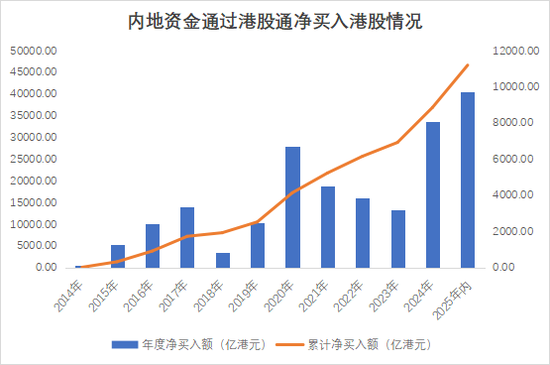
Core Viewpoint - The Hong Kong stock market is experiencing increased trading activity and stability, supported by significant inflows of southbound capital, which have reached a historical high of over 1 trillion Hong Kong dollars this year [1][3]. Group 1: Southbound Capital Inflows - As of September 2, 2023, the cumulative net inflow of southbound capital has surpassed 1 trillion Hong Kong dollars, reaching 10,002.21 million Hong Kong dollars, marking a record high [1]. - Daily trading volume of southbound capital has increased from approximately 5% at the beginning of the Hong Kong-Shanghai Stock Connect to around 35% currently, enhancing market liquidity and altering investment structures [1]. - Since the launch of the Stock Connect mechanism in November 2014, total southbound capital inflows have reached 4.7 trillion Hong Kong dollars, with a consistent net inflow trend observed since 2015 [3][4]. Group 2: Investment Preferences - The top ten stocks with the largest increase in market value held by southbound capital include Tencent Holdings, Alibaba, and others, with significant increases in market value ranging from 391.4 million to 2,169.2 million Hong Kong dollars [2]. - Southbound capital is primarily focused on globally competitive internet companies, stable cash flow value stocks with generous dividends, and innovative biopharmaceutical companies [2]. - The preference for high-dividend assets has led to significant valuation improvements in sectors such as finance, energy, and telecommunications over the past two years [2]. Group 3: Market Dynamics and Future Outlook - The influx of southbound capital has transformed the Hong Kong stock market into a core market for global investors seeking to allocate "Chinese assets," influencing market styles, sector rotations, and individual stock performances [5]. - The trend of increasing southbound capital inflows is expected to continue, driven by the valuation discrepancies between A-shares and H-shares, with investors favoring lower-priced Hong Kong stocks for similar dividend returns [4][6]. - The shift from retail to institutional dominance in southbound capital has enhanced the professional investment capabilities and value discovery functions within the Hong Kong market [6].

爆买!超1万亿港元!
Zheng Quan Shi Bao· 2025-09-02 12:49
Core Insights - The Hong Kong stock market has seen significant inflows from southbound funds, with a net purchase of 92.81 billion HKD on September 2, leading to an annual net purchase exceeding 1 trillion HKD, the highest since the launch of the mutual market access mechanism [1][2] - The Hang Seng Index and Hang Seng Tech Index have both risen over 20% this year, contributing to the attractiveness of the Hong Kong market for mainland investors [2][4] Group 1: Southbound Fund Inflows - Southbound funds have accumulated a total net purchase of nearly 4.7 trillion HKD in the Hong Kong stock market, setting a historical record [1][2] - The proportion of trading volume attributed to southbound funds has increased to over 45% this year, compared to 34.63% in 2024 [6][8] - The influx of southbound funds has created a positive cycle, enhancing liquidity and valuation in the Hong Kong market [1][4] Group 2: Market Dynamics and Investor Behavior - The return of the Hong Kong market's performance has attracted mainland investors, with notable stocks like Xiaomi and Pop Mart reaching new highs, creating a "wealth effect" [4][5] - Low valuations and high dividend yields in the Hong Kong market are appealing to risk-averse investors, especially in a low domestic interest rate environment [5][11] - The strategic positioning of Hong Kong as a platform for RMB internationalization and the return of Chinese concept stocks has further attracted capital [5][8] Group 3: Future Outlook - While there is still room for net purchases from southbound funds, the pace of inflows may slow down due to the recent strong performance of the A-share market, which offers more immediate profit opportunities [11][12] - The overall valuation of the Hong Kong market remains low, but the recent rise in A-shares may lead to a shift in investor focus away from Hong Kong stocks [11][12] - The increasing influence of southbound funds is expected to enhance the correlation between Hong Kong and A-share markets, although southbound funds do not possess absolute pricing power [8][11]

港交所CEO陈翊庭:多项互联互通优化措施在筹备中
Zheng Quan Shi Bao Wang· 2025-08-30 08:53
Core Insights - The Hong Kong Stock Exchange (HKEX) is actively promoting economic and financial development in the Guangdong-Hong Kong-Macao Greater Bay Area, positioning itself as a key financial infrastructure [1] - Recent reforms in listing rules have made it easier for new economy companies, particularly in healthcare, renewable energy, and TMT sectors, to raise funds in Hong Kong, with over 60% of new stock financing coming from these industries [1] - HKEX has established various connectivity mechanisms with mainland financial markets, enhancing capital market openness and providing international investors with convenient access to Chinese markets [2] Group 1: Financial Development Initiatives - HKEX has implemented multiple listing rule reforms, allowing companies with dual-class share structures and biotech firms without revenue to list in Hong Kong [1] - In the first seven months of the year, Hong Kong's new stock market raised HKD 127.9 billion, ranking first globally [1] - There are currently over 200 listing applications being processed, many from high-tech companies in the Greater Bay Area [1] Group 2: Connectivity and Collaboration - HKEX has been working closely with mainland financial institutions to enhance connectivity through mechanisms like Stock Connect and Bond Connect, facilitating cross-border investment [2] - Ongoing collaborations with Shanghai and Shenzhen Stock Exchanges aim to optimize trading mechanisms, including the inclusion of REITs and a block trading mechanism [2] - HKEX is also developing a comprehensive fund platform in partnership with Shenzhen Stock Exchange to improve market efficiency and reduce trading costs [2] Group 3: Green Finance and Low-Carbon Transition - HKEX is committed to developing green finance in response to the global shift towards low-carbon economies, collaborating with mainland financial institutions [2] - Future plans include exploring opportunities for carbon market cooperation within the Greater Bay Area to support national dual carbon goals [2]

港交所 CEO陈翊庭:多项互联互通优化措施在筹备中
Zheng Quan Shi Bao Wang· 2025-08-30 08:40
Group 1 - The Hong Kong Stock Exchange (HKEX) is actively promoting the economic and financial development of the Greater Bay Area, serving as a core financial infrastructure [1] - Recent reforms in listing rules have provided diverse and convenient channels for new economy companies to list in Hong Kong, including those with dual-class share structures and biotech firms without revenue [1] - New economy sectors, such as healthcare, renewable energy, and TMT, account for over 60% of new stock financing in Hong Kong, with total financing reaching HKD 127.9 billion from January to July, ranking first globally [1] Group 2 - HKEX is enhancing connectivity with mainland financial markets through mechanisms like Stock Connect and Bond Connect, facilitating international investment in China and providing mainland funds access to overseas assets [2] - Ongoing collaborations with the Shanghai and Shenzhen stock exchanges aim to optimize Stock Connect by including REITs and introducing block trading mechanisms [2] - HKEX is also focusing on green finance and low-carbon transition, seeking to explore carbon market cooperation opportunities with more financial institutions in the Greater Bay Area [2]
港交所CEO陈翊庭:新经济公司已经成为香港新股市场融资主力军
2 1 Shi Ji Jing Ji Bao Dao· 2025-08-30 07:18
Core Insights - The seventh Guangdong-Hong Kong-Macao Greater Bay Area Financial Development Forum was held in Guangzhou, focusing on comprehensive financial cooperation and development [1] - Hong Kong's financial market raised HKD 127.9 billion from January to July this year, ranking first globally, with over 200 listing applications currently being processed, many from high-tech companies in the Greater Bay Area [1] - The Hong Kong Stock Exchange (HKEX) has optimized its listing system for new economy companies, allowing dual-class share structures and biotech firms without revenue to list, with at least 60% of the financing coming from sectors like pharmaceuticals, new energy, and TMT [1] Listing and Regulatory Developments - In October 2024, HKEX and the Hong Kong Securities and Futures Commission will streamline the approval process for eligible A-share companies seeking to list in Hong Kong [1] - By May 2025, HKEX will launch a technology-focused channel to further optimize the application process for specialized technology and biotech companies [1] - In August 2025, HKEX will enhance new stock pricing and public holding requirements, easing restrictions to improve pricing efficiency and international competitiveness [1] Market Connectivity and Collaboration - The Shenzhen-Hong Kong Stock Connect has seen active trading, with cumulative transactions reaching approximately RMB 116 trillion by the end of July this year [2] - HKEX is collaborating with the Shanghai and Shenzhen stock exchanges to include block trading in the connectivity mechanism and optimize the inclusion of RMB counters in the Hong Kong Stock Connect [2] - HKEX is also working on a comprehensive fund platform with the Shenzhen Stock Exchange to enhance the fund distribution network and market efficiency [2] - The establishment of HKEX's subsidiary in Shenzhen, with over 200 employees, aims to leverage the region's technological and talent advantages to enhance market competitiveness [2]
港交所多项市场数据创新高
Jin Rong Shi Bao· 2025-08-26 01:28
Core Insights - Hong Kong Stock Exchange (HKEX) has implemented various measures to enhance market activity, resulting in significant performance improvements in 2025 [1][2] - The exchange aims to continue enhancing its platform, infrastructure, and product offerings to provide diverse options, ample liquidity, and efficient connectivity for investors and issuers [1] Market Performance - In the first half of 2025, HKEX achieved record highs in multiple market metrics, with an average daily trading amount of HKD 240.2 billion, a year-on-year increase of 118% [2] - The average daily trading volume for futures and options exceeded 1.7 million contracts, up 11% year-on-year [2] - The Hong Kong ETF market saw a significant increase, with an average daily trading amount of HKD 33.8 billion, rising 184% compared to the same period last year [2] - Northbound and southbound trading through the Stock Connect also reached record highs, with an average daily trading amount of RMB 171.3 billion, a 32% increase from the first half of 2024 [2] Revenue Growth - HKEX reported a record revenue and other income of HKD 14.076 billion in the first half of 2025, a 33% increase from the same period in 2024 [3] - The increase in trading activity significantly contributed to revenue growth, with trading fees and system usage fees reaching HKD 4.906 billion, up 49.11% year-on-year [3] - Clearing and settlement fees amounted to HKD 3.155 billion, reflecting a year-on-year growth of 48.47% [3] - Nearly 90% of HKEX's profits are allocated for dividends, with a total interim dividend of approximately HKD 7.6 billion [3] IPO Market - HKEX regained the top position globally in terms of fundraising in the first half of 2025, welcoming 44 new listings, a 716% increase year-on-year [4] - Notable IPOs included CATL, which raised HKD 41 billion, marking the largest IPO on HKEX since February 2021 [4] - The number of companies waiting to go public reached 207, indicating a robust pipeline for new listings [4] - The total amount raised through refinancing reached HKD 244.8 billion, the highest for a half-year since 2021 [4] Strategic Initiatives - HKEX is advancing several strategic initiatives to solidify its role as a global hub, including extending the duration of interest rate swap contracts to 30 years to meet diverse risk management needs [5] - Plans to include RMB-denominated stocks in the Stock Connect are underway, enhancing connectivity between Hong Kong and mainland markets [5] - The introduction of the "Specialized Technology Company Route" allows tech firms to submit IPO applications confidentially, promoting a more accessible listing process [6] - HKEX has expanded its product offerings, including new stock options and the first Nasdaq-100 ETF listed in Asia, enhancing investor choices [6] Future Outlook - Despite various external uncertainties, HKEX remains cautiously optimistic about the market outlook for the second half of 2025, with confidence in its ability to adapt to changing conditions [6][7]