
信贷结构优化

Search documents
苏州市上半年综合融资成本稳中有降
Su Zhou Ri Bao· 2025-08-13 00:26
信贷结构优化,重点领域投放加速。信贷存量主要集中于民营经济(1.43万亿元)、房地产业 (1.33万亿元)、工业制造(1.09万亿元)、绿色发展(1.01万亿元)等经济基础领域,规模均超万亿 元。人民银行苏州市分行相关负责人解释,因统计维度差异,部分贷款项目可能同时涉及民营经营主 体、制造业或绿色产业,存在合理交叉统计,总体而言这些领域的基础性支撑作用显著。 记者从昨天(8月12日)人民银行苏州市分行召开的新闻通气会上获悉,今年上半年,该行精准实 施适度宽松的货币政策,推动货币信贷合理增长,引导信贷结构不断优化,助力社会综合融资成本下 降,全市金融运行态势良好,为经济高质量发展营造适宜的货币金融环境。 与此同时,今年以来重点领域贷款投放加速:制造业中长期贷款增长势头强劲,6月末余额同比增 速11.4%,较各项贷款增速高4.5个百分点;基础设施领域信贷投放持续加力,6月末余额同比增速 9.8%,较各项贷款增速高2.9个百分点;绿色贷款稳步增长,6月末较年初新增1170.42亿元,助力经济 社会绿色转型。 存贷款总量保持稳健增长。截至6月末,全市本外币存贷款总量达11.74万亿元。其中,本外币各项 存款5.75万 ...
新设再贷款促信贷结构优化
Xin Hua Wang· 2025-08-12 06:28
Group 1 - The State Council's recent meeting emphasized support for financing in key areas and weak links, establishing two special relending programs for technological innovation and inclusive elderly care, with the People's Bank of China providing 60% and 100% relending support for the principal loans respectively [1][4] - Relending is defined as loans from the central bank to financial institutions, with a focus on guiding loan funds to better serve key areas and weak links in the economy [1][3] - The need for technological innovation is highlighted as crucial for achieving high-quality economic development, addressing challenges such as the lack of mastery over core technologies [1][2] Group 2 - Population aging is identified as a significant issue, with over 260 million people aged 60 and above, necessitating financial support for elderly care services [2] - The overall profitability of the elderly care service sector is currently low, indicating a need for policy support to encourage financial institutions to invest in this area [2] - Both technological innovation and elderly care require substantial financial support, particularly in terms of financing, with a call for effective policies to guide financial institutions in these sectors [2][4] Group 3 - The role of relending in China has evolved from primarily injecting base currency to facilitating structural adjustments, effectively guiding credit funds to specific sectors [3] - The model of relending involves financial institutions issuing loans first and then applying for funds from the People's Bank of China, ensuring precise allocation of funds to the real economy [3] - The establishment of special relending programs for technological innovation and elderly care is expected to lower financing costs in these sectors, promoting their development [4]
金融“活水”为回升向好添动力增活力
Shan Xi Ri Bao· 2025-08-09 23:50
Core Viewpoint - The financial policies implemented in Shaanxi have effectively supported the province's economic growth and stability, with significant improvements in financing and credit structures observed in the first half of the year [1][2]. Financial Performance - Shaanxi's social financing scale increased by 347.9 billion yuan in the first half of the year, with the balance of RMB loans reaching 61,173.27 billion yuan, a year-on-year growth of 7.93%, surpassing the national average by 0.83 percentage points [1]. - The balance of RMB deposits stood at 74,896.67 billion yuan, reflecting a year-on-year increase of 8.29% [1]. Loan Distribution - Over 80% of new loans were directed towards enterprises, with medium and long-term loans increasing by 73.06 billion yuan year-on-year [3]. - The growth in loans for the leasing, business services, manufacturing, and construction sectors accounted for 68% of the total loan increase, indicating an optimized credit structure [3]. Targeted Financial Support - New medium and long-term loans for the manufacturing sector amounted to 56.11 billion yuan, an increase of 17.96 billion yuan year-on-year [4]. - The balance of inclusive micro and small enterprise loans reached 6,156.16 billion yuan, growing by 14.26% year-on-year [4]. - Green loan balances increased to 8,239.26 billion yuan, reflecting a growth of 9.40% since the beginning of the year [4]. Focus on Key Projects - Financial support for key projects has intensified, with loans for provincial key projects in the first five months accounting for over half of the total loans disbursed in the previous year [5]. - The government has been actively facilitating "government-bank-enterprise" connections to ensure funding for critical projects [5]. Innovation and Technology Financing - Shaanxi's technology finance initiatives are gaining momentum, with the establishment of various financial products and services aimed at supporting innovation [6]. - The expansion of the AIC equity investment fund and the launch of the first technology enterprise merger loan in Xi'an highlight the province's commitment to fostering a robust technology finance ecosystem [6].
金融总量增长既“稳”又“实”
Jin Rong Shi Bao· 2025-08-08 08:02
Core Viewpoint - The People's Bank of China has implemented a moderately loose monetary policy, leading to significant growth in broad money (M2) and social financing scale, indicating a stable and real financial growth environment [1][2]. Monetary Policy and Financial Growth - As of April 2025, M2 balance reached 325.17 trillion yuan, growing by 8% year-on-year, which is 1 percentage point higher than the previous month [1]. - From January to April, the cumulative increase in social financing scale was 16.34 trillion yuan, an increase of 3.61 trillion yuan compared to the same period last year [1]. - The balance of RMB loans reached 265.70 trillion yuan, with a year-on-year growth of 7.2% [1]. - The central bank's actions, including reserve requirement ratio cuts, have maintained ample liquidity and supported commercial banks in meeting the financing needs of the real economy [1]. Government Bond Issuance - The acceleration of government bond issuance has been a major driver of the rapid growth in social financing scale, with net financing exceeding 5 trillion yuan from January to April, a year-on-year increase of 3.6 trillion yuan [2]. - In April, the issuance of special government bonds and local government special refinancing bonds contributed approximately 970 billion yuan to net financing, increasing the social financing growth rate by 0.3 percentage points [2]. - The fiscal budget deficit rate has been raised to 4%, with plans to issue nearly 12 trillion yuan in new government bonds, marking a historical high [2]. Credit Growth and Structure - Despite market expectations, credit growth remained high in April, with RMB loan growth maintaining above 8% after adjusting for local debt replacement effects [4]. - The structure of credit has improved, with inclusive small and micro loans reaching 34.31 trillion yuan, growing by 11.9% year-on-year, and medium to long-term loans for manufacturing at 14.71 trillion yuan, growing by 8.5% [6]. - The proportion of loans to small and micro enterprises has increased from 31% to 38%, while loans to large and medium-sized enterprises have decreased from 69% to 62% [6]. Sectoral Focus and Future Outlook - Financial institutions are increasingly directing credit resources towards manufacturing and technology innovation, with the share of manufacturing loans in total medium to long-term loans rising from 5.1% to 9.3% [7]. - The market anticipates stable financial growth in the near term, supported by effective macroeconomic policies and a focus on enhancing consumer demand [5]. - The development of consumer finance is crucial for expanding effective consumption demand, although there are concerns about high leverage among households [8].
金融总量合理增长 债券对贷款的替代效应继续显现
Jin Rong Shi Bao· 2025-08-08 07:59
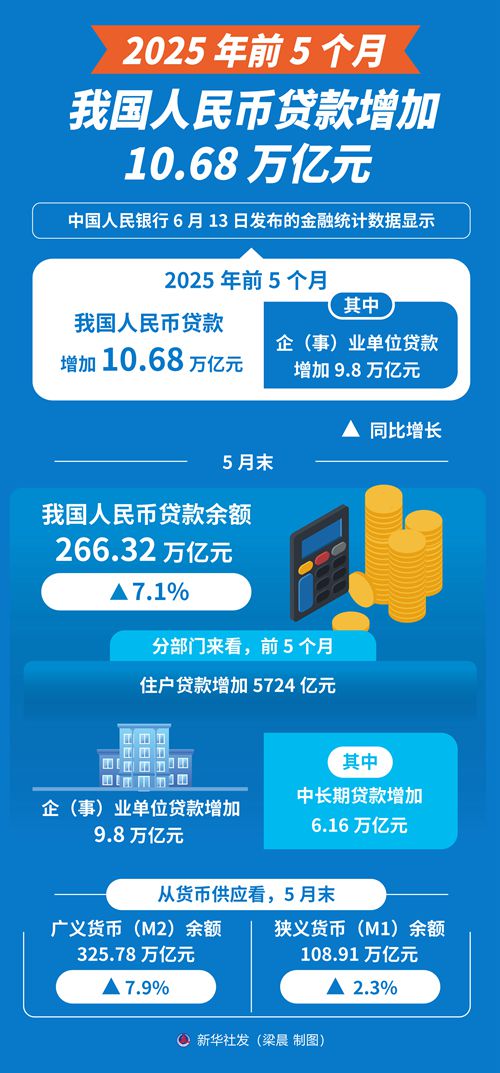
Group 1: Monetary and Financing Data - As of May 2025, the broad money supply (M2) reached 325.78 trillion yuan, with a year-on-year growth of 7.9%, an increase of 0.9 percentage points compared to the same period last year [1] - From January to May 2025, the cumulative increment of social financing was 18.63 trillion yuan, which is 3.83 trillion yuan more than the same period last year [1] - By the end of May, the balance of RMB loans was 266.32 trillion yuan, showing a year-on-year growth of 7.1% [1] Group 2: Government Bonds and Social Financing - Government bonds were identified as the primary driver for the rapid growth of social financing, with net financing exceeding 3.8 trillion yuan in the first quarter, an increase of 2.5 trillion yuan year-on-year [2] - The fiscal deficit rate has been raised to 4%, with plans to issue nearly 12 trillion yuan in government bonds, marking a historical high [2] - In May, the issuance of new special bonds reached 443.2 billion yuan, setting a new monthly record for the year [2] Group 3: Corporate Bond Financing - Corporate bond financing increased in May, with the average yield of 5-year AAA-rated corporate bonds dropping to 1.97%, encouraging companies to issue more bonds [3] - The overall trend of declining financing costs has prompted companies to increase their bond issuance [3] Group 4: Loan Growth and Market Conditions - Loan growth remained stable, supported by a decrease in policy interest rates, which has made borrowing more attractive for businesses [4] - External factors, such as tariff negotiations, have also contributed to increased credit demand from foreign trade enterprises [4] - Personal loans have seen an uptick due to a recovering real estate market and promotional activities [4] Group 5: Debt Replacement Effects - The replacement effect of bonds on loans has become more pronounced, with special refinancing bonds issued to repay bank loans [5] - The issuance of special refinancing bonds has exceeded 1.6 trillion yuan this year, corresponding to the replacement of approximately 2.3 trillion yuan in loans [5] Group 6: Investment Sources and Trends - Government bonds have increasingly replaced bank loans in funding infrastructure projects, with a notable increase in the share of government budget funds in fixed asset investment [6] - Recent policies have facilitated easier access to bond financing for private and technology enterprises, enhancing their ability to issue bonds [6] Group 7: Financing Structure and Economic Development - The social financing scale, which includes direct financing, is seen as a more comprehensive measure of financial support compared to loans alone [7] - The structure of credit is improving, with a greater focus on manufacturing and technology innovation sectors, reflecting the ongoing economic transition [8] - The balance of inclusive small and micro loans reached 34.42 trillion yuan, growing by 11.6%, indicating a shift in credit allocation [8] Group 8: Future Outlook - The optimization of loan structure is expected to continue, with a focus on better supporting consumption as a key area for future efforts [9]

拆解信贷“成绩单”资金流向了哪里?
Zheng Quan Ri Bao· 2025-08-08 07:19
作为实体经济的根基,制造业获得信贷支持,有助于推动产业升级,提高创新能力和国际竞争力;而基 础设施建设关乎国计民生,对拉动经济增长、改善投资环境具有重要意义。 从居民端来看,信贷结构同样亮点突出。上半年,住户贷款增加1.17万亿元。其中9239亿元流向了经营 性贷款,占比近八成,表明金融机构积极支持个体工商户和小微企业主的生产经营活动。 个体工商户、小微企业是经济运行的"毛细血管",也是社会就业的"蓄水池",更是激活市场经济的"一 池春水"。金融机构对他们源源不断地支持,将进一步激发市场活力,促进就业、稳定民生、推动创 新。 在这张资金流向热力图上,行业投向的脉络同样清晰可辨。上半年,新增贷款主要投向制造业、基础设 施业等重点领域。6月末,制造业中长期贷款余额同比增长8.7%,上半年增加9207亿元;基础设施业中 长期贷款余额同比增长7.4%,上半年增加2.18万亿元。 ■ 刘 琪 7月14日,中国人民银行公布了今年上半年的信贷"成绩单"——上半年,人民币贷款新增12.92万亿元; 6月末,人民币贷款余额268.56万亿元,同比增长7.1%。在金融总量合理增长的同时,信贷结构也在持 续优化。这种结构演变既是经 ...
6月末北京地区人民币贷款余额超12万亿元
Mei Ri Jing Ji Xin Wen· 2025-07-31 00:22
Group 1: Loan Growth and Financial Statistics - As of the end of June, the total RMB loan balance in Beijing reached 12.08 trillion yuan, marking a year-on-year growth of 7.3%, the highest increase in nearly 10 months, and 2.2 percentage points higher than the end of Q1 [1][2] - Corporate loans increased by 9.4% year-on-year, with an addition of 462.78 billion yuan in the first half of the year, accounting for 84.4% of all new loans, which is a 53.1 percentage point increase compared to the same period last year [2] - Household loans grew by 6.0% year-on-year, with personal housing loans increasing by 7.5%, showing a monthly upward trend throughout the year [2] Group 2: Financing Costs and Deposit Growth - The average weighted interest rate for loans in Beijing was 3.29% in June, down 34 basis points year-on-year, while the average interest rate for corporate loans was 2.52%, down 40 basis points [3] - The total RMB deposit balance in Beijing reached 25.54 trillion yuan by the end of June, with a year-on-year growth of 2.4%, and an increase of 983.8 billion yuan since the beginning of the year [3] Group 3: Cross-Border Trade Facilitation - Since February 2024, the State Administration of Foreign Exchange in Beijing has implemented a high-level open pilot for cross-border trade, focusing on serving the real economy [4] - A total of 30 pilot banks in Beijing have processed over 150,000 facilitation transactions for quality enterprises, amounting to 176 billion USD [6] - The pilot program includes simplified procedures for foreign exchange payments for quality enterprises, optimization of international trade settlement, and expanded net settlement ranges to reduce exchange rate risks [4][5][6]
上半年北京地区信贷总量平稳增长
Zhong Guo Jing Ji Wang· 2025-07-30 06:31
Group 1 - The total credit volume in Beijing has shown steady growth in the first half of the year, with a year-on-year increase of 7.3% as of the end of June, reaching 12.08 trillion yuan, marking the highest growth rate in nearly 10 months [1] - The average weighted interest rate for general loans in Beijing was 3.29% in June, a decrease of 34 basis points year-on-year, while the average weighted interest rate for corporate loans was 2.52%, down 40 basis points year-on-year [1] - The People's Bank of China has implemented policies to optimize the credit structure and reduce financing costs for key sectors, effectively supporting high-quality economic development in the capital [1] Group 2 - As of the end of June, banks in Beijing have issued 8.04 billion yuan in loans to key service consumption sectors and the elderly care industry, with an average loan interest rate around 3% [2] - New loans issued to five major service consumption sectors include 1.25 billion yuan for accommodation and catering, 2.74 billion yuan for cultural and entertainment, 430 million yuan for education, 1.29 billion yuan for resident services, and 490 million yuan for tourism [2] - The foreign exchange bureau in Beijing has implemented pilot measures for high-level opening of cross-border trade, enhancing banks' autonomy in reviewing transactions and improving the efficiency of foreign exchange services [2] Group 3 - The sale of treasury bonds in Beijing has consistently ranked first in the country, with savings treasury bonds being directly issued by the Ministry of Finance, offering a "zero risk, stable return" investment option for ordinary residents [3] - Savings treasury bonds are issued multiple times a year, typically from March to November, and can be purchased through approximately 130,000 bank outlets across 40 banks, including online banking options [3] - Residents can access information about treasury bond policies and issuance through the Ministry of Finance or the People's Bank of China websites, as well as by consulting local bank branches [3]
上半年上海个人房货需求回升,信贷结构持续优化
Guo Ji Jin Rong Bao· 2025-07-24 12:02
Core Insights - The People's Bank of Shanghai reported a stable growth in credit and financing costs, contributing to the high-quality economic development of Shanghai in the first half of 2025 [1][3] Group 1: Credit and Financing - As of June, the total balance of loans in Shanghai reached 12.85 trillion yuan, with a year-on-year growth of 8.4%, which is 1.6 percentage points higher than the national average [1] - Household loans increased by 13.7% year-on-year, with a notable recovery in personal housing loan demand since October of the previous year [1] - Non-financial enterprise loans grew by 5.5% year-on-year, with these loans accounting for 55.2% of all new loans in the first half of the year [1] Group 2: Loan Structure and Costs - The loan structure has been optimized, with significant increases in loans to the technology and inclusive finance sectors, showing year-on-year growth of 28.9% for information technology, 19.7% for research services, and 14.9% for inclusive small and micro loans [2] - The weighted average interest rate for newly issued corporate loans in June was 2.74%, down 49 basis points from the previous year, marking a historical low [2] - The weighted average interest rate for small and micro enterprise loans was 3%, a decrease of 56 basis points year-on-year [2] Group 3: Social Financing and Direct Financing - The social financing scale in Shanghai increased by 841.8 billion yuan in the first half of the year, which is 324 billion yuan more than the previous year, effectively meeting the financing needs of the real economy [3] - RMB loans to the real economy increased by 510.8 billion yuan, accounting for 60% of the total social financing increment [3] - Direct financing saw significant growth, with net financing from corporate bonds at 102.6 billion yuan, net financing from non-financial enterprise stocks at 14.2 billion yuan, and net financing from government bonds at 144.4 billion yuan, with the latter showing a year-on-year increase of 2.036 billion yuan [3]
银行业观察:信贷结构优化提速;货币供应改善支撑流动性
Sou Hu Cai Jing· 2025-07-15 01:57
Core Insights - The banking sector in China shows marginal improvement in credit issuance and synchronized optimization of money supply in the first half of 2025, with social financing scale increasing by 8.9% year-on-year and RMB loan growth stabilizing at 7.1% [1] Group 1: Credit Structure and Government Support - The credit structure continues to optimize, with government bonds supporting social financing growth, as new RMB loans increased by 2.36 trillion yuan in June, up 171 billion yuan year-on-year [1] - Short-term loans for enterprises surged by 1.16 trillion yuan, reflecting banks' proactive lending during peak season, while medium to long-term loans also showed stability with an increase of 1.01 trillion yuan [1] - The reduction in bill financing by 410.9 billion yuan indicates effective regulatory measures against fund circulation [1] Group 2: Household Demand and Policy Effects - Household medium to long-term loans increased by 335.3 billion yuan, continuing the improvement trend since May, driven by lower mortgage rates and reduced repayment pressure [2] - Short-term loans for households rose by 262.1 billion yuan, supported by seasonal consumption demands [2] Group 3: Government Debt and Credit Risk Mitigation - New government bonds issued in June amounted to 1.35 trillion yuan, up 507.2 billion yuan year-on-year, with total new government debt reaching 7.66 trillion yuan in the first half of the year [3] - The issuance of long-term special government bonds and local special bonds has become a crucial support for social financing growth [3] Group 4: Interest Rate Adjustments and Liquidity - The synchronized decline in deposit and loan rates has alleviated margin pressure, with the average corporate loan rate dropping by 45 basis points year-on-year [3] - M2 growth rebounded to 8.3%, reflecting improved credit efficiency and increased fiscal spending [3] Group 5: Structural Policies and Economic Transition - The central bank emphasizes "technology innovation + service consumption" as dual priorities, with significant funds allocated to small and green sectors [4] - The cautious approach to real estate financing aligns with the need for economic transformation and provides banks with policy tools for asset optimization [4] Group 6: Overall Banking Environment - The banking sector is experiencing a more favorable operating environment supported by stable growth, optimized structure, and reduced margin pressure [5]