
融合化

Search documents
中国宝武胡望明:聚焦“新阶段、新战略、新模式”战略部署 持续深化中央企业品牌引领行动
Zhong Zheng Wang· 2025-11-07 11:19
Core Insights - The forum highlighted the achievements of the second batch of the Central Enterprises Brand Leadership Action, with China Baowu and nine other central enterprises recognized for their brand initiatives [1][2] - China Baowu emphasizes technological self-reliance and innovation as the foundation of its brand, positioning itself as a "breaker" in key areas and a "stabilizer" in the modern industrial chain [1][2] Group 1 - China Baowu is recognized for its commitment to technological innovation, focusing on overcoming material and technical challenges [1] - The company aims to provide stable, reliable, and high-quality steel materials to energize various downstream industries [1] - The company has been selected as part of the second batch of the Central Enterprises Brand Leadership Action, following Baosteel's recognition in the first batch [1] Group 2 - China Baowu is driving its brand's future through green and intelligent dual initiatives, aiming to lead the global steel industry's green transformation [2] - The company is committed to becoming a model for green development and a pioneer in smart manufacturing through the integration of steel and AI [2] - The company aspires to achieve satisfaction among shareholders, customers, and employees while being respected by society, embodying the principle of "three satisfactions and one respect" [2] Group 3 - Looking ahead, China Baowu aligns with the development directions of "intelligent, green, and integrated" as outlined in the 20th Central Committee's fourth plenary session [2] - The company plans to focus on "new stage, new strategy, new model" to deepen the brand leadership action among central enterprises [2] - China Baowu aims to establish a modern brand governance system and create world-class product and technology brands [2]

中国宝武胡望明:聚焦“新阶段、新战略、新模式” 构建现代化品牌治理新体系
Zheng Quan Shi Bao Wang· 2025-11-06 10:44
Core Insights - The forum highlighted the second batch of achievements in the Central Enterprise Brand Leading Action, with China Baowu and nine other central enterprises recognized for their brand initiatives [1][2] - China Baowu's chairman emphasized the importance of brand value, stating that a world-class enterprise should not only be large but also strong, serving as a key executor of national strategies and a leader in industry progress [1][2] Group 1 - China Baowu is focusing on technological self-reliance to strengthen its brand foundation, addressing critical material and technology challenges [1] - The company has successfully replaced imported materials with high-precision products, supporting major national projects such as advanced aerospace engines and large-scale hydropower stations [1] - Over 100 products have achieved global firsts, showcasing the company's innovation capabilities [1] Group 2 - The brand's value is rooted in its commitment to the mission of building a strong steel nation, which serves as a foundation of trust [2] - China Baowu aims to reshape its brand future through green and intelligent dual-driven strategies, leading the global steel industry's green transformation [2] - The company is committed to integrating AI with steel production, promoting smart manufacturing and full connectivity in industrial settings [2] Group 3 - Looking ahead, China Baowu plans to focus on the strategic directions of "intelligent, green, and integrated" development as outlined in the 20th National Congress [2] - The company will enhance brand governance and create world-class product and technology benchmarks [2] - China Baowu aims to become a trusted strategic partner for the nation, a preferred collaborator for customers, a proud platform for employees, and a recognized industrial brand globally [2]
“十五五”锚定现代化产业体系 固本育新打开增长新空间
Zheng Quan Shi Bao· 2025-11-05 18:35
Core Insights - The core viewpoint of the article emphasizes the importance of strengthening the real economy as a strategic priority in China's 15th Five-Year Plan, highlighting its critical role in national development and economic resilience [1][2]. Group 1: Strengthening the Real Economy - The real economy is identified as the foundation of a nation's economy, essential for wealth creation and national strength [2]. - The plan aims for industrial value-added growth from 31.3 trillion yuan to 40.5 trillion yuan between 2020 and 2024, providing robust support for economic, technological, and comprehensive national strength [2]. - The strategy includes building a modern industrial system focused on advanced manufacturing, quality, and green development, ensuring a balanced manufacturing sector [2][3]. Group 2: Upgrading Traditional Industries - The plan outlines four key areas for optimizing traditional industries: solidifying foundations, fostering innovation, expanding capacity, and enhancing efficiency [3]. - Key industries such as mining, metallurgy, chemicals, and machinery are targeted for quality upgrades to maintain global competitiveness [3][4]. - A collaborative approach involving policy, technology, and finance is necessary for the transformation of traditional industries [4]. Group 3: Cultivating Emerging and Future Industries - The plan emphasizes the cultivation of emerging and future industries, including new energy, new materials, and aerospace, to inject new momentum into economic growth [5][6]. - It proposes implementing industry innovation projects and exploring diverse technological routes and business models for future industries [5]. - Addressing challenges in emerging industries requires innovative mechanisms and a focus on application-oriented development [6]. Group 4: Enhancing the Service Sector - The plan recognizes significant potential for expanding and improving the service sector, aiming to enhance its integration with advanced manufacturing and modern agriculture [7]. - It calls for actions to elevate the quality and capacity of the service industry, promoting specialized and high-value production services [7].
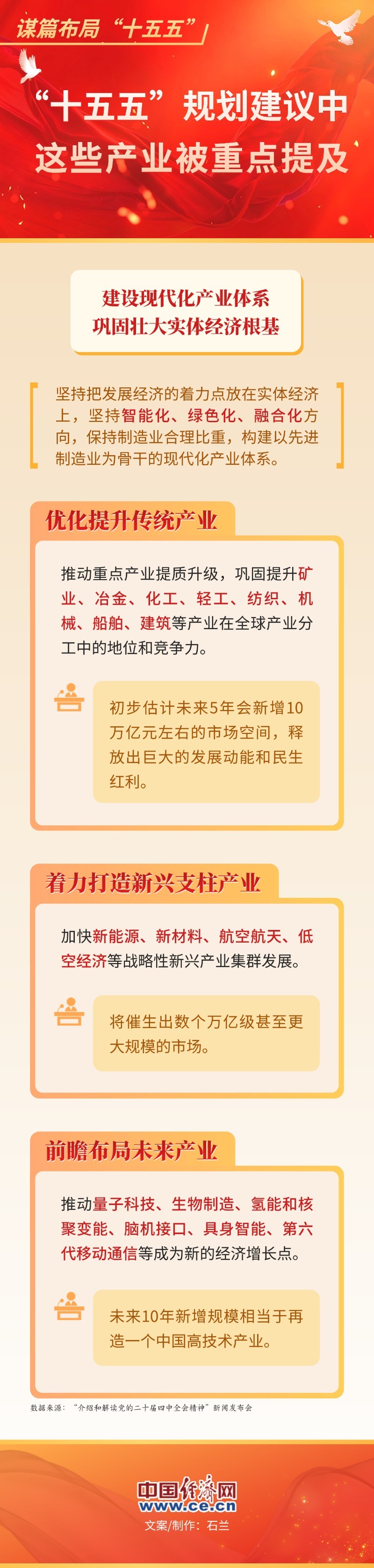
【图解】谋篇布局“十五五”|“十五五”规划建议中,这些产业被重点提及
Zhong Guo Jing Ji Wang· 2025-11-05 07:17
Core Viewpoint - The article emphasizes the importance of developing a modern industrial system focused on strengthening the real economy, with a commitment to intelligent, green, and integrated development, while maintaining a reasonable proportion of manufacturing [3][5]. Group 1: Modern Industrial System - The focus is on consolidating and expanding the foundation of the real economy by prioritizing the development of the real economy [3]. - There is a commitment to maintaining a reasonable proportion of manufacturing and constructing a modern industrial system centered on advanced manufacturing [3]. Group 2: Traditional Industry Optimization - The article discusses the need to enhance traditional industries such as mining, metallurgy, chemicals, light industry, textiles, machinery, shipping, and construction to improve their global competitiveness [5]. - An estimated market space of around 10 trillion yuan is expected to be added over the next five years, releasing significant development momentum and benefits for people's livelihoods [5]. Group 3: Emerging Pillar Industries - There is a push to accelerate the development of strategic emerging industries such as new energy, new materials, aerospace, and low-altitude economy [6]. - This initiative is expected to create several trillion-level markets or even larger scales [7]. Group 4: Future Industry Layout - The article highlights the importance of forward-looking layouts for future industries, promoting quantum technology, biomanufacturing, hydrogen energy, nuclear fusion energy, brain-computer interfaces, embodied intelligence, and sixth-generation mobile communication as new economic growth points [8]. - The anticipated scale of new high-tech industries over the next decade is comparable to recreating an entire high-tech industry in China [8].

创新势能足 产业焕新机
Ren Min Ri Bao Hai Wai Ban· 2025-11-04 01:21
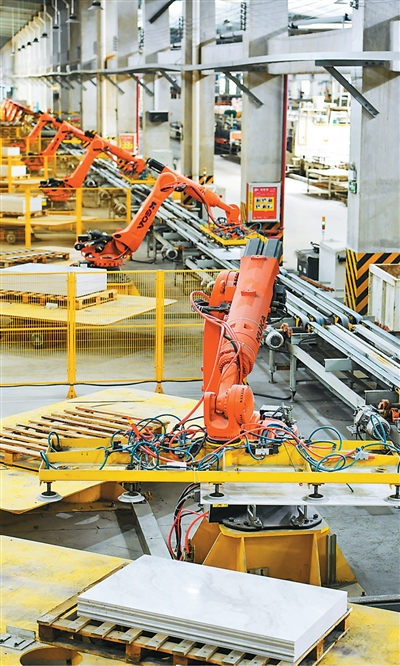
Core Insights - The article highlights the rapid advancement of automation and intelligent manufacturing across various industries in China, showcasing the integration of AI and digital technologies into traditional production processes [13]. Group 1: Automation in Manufacturing - Jiangxi Province's Weimei Ceramics Co., Ltd. has achieved fully digital and intelligent production on its automated ceramic production line [1]. - In Anhui Province, CRRC Puzhen Alstom Transportation Systems Co., Ltd. is manufacturing unmanned rail trains, indicating a shift towards autonomous transportation solutions [3]. - A toy manufacturing company in Yongzhou, Hunan Province, is utilizing automated production lines, reflecting the trend of automation in consumer goods manufacturing [11]. Group 2: Intelligent Mining and Resource Management - In Hainan Province, an unmanned mining truck is operating at a granite mining project, which is recognized as the most intelligent "AI + green smart mine" in the region [2]. - Shandong Province's Rongcheng City is accelerating the development of a new energy system that integrates nuclear, wind, and solar resources, indicating a strategic approach to resource management and industrial cultivation [5]. Group 3: Smart Factories and AI Integration - In Fujian Province, Shuangchi Technology's smart factory uses AI to match consumers' foot data with suitable shoe designs, demonstrating the application of AI in personalized manufacturing [7]. - In Heilongjiang Province, AI is employed for quality inspection in the manufacturing process at Harbin Boiler Factory, showcasing the role of AI in enhancing product quality [9]. - The "island-style" lean manufacturing factory by SAIC-GM-Wuling in Liuzhou, Guangxi, represents a breakthrough in traditional assembly line models, emphasizing innovative production methods [9]. Group 4: Industry Transformation and Policy Support - The 20th Central Committee of the Communist Party of China has outlined strategies to optimize traditional industries and foster emerging sectors, aligning with the ongoing trend of intelligent and green industrial transformation [13].
巩固壮大实体经济根基,构建以先进制造业为骨干的现代化产业体系
Jing Ji Ri Bao· 2025-11-03 05:02
Group 1 - The core viewpoint emphasizes the importance of the real economy as the foundation of national economic stability and high-quality development, highlighting its priority in strategic tasks [1] - The real economy is identified as the fundamental source of wealth creation, contributing significantly to economic growth and employment, absorbing over 400 million jobs, and serving as a stabilizer for people's livelihoods [1] - The real economy is crucial for international competition, with a complete industrial system enhancing economic resilience against external shocks [1] Group 2 - The real economy currently faces multiple pressures, including weak global economic recovery, rising trade protectionism, geopolitical risks, and increased costs for raw materials and logistics [2] - Internally, there is insufficient effective demand, rising labor and raw material costs, severe market competition, and low profitability among small and medium-sized enterprises [2] - The transition from old to new economic drivers is experiencing challenges, with insufficient private investment and financing difficulties for some enterprises [2] Group 3 - Strengthening the real economy requires building a modern industrial system centered on advanced manufacturing, which is the most innovative and high-value-added sector of the manufacturing industry [2] - The focus should be on integrating technological innovation with industrial innovation to enhance the effectiveness of industrial technological innovation [2] Group 4 - Key directions for development include intelligentization, greening, and integration, which can enhance efficiency, reduce costs, and promote sustainable development [3] - Intelligentization leverages digital technology across production processes, while greening addresses resource consumption and environmental pressures, creating new growth points in green industries [3] - Integration breaks down industry boundaries, promoting synergy between various sectors and creating new value [3] Group 5 - Consolidating and strengthening the real economy involves optimizing traditional industries while nurturing emerging and future industries [4] - Traditional industries account for about 80% of the added value in manufacturing and are essential for economic stability [4] - Upgrading traditional industries requires focusing on key sectors and enhancing competitiveness through technological improvements [4] - Emerging industries such as new energy, new materials, and aerospace should be developed, alongside future industries like quantum technology and hydrogen energy, to create new growth points [4]
中上协:上市公司业绩向好 分红回购频次稳步提升
Zhong Guo Zheng Quan Bao· 2025-11-03 00:01
Core Insights - The overall performance of listed companies in China continues to improve, with significant contributions from technology-driven enterprises and a focus on high-quality development [1][2][3] Group 1: Financial Performance - As of October 31, 2025, a total of 5,446 listed companies disclosed their Q3 reports, showing a year-on-year increase in operating revenue of 1.36% to 53.46 trillion yuan and a net profit increase of 5.50% to 4.70 trillion yuan [2] - In Q3 alone, revenue and net profit grew by 3.82% and 11.45% year-on-year, respectively, indicating a significant improvement compared to the first half of the year [2] - The total cash dividend announced by 1,033 companies reached 734.9 billion yuan, with 89 companies distributing over 1 billion yuan in dividends [1][5] Group 2: Sector Performance - Among 19 industry categories, 17 reported profits, with 9 experiencing revenue growth and 10 showing net profit growth [3] - The electronic industry leads in market capitalization, surpassing the banking sector, with a market share of 12.42%, an increase of nearly 3 percentage points since the beginning of the year [2] - The storage chip industry saw revenue growth of 16.08% and net profit growth of 26.44%, driven by expanding AI data storage needs [3] Group 3: Innovation and R&D - Listed companies invested a total of 1.16 trillion yuan in R&D, marking a 3.88% increase year-on-year, with 168 companies investing over 1 billion yuan [4] - The overall R&D intensity across the market is 2.16%, with the ChiNext, STAR Market, and Beijing Stock Exchange showing higher intensities of 4.54%, 11.22%, and 4.42%, respectively [4] Group 4: Capital Market Reforms - The frequency of cash dividends and share buybacks has steadily increased, with 1,195 companies announcing 1,525 buyback plans, completing 899 of them [5] - The total amount repurchased reached 92.3 billion yuan, with 36% of buybacks funded by self-owned capital [5] - The "14th Five-Year Plan" period has seen positive outcomes from capital market reforms, with significant measures being implemented to attract long-term investments [5]
整体业绩持续改善 含“科”量进一步提高
Zheng Quan Shi Bao· 2025-11-02 23:45
Core Insights - The overall performance of listed companies in China has shown continuous improvement, with significant contributions from the technology sector and a shift towards high-quality development [1][2][3] Financial Performance - In the first three quarters, listed companies achieved a total revenue of 53.46 trillion yuan and a net profit of 4.7 trillion yuan, representing year-on-year growth of 1.36% and 5.50% respectively [1] - In Q3 alone, revenue and net profit grew by 3.82% and 11.45% year-on-year, with quarter-on-quarter increases of 2.40% and 14.12% [1] Sector Performance - The technology sector, particularly the ChiNext, STAR Market, and Beijing Stock Exchange, reported significant revenue and profit growth, with the ChiNext showing over 10% growth in both metrics [2] - Among 19 industry categories, 17 reported profitability, with advanced manufacturing and new energy sectors being key growth drivers [3] Consumer Trends - Consumer sectors such as film, gaming, and transportation saw revenue increases of 9.31%, 24.40%, and 0.25% respectively, indicating a recovery in consumer spending [4] - The precious metals industry experienced a revenue growth of 22.36% and a net profit increase of 55.96% due to rising gold prices [4] Innovation and R&D - Listed companies invested a total of 1.16 trillion yuan in R&D, marking a 3.88% increase year-on-year, with a notable focus on strategic emerging industries [5] - The overall R&D intensity across the market was 2.16%, with the ChiNext and STAR Market showing higher intensities of 4.54% and 11.22% respectively [5] Shareholder Returns - A total of 1,033 companies announced cash dividend plans, with a total payout of 734.9 billion yuan, reflecting an increase in shareholder returns [5] - The number of share buyback plans reached 1,525, with completed buybacks amounting to 92.3 billion yuan, indicating a trend towards returning capital to shareholders [5]
上市公司业绩向好 分红回购频次稳步提升
Zhong Guo Zheng Quan Bao· 2025-11-02 20:16
Core Insights - The overall performance of listed companies in China has shown continuous improvement, with significant contributions from technology-driven enterprises and a focus on high-quality development [1][2][3] Summary by Category Cash Dividends and Buybacks - As of October 31, 1033 listed companies announced cash dividend plans for the first, second, and third quarters, an increase of 141 companies compared to the previous year, with a total cash dividend amount of 734.9 billion yuan [1][4] - 89 companies have distributed over 1 billion yuan in dividends this year, and 1195 companies have released 1525 buyback plans, with 899 completed, totaling 92.3 billion yuan in buybacks [4] Financial Performance - In the first three quarters, listed companies achieved a total revenue of 53.46 trillion yuan and a net profit of 4.70 trillion yuan, representing year-on-year growth of 1.36% and 5.50% respectively [1][2] - The third quarter saw revenue and net profit growth of 3.82% and 11.45% year-on-year, indicating a significant improvement compared to the first half of the year [1] Sector Performance - Technology-driven sectors, particularly those listed on the ChiNext, STAR Market, and Beijing Stock Exchange, reported strong growth, with revenues of 32.49 trillion yuan, 1.01 trillion yuan, and 145.07 billion yuan respectively, and net profits of 244.66 billion yuan, 44.12 billion yuan, and 9.20 billion yuan [2] - The electronics industry leads in market capitalization, surpassing the banking sector, with a market share of 12.42%, reflecting a nearly 3 percentage point increase since the beginning of the year [2] Innovation and R&D - Listed companies have actively pursued innovation, with total R&D investment reaching 1.16 trillion yuan, marking a year-on-year increase of 3.88% [3] - The overall R&D intensity across the market is 2.16%, with higher intensities in the ChiNext and STAR Market at 4.54% and 11.22% respectively [3]
中上协发布上市公司三季报经营业绩报告 整体业绩持续改善 含“科”量进一步提高
Zheng Quan Shi Bao· 2025-11-02 18:07
Core Insights - The overall performance of listed companies in China has shown continuous improvement, with significant contributions from the technology sector, indicating a shift towards high-quality development [1][2][3] Group 1: Financial Performance - In the first three quarters, listed companies achieved a total revenue of 53.46 trillion yuan and a net profit of 4.7 trillion yuan, representing year-on-year growth of 1.36% and 5.50% respectively [1] - In Q3 alone, revenue and net profit grew by 3.82% and 11.45% year-on-year, with quarter-on-quarter growth of 2.40% and 14.12%, indicating a solid upward trend [1] Group 2: Sector Performance - The technology sector, particularly the ChiNext, STAR Market, and Beijing Stock Exchange, showed remarkable growth, with revenues of 32,486.28 billion yuan, 10,142.07 billion yuan, and 1,450.68 billion yuan respectively, and net profits of 2,446.61 billion yuan, 441.25 billion yuan, and 92.03 billion yuan [2] - Advanced manufacturing and new energy sectors are emerging as significant growth drivers, with storage chip companies reporting revenue growth of 16.08% and net profit growth of 26.44% [3] Group 3: Consumer Trends - Consumer sectors are experiencing a boost, with the total box office surpassing 40 billion yuan and gaming industry revenues increasing by 24.40% [4] - The precious metals sector saw revenue growth of 22.36% and net profit growth of 55.96%, driven by rising gold prices [4] Group 4: Innovation and R&D - Listed companies invested a total of 1.16 trillion yuan in R&D, marking a year-on-year increase of 3.88%, with a total R&D intensity of 2.16% across the market [4] - Strategic emerging industries have a higher R&D intensity of 5.21%, indicating a strong focus on innovation [4] Group 5: Shareholder Returns - A total of 1,033 companies announced cash dividend plans, with a total cash dividend amounting to 734.9 billion yuan, reflecting an increase in shareholder returns [5] - The number of share buyback plans reached 1,525, with a total buyback amount of 92.3 billion yuan, indicating a commitment to returning value to shareholders [5] Group 6: Market Reforms - The capital market reforms are progressing, with initiatives aimed at attracting long-term investments and enhancing market adaptability and inclusiveness [6]