
资产管理

Search documents
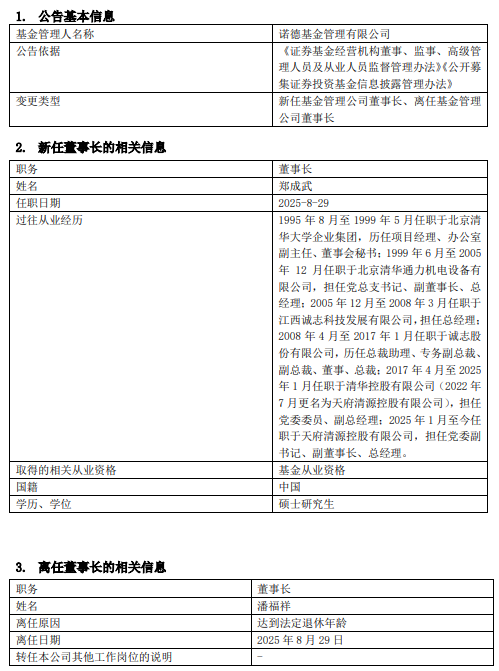
诺德基金换帅:潘福祥到龄退休 新任郑成武为董事长
Xin Lang Ji Jin· 2025-08-29 09:40
Group 1 - The core point of the article is the significant leadership change at Nord Fund, with Chairman Pan Fuxiang retiring due to reaching the legal retirement age, and Na Chengwu being appointed as the new Chairman [1][4][5] - Pan Fuxiang has been a key figure in the establishment and growth of Nord Fund since its founding in 2004, serving in various roles including Vice General Manager and General Manager before becoming Chairman in 2015 [4][5] - Under Pan's leadership, the company's asset management scale increased nearly ninefold from the end of 2015 to the end of July 2025 [4] Group 2 - Na Chengwu, the new Chairman, has extensive experience in various leadership roles within companies associated with Tsinghua University and has held significant positions in the financial sector [3][5] - Nord Fund was established in 2006 and has undergone changes in its ownership structure, currently being led by local state-owned assets [6] - The company emphasizes a core development philosophy focused on stable investment, value discovery, and long-termism, aiming to provide diverse product offerings and sustainable investment returns [6][7] Group 3 - Nord Fund plans to adhere to prudent operational principles and enhance its investment research capabilities while focusing on high-quality development and investor interests [7] - The company aims to strengthen the strategic role of state-owned financial capital in supporting the transformation of the real economy and contributing to national strategies and regional development [7]

《2025中国资产管理发展趋势报告》重磅发布
2 1 Shi Ji Jing Ji Bao Dao· 2025-08-28 23:06
Core Insights - The "2025 Asset Management Annual Conference" was held in Shanghai, focusing on the theme "Breaking the Deadlock and Restructuring - Rebuilding Competitiveness in Asset Management" [1] - The conference featured the release of the "2025 China Asset Management Development Trend Report," which aims to analyze industry changes and trends to guide asset management institutions and professionals [1] Summary by Sections - The report consists of five sections: a retrospective on asset management, rebuilding competitiveness, new trends in asset allocation, a semi-annual report on bank wealth management, and interviews with industry leaders [2] - The first section reviews the past decade of asset management data and highlights the top ten significant events in the past year [2] - The second section analyzes new characteristics of the asset management industry, wealth management transformation, and public fund reforms to identify core competitiveness [2] - The third section discusses the predictions and investment strategies of asset management institutions regarding various asset trends in a low-interest-rate environment [2] - The fourth section provides data analysis of the wealth management market for the first half of the year, utilizing the South Finance Wealth Management platform [2] - The fifth section features interviews with leaders from various asset management institutions, discussing the current state and future of the industry [2][3]

伟能集团(01608)发布中期业绩,股东应占溢利2068.3万港元
智通财经网· 2025-08-28 13:35
Core Viewpoint - The company reported a decline in revenue but achieved profitability due to strategic asset management and operational improvements [1] Financial Performance - Revenue for the first half of 2025 was HKD 612 million, a decrease of 25% year-on-year [1] - Profit attributable to shareholders was HKD 20.683 million, compared to a loss of HKD 138.6 million in the same period last year [1] - Basic earnings per share were HKD 0.031 [1] Business Strategy - The company is steadily advancing its distributed generation market layout, leveraging the strong business network of its controlling shareholder [1] - Ongoing project construction and operational commencement are expected to strengthen the business foundation and improve future profitability [1] - The company is focused on optimizing its business structure and enhancing operational efficiency to achieve long-term development goals [1] Asset Management - Strategic asset management measures have been successfully implemented, leading to effective financial cost reduction and a turnaround from loss to profit [1]
招商积余(001914):业绩表现稳健,商业运营稳步发展
Shenwan Hongyuan Securities· 2025-08-28 07:18
Investment Rating - The investment rating for the company is "Buy" (maintained) [2][7]. Core Views - The company has demonstrated stable performance with steady development in commercial operations. The revenue for the first half of 2025 increased by 16.2% year-on-year, while the net profit attributable to shareholders rose by 8.9%, slightly below market expectations. The gross profit margin decreased slightly [7]. - The company is backed by the China Merchants Group, focusing on property management and asset management, with strong resource endowments and market expansion capabilities. It is expected to continue leading the property management industry [7]. Financial Data and Profit Forecast - Total revenue projections for 2025 are estimated at 19,424 million, with a year-on-year growth rate of 13.1%. The net profit attributable to shareholders is forecasted to be 943 million, reflecting a growth rate of 12.1% [6]. - The earnings per share (EPS) for 2025 is projected to be 0.89 yuan, with a gross profit margin of 11.8% [6]. - The return on equity (ROE) is expected to be 8.4% in 2025, with a price-to-earnings ratio (PE) of 14 [6]. Revenue Breakdown - In the first half of 2025, property management revenue reached 88.0 million, up 16.8% year-on-year, while asset management revenue was 3.1 million, increasing by 5.9% [7]. - The company’s management area reached 368 million square meters by the end of the first half of 2025, with a year-on-year decrease of 4.4% [7]. Commercial Operations - The company’s commercial management area remained stable at 397,000 square meters, with commercial operation revenue increasing by 30.7% year-on-year [7]. - The company manages 72 commercial projects, with a focus on increasing support from the China Merchants Group in commercial real estate [7].

万亿资管巨头,高管变动
Zhong Guo Ji Jin Bao· 2025-08-26 13:19
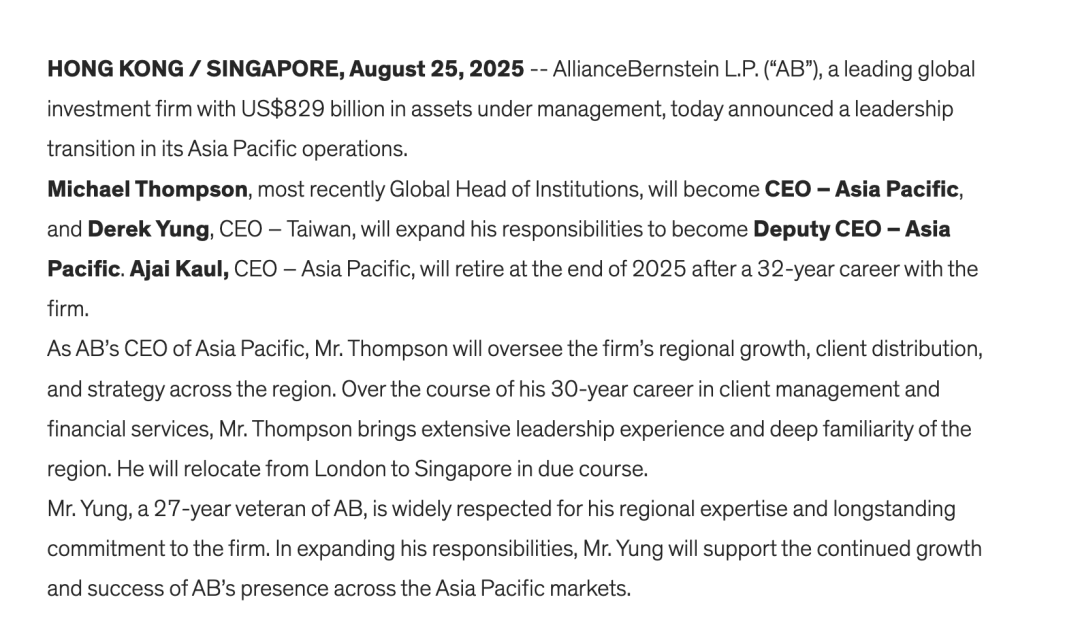
Group 1 - The core point of the news is the leadership changes at the asset management giant, Legg Mason, with Michael Thompson appointed as the new CEO for the Asia-Pacific region, effective January 1, 2024, while Derek Yung will be promoted to Deputy CEO for the region [1][2] - Ajai Kaul, the current Asia-Pacific CEO, will retire at the end of this year after 32 years with the company, and he also serves as the chairman of Legg Mason Funds, which may see a leadership change as well [1][2] - Legg Mason's asset management scale is approximately $829 billion, equivalent to about 59,355 million RMB [2] Group 2 - Michael Thompson has 30 years of experience in client management and financial services, and he will relocate from London to Singapore to oversee growth, client distribution, and strategy in the Asia-Pacific region [2] - Derek Yung has been with Legg Mason for 27 years and will support the company's ongoing growth and success in the Asia-Pacific market [2] - On January 2, 2024, Legg Mason announced that its wholly-owned subsidiary, Legg Mason Funds, received a license from the China Securities Regulatory Commission to conduct public fund business in China, making it one of the global asset management companies to do so [2] Group 3 - Legg Mason Funds has launched three public fund products to date, including two equity products (mixed equity) and one fixed income product, with a total scale of 1.11 billion RMB [3] - Following the departure of the first general manager, Qian Feng, Legg Mason appointed Luo Dengpan, who has both foreign and domestic public fund experience, as the new general manager [3] - Legg Mason also announced the appointment of a new head for the Indian market on August 26 [3]
X @Yuyue
Yuyue· 2025-08-24 06:18
Project Overview - Lombard is perceived as a project with significant resources and funding, focusing on BTC asset management for B-end institutions [1] - Lombard is developing BTC-related asset management, securing BTC from numerous B-end institutions for asset packaging and wealth management [1] - LBTC, as the only native yield-bearing Bitcoin LST, has $1 billion TVL, surpassing traditional Ethereum re-staking Ether in growth rate, indicating demand in the B-end BTC capital market [1] Security and Partnerships - Lombard has undergone comprehensive audits by institutions like Chainlink, with product design geared towards institutions, positioning it as a ToB project [1] - Institutions are likely to collaborate with well-resourced and funded projects like Lombard when entering the blockchain space [1] - Lombard's inclusion in Buidlpad demonstrates its resources and strength [1] - Polychain led the previous funding round with $16 million, establishing Lombard as a Polychain-backed project [1] Community Engagement - Participation in Lombard + Buidlpad community activities is available until the 25th, with UGC content submission on Buidlpad granting non-diluted subscription quotas [1] - The formal subscription is scheduled for the 26th, with KYC preparation advised [1]
东百集团: 东百集团财务管理制度(修订)
Zheng Quan Zhi Xing· 2025-08-22 08:12
Core Points - The financial management system of Fujian Dongbai Group Co., Ltd. aims to enhance financial management, standardize internal controls, and improve the quality of financial information [1][2] - The system applies to the company and all subsidiaries within the consolidated financial statements [1] - The basic principles of financial management include unified management, hierarchical responsibility, authorization and approval management, separation of duties, and internal supervision [1][2] Financial Management System - The president is fully responsible for daily financial management and reports to the board of directors [3] - The company has a financial director appointed by the board, responsible for overall financial activities [3] - The financial center of the group implements financial management across the enterprise, with subsidiary financial personnel under its unified leadership [3] Accounting Basis and Norms - The company follows national accounting standards and develops accounting policies accordingly [4] - Accounting policies must remain consistent across accounting periods unless changes are required by law or for improved reliability [4] - All accounting records must be based on actual economic transactions, and no false information is allowed [4][5] Fund Management - The company implements centralized fund management and budget control to meet financial needs while minimizing costs [6] - All fund payments require appropriate authorization based on the nature of the payment [6] - A responsibility system is established for monetary fund operations to ensure separation of duties and supervision [6] Budget Management - The company practices comprehensive budget management, including operational, investment, and financing budgets [7] - The budget is prepared based on strategic requirements and is subject to regular monitoring and reporting [7][8] - Adjustments to the budget are made only under significant changes in market conditions or operational needs [8] Investment Management - Investment management includes both internal and external investments, with a dedicated investment decision-making committee [9] - The company must maintain proper accounting for investments and ensure compliance with internal management procedures [9] Asset Management - The company manages various assets, including receivables, inventory, fixed assets, and intangible assets [10][11] - Regular assessments and audits of assets are conducted to ensure their safety and value [10][11] Liability Management - Liabilities are categorized into current and non-current, with specific management practices for each type [40] - The company maintains detailed records of accounts payable and contract liabilities [41] Owner's Equity and Profit Distribution - Owner's equity includes capital stock, capital reserves, and retained earnings, with specific rules for profit distribution [43][44] - The board of directors must implement profit distribution decisions within two months of shareholder approval [48] Cost and Expense Management - The company controls costs and expenses through budget management, ensuring accountability for budget execution [49][50] Tax Management - Tax management focuses on legal compliance and cost-effectiveness, with regular assessments of tax risks [52][53] - The financial department is responsible for identifying and managing tax risks systematically [56][57] Financial Reporting and Analysis - Financial reports must adhere to national accounting standards and be prepared accurately [58][59] - Regular financial analysis meetings are held to evaluate the company's financial status and operational performance [61] Financial Information System - The company utilizes a unified financial information system for accounting and financial management [62][63] Financial Supervision and Control - Internal controls are established to ensure effective supervision and separation of incompatible duties [65][66] - The board's audit committee oversees financial activities and internal audits [66]

透视半年报|营收腰斩、亏损收窄 金融街手握核心资产能否突围?
Xin Jing Bao· 2025-08-20 14:27
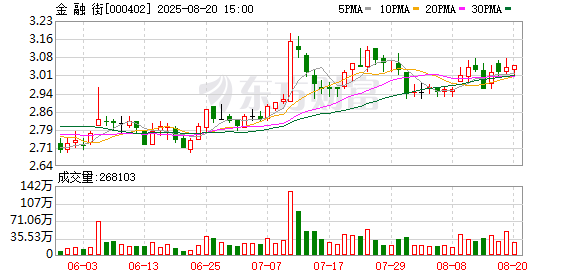
Core Viewpoint - Financial Street, a well-established real estate company, continues to face significant pressure on its performance, with a substantial decline in revenue and ongoing losses in the first half of 2025 [2][10]. Financial Performance - The company reported a revenue of 4.655 billion yuan in the first half of the year, representing a year-on-year decrease of 51.79% [3][6]. - The net profit attributable to shareholders was -1.008 billion yuan, showing a reduction in losses by 49.20% compared to the previous year [3][6]. - The cash flow from operating activities was 1.606 billion yuan, down 9.96% from the same period last year [3]. - The basic and diluted earnings per share were both -0.34 yuan, an improvement of 48.48% from -0.66 yuan [3]. - Total assets decreased by 5.17% to 115.35 billion yuan, while net assets attributable to shareholders fell by 4.01% to 23.89 billion yuan [3]. Business Segments - The primary source of revenue, real estate development, accounted for 77.8% of total revenue, with a significant decline of 57.42% year-on-year, generating 3.624 billion yuan [6][8]. - The property leasing segment generated 776 million yuan, down 9.99%, but maintained a high gross margin of 85.93% [8]. - The property management business achieved revenue of 183 million yuan, primarily due to the transfer of hotel properties, with a gross margin increase of 15.05 percentage points to 38.34% [8][9]. - Other business revenues decreased by 9.61% to 73 million yuan, with a gross margin turning negative at -0.75% [9]. Strategic Initiatives - Financial Street is focusing on stabilizing operations and accelerating sales in the development business while enhancing asset management capabilities [2][6]. - The company is pursuing a four-pronged strategy involving development, asset management, urban renewal, and cultural tourism, with new projects like the Tianjin observation tower and the Zunhua ancient spring town being highlighted [9][11]. - The company aims to optimize its sales management model and balance project sales strategies to adapt to market dynamics [7]. Historical Context - Financial Street was once a leading profit-maker among Beijing's real estate firms, with significant holdings in prime locations [10]. - The company's aggressive expansion from 2017 to 2020 led to a substantial increase in debt, peaking near 100 billion yuan, which has become unsustainable amid industry adjustments [10][11]. - The company has been divesting key assets to manage debt pressures, while still retaining valuable properties in major cities [11].

平安好医生附属签订全权委托管理专户合约
Zhi Tong Cai Jing· 2025-08-19 08:47
Core Viewpoint - Ping An Good Doctor (01833) announced a significant investment management agreement with China Life Franklin Asset Management, involving a total principal amount of up to USD 55 million for asset management services over a three-year period [1] Group 1 - The subsidiary Glorious Delight Limited (鑫悦) will act as the principal in the agreement [1] - China Life Franklin will serve as the investment manager under the discretionary management agreement [1] - The agreement is set to take effect on August 19, 2025, and will last for three years [1]

银行理财产品与基金如何选择?
Sou Hu Cai Jing· 2025-08-15 17:51
Group 1: Core Perspectives - The article emphasizes the importance of understanding the characteristics and differences between bank wealth management products and funds for investors to make informed decisions [1][4] - Bank wealth management products are designed based on analysis of target customer groups and are closely related to the bank's credit and risk management capabilities [1][4] - Funds are a collective investment method where investors pool their money, managed by fund managers, with various types of funds available, including money market funds, bond funds, stock funds, and mixed funds [2][4] Group 2: Risk and Return Characteristics - Bank wealth management products have varying risk levels, with low-risk products focusing on capital safety and moderate returns, while medium to high-risk products may include equities, offering higher potential returns but with increased risk [1][3] - Funds do not have a predetermined expected return; their performance is entirely dependent on the underlying assets, with daily net asset value updates reflecting market conditions [3][4] Group 3: Liquidity and Investment Horizon - Bank wealth management products typically have fixed terms, with restrictions on early redemption, while some open-ended products allow for more flexibility [2][3] - Funds generally offer better liquidity, especially money market funds, which can provide real-time redemption [2][3] Group 4: Cost Considerations - Investors should consider the fee structures associated with both bank wealth management products and funds, as these can impact overall returns over time [3][4] - Bank wealth management products may incur sales commissions and management fees, while funds may have management fees, custody fees, and various transaction fees [3][4]