
高性能计算

Search documents
胜宏科技:2025年净利润同比预增260.35%—295%
Zheng Quan Shi Bao Wang· 2026-01-16 11:11
Core Viewpoint - Shenghong Technology (300476) expects a net profit attributable to shareholders of 4.16 billion to 4.56 billion yuan for 2025, representing a year-on-year growth of 260.35% to 295.00% [1] Group 1: Financial Performance - The company anticipates a significant increase in net profit for 2025, with projections indicating a growth range of 4.16 billion to 4.56 billion yuan [1] - This expected growth reflects a substantial year-on-year increase of 260.35% to 295.00% [1] Group 2: Industry Position and Product Development - Shenghong Technology continues to solidify its technological leadership in the global PCB manufacturing sector [1] - The company has achieved large-scale production of multiple high-end products in key areas such as AI computing power, data centers, and high-performance computing [1] - There is a notable upgrade in product structure towards higher value and higher technical complexity, with a significant increase in the proportion of high-end products contributing to rapid growth in company performance [1]

胜宏科技2025年业绩预增260.35%-295.00%,AI算力需求驱动业绩大爆发 | 财报见闻
Hua Er Jie Jian Wen· 2026-01-16 11:08
Core Viewpoint - The company expects a net profit of 4.16 billion to 4.56 billion yuan in 2025, representing a year-on-year growth of 260.35% to 295.00% [1] Group 1: Financial Projections - The projected net profit for 2025 is significantly high, indicating strong future performance [1] - The expected growth rate reflects a substantial increase compared to previous years, showcasing the company's robust financial health [1] Group 2: Product Development and Market Position - The company has achieved large-scale production of multiple high-end products in key areas such as AI computing power, data centers, and high-performance computing [1] - There is a notable upgrade in product structure towards higher value and more technically complex products, which has led to a significant increase in the proportion of high-end products [1] - The growth in high-end product sales is a key driver of the company's rapid performance increase [1]
胜宏科技:2025年全年净利润同比预增260.35%—295.00%
2 1 Shi Ji Jing Ji Bao Dao· 2026-01-16 11:08
21智讯1月16日电,胜宏科技发布年度业绩预告,预计2025年全年归属于上市公司股东的净利润为 416000万元—456000万元,同比预增260.35%—295.00%;预计2025年全年归属于上市公司股东的扣除 非经常性损益的净利润为415000万元—455000万元,同比预增263.59%—298.64%,2025年度,公司坚 定"拥抱AI,奔向未来",精准把握AI算力技术革新与数据中心升级浪潮带来的历史新机遇,持续巩固在 全球PCB制造领域的技术领先地位。随着全球AI基础设施与算力需求的持续扩张,公司凭借行业领先的 技术能力、品质能力、交付能力和全球化服务能力,成为国内外众多头部科技企业的核心合作伙伴。在 AI算力、数据中心、高性能计算等关键领域,多款高端产品已实现大规模量产,带动产品结构向高价 值量、高技术复杂度方向升级,高端产品占比显著提升,推动公司业绩高速增长。 ...
胜宏科技:预计2025年度归母净利润41.6亿元-45.6亿元,同比增长260%-295%
Xin Lang Cai Jing· 2026-01-16 11:06
Core Viewpoint - The company expects a significant increase in net profit for the fiscal year 2025, projecting a range of 4.16 billion to 4.56 billion yuan, which represents a year-on-year growth of 260.35% to 295% [1] Group 1 - The company has become a core partner for many leading technology enterprises both domestically and internationally [1] - The company has achieved large-scale production of several high-end products in key areas such as AI computing power, data centers, and high-performance computing [1] - The product structure is upgrading towards higher value and higher technical complexity, with a significant increase in the proportion of high-end products [1]
胜宏科技:预计2025年净利润41.6亿元-45.6亿元,同比增长260.35%-295.00%
Hua Er Jie Jian Wen· 2026-01-16 11:03
Core Viewpoint - Shenghong Technology expects a net profit of 4.16 billion to 4.56 billion yuan in 2025, representing a year-on-year growth of 260.35% to 295.00% [1] Group 1: Financial Performance - The company anticipates significant growth in net profit for 2025, driven by advancements in AI computing power, data centers, and high-performance computing [1] - The expected net profit range indicates a strong upward trajectory in financial performance, reflecting the company's strategic focus on high-value and technologically complex products [1] Group 2: Product Development - Multiple high-end products have achieved large-scale production, contributing to the upgrade of the product structure towards higher value and complexity [1] - The significant increase in the proportion of high-end products is a key factor in driving the company's rapid growth in performance [1]
通富微电(002156) - 002156通富微电投资者关系管理信息20260116
2026-01-16 08:58
证券代码:002156 证券简称:通富微电 通富微电子股份有限公司投资者关系活动记录表 编号:2026-001 | 投资者关系活动 ☑ | 特定对象调研 □分析师会议 | | --- | --- | | 类别 | □媒体采访 □业绩说明会 | | | □新闻发布会 □路演活动 | | | □现场参观 | | | □其他 (请文字说明其他活动内容) | | 参与单位名称及 | 鹏扬基金:章宏帆;泰康资产:余思雨;申万菱信:徐巡;拾贝 | | 人员姓名 | 投资:王祥宇;鑫元基金:施欣彤;南方基金:葛树名、金岚枫; | | | 兴银基金:阮姝漫;道仁资产:李晓光;汇丰晋信:刘昱辰;汇 | | | 添富:钱晨润;长江证券:钟智铧;丹羿投资:朱亮 | | 时间 | 2026 年 1 月 16 日 | | 地点 | 公司会议室 | | 上市公司接待人 | 董事会秘书 蒋澍 | | 员姓名 | | | | 一、公司概况 | | | 通富微电是集成电路封装测试服务提供商,为全球客户提供 | | | 从设计仿真到封装测试的一站式服务。公司的产品、技术、服务 | | | 全方位覆盖了人工智能、高性能计算、大数据存储、显示驱动、 ...

1秒赚30000元,台积电把光刻机“干冒烟”
3 6 Ke· 2026-01-16 02:30
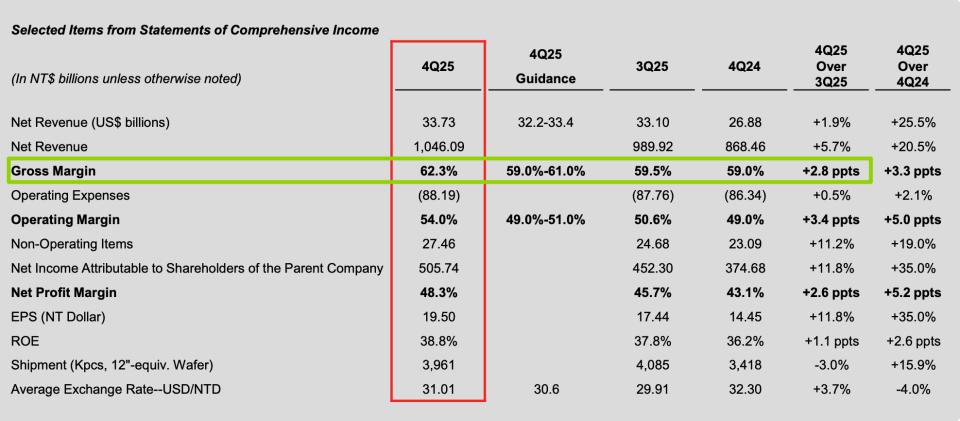
Core Insights - TSMC reported a significant increase in revenue and profit for Q4 2025, with revenue reaching $33.73 billion, a year-on-year growth of 25.5%, and net profit of $16.297 billion, up 40.2% year-on-year [1][6][12] - The company anticipates a strong growth trajectory for 2026, projecting nearly 30% revenue growth based on its leadership in advanced processes and packaging technologies [1][12] Financial Performance - Q4 2025 revenue was $33.73 billion, exceeding guidance of $32.2-33.4 billion, with a gross margin of 62.3%, surpassing the previous guidance of 59%-61% [6][9] - TSMC's net income attributable to shareholders was $505.74 million, reflecting a 35% increase year-on-year [6][9] - Capital expenditures for Q4 2025 were $11.51 billion, with a total of $40.90 billion for the year, indicating a strong investment in capacity expansion [11][10] Advanced Technology and Market Trends - Advanced processes (7nm and below) accounted for 77% of total wafer revenue, with 5nm contributing 35% due to high-performance computing (HPC) demand [2][8] - Revenue from AI accelerators constituted a significant portion of total revenue, with a projected compound annual growth rate (CAGR) of nearly 50% for AI accelerator revenue from 2024 to 2029 [3][4][13] - The company is transitioning to 2nm production, with expectations of significant contributions from this node in 2026 [15][22] Customer and Geographic Insights - North American customers contribute approximately 75% of TSMC's revenue, while customers from mainland China accounted for 9% in Q4 2025 [5][12] - TSMC is expanding its manufacturing footprint in the U.S. and Japan, with plans for multiple fabs to support AI and HPC demands [14][15] Future Outlook - TSMC's CEO expressed confidence in the sustainability of AI demand, emphasizing that AI has become integral to core business processes for major cloud service providers [16][17] - The company aims to maintain a long-term gross margin target of over 53%, despite rising operational costs associated with overseas manufacturing [20][21] - TSMC is committed to a flexible capital expenditure strategy to ensure that investments translate into future earnings growth [23]


【招商电子】台积电25Q4跟踪报告:26年资本开支指引大超预期,上修24-29年AI芯片增速
招商电子· 2026-01-15 15:58
Core Viewpoint - TSMC's Q4 2025 financial results exceeded guidance, driven by improved capacity utilization and cost optimization, indicating strong demand for advanced process technologies [1][11]. Financial Performance - Q4 2025 revenue reached $33.73 billion, surpassing the guidance range of $32.2-33.4 billion, with a year-over-year increase of 25.5% and a quarter-over-quarter increase of 1.9% [1]. - Gross margin was 62.3%, up 3.3 percentage points year-over-year and 2.8 percentage points quarter-over-quarter, attributed to cost optimization and favorable exchange rates [1][11]. - GAAP net profit was $16.37 billion, reflecting a year-over-year increase of 34.98% and a quarter-over-quarter increase of 11.82% [1]. - For the full year 2025, revenue was $122 billion, a 35.9% year-over-year increase, with a gross margin of 59.9% [1][12]. Advanced Process Technology - Advanced process nodes (3nm, 5nm, 7nm) accounted for 77% of revenue, with 3nm contributing 28%, 5nm 35%, and 7nm 14% [2][11]. - High-Performance Computing (HPC) revenue was $18.55 billion, slightly down 1.67% quarter-over-quarter, while smartphone revenue increased by 8.7% to $10.79 billion [2][12]. Future Guidance - For Q1 2026, TSMC expects revenue between $34.6 billion and $35.8 billion, with a year-over-year increase of 38.6% and a quarter-over-quarter increase of 7.3% [3]. - Gross margin is projected to be between 63% and 65%, with potential dilution from overseas expansion and the ramp-up of 2nm technology expected to impact margins by 2-3% [3][16]. Capital Expenditure and AI Growth - Q4 2025 capital expenditure was $11.51 billion, with a full-year capex of $40.9 billion, and 2026 capex is expected to be between $52 billion and $56 billion [4][17]. - AI-related revenue is projected to account for 15% of total revenue in 2025, with a compound annual growth rate (CAGR) for AI accelerator business expected to be 55-59% from 2024 to 2029 [4][19]. Global Manufacturing Expansion - TSMC is expanding its manufacturing footprint in Arizona, with plans for multiple fabs to meet strong demand, particularly in AI and HPC applications [20][21]. - The company is also establishing special process fabs in Japan and Germany, with ongoing investments in Taiwan to enhance advanced process capabilities [22][23]. Technology Development - The 2nm process is set to begin volume production in late 2026, with expectations for significant revenue contributions [23][33]. - TSMC is also introducing N2P technology, an extension of the 2nm series, aimed at optimizing performance and power consumption [23]. Customer Demand and Market Outlook - TSMC's customers, particularly in AI, are signaling strong demand for increased capacity, with ongoing efforts to address supply constraints [24][30]. - The company remains confident in the sustainability of semiconductor demand driven by AI and other high-performance applications [19][34].
台积电25Q4跟踪报告:26年资本开支指引大超预期,上修24-29年AI芯片增速
CMS· 2026-01-15 15:40
Investment Rating - The report maintains a positive outlook on the semiconductor industry, particularly for TSMC, with expectations of strong revenue growth and profitability in the coming years [4][23]. Core Insights - TSMC's Q4 2025 revenue reached $33.73 billion, exceeding guidance, with a year-over-year growth of 25.5% and a gross margin of 62.3% [1][19]. - The company anticipates Q1 2026 revenue between $34.6 billion and $35.8 billion, reflecting a year-over-year increase of 38.6% [3][23]. - TSMC's capital expenditure for 2026 is projected to be between $52 billion and $56 billion, with a significant portion allocated to advanced process technologies [4][25]. - The AI market is expected to drive substantial growth, with AI accelerator revenue projected to account for 15% of total revenue in 2025 [4][26]. Summary by Sections Financial Performance - TSMC's Q4 2025 revenue was $33.73 billion, with a gross margin of 62.3%, driven by improved capacity utilization and cost optimization [1][19]. - The company reported a net profit of $16.37 billion for Q4 2025, a year-over-year increase of 34.98% [1][19]. - For the full year 2025, TSMC's revenue was $122 billion, reflecting a 35.9% year-over-year growth [1][22]. Advanced Technology and Market Segmentation - Advanced process technologies (3nm, 5nm, and 7nm) accounted for 77% of TSMC's revenue, with 3nm technology representing 28% [2][20]. - The high-performance computing (HPC) segment generated $18.55 billion in revenue, while smartphone revenue was $10.79 billion [2][20]. Capital Expenditure and Growth Projections - TSMC's capital expenditure for 2025 was $40.9 billion, with 70%-80% allocated to advanced process technologies [4][25]. - The company has raised its CAGR forecast for AI-related revenue from 2024 to 2029 to 55%-59% [4][26]. Future Outlook - TSMC expects Q1 2026 gross margin to be between 63% and 65%, with potential dilution from overseas expansion and new technology ramp-up [3][24]. - The company plans to enhance production efficiency and expand capacity to meet growing demand, particularly in AI and HPC sectors [26][27].
台积电:预计今年资本支出将升至520亿美元至560亿美元
Zheng Quan Shi Bao Wang· 2026-01-15 13:00
Core Insights - TSMC reported a consolidated revenue of approximately NT$1,460.9 billion for Q4 2025, representing a year-on-year increase of 20.5% and a quarter-on-quarter increase of 1.9% [1] - The net profit after tax for the same quarter was approximately NT$505.7 billion, with earnings per share of NT$19.5, both showing a year-on-year increase of 35.0% and a quarter-on-quarter increase of 11.8% [1] - The gross margin was 62.3%, and the net profit margin was 48.3% [1] Revenue Breakdown - In Q4 2025, TSMC's revenue from advanced processes (including 7nm and more advanced processes) accounted for 77% of the total wafer sales revenue, with 3nm process shipments contributing 28%, 5nm contributing 35%, and 7nm contributing 14% [1] - High-performance computing (HPC) and smartphones accounted for 55% and 32% of revenue, respectively, while IoT, automotive, data communication equipment (DCE), and others contributed 5%, 5%, 1%, and 2% [2] Future Outlook - TSMC expects capital expenditures to rise to a record high of between $52 billion and $56 billion in 2026, following a total of $40.9 billion in capital expenditures for 2025 [2] - The company maintains over 90% market share in the AI chip market, which is expected to drive revenue growth [2] - According to Morgan Stanley, TSMC's revenue in 2026 is projected to grow by 30% year-on-year when measured in USD [3]