
数字经济

Search documents
权威发布丨来之不易成绩单彰显经济韧性活力
Ren Min Ri Bao· 2026-01-20 02:37
Economic Resilience and Growth - China's economy is expected to continue its strong resilience and vitality, achieving major goals for social and economic development by 2025, marking a successful conclusion to the "14th Five-Year Plan" [1] - The national economy is projected to grow steadily, with a focus on innovation-driven development, industrial quality improvement, digital empowerment, and green transformation [2] Innovation and Industrial Upgrading - China has become the first country with over 5 million valid domestic invention patents, with R&D expenditure reaching 39,262 billion yuan, maintaining the second position globally [2] - The added value of high-tech manufacturing and equipment manufacturing accounted for 17.1% and 36.8% of the total industrial added value, respectively [2] - The production of civil drones and industrial robots increased by 37.3% and 28% year-on-year, respectively [2] Green Energy Development - Clean energy generation from hydropower, nuclear power, wind, and solar sources grew by 8.8%, with non-fossil energy consumption rising by approximately 2 percentage points compared to 2024 [3] - The annual production and sales of new energy vehicles exceeded 16 million units [3] - The energy consumption per unit of added value in major energy-consuming industries showed significant reductions compared to 2024 [3] Consumer Market Expansion - The total retail sales of consumer goods surpassed 50 trillion yuan, growing by 3.7% year-on-year, with final consumption contributing 52% to economic growth [4] - Service retail sales increased by 5.5%, outpacing goods retail sales, indicating a shift towards balanced consumption between goods and services [4] - Online retail sales grew by 8.6%, driven by e-commerce and digital technologies [4] Household Consumption Trends - The average number of household cars reached 52.9 vehicles per 100 households, an increase of 1.7 vehicles from 2024 [6] - Policies promoting the replacement of old goods contributed to a 4.1% increase in retail sales of related products [6] - The added value of the equipment manufacturing industry is expected to grow by 9.2% year-on-year, reflecting accelerated industrial upgrades [6] Economic Policy and Support - The government is implementing proactive macroeconomic policies to ensure stable economic growth, including measures to stabilize employment and promote high-quality development [6] - The core Consumer Price Index (CPI) rose by 1.2% year-on-year, while the decline in industrial producer prices has narrowed [7] - Manufacturing profits increased by 5.0% from January to November 2025 [7] Future Economic Outlook - The economic foundation is solid, with significant growth in economic strength and technological capabilities during the "14th Five-Year Plan" period [8] - Positive economic trends are expected to continue, supported by new production capacities and macroeconomic policies [8] - International organizations have raised their growth forecasts for China's economy, indicating a favorable outlook for future development [9]
2025年GDP突破140万亿元 同比增长5.0%
Zheng Quan Ri Bao· 2026-01-20 02:19
数据显示,2025年全年社会消费品零售总额突破50万亿元,比上年增长3.7%,规模居全球零售市场前 列。2025年服务零售额比上年增长5.5%,快于商品零售额1.7个百分点,服务零售额占整体零售额的比 重上升。此外,新型消费方兴未艾,2025年,网上零售额比上年增长8.6%,其中实物商品网上零售额 增长5.2%,占社会消费品零售总额的比重是26.1%。 工业是实体经济的重要组成部分,也是经济稳定运行的"压舱石"。康义表示,2025年,工业生产呈现出 增长较快、结构向优、动能向新的特点,为经济稳定运行发挥了重要的支撑作用。 数据显示,2025年,我国工业增加值达到41.7万亿元,比上年增长5.8%,对经济增长的贡献率达到 35%,比上年提高1.8个百分点。作为工业经济的主体,制造业产出规模持续扩大。2025年制造业增加 值34.7万亿元,比上年增长6.1%,占GDP的比重稳定在25%左右,制造业规模有望连续16年保持全球第 一,门类体系完整的优势更加明显。 经济稳中向好有条件、有支撑 康义表示,2026年是"十五五"开局之年,我国发展站上了新起点。尽管外部环境变化影响加深,国内稳 定发展面临挑战,但我国经济基础 ...
2025年主要发展目标任务顺利实现——来之不易成绩单彰显经济韧性活力
Ren Min Ri Bao· 2026-01-20 01:58
Economic Resilience and Growth - In 2025, China's economy is expected to continue its strong resilience and vitality, achieving major goals set for social and economic development during the "14th Five-Year Plan" [1] - The national economy is projected to maintain a steady growth trajectory, with a focus on innovation-driven development, industrial quality improvement, digital empowerment, and green transformation [2] Innovation and Industrial Upgrading - China has become the first country to possess over 5 million valid domestic invention patents, with R&D expenditure reaching 39,262 billion yuan, ranking second globally [2] - The added value of high-tech manufacturing and equipment manufacturing accounted for 17.1% and 36.8% of the total industrial added value, respectively [2] - The production of civil drones and industrial robots increased by 37.3% and 28% year-on-year [2] Green Energy Development - Clean energy generation from hydropower, nuclear power, wind, and solar sources grew by 8.8%, with non-fossil energy consumption rising by approximately 2 percentage points compared to 2024 [3] - The annual production and sales of new energy vehicles exceeded 16 million units [3] - Industrial added value reached 41.7 trillion yuan, growing by 5.8% year-on-year, contributing 35% to economic growth [3] Consumer Market Expansion - The total retail sales of consumer goods surpassed 50 trillion yuan, marking a 3.7% increase from 2024, with final consumption contributing 52% to economic growth [4] - Service retail sales grew by 5.5%, outpacing goods retail sales, indicating a shift towards balanced consumption between goods and services [4] - Online retail sales increased by 8.6%, driven by e-commerce and digital technologies [4] Policy Implementation and Economic Stability - Macro policies are being actively implemented to support high-quality economic development, including measures to stabilize employment and promote investment [7] - The policy of replacing old products with new ones has led to a 4.1% increase in retail sales of related goods, contributing to overall retail growth [7] - By the end of 2025, the number of cars per hundred households is expected to reach 52.9, an increase of 1.7 from 2024 [7] Technological and Industrial Integration - The added value of smart unmanned aerial vehicle manufacturing and smart vehicle equipment manufacturing grew by 57% and 26.2%, respectively [8] - The development of artificial intelligence and quantum technology is fostering new business opportunities and enhancing economic productivity [8] Positive Economic Outlook - Major international organizations have raised their growth forecasts for China's economy, reflecting a positive outlook for future development [10] - The focus on innovation, reform, and domestic circulation is expected to drive qualitative improvements and reasonable growth in the economy [10]
来之不易成绩单彰显经济韧性活力
Ren Min Ri Bao· 2026-01-20 01:57
Core Insights - China's economy demonstrates strong resilience and vitality, with significant progress expected in innovation, industrial quality improvement, digital empowerment, and green transformation by 2025 [1][2] Supply Quality Improvement - China becomes the first country with over 5 million valid domestic invention patents, with R&D expenditure reaching 39,262 billion yuan, maintaining the second position globally [2] - The added value of high-tech manufacturing and equipment manufacturing accounts for 17.1% and 36.8% of the total industrial added value, respectively [2] - The production of civil drones and industrial robots increases by 37.3% and 28% year-on-year [2] Green Leadership - Clean energy generation from hydropower, nuclear, wind, and solar grows by 8.8%, with non-fossil energy consumption rising by approximately 2 percentage points compared to 2024 [3] - The industrial added value reaches 41.7 trillion yuan, growing by 5.8% year-on-year, contributing 35% to economic growth [3] Consumption Trends - The total retail sales of consumer goods exceed 50 trillion yuan, growing by 3.7% compared to 2024, with final consumption contributing 52% to economic growth [4] - Service retail sales increase by 5.5%, outpacing goods retail sales, with service consumption accounting for 46.1% of per capita consumption expenditure [4] - Online retail sales grow by 8.6%, driven by e-commerce and digital technologies [4] Policy Effectiveness - The number of household cars reaches 52.9 per hundred households, an increase of 1.7 from 2024 [6][7] - Policies promoting consumption upgrades lead to a 4.1% increase in retail sales of six categories of goods [7] Technological and Industrial Innovation - The added value of smart unmanned aerial vehicle manufacturing and smart vehicle-mounted equipment manufacturing grows by 57% and 26.2%, respectively [8] - The core CPI rises by 1.2% year-on-year, while the decline in industrial producer prices narrows [8] Positive Economic Trends - The economic foundation remains solid, with over 36 trillion yuan added to the economy during the 14th Five-Year Plan [9] - The manufacturing purchasing managers' index returns to expansion territory, indicating positive growth trends [9] - New production forces and reform benefits continue to emerge, with significant advancements in artificial intelligence and digital economy [9] Supportive Development Environment - More proactive macro policies are expected to ensure stable economic operations, with a focus on key project implementations [10]
中国经济再上新台阶
Ren Min Ri Bao Hai Wai Ban· 2026-01-20 01:57
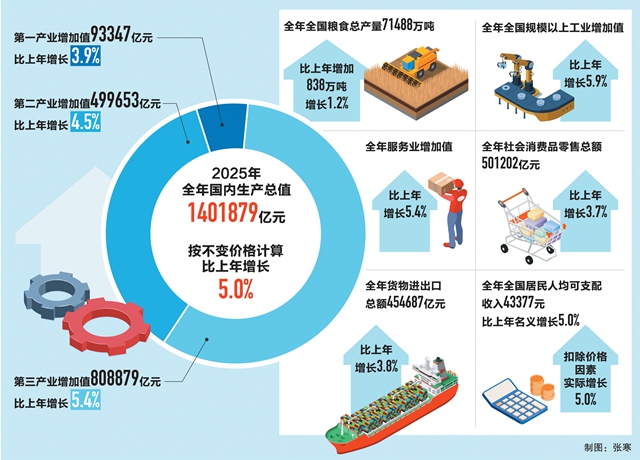
刘满仓摄(新华社发) 杜鹏辉摄(新华社发) 化,全国统一大市场建设纵深推进,民营经济促进法正式施行,综合整治"内卷式"竞争成效显现。同 时,海南自由贸易港启动全岛封关运作,高水平对外开放迈出重要一步。 "新"的动能培育壮大。2025年,我国研发经费投入强度达2.8%,比上年提高0.11个百分点,首次超过 OECD(经济合作与发展组织)国家平均水平。世界知识产权组织数据显示,我国创新指数排名首次进 入全球前十。从基础研究的新探索到关键技术的新突破,从科技创新与产业创新的深度融合到惠民成果 的广泛落地,我国在人工智能、量子科技、脑机接口等前沿领域捷报频传,一批重大科研成果竞相涌 现,新质生产力不断发展壮大。 "韧"的特性愈发凸显。放眼全球,我国经济增速在主要经济体中名列前茅,是全球经济增长最稳定、最 可靠的动力源。稳外贸多样化格局加速形成,高技术、高附加值产品成为出口增长主力,外贸展现强大 韧性。 1月19日,中国经济交出2025年"成绩单"。国家统计局数据显示,2025年中国国内生产总值(GDP) 1401879亿元,首次跃上140万亿元新台阶,按不变价格计算,比上年增长5.0%。 "2025年,面对国内外经济 ...

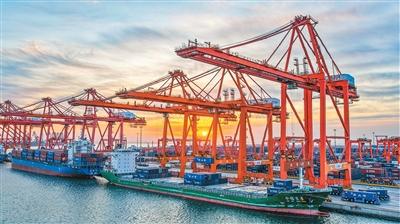
2025年主要发展目标任务顺利实现 来之不易成绩单彰显经济韧性活力
Ren Min Ri Bao· 2026-01-20 00:57
Economic Resilience and Growth - China's economy is expected to achieve significant progress in innovation, industrial quality improvement, digital empowerment, and green transformation by 2025, marking a successful conclusion to the "14th Five-Year Plan" [1][2] - The total value of industrial output reached 41.7 trillion yuan, with a year-on-year growth of 5.8%, contributing 35% to economic growth, an increase of 1.8 percentage points from 2024 [3] Innovation and Technology - China has become the first country to possess over 5 million valid domestic invention patents, with R&D expenditure reaching 39,262 billion yuan, maintaining the second position globally [2] - The manufacturing value added in high-tech sectors accounted for 17.1% of total industrial output, with significant growth in smart manufacturing and green energy sectors [2] Consumer Market Dynamics - The total retail sales of consumer goods exceeded 50 trillion yuan, growing by 3.7% compared to 2024, with final consumption contributing 52% to economic growth, an increase of 5 percentage points [4] - Service consumption is gaining momentum, with service retail sales growing by 5.5%, outpacing goods retail sales [4] Policy Impact - Macro policies are being implemented to support economic stability and high-quality development, including measures to boost employment and investment [7] - The policy of replacing old products with new ones has led to a 4.1% increase in retail sales of related goods, contributing to overall retail growth [7] Green Energy and Sustainability - The construction of a clean, low-carbon, and efficient energy system is accelerating, with renewable energy generation increasing by 8.8% [3] - Non-fossil energy sources accounted for a larger share of total energy consumption, rising by approximately 2 percentage points from 2024 [3] Future Outlook - The economic foundation is solid, with significant growth in economic strength and technological capabilities during the "14th Five-Year Plan" period [9] - Positive trends in economic indicators, such as the manufacturing purchasing managers' index returning to expansion territory, suggest a favorable economic outlook for 2026 [9][10]
十年翻一番——2025年我国用电量首次超过10万亿千瓦时
Zhong Guo Dian Li Bao· 2026-01-20 00:41
Core Viewpoint - China's total electricity consumption in 2025 is projected to reach 10,368.2 billion kilowatt-hours, reflecting a year-on-year growth of 5.0%, showcasing the resilience and vitality of China's large-scale economy [1][3]. Group 1: Electricity Consumption Growth - The average annual growth rate of electricity consumption during the 14th Five-Year Plan period is approximately 6.6%, with an annual increase of 563.6 billion kilowatt-hours, which is 0.9 percentage points higher than the previous five-year period [2][3]. - By 2025, China's electricity consumption will exceed the total of several major economies, including the EU, Russia, India, and Japan, highlighting China's status as a manufacturing and population powerhouse [3]. Group 2: Economic Impact on Electricity Demand - Economic growth is driving electricity demand, with urban and rural residential electricity consumption growing at annual rates of 6.4% and 6.2%, respectively, indicating a gradual reduction in the urban-rural electricity consumption gap [4]. - In 2025, the first, second, and third industries are expected to see electricity consumption growth rates of 9.9%, 3.7%, and 8.2%, respectively, with the first and third industries leading the growth [6]. Group 3: High-End Manufacturing and New Energy - High-tech and equipment manufacturing industries are projected to have an electricity consumption growth rate of 6.4%, with significant growth in automotive, general equipment, and instrumentation manufacturing [6]. - The electricity consumption growth in new energy vehicles and wind power equipment manufacturing is expected to exceed 20% and 30%, respectively, indicating a strong shift towards new scenarios and services [7]. Group 4: Third Industry and New Infrastructure - The third industry is anticipated to consume 2.0 trillion kilowatt-hours of electricity by 2025, accounting for approximately 19.2% of total electricity consumption, becoming a key driver of electricity demand [7]. - New infrastructure and emerging technologies, such as charging services and information technology services, are experiencing significant growth, with year-on-year increases of 48.8% and 17.0%, respectively [7].
深度关注丨中国经济向新向优
Zhong Yang Ji Wei Guo Jia Jian Wei Wang Zhan· 2026-01-20 00:37
中央纪委国家监委网站 柴雅欣 1月19日,2025年中国经济成绩单公布:初步核算,全年国内生产总值1401879亿元,按不变价格计算, 比上年增长5.0%。 2025年是"十四五"规划收官之年。在以习近平同志为核心的党中央坚强领导下,中国经济航船无惧风 雨,顶住多重压力,保持稳中有进发展态势,高质量发展取得新成效。但也要看到,外部环境变化影响 加深,国内供强需弱矛盾突出,经济发展中老问题、新挑战仍然不少。翻开这份成绩单,我们应如何看 待经济数据背后的发展成色?面对新的风高浪急,中国经济航船如何继续乘风破浪、勇毅前行? 稳中有进:在风浪中稳住了发展底盘、巩固了发展根基 "稳"是2025年中国经济的突出特点。面对外部环境急剧变化,国内困难挑战增多的复杂严峻形势,我国 实施更加积极有为的宏观政策,不仅有效化解外部环境变化的不利影响,更在风浪中稳住了发展的底 盘、巩固了发展的根基。 "全年社会消费品零售总额突破50万亿元,比上年增长3.7%,比2024年加快0.2个百分点,规模居全球零 售市场前列。"康义说。 "中国经济又一次在爬坡过坎中实现全年5%的增长,完成了年初确定的目标。特别是2025年国内生产总 值首次站上 ...
推动更高水平的消费与投资良性循环丨孙立坚专栏
2 1 Shi Ji Jing Ji Bao Dao· 2026-01-19 23:05
Economic Growth and Consumption - In 2025, China's GDP is projected to exceed 140 trillion yuan, marking a 5.0% increase from the previous year [1] - Retail sales of consumer goods are expected to surpass 50 trillion yuan, reaching 50,120.2 billion yuan, with a growth rate of 3.7%, accelerating by 0.2 percentage points compared to the previous year [1] - Final consumption expenditure is anticipated to contribute over 50% to GDP growth, with service retail sales increasing by 5.5% [2] Investment Trends - Fixed asset investment (excluding rural households) is projected to total 48,518.6 billion yuan, reflecting a 3.8% decline from the previous year [1] - Investment in the real estate sector is expected to decrease by 17.2%, while high-tech industries such as information services and aerospace manufacturing are projected to grow by 28.4% and 16.9%, respectively [2][3] - The investment structure is shifting, with a focus on effective investment rather than just total volume [3] Challenges and Reforms - Consumer confidence needs to be bolstered, as 62.3% of residents prefer to save more, indicating a cautious approach to spending [2] - There is a need for reforms in income distribution to increase labor compensation and expand the middle-income group [2] - The investment landscape is affected by three main factors: adjustments in the real estate market, the need to boost private sector confidence, and the transitional pains of traditional industries [2] Future Directions - The focus should shift from scale-oriented investment to efficiency-oriented investment, emphasizing the importance of legal frameworks to support the private economy [3] - China aims to leverage its vast domestic market to attract global resources and enhance industrial upgrades, while also promoting its digital economy [4] - A virtuous cycle of consumption, investment, and exports is essential for economic stability and growth, requiring precise financial resource allocation and a competitive environment [4]
中国经济再上新台阶(锐财经)
Ren Min Ri Bao Hai Wai Ban· 2026-01-19 22:45
Core Viewpoint - In 2025, China's GDP reached 140 trillion yuan, marking a significant milestone with a 5.0% growth compared to the previous year, reflecting the country's resilience and commitment to high-quality development amidst complex economic challenges [4][5]. Economic Stability - The economic performance in 2025 is characterized by stability, progress, innovation, and resilience, with a focus on maintaining a solid development foundation despite external pressures [5]. - The urban unemployment rate averaged 5.2%, indicating overall employment stability, while foreign exchange reserves exceeded 3.3 trillion USD, showcasing the robustness of China's economic structure [5]. Economic Progress - Structural adjustments led to an increase in the proportion of high-tech manufacturing value added to 17.1%, with final consumption contributing over 50% to economic growth [5]. - The implementation of the Private Economy Promotion Law and the deepening of the national unified market have fostered a more favorable business environment [5]. Innovation and New Growth Drivers - R&D expenditure intensity reached 2.8%, surpassing the OECD average for the first time, and China's innovation index entered the global top ten [6]. - Significant advancements in artificial intelligence, quantum technology, and other cutting-edge fields have been reported, indicating a strong growth in new productive forces [6]. Economic Resilience - China's economic growth rate ranks among the highest globally, with a diverse foreign trade structure and high-value exports demonstrating strong resilience [6][7]. - The economy's substantial scale enhances its risk resistance capabilities, with agricultural production stabilizing at 1.4 trillion jin and manufacturing value added remaining the highest in the world for 16 consecutive years [7]. Global Economic Contribution - During the "14th Five-Year Plan" period, China's average contribution to global economic growth was around 30%, with imports expected to reach 18.5 trillion yuan in 2025, providing vast market opportunities for other countries [8]. Future Economic Outlook - The outlook for 2026 suggests that opportunities outweigh challenges, supported by a solid economic foundation and ongoing reforms [9]. - Positive economic indicators, such as a return to expansion in the manufacturing purchasing managers' index and sustained growth in logistics, are expected to contribute to a favorable economic environment [9]. Policy Support - Proactive macroeconomic policies are anticipated to ensure stable economic operations, with a focus on key project implementations to drive growth [9][10].