
食品安全

Search documents
沙湾市:铁腕整治肉制品市场,守护群众“舌尖安全”
Zhong Guo Shi Pin Wang· 2025-07-25 03:05
Core Viewpoint - The article discusses a comprehensive special rectification action launched by the Shawan City Market Supervision Administration to enhance food safety in meat products, focusing on risk identification across the entire production and operation chain [1][2]. Group 1: Special Rectification Action - The rectification action is guided by the principle of "Four Strictest" in food safety, aiming to identify risks in meat product production and operation [1]. - Key areas of focus include urban-rural junctions, agricultural markets, meat shops, hot pot restaurants, and barbecue shops, addressing issues such as "two excesses and one non-compliance," adulteration, false labeling, and unlicensed production [1]. Group 2: Enforcement and Compliance - The enforcement approach combines strict inspections with professional training, allowing for immediate identification of issues and guidance for operators to correct them [1]. - A flexible enforcement mechanism is adopted, emphasizing "no penalty for first-time violations and exemption for minor infractions," which has led to the investigation of four illegal cases related to meat products [2]. Group 3: Future Plans - The Shawan City Market Supervision Administration plans to maintain a strong sense of responsibility and continue enhancing supervision over the meat product market to ensure the sustainability of the rectification results [2]. - The goal is to ensure that the public can enjoy safe and high-quality food, referred to as "the happiness on the tip of the tongue" [2].
吉林香格特酒业因标签“双生产日期”问题被处罚
Qi Lu Wan Bao· 2025-07-25 02:31
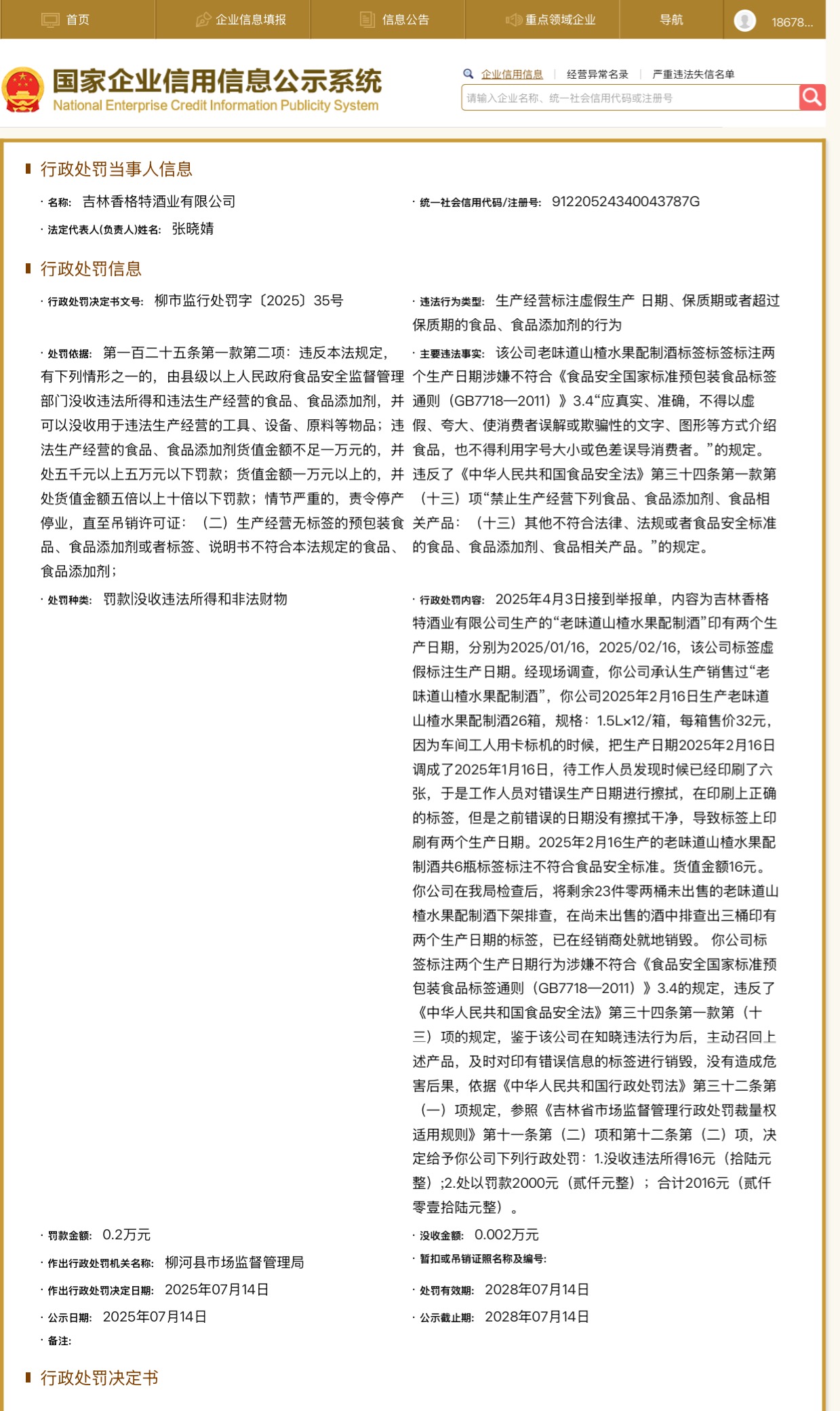
Group 1 - The core issue involves Jilin Xianggete Wine Co., Ltd. being fined for labeling discrepancies on their product "Old Flavor Hawthorn Fruit Wine," which displayed two different production dates [1] - The company was fined 2,000 yuan and had illegal gains of 16 yuan confiscated, totaling 2,016 yuan in penalties [2] - The product batch in question consisted of 26 boxes, with a total value of only 16 yuan, and the company proactively recalled and destroyed the problematic products [1][2] Group 2 - Jilin Xianggete Wine Co., Ltd. was established on August 24, 2015, with a registered capital of 2 million yuan and is located in Liuhe County [5] - The company operates in the beverage manufacturing industry, specifically in the production of alcoholic beverages [5]

青岛神秘园酒业平度分公司因产品标签虚假标注被处罚
Qi Lu Wan Bao· 2025-07-25 01:44
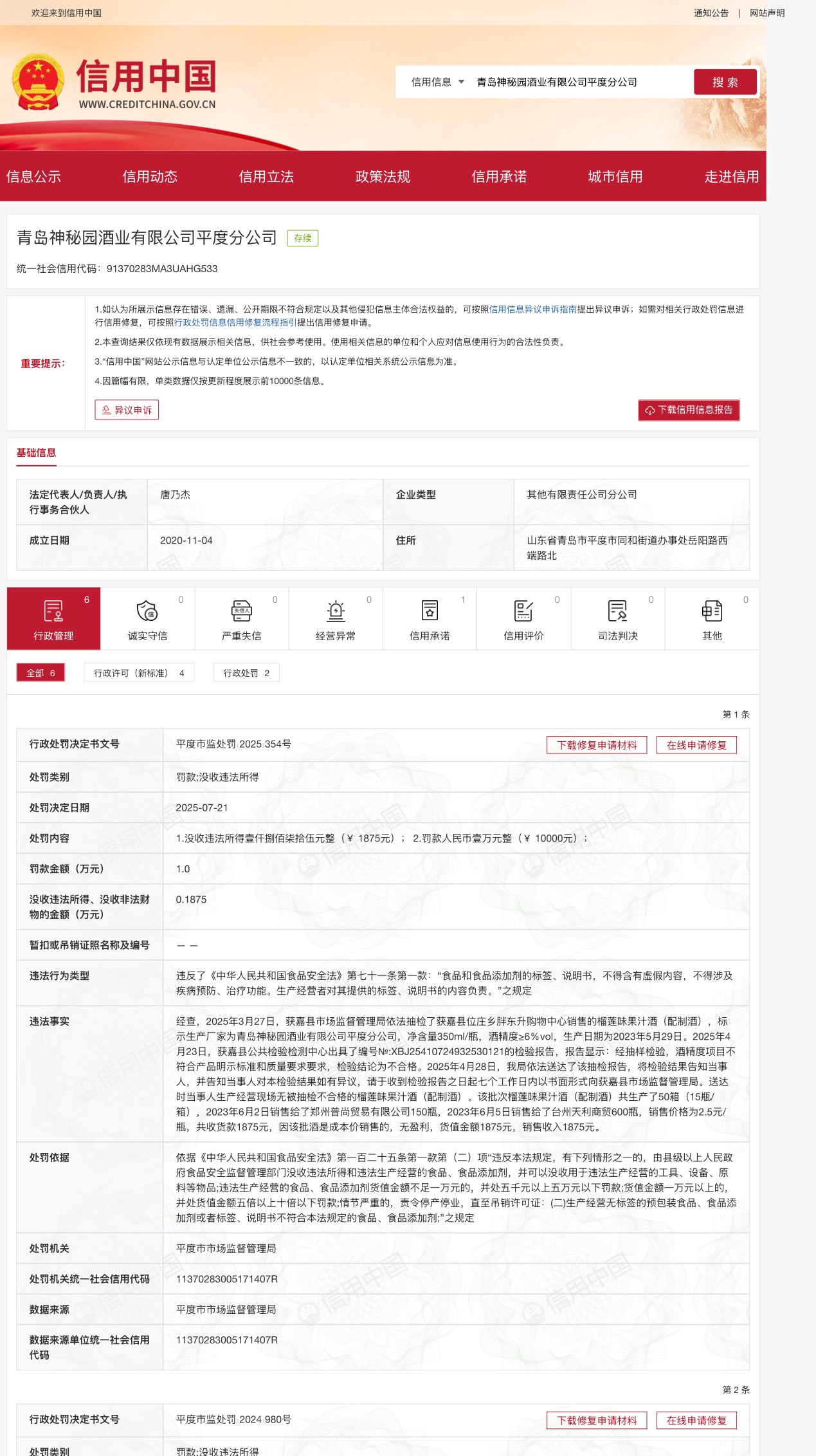
近日,平度市市场监督管理局公布行政处罚决定(平度市监处罚﹝2025﹞354号),青岛神秘园酒业有限公司平度分公司因生产经营标签含虚假内容的食 品,被处以罚款1万元、没收违法所得1875元的行政处罚,处罚日期 2025年7月21日。 经查,2025年3月27日,河南获嘉县市场监管局抽检发现当地商超销售的该公司2023年5月生产的"榴莲味果汁酒"存在质量问题。检验报告(编号 №:XBJ25410724932530121)明确显示,该批次产品酒精度不符合其标签明示标准,被判定为不合格产品。 | 物的金额(万元) | | | --- | --- | | 暂扣或吊销证照名称及编号 | | | 违法行为或 | 违反了《中华人民共和国食品安全法》第七十一条第一款:"食品和食品添加剂的标签、说明书,不得含有虚假内容,不得含有虚假内容,不得 | | | 疾病预防、治疗功能。生产经营者对其提供的标签、说明书的内容负责。"之规定 | | 违法事实 | 经查、2025年3月27日,获嘉县市场监督管理局依法抽检了获嘉县位庄乡胖东升购物中心销售的榴莲味果汁酒(配制酒) | | | 示生产厂家为青岛神秘园酒业有限公司平度分公司、净含量35 ...
青岛崂世家啤酒有限公司因产品标签缺失关键警示信息被处罚
Qi Lu Wan Bao· 2025-07-25 01:35
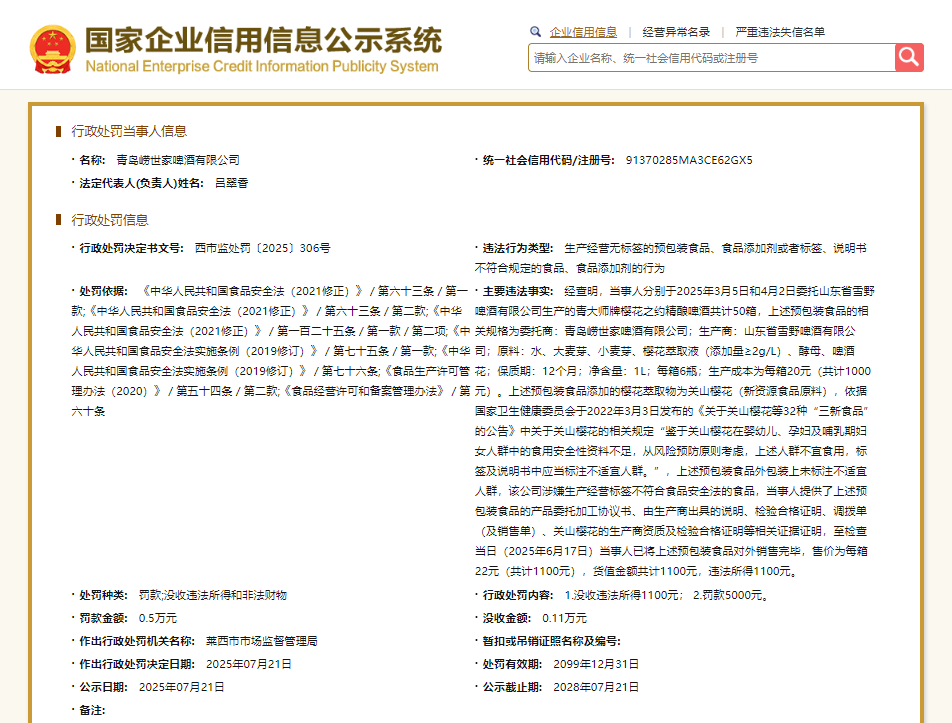
Core Viewpoint - Qingdao Laoshijia Beer Co., Ltd. was fined and had illegal gains confiscated due to non-compliance with food labeling regulations for pre-packaged food products [1] Group 1: Regulatory Actions - The company was penalized with a total fine of RMB 5,000 and confiscation of illegal gains amounting to RMB 1,100, resulting in a total penalty of RMB 6,100 [1] - The administrative penalty was issued by the Laixi City Market Supervision Administration on July 21, 2025, and made public [1] Group 2: Product and Safety Issues - The company produced and sold 50 boxes of "Qing Dashi Brand Sakura Brewed Beer," which contained cherry blossom extract, without the required warning label indicating it was unsuitable for certain populations [1] - The product was sold out by June 17, 2025, with a selling price of RMB 22 per box, totaling a value of RMB 1,100 [1] Group 3: Company Background - Qingdao Laoshijia Beer Co., Ltd. was established on July 25, 2016, with a registered capital of RMB 2 million [2] - The legal representative of the company is Lü Cuixiang, and it is registered in Laixi City, Shandong Province [2]
洛桑江村率全国人大常委会执法检查组来豫开展食品安全法执法检查
He Nan Ri Bao· 2025-07-24 10:37
Group 1 - The National People's Congress (NPC) Standing Committee conducted an enforcement inspection in Henan Province regarding the implementation of the Food Safety Law from July 21 to 24 [1] - The NPC delegation, led by Vice Chairman Luosang Jiangcun, engaged with provincial leaders to discuss the effective implementation of food safety measures and the importance of public health [1][2] - The inspection included meetings with government officials, experts, and student representatives, as well as on-site checks at food production facilities and markets [1][2] Group 2 - The NPC inspection team acknowledged the significant achievements of Henan Province in implementing the Food Safety Law [2] - Luosang Jiangcun emphasized the need to adhere to President Xi Jinping's directives on food safety, focusing on risk prevention and ensuring public trust in food safety [2] - The inspection aimed to enhance government accountability, improve risk management, and strengthen the regulatory framework for food safety [2]
西安市鄠邑区市场监督管理局关于第21期食品监督抽检产品信息的通告(2025年第21号)
Zhong Guo Zhi Liang Xin Wen Wang· 2025-07-24 08:31
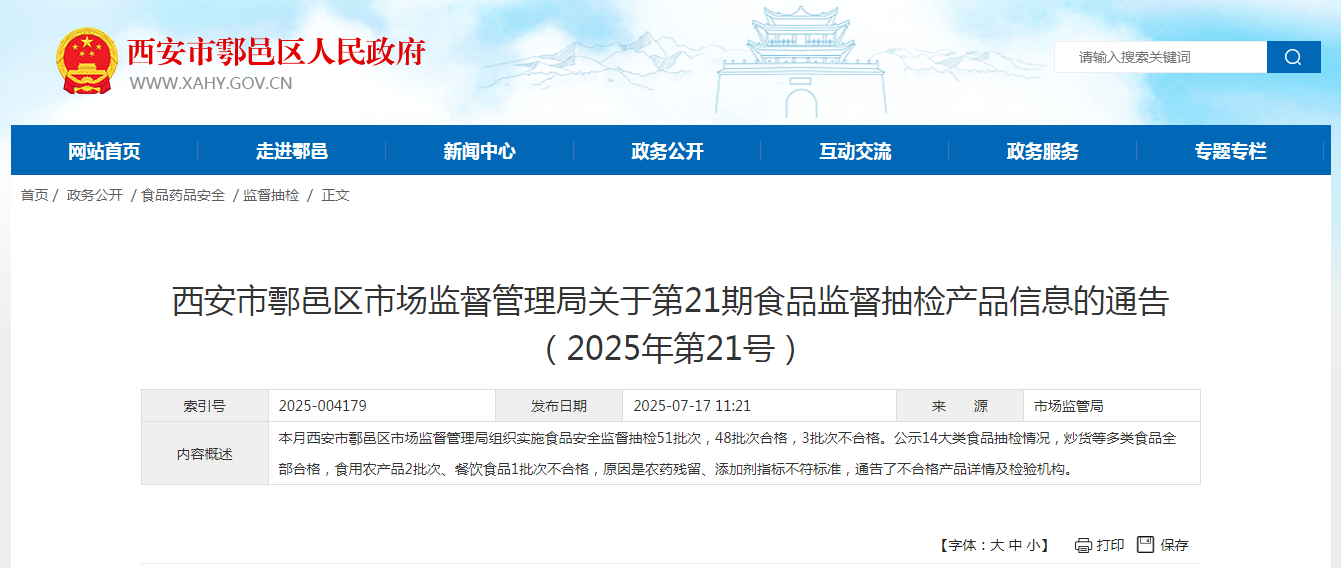
Overall Situation - The Xi'an Huyi District Market Supervision Administration conducted a food safety supervision sampling of 51 batches, with 48 batches passing and 3 batches failing [2][3] - The sampling covered 14 categories of food, including nuts, sugar, convenience foods, vegetable products, frozen drinks, pastries, bean products, grain products, edible oils, alcoholic beverages, and fruit products, all of which passed [2][3] - The main reasons for the failures were pesticide residues and non-compliance with food safety national standards regarding food additives [2][3] Non-compliant Products - The non-compliant products included: 1. Disinfected bowls from a restaurant with a result of 0.019 mg/100 cm² for anionic synthetic detergent, which should not be detected [3] 2. Ginger purchased from a supermarket with a pesticide residue of 0.62 mg/kg for dichlorvos, exceeding the standard of ≤0.02 mg/kg [3] 3. Yam purchased from the same supermarket with a result of 0.462 mg/kg for carbendazim and its manganese salt, exceeding the standard of ≤0.3 mg/kg [3] Compliant Products - All tested batches of various food categories, including nuts, sugar, convenience foods, vegetable products, frozen drinks, pastries, bean products, grain products, edible oils, alcoholic beverages, and fruit products, were compliant [2][3] - Specific compliant products included: - Canola oil from Weinan Chang'an Flower Oil Co., 5L per barrel [5] - Small liquor peanuts from Heze Suiyuan Food Co., 360g per package [5]
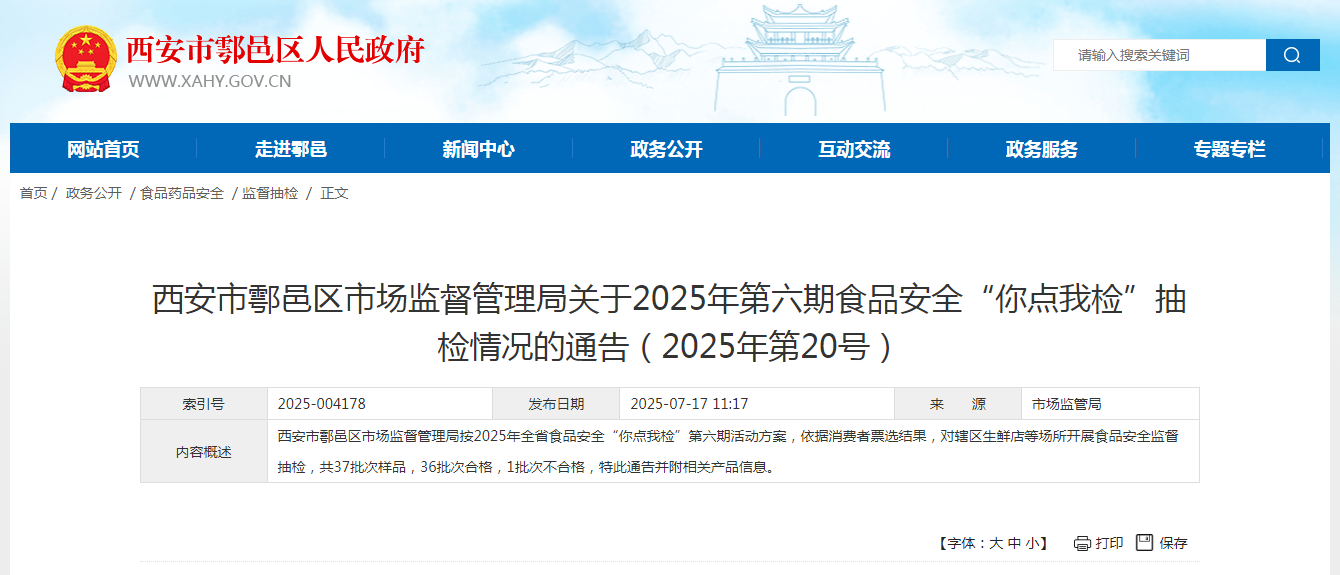
西安市鄠邑区市场监督管理局关于2025年第六期食品安全“你点我检”抽检情况的通告(2025年第20号)
Zhong Guo Zhi Liang Xin Wen Wang· 2025-07-24 08:31
Summary of Key Points Core Viewpoint - The Xi'an Huyi District Market Supervision Administration conducted a food safety inspection as part of the provincial "You Choose, I Test" initiative, resulting in 36 out of 37 samples passing the safety standards, with one sample failing due to pesticide residue [2][3]. Group 1: Inspection Results - A total of 37 samples were tested, with 36 passing and 1 failing [2]. - The failed sample was a carrot from a self-service store in Huyi District, which contained 0.062 mg/kg of flufenacet, exceeding the standard limit of 0.02 mg/kg [3]. Group 2: Sample Categories - The inspection covered various food categories, including edible agricultural products, dairy products, beverages, seasonings, starch and starch products, grain processing products, pastries, convenience foods, and catering foods [2]. - The inspection aimed to enhance food safety and consumer confidence in local food products [2]. Group 3: Compliance and Quality Assurance - The inspection was part of a broader initiative to ensure food safety across the province, reflecting the government's commitment to public health [2]. - The results indicate a high compliance rate among local food vendors, with only one instance of non-compliance noted [2][3].
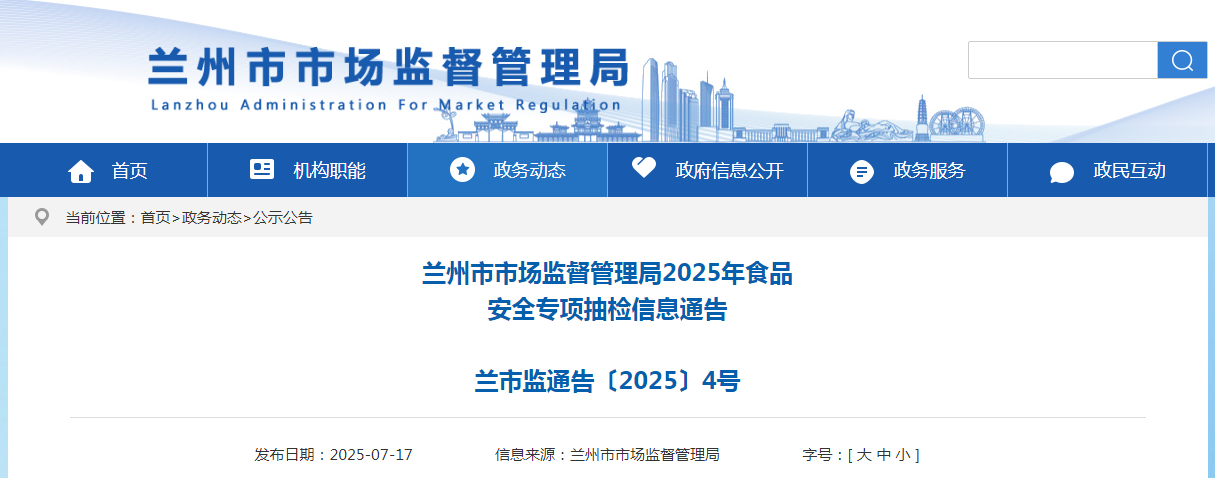
兰州市市场监督管理局2025年食品安全专项抽检信息通告 兰市监通告〔2025〕4号
Zhong Guo Zhi Liang Xin Wen Wang· 2025-07-24 08:26
Summary of Key Points Core Viewpoint - The Lanzhou Market Supervision Administration conducted a food safety inspection from May to June 2025, testing 594 batches of ordinary food and 212 batches of agricultural products, with overall compliance rates of 87.37% and 96.70% respectively. Group 1: Inspection Results - A total of 594 batches of ordinary food were tested, with 519 passing and 75 failing, resulting in a compliance rate of 87.37% [2] - For agricultural products, 212 batches were tested, with 205 passing and 7 failing, leading to a compliance rate of 96.70% [2] Group 2: Actions Taken - The market supervision department has initiated investigations and required non-compliant producers to cease production, remove products from shelves, and recall items to mitigate food safety risks [2] Group 3: Consumer Guidance - Consumers are encouraged to report any food safety issues by calling the complaint hotline 12315 [2]
塑料制品盛热食有安全风险吗
Ke Ji Ri Bao· 2025-07-24 01:02
Core Viewpoint - Recent viral videos on short video platforms raise concerns about the safety of plastic food containers used for hot meals, suggesting they may release harmful substances like phthalates and fluorides, leading to public skepticism about takeaway food safety [1][2] Group 1: Regulatory Framework and Material Safety - China has strict regulations governing the use of plastic food containers through the Food Safety Law and related national standards, which cover sensory properties, overall cleanliness, and migration limits of harmful substances [1] - The primary materials for plastic food containers are polypropylene and polyethylene, which possess suitable mechanical properties and do not require the addition of phthalates for flexibility [1][2] Group 2: Microplastics and Their Impact - Microplastics have existed since the advent of plastic, but advancements in technology have made them detectable; they primarily result from the aging and prolonged use of plastic products [2] - Single-use plastic containers, like takeaway boxes, have a short usage time and high replacement frequency, minimizing consumer exposure to microplastics [2] Group 3: Consumer Recommendations - Consumers are advised to choose reputable takeaway vendors and ensure that the plastic containers used are produced by certified companies, which undergo regular inspections for harmful substances [3] - It is recommended that consumers consume takeaway food promptly to preserve its quality and reduce potential risks from packaging [3] - Repeated use of single-use plastic containers is discouraged, as it can accelerate plastic aging and increase food safety risks [3] Group 4: Usage Instructions - Consumers should follow the usage instructions on plastic food containers, particularly regarding microwave heating, as most containers are not designed for this purpose unless explicitly marked [4]
坚持不懈治理农残超标
Jing Ji Ri Bao· 2025-07-23 22:08
Core Viewpoint - Recent reports highlight ongoing issues in food safety, particularly concerning excessive veterinary drug residues in eggs and pesticide residues in agricultural products, necessitating vigilance in the food safety sector [1][2]. Group 1: Food Safety Issues - The presence of pesticide residues is a common consequence of pesticide use, with strict regulations established by laws such as the Food Safety Law of the People's Republic of China to ensure safety standards [1]. - Some unscrupulous businesses are overusing pesticides or hormones to achieve rapid profits in agriculture, while others are illegally adding non-food additives to enhance product appearance and reduce spoilage during transport, posing serious risks to food safety [1]. Group 2: Regulatory Recommendations - Regulatory bodies are urged to implement the strictest standards, oversight, penalties, and accountability measures to prevent food safety issues from escalating [2]. - There is a call for comprehensive management of the entire agricultural product supply chain and the establishment of a food safety risk prevention system to trace and penalize violations effectively [2]. - Emphasis is placed on enhancing public awareness of food safety laws and fostering a collaborative environment to ensure the safety of the food supply for consumers [2].