
财务造假

Search documents
富二代辞职接班潮:沈家雯接任力源科技董事长
Sou Hu Cai Jing· 2025-08-13 13:50
Group 1 - The article discusses the challenges faced by second-generation wealthy individuals in balancing family business responsibilities with personal career aspirations [2][3] - It highlights the case of Liyuan Technology, where the chairman Shen Wanzhong resigned due to personal reasons, and his daughter Shen Jiawen has been nominated as a non-independent director [3][4] - Shen Wanzhong's resignation is linked to legal issues involving financial fraud, with the company having inflated revenue and profits in its financial reports [5][6] Group 2 - Shen Jiawen holds a master's degree in economics and has experience in compliance and risk management at Huatai Securities before joining Liyuan Technology [6][9] - The article also mentions other second-generation leaders, such as Zhao Xiaomeng of Fengyuan Co., who transitioned from a successful career in finance to take over the family business [12][14] - The trend of second-generation leaders returning to family businesses is noted, with examples of young leaders adapting to market challenges and driving company growth [22][24]



泽达易盛财务造假案余波未平 引发连环索赔诉讼
Mei Ri Jing Ji Xin Wen· 2025-08-13 12:26
Core Viewpoint - The financial fraud case involving Zeda Yisheng continues to have repercussions, leading to a series of compensation lawsuits against Geer Software and other involved parties [2][3]. Group 1: Legal Proceedings - Geer Software has received notifications from the Shanghai Financial Court regarding lawsuits filed by Tianjian Accounting, Dongxing Securities, and Kangda Law Firm, seeking compensation for losses [3]. - The three intermediary institutions are pursuing claims against 37 companies and 2 individuals, requesting a total of approximately 1.23 billion yuan, 2.15 billion yuan, and 0.33 billion yuan in principal and interest [3]. - Zeda Yisheng was previously penalized by the China Securities Regulatory Commission for fraudulent issuance and information disclosure violations, leading to a total compensation payout of about 493 million yuan to investors [2][3]. Group 2: Financial Impact - Geer Software stated that the ongoing lawsuits have not yet gone to trial, making it difficult to assess their impact on the company's current or future profits [4]. - The transactions involved in the lawsuits were determined to have a minor effect on the accuracy of Geer Software's financial statements from 2018 to 2021, thus no retrospective adjustments are necessary [4]. Group 3: Historical Context - Geer Software's historical announcements reveal that the company inflated its net profit by 2.75 million yuan, 2.51 million yuan, and 773,800 yuan from 2018 to 2020, while reducing its net profit by 1.90 million yuan in 2021 [5]. - The Shanghai Securities Regulatory Bureau issued a warning letter to Geer Software and related personnel in 2023 regarding these financial discrepancies [5]. Group 4: Legal Framework and Defense - Legal experts indicate that for the intermediary institutions to exercise their right of recourse, they must prove that the parties being pursued had faults and that there is a direct causal relationship between their actions and the damages incurred [6]. - The concept of "no commercial substance" in transactions may not be sufficient for a successful claim unless it can be shown that the involved parties knowingly participated in fraudulent activities [7]. Group 5: Risk Mitigation Strategies - Geer Software is taking proactive measures to strengthen the understanding of relevant laws and regulations among its directors, supervisors, and senior management [8]. - The company is also enhancing its internal control systems to improve operational compliance and risk identification capabilities [8].

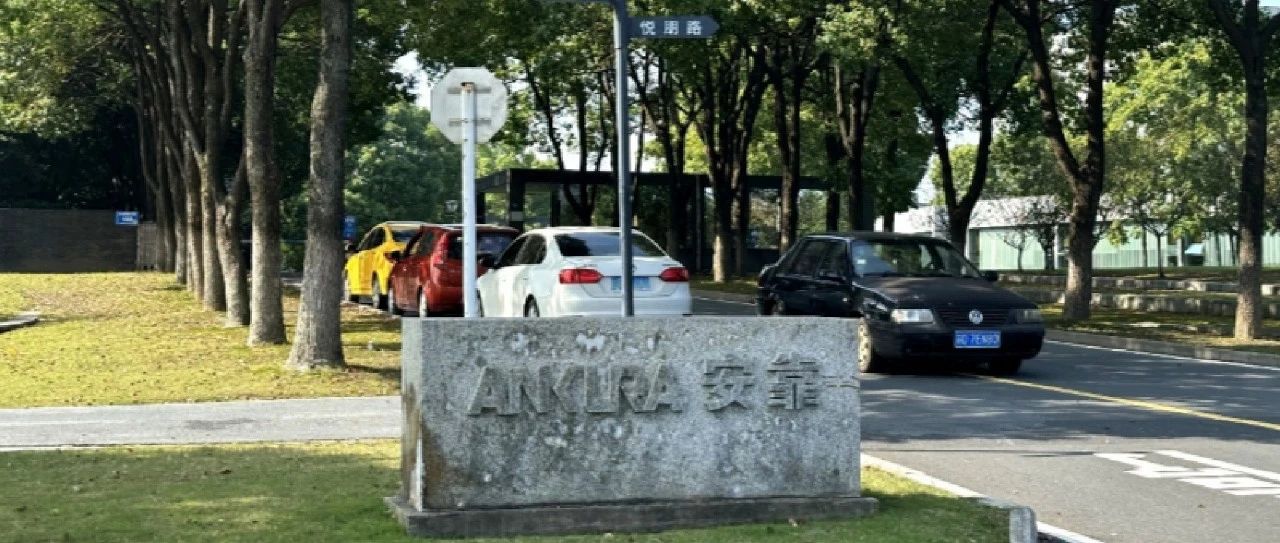
公司造假?董秘敲诈?安靠智电“吹哨人”疑案始末
凤凰网财经· 2025-08-13 10:19
Core Viewpoint - The ongoing legal dispute between the listed company Ankao Zhidian and its former secretary Huang Jiegen has reached a significant milestone, with Huang being convicted of extortion, which he plans to appeal. The case highlights the complexities of corporate governance and financial integrity within the company [1][3]. Group 1: Background of the Dispute - The conflict began in August 2022 when Huang Jiegen questioned the authenticity of Ankao Zhidian's financial reports and refused to sign them, leading to accusations of extortion when he sought stock rewards as per a performance agreement [1][5]. - Huang's apprehension stemmed from concerns about potential retaliation for his insistence on truthful reporting, prompting him to submit a written opinion indicating he could not guarantee the accuracy of the financial statements [8][9]. - The performance agreement stipulated that Huang would receive stock rewards contingent on the company's market value meeting specific targets over three years, alongside commitments to maintain a minimum profit growth [9][10]. Group 2: Financial Misconduct Allegations - Huang raised alarms about potential financial misconduct after noticing discrepancies in the company's profit figures across different versions of financial reports, leading him to suspect that profits were artificially inflated [17][21]. - He reported that the company had prematurely recognized revenue from a project, which he believed had not generated any actual income, resulting in significant profit inflation in the financial statements [19][21]. - Huang filed multiple complaints with the China Securities Regulatory Commission regarding the alleged financial fraud, but the regulatory response was limited, leading to dissatisfaction with the outcomes [22][23]. Group 3: Legal Proceedings and Outcomes - The legal proceedings have been marked by delays and conflicting narratives from both parties, with Huang portraying himself as a whistleblower while the company accused him of premeditated extortion [1][23]. - The court's ruling on Huang's conviction for extortion has raised questions about the nature of his demands, which he argues were legitimate claims for owed compensation rather than illegal extortion [5][26]. - The case reflects broader issues of corporate governance, accountability, and the protection of whistleblowers in the financial sector, with implications for investor confidence in Ankao Zhidian [27][30].
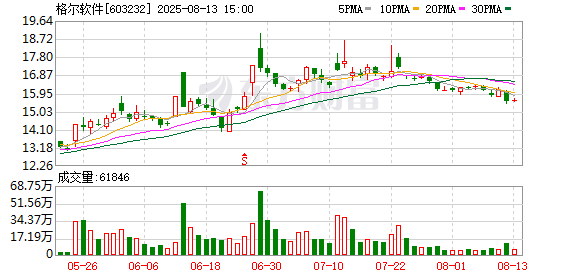
卷入3.7亿元索赔官司,格尔软件否认故意配合泽达易盛造假
Hua Xia Shi Bao· 2025-08-13 09:57
Core Viewpoint - The aftermath of the notorious Zeda Yisheng financial fraud case continues, with three intermediary institutions seeking to recover approximately 370 million yuan from 39 defendants after compensating investors [2][3]. Group 1: Zeda Yisheng Fraud Case Overview - Zeda Yisheng, a significant case in the STAR Market, was found to have fabricated major false content and concealed important facts in its prospectus and multiple annual reports, resulting in inflated revenue of 565 million yuan and inflated profits of 296 million yuan from 2016 to 2021 [3]. - The China Securities Regulatory Commission (CSRC) imposed a warning and fines totaling 86 million yuan on Zeda Yisheng and its responsible individuals, leading to the company's delisting from the Shanghai Stock Exchange on July 7, 2023 [3][4]. - A special representative lawsuit was initiated in July 2023, resulting in a settlement where 7,195 eligible investors received 285 million yuan in compensation, marking the first collective lawsuit involving a STAR Market company [4]. Group 2: Involvement of Intermediary Institutions - Dongxing Securities, Tianjian Accounting Firm, and Kangda Law Firm, all involved in Zeda Yisheng's IPO, previously compensated investors approximately 493 million yuan and are now pursuing recovery from other responsible parties [5]. - The total claims against the defendants, including Ger Software, amount to approximately 370 million yuan, with Dongxing Securities seeking about 215 million yuan, Tianjian Accounting Firm about 120 million yuan, and Kangda Law Firm about 33.45 million yuan [6]. Group 3: Ger Software's Position - Ger Software, listed on the Shanghai Stock Exchange, was implicated due to its involvement in non-commercial transactions with Zeda Yisheng, leading to inaccuracies in its financial reports from 2018 to 2021 [6][7]. - The company has stated that it did not intentionally cooperate with Zeda Yisheng's fraudulent activities and is taking the lawsuit seriously, engaging a legal team to respond effectively [7].
华熙生物前高管45万字手撕“玻尿酸女王”,“财务造假”内幕曝光
商业洞察· 2025-08-13 09:24
Core Viewpoint - Huaxi Biological is facing serious allegations of financial misconduct, including accusations of financial fraud and inflated revenue figures, which have led to a significant decline in its stock price and raised concerns about its governance and internal conflicts [3][4][29]. Group 1: Allegations and Responses - A former employee, David, has accused Huaxi Biological's controlling shareholder, Huaxi Xinyu Investment Co., of concealing shareholdings and committing fraud related to bond issuance and revenue inflation [3][4]. - Huaxi Biological has publicly responded, stating that David was previously a market director who committed fraud and was reported for embezzlement [3][24]. - The company claims that David's allegations were investigated during its IPO process in 2019 and were found to be unsubstantiated [3][29]. Group 2: Financial Data Discrepancies - Significant discrepancies in financial data have been highlighted, with David pointing out that the revenue for the first half of 2017 was reported at 278 million RMB, which was 91 times the total revenue for the entire year [11][14]. - The company's financial reports show a dramatic increase in operating income and expenses in 2017, followed by a sharp decline in the annual report, raising red flags about the accuracy of the financial statements [12][20]. - David alleges that the inflated figures were linked to profits from the sale of shares in Jinju Holdings, which were then misclassified as operational costs to reduce tax liabilities [14][16]. Group 3: Internal Conflicts and Governance Issues - Huaxi Biological has faced multiple internal disputes, including allegations of stock buybacks at undervalued prices and conflicts among founding members regarding profit-sharing [34][36]. - The company has been criticized for its governance practices, with frequent reports of employee grievances and accusations of workplace bullying [34][36]. - Recent financial performance has shown a decline, with a reported 11.6% drop in revenue and a 70.6% decrease in net profit for 2024, indicating potential underlying issues within the company [34][36].

重生之95后在金融圈奋斗到中层,爹不争气害我辞职回家当董事长
Sou Hu Cai Jing· 2025-08-13 06:00
Group 1 - The article discusses the challenges faced by second-generation wealthy individuals in balancing family business responsibilities with personal career aspirations [2][3] - It highlights the case of Liyuan Technology, where the chairman Shen Wanzhong resigned due to personal reasons, later revealed to be related to a criminal conviction for financial fraud [4][6] - Shen Wanzhong's daughter, Shen Jiawen, has been nominated as a non-independent director, holding 1.4 million shares, which is 0.94% of the total shares [5][6] Group 2 - Shen Wanzhong was sentenced to one year in prison with a suspended sentence for violating disclosure regulations, with a fine of 3.3 million RMB [6][7] - Liyuan Technology was found to have inflated revenue by approximately 104 million RMB and profit by over 27 million RMB in its 2021 annual report, representing 24.71% and 68.23% of the reported figures, respectively [7] - The article also mentions the tightening of regulations against financial fraud in the capital market, emphasizing the need for accountability among those involved in such activities [10][12] Group 3 - The article further explores the trend of second-generation individuals returning to family businesses, citing Zhao Xiaomeng of Fengyuan Co., who was elected as chairwoman after a successful career in finance [13][15] - Zhao Xiaomeng's father, Zhao Guanghui, built Fengyuan Co. from scratch, and she took over to ensure continuity and growth in the family business [16][18] - The company has expanded significantly in the lithium battery materials sector, with production capacity reaching 140,000 tons, and is poised for growth as lithium prices rise [19][22] Group 4 - The article also mentions the case of Shunli Medical, where the young chairwoman Shi Wenling returned to manage the company after a successful stint in a tech firm, highlighting the trend of young leaders taking charge in family businesses [23][24] - Shunli Medical has pivoted to new product lines, including dental implants and surgical robots, in response to market pressures, leading to a significant increase in stock price [24][25] - The article notes that there are currently 12 female chairpersons in A-share listed companies, with Shi Wenling being the youngest at 27 years old [25]

负债超2万亿中国恒大将在8月25日从港交所退市 ,这些钱去哪了?
Sou Hu Cai Jing· 2025-08-13 01:25
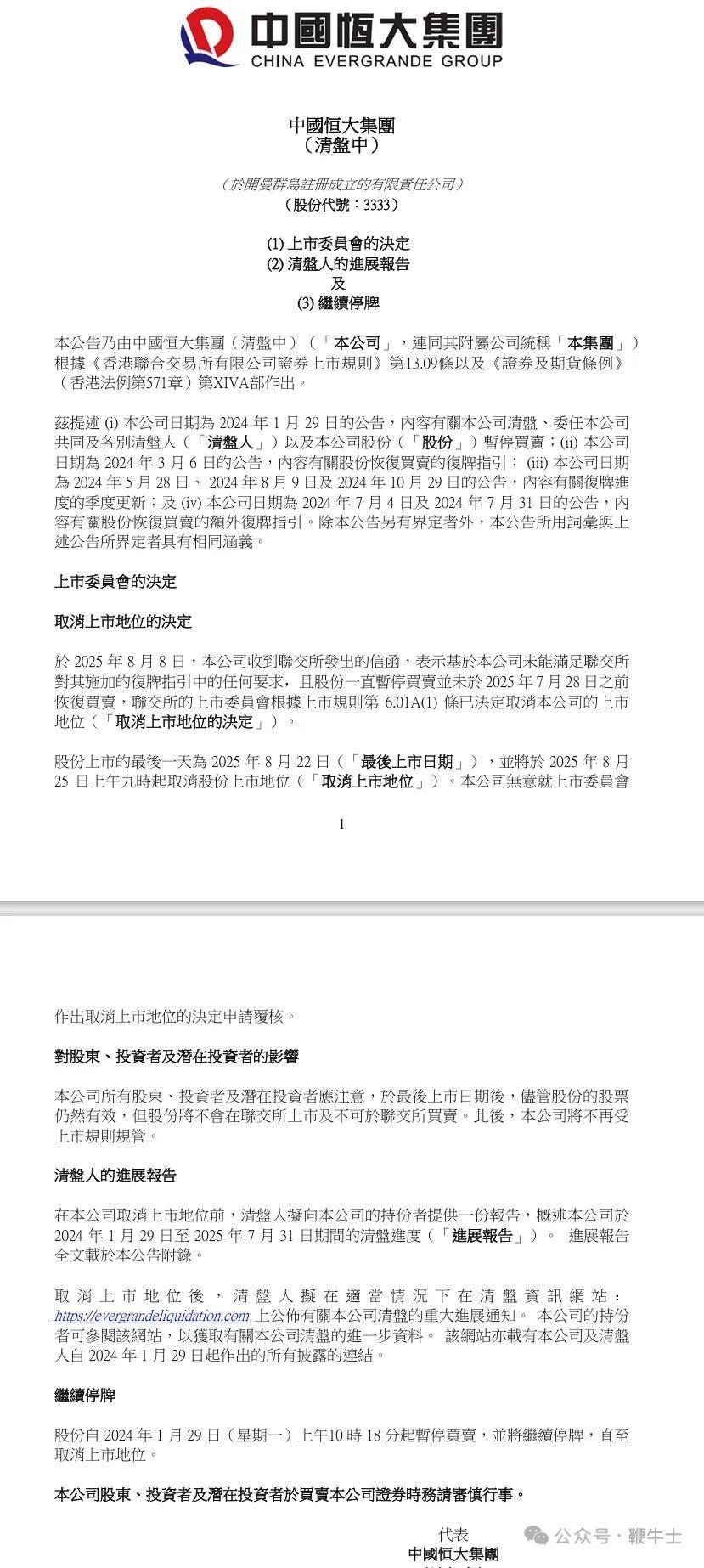
Core Viewpoint - China Evergrande Group is set to delist from the Hong Kong Stock Exchange on August 25, 2025, due to failure to meet the resumption guidelines set by the exchange, with no intention to appeal the decision [1][2]. Company Status - The last trading day for the shares will be August 22, 2025, after which the shares will remain valid but will not be tradable on the exchange [2]. - The company will no longer be subject to listing rules following the delisting [2]. Financial and Legal Issues - As of August 11, 2023, Evergrande has over 590 enforcement cases with a total amount exceeding 592 billion yuan, involving various disputes [7]. - The liquidation process remains unclear, with the liquidators unable to provide guidance on debt repayment expectations due to the uncertain value of assets and liabilities [9]. - Evergrande's total liabilities reached 2.39 trillion yuan as of June 30, 2023, while total assets were only 1.74 trillion yuan, resulting in a net asset deficit of 644.2 billion yuan [18]. Restructuring and Asset Management - The liquidators have taken control of over 100 companies associated with Evergrande, with the total asset value of these entities estimated at approximately 27 billion HKD [10]. - To date, the liquidators have managed to realize about 2 billion HKD (approximately 255 million USD) from asset sales, with only 1.67 billion USD recovered [10]. Historical Context - Evergrande was listed in November 2009 and reached a peak market value of 414.4 billion HKD in October 2017 [10]. - The company reported record revenue of 560 billion yuan in 2020, which was later revealed to have been inflated through accounting fraud, with over 564.1 billion yuan of revenue overstated between 2019 and 2020 [10][13][18]. Executive Actions and Legal Consequences - The chairman, Xu Jiayin, and other executives have faced legal actions, with Xu being detained for suspected criminal activities [12][19]. - The liquidators are pursuing legal actions against Xu and others for approximately 6 billion USD in dividends and compensation previously paid [20]. Asset Freezing and Recovery Efforts - Assets belonging to Xu Jiayin and his ex-wife, Ding Yumei, including luxury properties and private jets, have been frozen by the court, with Ding's assets valued at around 60 billion HKD [20]. - The liquidators are in the process of selling a private jet owned by Xu as part of the asset recovery efforts [20].
恒大,突传大消息!
Zhong Guo Jing Ying Bao· 2025-08-12 23:47
Group 1 - The core point of the announcement is that China Evergrande Group will have its listing status canceled due to failure to meet the resumption guidelines set by the Hong Kong Stock Exchange [2][6] - The last day of trading for the company's shares will be August 22, 2025, and the cancellation of listing status will take effect on August 25, 2025 [6][2] - The company has no intention to appeal the decision made by the listing committee regarding the cancellation of its listing status [2][6] Group 2 - The company’s shares have been suspended from trading since January 29, 2024, and will remain suspended until the cancellation of its listing status [7][6] - Prior to the suspension, the share price was reported at HKD 0.163 per share, with a total market capitalization of HKD 2.2 billion [7][6] - The company has been under liquidation since a court ruling in January 2024, with total liabilities amounting to CNY 2.4 trillion [11] Group 3 - The founder of the company, Xu Jiayin, has faced legal issues, including allegations of financial fraud, leading to penalties for several former executives [10][11] - The company has been involved in significant legal actions, including lawsuits to recover approximately USD 6 billion in dividends and compensation from Xu Jiayin and other former executives [11][12] - The company’s financial troubles have been exacerbated by a high debt load and a history of aggressive expansion strategies [9][11]
*ST富润虚增7亿营收如今黯然退市 受损股民可索赔
2 1 Shi Ji Jing Ji Bao Dao· 2025-08-12 15:13
Group 1 - The core issue is the financial fraud and subsequent delisting of Zhejiang Furun Digital Technology Co., Ltd. (*ST Furun), which faced severe penalties due to its actions [1][2] - From January 2020 to mid-2022, *ST Furun's subsidiary, Taiyi Zhishang, inflated revenue by 717 million yuan and costs by 716 million yuan through fictitious transactions, leading to significant misstatements in multiple financial reports [1][2] - The company was fined 5.5 million yuan, and key executives received individual fines totaling 2.5 million yuan for the fraudulent activities [1] Group 2 - As of the end of 2024, *ST Furun had accounts receivable of 1.596 billion yuan, with a bad debt provision of 1.449 billion yuan, indicating severe financial distress [2] - The audit report revealed that the company could not provide sufficient documentation to verify the nature and authenticity of its accounts receivable, raising concerns about its financial integrity [2] - The stock price of *ST Furun continued to decline, leading to its delisting in April 2025 after failing to meet the minimum price and market capitalization requirements [2] Group 3 - Investors who suffered losses during the specified period are eligible to file claims against the company, with legal support being organized for affected shareholders [3] - The initial assessment indicates that investors who purchased shares between April 27, 2021, and April 27, 2023, and sold or still hold shares after April 28, 2023, may qualify for compensation [3]

对近200亿元财务造假、欺诈发行竟没有察觉甚至“打保票” 国新证券是否勤勉尽责待考
Xin Lang Zheng Quan· 2025-08-12 10:20
Core Viewpoint - *ST Gaohong faces significant risks of forced delisting due to nearly 20 billion yuan in financial fraud and fraudulent issuance, as indicated by the China Securities Regulatory Commission's (CSRC) administrative penalty notice [1][4][5] Group 1: Financial Fraud Details - From 2015 to 2023, *ST Gaohong inflated its revenue by a total of 198.76 billion yuan through various fraudulent activities, including fictitious trade operations [3][12] - The inflated profits over the same period amounted to 76.23 million yuan, with the highest annual inflation occurring in 2019, where approximately 50% of the revenue was fabricated [3][13] - The fraudulent activities were primarily facilitated by the company's major stakeholders, including Jiang Qing and his spouse, who controlled key suppliers and customers [12][13] Group 2: Role of Guoxin Securities - Guoxin Securities, as the sponsor and independent financial advisor for *ST Gaohong's 2020 private placement, failed to detect the extensive financial fraud over seven years, during which the fraud amount reached 187.47 billion yuan, accounting for 94.32% of the total fraud [2][6] - Despite having a legal obligation to conduct thorough due diligence, Guoxin Securities did not identify any anomalies in *ST Gaohong's financial reports or related documents [5][11] - The lack of oversight by Guoxin Securities during the critical years of 2015-2021 raises questions about their diligence and responsibility in safeguarding investor interests [11][12] Group 3: Regulatory Actions and Consequences - The CSRC plans to impose penalties exceeding 160 million yuan on *ST Gaohong and related parties, including a fine of 135 million yuan for the company [4][5] - The potential for criminal charges against key individuals involved in the fraud is also being considered by the CSRC [4][5] - Guoxin Securities has not yet faced any formal investigation or penalties, but the ongoing scrutiny may lead to future accountability [5][12]

