
多边主义

Search documents
中国代表:全球治理倡议对联合国未来发展具有指导意义
Xin Hua She· 2025-10-25 00:34
——联合国要倡导共同、综合、合作、可持续的安全观,推动各国尊重彼此合理安全关切,以对话协商 代替穷兵黩武,以团结合作战胜阵营对抗。安理会要充分用好《联合国宪章》赋予的工具,切实承担起 维护国际和平与安全的首要责任。 ——联合国要将发展置于国际议程的核心位置,加速落实2030年可持续发展议程;秉持共同但有区别的 责任原则,推动《巴黎协定》有效落实;坚持以人为本、科技向善、公平普惠,支持联合国在人工智能 全球治理中发挥主渠道作用。 ——要坚持真正的多边主义,在联合国平台共同制定国际规则、共同治理全球事务、共同分享发展成 果。要顺应全球南方群体性崛起的历史潮流,提高发展中国家,特别是中小国家的发言权和代表性。 ——联合国应坚定自我革新,顺应时代需要。切实提高自身运行效率和履职能力,以工作实绩巩固联合 国地位,重振联合国权威。 傅聪强调,联合国正站在一个新的历史起点上。中方愿同各国一道,坚守联合国崇高理想,坚定维护以 联合国为核心的国际体系、以国际法为基础的国际秩序、以《联合国宪章》宗旨和原则为基础的国际关 系基本准则,朝着构建人类命运共同体的目标砥砺前行。 新华社联合国10月24日电 今年10月24日是《联合国宪章 ...
中国对多边主义有着深刻理解与有力实践(国际论坛)
Ren Min Ri Bao· 2025-10-24 22:20
《 人民日报 》( 2025年10月25日 03 版) 中华人民共和国自成立以来,始终坚持和平发展道路,积极践行多边主义,深度参与全球治理。 (责编:胡永秋、杨光宇) 要了解今天的中国,就要了解中国的历史。日本军国主义势力于1931年至1945年间对中国发起侵略战 争。危难之际,中国军民奋起反抗,以血肉之躯保卫祖国,谱写了可歌可泣的壮丽篇章,取得伟大胜 利。1949年10月1日,中华人民共和国宣告成立。此后,中国朝着现代化目标一路发展。今年,中国隆 重纪念中国人民抗日战争暨世界反法西斯战争胜利80周年。这个历经淬炼的文明古国,正以崭新姿态在 新时代砥砺前行。 巴拿马与中国于2017年正式建立外交关系。这是我们汇聚社会各界主流意见后作出的重大决策,有深厚 民意基础。巴拿马恪守一个中国原则和联合国相关决议,同台湾当局断绝所谓"外交关系"。针对个别国 家炮制渲染所谓"中国控制巴拿马运河"等毫无根据的论调,无论是巴拿马政府还是民众,都不应被误 导。巴拿马对华政策立足于国民认同之根本——它植根于巴拿马人民的共同意志,彰显出不受外来干 涉、捍卫国家主权的坚定信念,而这也应成为巴拿马外交政策的基石。 (作者为巴拿马前外交部 ...

以团结与担当谋划亚太发展新篇章——写在习近平主席出席亚太经合组织第三十二次领导人非正式会议并对韩国进行国事访问之际
Xin Hua She· 2025-10-24 15:56
Core Points - The article discusses President Xi Jinping's upcoming visit to South Korea for the APEC informal leaders' meeting, emphasizing China's commitment to regional cooperation and development [1][2][5] - It highlights the importance of the Asia-Pacific region in global economic dynamics, accounting for one-third of the world's population and over 60% of global economic output [2][3] - The article outlines China's role as a key driver of regional integration and trade within the APEC framework, with significant growth in trade volumes with APEC economies [3][6] Group 1: APEC and Regional Cooperation - APEC is described as the highest-level economic cooperation mechanism in the Asia-Pacific region, focusing on open cooperation and common development [1][2] - Xi Jinping's leadership has been pivotal in promoting a shared vision for the Asia-Pacific community, advocating for mutual trust and win-win partnerships [2][3] - The article emphasizes the need for open and inclusive development in the face of geopolitical tensions and economic fragmentation [3][4] Group 2: China-Korea Relations - The article details the historical and cultural ties between China and South Korea, highlighting the importance of their strategic partnership [5][6] - It notes that China has been South Korea's largest trading partner for 21 consecutive years, with bilateral trade reaching $328.08 billion in 2024, reflecting a 5.6% increase [6] - The ongoing cultural exchanges and people-to-people connections are underscored as vital for strengthening bilateral relations [5][6] Group 3: Economic Contributions and Future Outlook - China's economic growth is projected to average 5.5% annually from 2021 to 2024, contributing approximately 30% to global economic growth [9][11] - The article discusses China's commitment to high-quality development and green initiatives, positioning itself as a leader in sustainable economic practices [10][11] - It concludes with a vision for continued collaboration in the Asia-Pacific region, aiming for shared prosperity and stability [11][12]
新华时评丨中国永远是联合国可以信赖的伙伴
Xin Hua She· 2025-10-24 14:41
Group 1 - The core message emphasizes China's role as a reliable partner of the United Nations, advocating for true multilateralism and global governance reform [1][2][3] - China has been a significant contributor to global development, with initiatives like the Belt and Road Initiative benefiting over 150 countries and mobilizing over $23 billion for global southern development [2][3] - As a permanent member of the UN Security Council, China is committed to peace and security, being the only member that has pledged not to use nuclear weapons first and actively participating in peacekeeping missions [1][2] Group 2 - China promotes inclusive and resilient global development, urging developed nations to fulfill their commitments on development aid and climate financing [3] - The country has proposed four global initiatives—development, security, civilization, and governance—to address pressing global challenges and uphold multilateralism [3] - China remains steadfast in its commitment to the ideals of the United Nations, aiming to build a community with a shared future for humanity [3]
中国代表:联合国改革要把握好四组关系
Yang Shi Xin Wen Ke Hu Duan· 2025-10-24 06:20
Core Viewpoint - The UN80 reform aims to enhance the efficiency and effectiveness of the United Nations, focusing on providing better support and services to member states, particularly developing countries, rather than merely reducing its size [1][2]. Group 1: Relationship Management - The relationship between member states and the UN Secretariat is crucial, with member states holding the responsibility for authorization while the Secretariat must provide comprehensive support and enhance coordination among its departments [2]. - The Secretariat should leverage artificial intelligence for auxiliary support while ensuring safety management and cost-effectiveness in online authorization registration [2]. Group 2: Authorization Process - The relationship between authorization formulation and execution is emphasized, with member states needing to focus on core issues during authorization to ensure effective execution and resource allocation [2]. - Understanding past execution and financial resources is essential for member states to make optimal decisions regarding authorization [2]. Group 3: Reform Objectives - The reform should aim to eliminate bureaucratic inefficiencies while maintaining the stability and coherence of UN operations, ensuring adherence to core values such as multilingualism [2]. - The reform is intended to inject confidence and momentum into multilateralism through tangible results [2][3].
【环球财经】拉加经委会上调2025年拉美和加勒比地区经济增长预期至2.4%
Xin Hua Cai Jing· 2025-10-24 06:16
Core Insights - The United Nations Economic Commission for Latin America and the Caribbean (ECLAC) has raised its economic growth forecast for the region to 2.4% for 2025, maintaining a 2.3% growth forecast for 2026, with increased trade with China being a significant factor [1][2] Economic Growth Projections - ECLAC's upward revision reflects an improvement in the external environment affecting the region's economy, with major trading partners performing better than previously expected [1] - For South America, the growth forecast for 2025 is now 2.9%, up from the previous estimate of 2.7%, driven by increased trade with China and a rebound in prices of precious metals and other natural resources [1] - Central America and Mexico are expected to grow by 1.2%, slightly higher than before, mainly due to improved international trade conditions [1] - The Caribbean region (excluding Guyana) has a slightly raised growth forecast of 1.9%, benefiting from strong performance in the tourism sector [1] Recommendations for Regional Countries - ECLAC calls for regional countries to maintain macroeconomic stability, enhance productivity, promote export diversification, expand intra-regional trade, and encourage sustainable investment [2] - The importance of international cooperation and multilateralism is emphasized for consolidating economic recovery and mitigating geopolitical fragmentation [2]
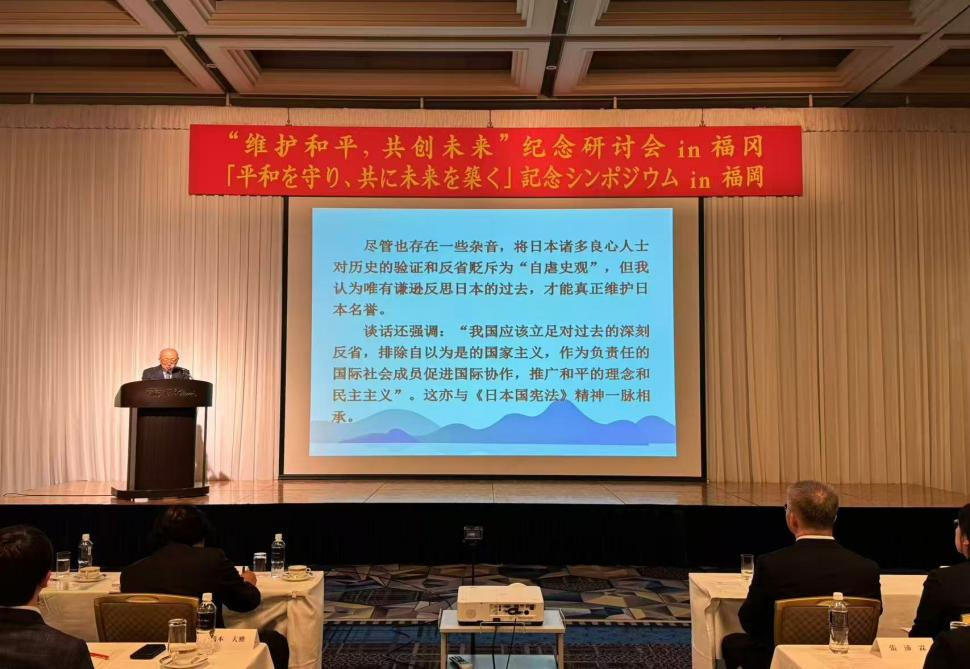
“维护和平,共创未来”纪念研讨会in福冈举办
人民网-国际频道 原创稿· 2025-10-24 06:10
Core Points - The seminar titled "Maintaining Peace, Creating the Future" held in Fukuoka focused on reflecting on the painful history of World War II and emphasized the importance of cherishing peace and enhancing cooperation between China and Japan in the context of global changes [1][2] Group 1 - The seminar was organized by the Chinese Embassy in Japan and the Chinese Consulate in Fukuoka, with support from various institutions, and attracted around 120 participants from both countries, including political, economic, and academic representatives [1] - Yu Yingfu highlighted China's role as a major builder and defender of the results of the global anti-fascist war, advocating for true multilateralism and regional stability, while emphasizing the importance of historical lessons and youth exchanges for future cooperation [2][3] - Zhao Baogang pointed out the resurgence of unilateralism and cold war mentality, stressing the need for China and Japan to work together to maintain peace and stability in the region, and to implement the consensus of mutual cooperation without threats [3] Group 2 - Former Japanese Prime Minister Yukio Hatoyama expressed concerns about the fading memory of Japan's militaristic past and the importance of learning from history to avoid repeating mistakes, advocating for a constructive and stable Japan-China relationship [4] - The late former Prime Minister Murayama Tomiichi emphasized the need for humility in reflecting on Japan's past to maintain the country's honor and to build a lasting friendly relationship with China as a foundation for peace in Asia [4]
联合国驻华协调员常启德:重振包容有效的多边主义
Zhong Guo Xin Wen Wang· 2025-10-24 05:36
Core Viewpoint - The United Nations has institutionalized multilateral cooperation to address global issues, emphasizing the need for countries to strengthen collaboration to achieve sustainable development goals by 2030 [1][2]. Group 1: Multilateralism and Global Challenges - Multilateralism is essential for addressing global challenges such as climate change, armed conflicts, pandemics, and digital risks, and is not an optional alternative but a necessary response [2]. - The upcoming UN Future Summit in 2024 aims to develop a multilateral framework through the "Future Pact" to adapt to future developments [2]. Group 2: Sustainable Development Goals - The 2030 Agenda for Sustainable Development, which includes 17 goals, aims to eliminate poverty, promote equality, and address climate change, but progress has been significantly delayed, with 18% of the targets showing regression [1][2]. - There is less than five years remaining to achieve all sustainable development goals, highlighting the urgency for countries to accelerate their actions [1]. Group 3: China's Role in Multilateralism - China is recognized as a key advocate for multilateralism and a strong supporter of the "Future Pact," with initiatives that align closely with UN goals, potentially creating substantial impacts through various channels [2]. - China's global development, security, civilization, and governance initiatives are seen as contributions to addressing global governance challenges and bridging financing gaps for sustainable development, particularly among Global South countries [2]. Group 4: UN's Position and Reform - Despite facing increasing criticism due to fragmentation, geopolitical divisions, and uneven development, the UN remains a crucial platform for global dialogue and coordination [3]. - There is a call for reform within the UN to enhance its efficiency and effectiveness in addressing current and future challenges, reinforcing the spirit of inclusive and effective multilateralism [3].
APEC峰会将至 多方探寻合作新路径
Zhong Guo Qing Nian Bao· 2025-10-23 23:38
Group 1 - The core theme of the APEC summit is "Building a Sustainable Tomorrow," focusing on three priority areas: enhancing connectivity, promoting innovation, and achieving inclusive growth and prosperity [2][3] - South Korea will lead discussions on two key issues: AI transformation and demographic changes, aiming to foster multilateral cooperation to address common challenges [2][3] - The APEC summit is expected to attract significant global attention, as it may reshape trade, diplomacy, and the global technology landscape [2][3] Group 2 - South Korea aims to establish "Artificial Intelligence Cooperation" as a focal point during the APEC summit, with expectations for a joint leaders' document on AI [3] - The APEC Economic Policy Report for next year will provide specific directions for building a secure AI ecosystem and narrowing the digital divide [3] - The upcoming APEC Business Leaders' Summit will gather around 1,700 global business leaders and officials, potentially leading to new AI partnerships and joint statements on digital governance and sustainability [4] Group 3 - APEC faces challenges from rising protectionism and unilateralism, which threaten the foundational principles of free trade and regional integration [5][6] - The current global economic environment poses significant challenges to trade growth, with calls for APEC to reinforce supply chain cooperation and enhance regional trust [6] - The upcoming summit's declaration may reflect the growing trend of protectionism, raising questions about the commitment to multilateral trade principles [6] Group 4 - The APEC summit holds significant political and diplomatic importance for South Korea, providing an opportunity to showcase its diplomatic capabilities and enhance its role in regional affairs [7] - China is set to host the APEC summit in 2026, with discussions on macroeconomic stability, innovation, and digital transformation being highlighted [8] - China's role as a stabilizing force in promoting trade and investment liberalization is recognized, with ongoing efforts to enhance its influence in the Asia-Pacific region [9]
外交部:联合国宪章宗旨和原则是践行国际法治的“规矩”
Xin Hua Wang· 2025-10-23 09:53
Core Viewpoint - The spokesperson emphasizes the importance of the UN Charter as the foundation of international law and the necessity of upholding multilateralism in the face of global challenges [1][2] Group 1: Importance of the UN - The UN is described as the most universal, representative, and authoritative intergovernmental organization, having played an irreplaceable role in maintaining peace, promoting development, and improving livelihoods over the past 80 years [1] - The spokesperson argues that without the UN, the world would regress to a state of "survival of the fittest," leading to chaos and frequent conflicts [2] Group 2: China's Role and Initiatives - China, as a responsible major country, has proposed several global initiatives, including the Global Development Initiative, Global Security Initiative, Global Civilization Initiative, and Global Governance Initiative, aimed at promoting true multilateralism and a fair global governance system [2] - These initiatives are aligned with the principles of the UN Charter, forming an organic whole that promotes prosperity through development, stability through security, mutual trust through civilization, and justice through governance [2] Group 3: Commitment to International Order - Regardless of changes in the international situation, China remains committed to maintaining a UN-centered international system and an international order based on international law [2] - The goal is to work together with other countries towards a multipolar world and inclusive economic globalization, ultimately striving for the construction of a community with a shared future for mankind [2]