量子计算

Search documents
大型科技股普涨,美股三大指数创新高
Zhong Guo Zheng Quan Bao· 2025-10-25 00:25
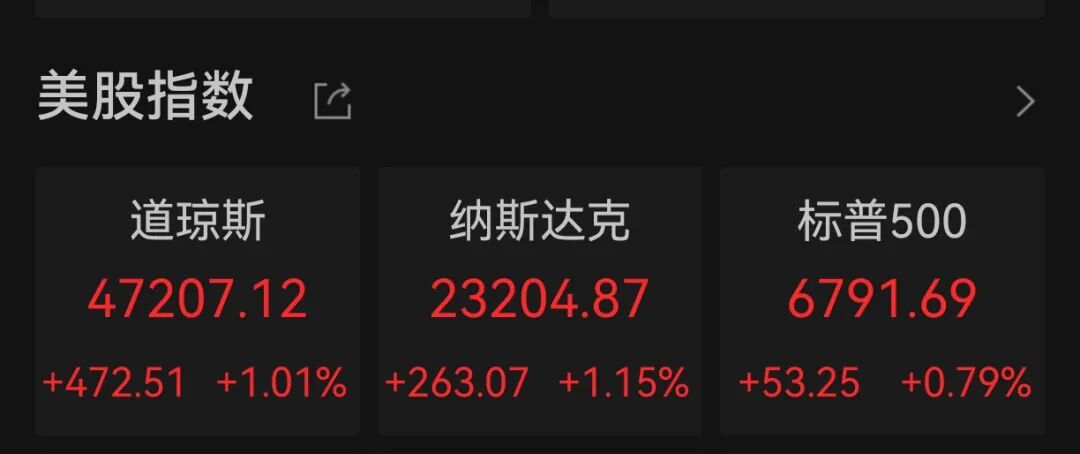
当地时间10月24日,欧美股市多数收涨,道指、纳指双双涨超1%,美股三大指数均创新高。中概股涨跌不一,纳斯达克中国金龙指数涨0.27%。大型科技 股普涨,IBM和AMD均涨逾7%。 美股三大指数收涨 当地时间10月24日,美股三大指数全线收涨,Wind数据显示,道指涨1.01%报47207.12点,标普500指数涨0.79%报6791.69点,纳指涨1.15%报23204.87 点,均创历史新高。本周,道指涨2.2%,标普500指数涨1.92%,纳指涨2.31%。 美股大型科技股多数上涨,万得美国科技七巨头指数上涨1.17%,其中,谷歌-C、英伟达涨逾2%,苹果、亚马逊涨超1%。 | < w | 万得美国科技七巨头指数(MAG: 64725.16 747.12 1.17% | | | --- | --- | --- | | 资料 成分 | 资讯 | 相关基金 | | 名称 | 现价 | 涨跌幅 == | | 谷歌(ALPHABE ... | 260.510 | 2.67% | | GOOG.O | | | | 英伟达(NVIDIA) | 186.260 | 2.25% | | NVDA.O | | | | 亚 ...

突发,美军部署航母打击群!俄总统特别代表抵美!美重磅经济数据发布!A股,重新向上!
Qi Huo Ri Bao· 2025-10-25 00:14
Group 1: Economic Indicators - The U.S. Consumer Price Index (CPI) rose by 3% year-on-year in September, marking the highest level since June 2024, and a month-on-month increase of 0.3%, which was lower than the expected 0.4% [1] - The CPI report is significant as it is the only official economic data released during the U.S. federal government shutdown, which has lasted four weeks [1] - The White House indicated that inflation data might not be released next month due to the government shutdown, emphasizing the potential disastrous consequences of missing economic data [1] Group 2: Market Reactions - Following the release of the CPI data, major U.S. stock index futures saw an increase, with the Dow Jones futures rising by 1.02%, S&P 500 futures by 0.77%, and Nasdaq 100 futures by 1.04% [1] - Traders have increased bets on the Federal Reserve potentially lowering interest rates two more times within the year [2] Group 3: Geopolitical Developments - A special representative from Russia confirmed arrival in the U.S. to continue dialogue, emphasizing the importance of understanding and respecting Russia's national interests [4] - The U.S. military is deploying the "Ford" aircraft carrier strike group to Latin American waters, aimed at combating transnational crime and drug terrorism [6][7] Group 4: Economic Forecasts - The International Monetary Fund (IMF) raised its economic growth forecast for the Asia-Pacific region to 4.5% for 2025, an increase of 0.6 percentage points from previous predictions [10] - The IMF noted that Asia will remain a crucial engine for global growth, contributing approximately 60% to global growth over the next two years [11] Group 5: Stock Market Trends - The A-share market has shown renewed upward momentum, with major indices reaching new highs, driven by policy direction and easing U.S.-China trade tensions [13] - Analysts suggest that the market's upward trend is supported by government policies aimed at boosting consumption and investment, particularly in technology and advanced manufacturing sectors [13][14] - Small-cap stocks are outperforming large-cap stocks, reflecting a shift in market risk appetite, influenced by expectations of further interest rate cuts by the Federal Reserve [16][17]
凌晨,见证历史!“超级央行周”,要来了
中国基金报· 2025-10-25 00:09
Group 1: Market Performance - The three major U.S. stock indices reached new historical highs, with the Dow Jones up 1.02%, S&P 500 up 0.79%, and Nasdaq up 1.15% [2][3] - This week, the indices recorded approximately 2% gains, marking the second consecutive week of increases. Year-to-date, the S&P 500 has risen by 15.47% and the Nasdaq by 20.17% [4][5] Group 2: Chip Sector Strength - Chip stocks showed strong performance, with notable gains from major companies: NVIDIA up 2.22%, AMD up 7.6%, and IBM up 7.88%, with both AMD and IBM reaching historical highs during trading [4][5][6] - IBM's executives announced that their quantum computing error correction algorithm is now operational on AMD's conventional chips, a significant step towards commercializing quantum supercomputers [6] Group 3: Ford Motor Company Financials - Ford Motor Company reported third-quarter earnings that exceeded Wall Street expectations, with revenue of $50.5 billion, a year-on-year increase of 9.3%, and a net profit of $2.4 billion [9][12] - Despite the impact of a fire incident at Novelis, Ford's stock surged by 12%, bringing its market capitalization to $55 billion [10][12] - Ford adjusted its full-year adjusted EBIT forecast to a range of $6 billion to $6.5 billion, down from a previous estimate of $6.5 billion to $7.5 billion, while maintaining a capital expenditure forecast of approximately $9 billion [12] Group 4: Inflation Data and Federal Reserve Outlook - The U.S. government is facing a shutdown, which may prevent the release of inflation data next month, marking a historical first [13][16] - The September Consumer Price Index (CPI) showed a year-on-year increase of 3%, slightly below expectations, leading traders to increase bets on two potential interest rate cuts by the Federal Reserve this year [14][16][19] - Next week, global financial markets will experience a "Super Central Bank Week," with major central banks, including the Federal Reserve, set to announce their latest interest rate decisions [20][21][23]


美股三大指数齐创新高
Xin Lang Cai Jing· 2025-10-24 23:56
Market Overview - All three major indices reached record closing highs due to moderate inflation data, leading investors to believe the Federal Reserve can continue its rate-cutting path, boosting the U.S. economy and supporting higher stock valuations [1] - The Dow Jones Industrial Average rose by 1.01% to 47,207.12 points, the S&P 500 increased by 0.79% to 6,791.69 points, and the Nasdaq Composite climbed by 1.15% to 23,204.87 points [3] Inflation Data - The U.S. Consumer Price Index (CPI) for September increased by 3% year-over-year and 0.3% month-over-month, slightly below economists' expectations of 3.1% and 0.4% respectively; the core CPI, excluding food and energy, rose by 3% year-over-year and 0.2% month-over-month, also lower than market expectations [6] - The CPI report was delayed due to the ongoing U.S. government shutdown, with warnings that inflation data may not be released next month [6] Federal Reserve Expectations - Following the CPI data release, traders increased bets that the Federal Reserve would cut rates in its remaining meetings this year, with the probability of a December rate cut rising from approximately 91% to 98.5% [7] - Major bank stocks strengthened, with JPMorgan Chase, Wells Fargo, and Citigroup all rising about 2% [7] Stock Performance - Major technology stocks saw gains, with Nvidia up 2.25%, Microsoft up 0.59%, Apple up 1.25%, Google up 2.70%, and Amazon up 1.41%; however, Tesla fell by 3.40% [8] - The Nasdaq Golden Dragon China Index increased by 0.27%, with Alibaba up 1.63% and JD.com up 0.03% [8] Company News - AMD and IBM both reached historical highs, with AMD rising by 7.63% and IBM by 7.88%, following IBM's announcement of running quantum computing algorithms on AMD chips [10] - Morgan Stanley plans to allow institutional clients to use Bitcoin and Ethereum as collateral for loans, indicating Wall Street's increasing integration into the cryptocurrency ecosystem [13] - JD Logistics announced plans to purchase 3 million robots, 1 million unmanned vehicles, and 100,000 drones over the next five years to enhance its logistics supply chain [14]

三大指数齐创历史新高 道指史上首次收在47000点上方
Zhi Tong Cai Jing· 2025-10-24 23:44
Market Performance - The three major U.S. indices reached historical highs, with the Dow Jones Industrial Average closing above 47,000 for the first time [1] - The Dow increased by 472.51 points (1.01%) to 47,207.12 points, while the Nasdaq rose by 263.07 points (1.15%) to 23,204.87 points, and the S&P 500 gained 53.25 points (0.79%) to 6,791.69 points [1] - Ford Motor Company saw a significant increase of 12%, while semiconductor stocks like Intel and AMD also performed well, with AMD rising by 7.63% [1] Economic Indicators - The U.S. Consumer Price Index (CPI) for September rose by 0.3% month-over-month, with a year-over-year increase of 3.0%, slightly above August's 2.9% [1] - Core CPI, excluding food and energy, increased by 0.2% month-over-month, with a year-over-year change from 3.1% in August to 3.0% in September [1] European Market Performance - The German DAX30 index rose by 21.17 points (0.09%) to 24,240.26 points, while the UK FTSE 100 index increased by 61.27 points (0.64%) to 9,639.84 points [2] - The French CAC40 index saw a slight decline of 0.15 points, remaining stable at 8,225.63 points [2] Commodity Prices - Light crude oil futures for December delivery fell by $0.28 to $61.50 per barrel, a decrease of 0.47% [2] - Spot gold decreased by 0.31%, priced at $4,112.75 [4] Cryptocurrency Developments - Bitcoin rose by 0.78% to $110,972.2, while Ethereum increased by nearly 1.9% to $3,930.88 [2] - JPMorgan plans to allow institutional clients to use their Bitcoin and Ethereum holdings as collateral for loans by the end of the year [2] Company News - WeRide (WRD.US) and Uber (UBER.US) launched Robotaxi public operations in Riyadh, marking a significant milestone for autonomous vehicle deployment in Saudi Arabia [8] - IBM (IBM.US) and AMD (AMD.US) stocks surged after reports indicated IBM's ability to run quantum error correction algorithms on AMD chips, with IBM reaching a historical high of $310.75 [8] Analyst Ratings - Wedbush raised Intel's (INTC.US) target price from $20 to $30 [9] - Deutsche Bank lowered Blackstone's (BX.US) target price from $188 to $166 [9]


美股三大指数齐创新高
财联社· 2025-10-24 23:38
Market Overview - The three major indices reached historical closing highs due to moderate inflation data, leading investors to believe that the Federal Reserve can maintain its rate-cutting path, thereby boosting the U.S. economy and supporting higher stock valuations [1] - As of the close, the Dow Jones Industrial Average rose by 1.01% to 47,207.12 points, the S&P 500 increased by 0.79% to 6,791.69 points, and the Nasdaq Composite climbed by 1.15% to 23,204.87 points [3] Inflation Data - The U.S. Consumer Price Index (CPI) for September showed a year-on-year increase of 3% and a month-on-month rise of 0.3%, slightly below economists' expectations of 3.1% and 0.4% respectively; the core CPI, excluding food and energy, also came in lower than expected [6] - The CPI report was delayed due to the ongoing U.S. government shutdown, with warnings that inflation data may not be released next month [7] Federal Reserve Expectations - Following the CPI data release, traders increased their bets on the Federal Reserve cutting rates in the remaining two meetings of the year, with the probability of a December rate cut rising from approximately 91% to 98.5% [8] - Market expectations for further rate cuts are driving bank stocks higher, with major banks like JPMorgan, Wells Fargo, and Citigroup all seeing around a 2% increase [9] Stock Performance - Major tech stocks saw gains, with Nvidia up 2.25%, Microsoft up 0.59%, and Apple up 1.25%; however, Tesla experienced a decline of 3.40% [10] - Chinese concept stocks mostly rose, with the Nasdaq Golden Dragon China Index increasing by 0.27% [10] Company News - AMD and IBM both reached historical highs, with AMD rising by 7.63% and IBM by 7.88%; IBM announced successful operation of quantum computing algorithms on AMD chips, marking a significant step towards commercialization [12] - Morgan Stanley plans to allow institutional clients to use Bitcoin and Ethereum as collateral for loans, indicating a shift towards integrating cryptocurrencies into traditional finance [15] - Eli Lilly announced the acquisition of Adverum Biotechnologies, with a focus on gene therapy, offering a potential maximum payout of $12.47 per share based on performance milestones [16] - WeRide and Uber launched Robotaxi public operations in Riyadh, marking a milestone in autonomous vehicle deployment [17] - JD Logistics plans to purchase 3 million robots, 1 million unmanned vehicles, and 100,000 drones over the next five years to enhance its logistics supply chain [18]

华尔街见闻早餐FM-Radio | 2025年10月25日
Hua Er Jie Jian Wen· 2025-10-24 23:25
Market Overview - The US core CPI growth slowed in September, significantly increasing expectations for two rate cuts by the Federal Reserve this year [5][11] - Technology stocks and small-cap stocks led the market, driving the S&P 500 and Nasdaq to new highs, while the Dow Jones closed above 47,000 for the first time [2] - Apple reached a historical high, gaining over 4% this week, while Tesla fell by 3.4%, the only one among the tech giants to decline [2] - AMD and IBM saw significant gains of 7.6% and nearly 8% respectively, following reports that IBM can utilize AMD chips in quantum computing [5][13] - Ford surged by 12%, marking its largest single-day increase since March 2020 [2] Economic Indicators - The US 10-year Treasury yield briefly fell significantly after the CPI data release but later narrowed its decline due to stronger-than-expected Markit PMI [2][11] - The 2-year Treasury yield dropped by 6.2 basis points before recovering most of its losses, while the 10-year yield remained above 4% [2] - The dollar experienced volatility, initially dropping before stabilizing, with the USD/CAD rate briefly surpassing 1.40 before declining [2] Asian Market Performance - The Shanghai Composite Index reached a ten-year high, with the ChiNext Index rising over 3%, driven by a surge in AI hardware stocks [2] Company Earnings - Ping An Bank reported a revenue of 100.7 billion yuan and a net profit of 38.3 billion yuan for the first three quarters, with rapid growth in private banking wealth management [17] - CITIC Securities saw a 55.71% year-on-year increase in revenue and a 51.54% rise in net profit, with investment income surging over 190% [18] - Dongfang Fortune's revenue doubled year-on-year, with a net profit increase of 78%, driven by commission and margin financing business [18] - China Shenhua's net profit decreased by 6.2% in Q3, reflecting ongoing pressure from falling coal prices [18] - Luoyang Molybdenum's net profit doubled year-on-year, reaching a historical high, despite a significant decline in cobalt sales impacting revenue [19] - Tongwei's Q3 losses narrowed by over 60%, attributed to price recovery in the photovoltaic industry [20] - Guoxuan High-Tech's net profit surged by 1434.42%, boosted by Chery's IPO [21] - Goldwind Technology, the world's largest wind turbine manufacturer, reported a 170% year-on-year increase in net profit, with a backlog of orders up 18.5% [22] - Zhongju High-Tech's revenue fell by 22.8% year-on-year, with net profit plummeting by 45.7% due to challenges in its main seasoning business [23] - GoerTek's net profit skyrocketed by 72 times, with operating cash flow increasing by 1780.60% [23] - Gree's stock price has significantly declined, with a market value of 1090.31 billion yuan, down nearly 60% from its peak in 2021 [24] Industry Trends - Goldman Sachs raised Alibaba's capital expenditure forecast to 460 billion yuan, citing explosive growth in AI demand and increased efficiency driving stronger revenue [16] - The Bank of England's report warns that AI-related asset valuations are nearing levels seen during the internet bubble, which could pose risks to financial stability if growth expectations are not met [12]

通胀数据提振市场,美股三大指数齐创新高
Feng Huang Wang· 2025-10-24 23:21
Market Overview - The three major indices reached historical closing highs due to moderate inflation data, leading investors to believe that the Federal Reserve can maintain its rate-cutting path, which supports higher valuations in the U.S. economy and stock market [1] - The Dow Jones index rose by 1.01% to 47,207.12 points, the S&P 500 index increased by 0.79% to 6,791.69 points, and the Nasdaq index climbed by 1.15% to 23,204.87 points [2] Inflation Data - The U.S. Consumer Price Index (CPI) for September rose by 3% year-on-year and 0.3% month-on-month, slightly below economists' expectations of 3.1% and 0.4% respectively; the core CPI, excluding food and energy, also fell short of expectations [6] - Following the CPI report, traders increased bets that the Federal Reserve would cut rates in its remaining meetings this year, with the probability of a December rate cut rising from approximately 91% to 98.5% [6] Stock Performance - Major bank stocks strengthened, with JPMorgan Chase, Wells Fargo, and Citigroup each rising about 2%, while Goldman Sachs and Bank of America also saw gains [6] - The S&P 500 index has increased by 15% year-to-date, and the Nasdaq has risen by 20% [6] Technology Sector - Major tech stocks saw gains, with Nvidia up 2.25%, Microsoft up 0.59%, Apple up 1.25%, Google up 2.70%, and Amazon up 1.41%; however, Tesla fell by 3.40% [7] Company News - AMD and IBM both reached historical highs, with AMD rising by 7.63% and IBM by 7.88%, following IBM's announcement that its quantum computing algorithms can run on AMD chips [8] - Morgan Stanley plans to allow institutional clients to use Bitcoin and Ethereum as collateral for loans, indicating a shift towards integrating cryptocurrencies into traditional finance [10] - Eli Lilly announced its acquisition of Adverum Biotechnologies for $3.56 per share, with potential additional payments based on the success of its experimental gene therapy product [11] - JD Logistics plans to purchase 3 million robots, 1 million unmanned vehicles, and 100,000 drones over the next five years to enhance its logistics supply chain [13]

IBM(IBM.US)可用AMD(AMD.US)芯片运行量子纠错算法 股价齐飞创历史新高
智通财经网· 2025-10-24 23:08
Core Insights - AMD's stock surged by 7.63%, reaching an all-time high of $253.39, following reports that IBM can utilize AMD's chips to run quantum computing error correction algorithms [1] - IBM's stock rose by 7.88%, hitting a historical peak of $310.75, after confirming the successful operation of quantum error correction algorithms on AMD's programmable logic chips (FPGAs) [1] - IBM and AMD announced a collaboration in August to develop quantum computing capabilities, with IBM aiming to launch a "large-scale, fault-tolerant quantum computer" by 2029 [1] Company Developments - IBM stated that achieving quantum error correction without relying on expensive GPU clusters is a significant advancement towards practical quantum computing [1] - A forthcoming academic paper will detail IBM's success in running quantum error correction algorithms on AMD's FPGAs, which IBM has confirmed [1] Industry Trends - Major tech companies like Google, Microsoft, and Amazon are intensifying their investments in quantum computing [1] - Microsoft launched its first quantum computing chip last year, while Google introduced a breakthrough chip named Willow [2] - Quantum computing stocks such as D-Wave Quantum and IonQ experienced gains, reflecting growing interest in the sector [2] - Regulatory and policy developments regarding quantum computing are attracting attention from Wall Street, especially following the Trump administration's denial of considering equity stakes in quantum computing firms [2]
新闻1+1丨“十五五”,有哪些关键部署?
Yang Shi Wang· 2025-10-24 22:41
Core Points - The 20th Central Committee's Fourth Plenary Session emphasizes the importance of economic construction as a central focus for China's development during the 14th Five-Year Plan period [2] - The session highlights the need for China to accelerate high-level technological self-reliance and innovation, particularly in key frontier areas such as artificial intelligence, quantum computing, and life sciences [3][5] - The integration of domestic demand expansion and investment in human capital is identified as crucial for enhancing consumer capacity and fostering a skilled workforce [7] - The establishment of a unified national market is deemed a significant task for the 14th Five-Year Plan, aimed at improving resource allocation efficiency and boosting domestic demand [9] - The new phase of high-level opening up is characterized by a shift towards a "China + N" model, where global enterprises engage in production and research in China while diversifying their operations internationally [10] Economic Construction - The focus on economic construction is rooted in the historical context of China's reform and opening up, which has led to significant GDP growth [2] - The need for continued economic growth is underscored by the public's desire for improved living standards and the challenges posed by international pressures, particularly from the U.S. [2] Technological Development - The session calls for breakthroughs in several core technological fields, with artificial intelligence being a primary focus, where China has made rapid advancements [3][5] - Other areas of emphasis include quantum computing, life sciences, and energy technologies, with expectations for explosive growth in these sectors during the 14th Five-Year Plan [5][6] Human Capital Investment - Investment in human capital is highlighted as essential for expanding domestic demand, with policies aimed at increasing income share and enhancing public welfare [7] - The importance of cultivating a well-educated workforce is reiterated, as it has been a key driver of China's rapid economic development [7] Unified National Market - The creation of a unified national market is seen as vital for effective resource allocation and resilience against external uncertainties [9] - Key components of this initiative include standardizing rules, systems, and government actions to enhance market efficiency [9] High-Level Opening Up - The new opening-up strategy emphasizes welcoming high-quality foreign enterprises while supporting Chinese companies in global expansion [10] - This approach aims to create synergies between domestic and foreign enterprises, enhancing China's position in global supply chains [10]