中概股回港上市

Search documents
“赴港二次上市”五年后,李彦宏想在香港扎根了?
Sou Hu Cai Jing· 2026-01-14 12:03
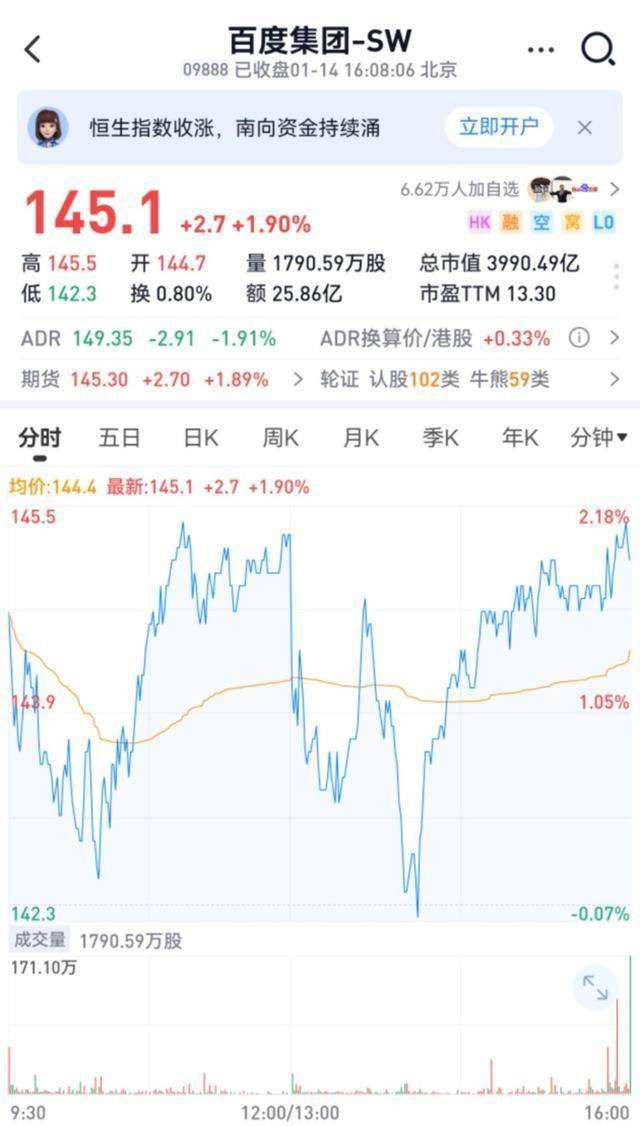
Group 1 - Baidu is considering upgrading its listing status in Hong Kong to a primary listing to increase exposure to mainland Chinese investors and to prepare for potential adverse U.S. policies [1] - As of January 14, Baidu's stock in Hong Kong rose by 1.9%, while its U.S. stock pre-market increased by over 2% [1] - Baidu was the first Chinese internet search engine company to be listed on NASDAQ in 2005 and became one of the largest tech companies in China to raise funds in the U.S. [5] Group 2 - In March 2021, Baidu achieved a secondary listing on the Hong Kong Stock Exchange with an issue price of HKD 252 per share, becoming one of the major Chinese companies to return to Hong Kong [5] - During the secondary listing event, Baidu's CEO expressed the sentiment of returning home to China, emphasizing the company's roots in the country [6]


禾赛科技回港上市首日冲高后跌近20% 高比例低折扣发行埋雷 破发期间稳市商中金未使用绿鞋资金稳市
Xin Lang Cai Jing· 2025-10-24 08:08
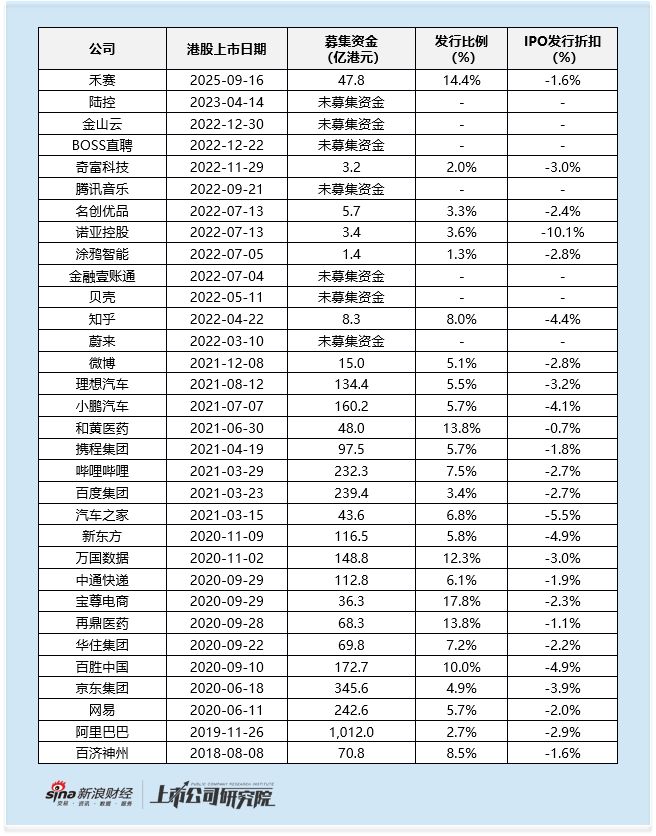
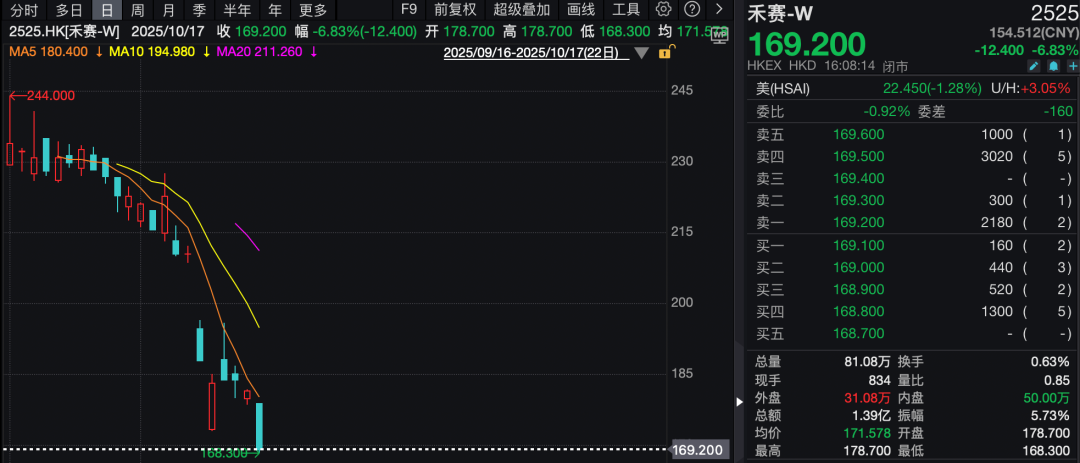
Core Viewpoint - Hesai Technology's IPO on the Hong Kong Stock Exchange marks the reopening of the channel for Chinese concept stocks to return to Hong Kong, but the stock has seen a nearly 20% decline from its issue price by October 23, indicating underlying risks despite initial high demand [1][2]. Group 1: IPO Details - The IPO was highly sought after, with a subscription rate of 14.09 times for international placements and 168.65 times for the Hong Kong public offering, leading to a total fundraising of HKD 47.8 billion (approximately USD 5.3 billion) [2][4]. - The issuance ratio of 14.4% is the second highest in history for Chinese concept stocks returning to Hong Kong, significantly above the average of 3.6% since 2022 [2][4]. Group 2: Pricing Strategy - The pricing strategy was controversial, with a minimal discount of only 1.6% compared to the previous trading day’s closing price, which deviates from industry norms and raises concerns about future performance [6][7]. - Historical data shows that higher issuance ratios typically require larger discounts to attract investors, yet Hesai opted for a near "par" pricing strategy, neglecting market demands for safety margins [6][7]. Group 3: Market Performance - On the first day of trading, the stock peaked at HKD 240.80, but subsequently entered a downward trend, falling below the issue price by October 8, and closing at HKD 171.40 on October 23, representing a 19.5% decline [8][10]. - The decline has resulted in significant losses for cornerstone investors, with Hillhouse Capital facing a loss of approximately HKD 110 million [11]. Group 4: Stabilization Mechanism - The green shoe mechanism, intended to stabilize the stock price, was ineffective as the designated stabilizing agent, CICC, did not engage in any buyback activities during the critical period after the stock price fell below the issue price [10][12]. - This lack of action suggests a prioritization of maximizing fundraising over maintaining market confidence, undermining the intended purpose of the stabilization mechanism [10].
快讯 | 中概股回港上市潮再提速!多家企业密集登陆港交所
Sou Hu Cai Jing· 2025-10-21 01:50
Group 1 - The trend of Chinese companies returning to Hong Kong for listings is accelerating amid a reshaping of the global capital landscape and increasing geopolitical uncertainties [1] - Hesai Technology became the first Chinese company to list in Hong Kong this year on September 16, marking a significant event in the return of Chinese stocks [1] - Several companies have made recent moves, including WeRide receiving approval for overseas listing on October 14, with a market value of $3.294 billion, and Pony.ai passing the Hong Kong Stock Exchange hearing on October 17 [1] Group 2 - WeRide holds autonomous driving licenses in seven countries and has already listed on NASDAQ [1] - Pony.ai is providing driverless ride-hailing services in first-tier cities [1] - Tianjing Biopharma announced on October 17 that it will achieve dual listings on NASDAQ and Hong Kong to expand its market and investor base in Asia [1]

小马智行等多家中概股加快推进回港上市
Zheng Quan Ri Bao· 2025-10-20 16:40
Core Insights - Multiple Chinese concept stocks are accelerating their return to the Hong Kong market, enhancing market liquidity and attracting international capital [1][2][3] - The return of quality tech companies like Hesai Technology and others is expected to strengthen the "tech attribute" of the Hong Kong stock market [2][3] - The Hong Kong Stock Exchange (HKEX) has implemented reforms to create a favorable environment for the return of Chinese concept stocks [3] Group 1: Market Dynamics - The recent listings include Hesai Technology, which raised approximately HKD 4.16 billion, marking the largest fundraising by a Chinese concept stock in Hong Kong in four years [2] - As of now, 34 Chinese concept stocks have returned to the Hong Kong market through dual primary listings or "second listings" [1] - The trend indicates a shift towards hard tech sectors such as autonomous driving and biomedicine for companies planning to list in 2025 [2] Group 2: Regulatory Environment - The HKEX has introduced an IPO pricing mechanism reform to enhance pricing efficiency and attract international issuers [3] - The China Securities Regulatory Commission (CSRC) has expressed support for quality Chinese concept stocks returning to both the mainland and Hong Kong markets [3] - Recent measures aim to improve market liquidity and the capacity to absorb quality, large-scale enterprises returning to the Hong Kong stock market [3]
中概股启动新一轮回港上市,什么信号?
Zheng Quan Shi Bao· 2025-10-19 05:00
Core Viewpoint - The recent wave of Chinese companies returning to the Hong Kong stock market is led by technology-intensive new economy firms, enhancing the market's ecosystem and providing new investment opportunities [1][12]. Group 1: Recent Listings and Announcements - Hesai-W successfully completed its dual listing in Hong Kong on September 16, marking the first Chinese company to return to the Hong Kong market this year [3]. - Tianjing Bio announced its intention to dual list in Hong Kong, aiming to leverage a new business model and enhance its market position in Asia [6]. - WeRide and Pony.ai have initiated their listing processes in Hong Kong, with Pony.ai already passing the listing hearing [1][5]. Group 2: Market Trends and Statistics - Since the revision of the Hong Kong Stock Exchange listing rules in 2018, a total of 34 Chinese companies have returned to the Hong Kong market, with 22 achieving dual primary listings and 12 opting for secondary listings [8]. - The return of companies like Alibaba, JD.com, and NetEase has significantly upgraded the market structure and liquidity of the Hong Kong stock market [8]. - The market has seen a concentration of returns from 2020 to 2022, with 29 companies listed during this period, while only one company returned in 2023 [8]. Group 3: Market Performance and Outlook - Many returning companies have substantial market capitalizations, with Alibaba's market cap exceeding HKD 3 trillion, making it a cornerstone of the Hong Kong market [9]. - The biotechnology sector is experiencing varied stock price performances due to long R&D cycles and high policy sensitivity, while the smart vehicle sector remains robust [9]. - Hong Kong is actively attracting quality issuers globally, with expectations that it will continue to be the preferred destination for returning Chinese companies [9]. Group 4: Regulatory and Structural Changes - The Hong Kong government is facilitating the return of Chinese companies, believing it will inject new vitality into the market and enhance its growth potential [11]. - Recommendations for reform include establishing a dedicated service office for returning companies and relaxing regulatory requirements for high-growth firms [11]. - The return of Chinese companies is seen as a strategic move to mitigate external risks and represents a significant opportunity for the Hong Kong capital market [12].
新经济领衔 中概股启动新一轮回港上市
Zheng Quan Shi Bao· 2025-10-17 19:02
Core Viewpoint - The recent trend of Chinese companies returning to the Hong Kong stock market is led by technology-intensive new economy firms, enhancing the market ecosystem and attracting more quality listings [1][4]. Group 1: Recent Listings and Market Dynamics - Hesai-W successfully completed its dual listing in Hong Kong on September 16, marking the first Chinese concept stock to return this year [2]. - On October 14, WeRide and Pony.ai initiated their Hong Kong listing processes, with Pony.ai already passing the Hong Kong Stock Exchange's listing hearing [1][3]. - WeRide plans to issue up to 102.4 million shares and has a market capitalization of $3.294 billion as of October 16 [2]. - Pony.ai aims to issue up to 102.1 million shares and has a market capitalization of $7.253 billion as of October 16 [3]. - Tianjing Bio announced its intention to dual list in Hong Kong and Nasdaq, aiming to enhance its market position in Asia [3]. Group 2: Historical Context and Trends - Since the revision of the Hong Kong Stock Exchange's listing rules in 2018, a total of 34 Chinese concept stocks have returned to the Hong Kong market, with 22 as dual primary listings and 12 as secondary listings [4]. - The return of major companies like Alibaba in 2019, which raised approximately HKD 101.2 billion, marked a significant milestone in this trend [4]. - The period from 2020 to 2022 saw a concentrated influx of 29 Chinese concept stocks, including major players like NetEase and JD.com [4]. Group 3: Market Performance and Future Outlook - Many returning companies have significant market capitalizations, with Alibaba exceeding HKD 3 trillion, serving as a cornerstone of the Hong Kong market [5]. - The biotechnology sector shows varied stock performance due to long R&D cycles and high policy sensitivity, while the smart vehicle sector remains robust amid high industry demand [5]. - Hong Kong is actively creating a favorable environment for quality issuers, with expectations for continued influx of Chinese concept stocks [5][6]. Group 4: Regulatory and Structural Improvements - The Hong Kong government aims to assist Chinese concept stocks in returning, believing it will inject new vitality into the market and enhance its growth potential [6]. - Suggestions for reform include flexible regulatory measures for high-growth companies and establishing a dedicated service office for returning stocks to streamline the listing process [7]. - The return of these companies is seen as a strategic move to mitigate external risks and an opportunity for the Hong Kong capital market to deepen its reforms [7].

毕马威:中国香港今年有望重夺全球IPO市场榜首,中概股回港上市数量有望持续增加
Mei Ri Jing Ji Xin Wen· 2025-10-09 14:33
Group 1 - Hong Kong is expected to reclaim the top position in the global IPO market by the end of 2025, driven by an unprecedented wave of listing applications [1][2] - As of September 30, 2023, Hong Kong's securities market recorded nearly 300 listing applications, marking a historical high [1] - In the first three quarters of 2025, the global IPO market raised $111.6 billion with 930 listings, reflecting a 32% increase in capital raised and a 3% increase in the number of listings compared to the same period last year [1] Group 2 - The Hong Kong IPO market saw 67 new listings in the first nine months of 2025, raising HKD 182.9 billion, which represents a year-on-year increase of 49% and 229% respectively [1] - The growth in Hong Kong's IPO market is primarily driven by "A+H" listings, which accounted for 50% of the total IPO fundraising in the first three quarters [1] - The return of Chinese concept stocks, such as Hesai Technology, which completed a dual primary listing in Hong Kong, is expected to increase the number of such listings in the future [2]
制度创新激活港股新生态:“A+H”扩容,中概股回归趋势强化
2 1 Shi Ji Jing Ji Bao Dao· 2025-09-17 13:11
Group 1 - The Hong Kong government aims to enhance financial support for technology companies from mainland China through initiatives like the "Tech Company Special Line" to facilitate their financing in Hong Kong [1] - The Hong Kong IPO market has seen a significant surge in activity, with 62 new listings raising a total of 1,441.58 billion HKD this year, surpassing the total fundraising of the past two years [1][2] - The "A+H" listing trend is accelerating, with 11 A-share companies achieving dual listings, particularly in emerging sectors such as hard technology, new consumption, and biomedicine [2] Group 2 - The top five fundraising companies in the Hong Kong IPO market this year are all A-share companies, collectively raising 916.89 billion HKD, which accounts for over 50% of the total IPO fundraising [2] - CATL's IPO raised 410.06 billion HKD, marking the largest IPO in Hong Kong in nearly four years, with an oversubscription rate of 15.2 times for international placements and 151.2 times for retail investors [2] Group 3 - The trend of A-share companies listing in Hong Kong is driven by favorable policies, global capital reallocation, and the need for financial security and competitiveness [3] - Companies listing in Hong Kong can build an "A+H" dual financing platform, enhancing their international credibility and brand image while allowing for offshore fund usage without domestic currency restrictions [3] Group 4 - Innovative listing methods are emerging, such as share swap mergers and "privatization + introduction listing," which simplify the listing process and reduce risks and costs [5] - New opportunities for "A+H" listings are being created, as seen with Zhejiang Huhangyong's announcement of a share swap merger with Zhenyang Development [3][5] Group 5 - The Hong Kong Stock Exchange has implemented reforms to facilitate IPOs for technology companies and the return of Chinese concept stocks, including the introduction of the "Tech Company Special Line" [6] - The successful listing of Hesai Technology marked the largest IPO in the global lidar industry and the largest return of a Chinese concept stock to Hong Kong in four years, raising over 41.6 billion HKD [6] Group 6 - The Hong Kong government is considering optimizing the "dual-class share" listing regulations to further facilitate the return of Chinese concept stocks [7] - Current regulations for companies with different voting rights structures are seen as stringent, with suggestions for easing requirements to attract high-growth technology companies back to Hong Kong [8]
“激光雷达老大”禾赛科技港股“首秀”大涨
Hua Er Jie Jian Wen· 2025-09-16 07:50
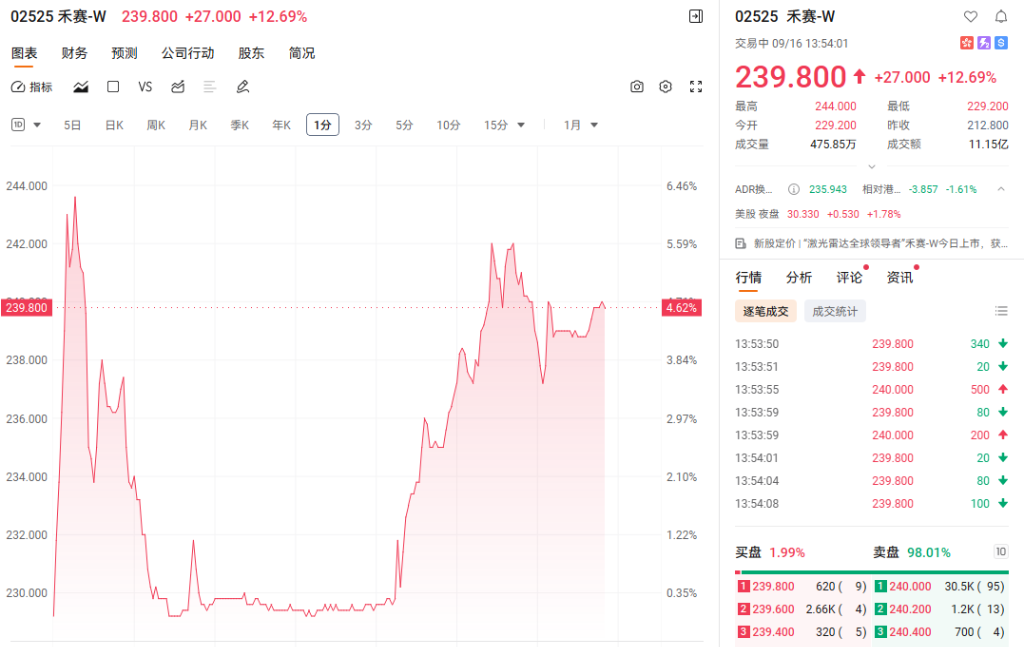
Group 1 - Hesai Technology, a global leader in LiDAR, officially listed on the Hong Kong Stock Exchange on September 16, with a strong debut performance, reaching a peak increase of 15% to HKD 244 [2][3] - The IPO price was set at HKD 212.80, raising a total of HKD 41.60 billion (approximately USD 5.35 billion), with significant cornerstone investors like Hillhouse Capital and Grab Holdings participating [3] - This listing marks Hesai as the first LiDAR company to achieve a dual primary listing in both the US and Hong Kong, and it is the largest IPO of a Chinese concept stock returning to Hong Kong in the past four years [3] Group 2 - The strong performance of Hesai is aligned with the increasing adoption of LiDAR technology by automotive manufacturers to enhance Advanced Driver Assistance Systems (ADAS) [3] - The company plans to use the funds raised to reduce the manufacturing costs of its LiDAR systems, aiming to lower the price from USD 50,000 to USD 200, which could significantly boost the technology's adoption in mainstream passenger vehicles [5] - As of March 31, 2025, Hesai has secured the highest number of mass production designations in the ADAS market, covering 120 models from 22 global OEMs, including well-known brands like Li Auto, Zeekr, and Leap Motor [5] Group 3 - Founded in 2014, Hesai maintains a leading position in multiple niche markets, being the largest revenue-generating LiDAR supplier globally in 2022, 2023, and 2024 according to Frost & Sullivan [5] - The strong market demand is reflected in the company's performance, with its American Depositary Receipts (ADR) doubling in price this year and a 54% year-over-year revenue growth in the second quarter, surpassing the previous quarter's growth rate [5]
上海超级IPO,刚刚敲钟
投中网· 2025-09-16 03:48
Core Viewpoint - The successful return of Hesai Technology to the Hong Kong stock market signals a potential resurgence of Chinese concept stocks returning to Hong Kong, which may encourage more companies to follow suit [5][18]. Group 1: Company Overview - Hesai Technology, a leading lidar company, successfully listed on the Hong Kong stock market on September 16, 2023, after 31 months of being listed in the U.S. [3][4]. - The company raised over HKD 4.1 billion, making it one of the largest fundraising projects for Chinese concept stocks returning to Hong Kong in recent years [4]. - With a market capitalization exceeding HKD 36 billion at the opening, Hesai Technology's stock price rose over 12% from its issue price of HKD 212.8 [3][4]. Group 2: Founders and Development - Founded in October 2014 by three scholars, Li Yifan, Sun Kai, and Xiang Shaoqing, Hesai Technology initially focused on gas detection equipment before pivoting to lidar technology [7][8]. - The company developed China's first 32-line hybrid solid-state lidar in October 2016 and later the first 40-line hybrid solid-state lidar, gaining significant recognition in the industry [8][9]. - By September 2022, Hesai Technology had delivered 100,000 lidar products, becoming the first company to achieve a monthly shipment of 10,000 units [9]. Group 3: Financial Performance - In 2024, Hesai Technology sold 501,900 lidar units, with revenue increasing from over CNY 1.2 billion in 2022 to over CNY 2 billion in 2024 [10]. - The company's revenue reached CNY 706 million in Q2 2025, with a net profit of CNY 44 million, marking a turnaround from previous losses [10]. - A significant order worth over USD 40 million was signed with a leading U.S. Robotaxi company, further solidifying Hesai's market position [10]. Group 4: Investment and Financing - Hesai Technology has completed at least nine rounds of financing, attracting numerous investors including Hillhouse Capital, Baidu, and Bosch Group [12][13]. - The company raised USD 173 million in its C round of financing in January 2020, setting a record for lidar industry financing [13][14]. - By November 2021, Hesai announced over USD 370 million in D round financing, with its valuation soaring to USD 2 billion [14]. Group 5: Market Trends and Future Outlook - The return of Hesai Technology to Hong Kong indicates a reopening of the channel for Chinese concept stocks, potentially leading to a new wave of listings [5][18]. - The Chinese Securities Regulatory Commission has expressed support for quality Chinese concept stocks returning to domestic and Hong Kong markets, with regulatory bodies preparing to facilitate this trend [18].