
以购代建

Search documents
上海二手房收购试点正式落地
21世纪经济报道· 2026-02-05 10:14
Core Viewpoint - The article discusses the launch of a pilot program in Shanghai for the acquisition of second-hand housing to be converted into affordable rental housing, aimed at addressing the housing needs of new citizens, young people, and university graduates [1][4]. Group 1: Pilot Program Details - The pilot program will focus on three districts: Pudong New Area, Jing'an District, and Xuhui District, with specific criteria for the types of second-hand homes to be acquired [1][3]. - Pudong will prioritize second-hand homes built before 2000, under 70 square meters, and priced below 4 million yuan, with a focus on facilitating the purchase of new homes [3]. - Jing'an will target homes within 3 kilometers of key industrial areas and transport hubs, while Xuhui will adopt a cash acquisition model without replacement requirements [3]. Group 2: Market Impact and Analysis - Analysts suggest that the effectiveness of the program will depend on whether the acquisition prices align with homeowners' expectations, which is crucial for the policy's success [1][4]. - The initiative is expected to enhance market activity and facilitate the sale of new homes, as it aims to link the second-hand and new housing markets more effectively [5][8]. - The program is seen as a response to rising inventory pressures in certain areas and aims to improve the overall housing supply without reducing market availability [3][4]. Group 3: Broader Implications - The pilot is part of a broader strategy to increase the supply of affordable housing in Shanghai, with a target of constructing 74,000 units by 2025 [7]. - The program is also aligned with national trends, as over 30 cities have initiated similar stock acquisition policies since 2022, indicating a nationwide shift towards using existing housing stock to meet demand [9]. - The initiative is viewed as a multi-win solution, providing a safe exit for owners of older homes while stimulating the housing market and improving rental options for new citizens and young people [7][9].

上海二手房收购试点正式落地 浦东、静安、徐汇三区先行
2 1 Shi Ji Jing Ji Bao Dao· 2026-02-04 12:41
Core Viewpoint - The Shanghai branch of China Construction Bank announced full-cycle financial support for the acquisition of second-hand housing for affordable rental housing projects, focusing on new citizens, young people, and university graduates' rental needs [1][6]. Group 1: Policy Implementation - The pilot program for acquiring second-hand housing is being implemented in three districts: Pudong New Area, Jing'an District, and Xuhui District, with a focus on housing that meets specific criteria such as size and price [1][2]. - Jing'an District has initiated a targeted acquisition of second-hand homes under 70 square meters and priced below 4 million yuan, facilitating owners' transition to new homes [1][2]. - Pudong New Area prioritizes the acquisition of second-hand homes built before 2000, with a similar price cap, but owners will receive housing vouchers instead of cash [2][3]. Group 2: Financial Mechanisms - Xuhui District employs a cash acquisition model, utilizing fiscal injections and bank loans to fund the purchases [3]. - The acquired second-hand homes will undergo renovation and be included in the affordable rental housing system, with rents set at 70%-80% of market rates [3][4]. Group 3: Market Impact - Analysts suggest that the acquisition of second-hand homes will enhance market liquidity and support new home sales, addressing the disconnect between the first and second-hand markets [4][6]. - The initiative is expected to activate the housing market by providing a safe exit for owners of older properties and stimulating new home transactions [6][7]. Group 4: Broader Context - The pilot program aligns with Shanghai's long-term planning for increasing affordable housing supply, with a target of constructing 74,000 affordable rental units by 2025 [6][8]. - The initiative reflects a national trend, as over 30 cities have started similar programs to acquire existing housing for affordable purposes since 2022 [7][8].
中指研究院:1月核心城市二手房成交回暖
智通财经网· 2026-02-04 05:53
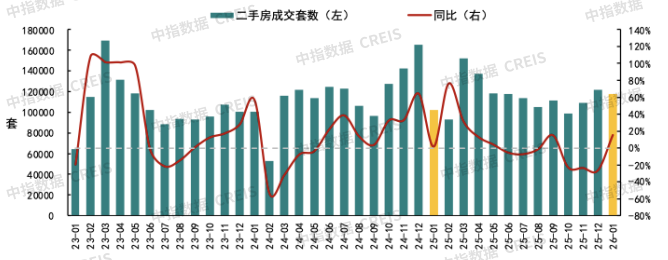
Core Insights - The second-hand housing market in key cities continues to exhibit a "price-for-volume" characteristic as of January 2026, with a total of 118,000 transactions in 20 cities, reflecting a slight month-on-month decrease of 3.1% but a year-on-year increase of 15.3% [1][4] - Structural contradictions in the market remain prominent, particularly the widening price gap between new and second-hand homes in core cities like Shanghai and Beijing, which may hinder the "sell old to buy new" chain [4][10] Market Activity - In January 2026, Shanghai's second-hand housing transactions reached 22,800 units, showing a month-on-month increase of 1.1% and a year-on-year increase of 26.1%, indicating a high level of market activity [10] - In 2025, second-hand homes accounted for 83% of the total transaction volume in Shanghai, highlighting the dominance of the second-hand market [10] Policy Initiatives - Shanghai has recently launched a new policy to acquire second-hand homes for the purpose of providing affordable rental housing, with the first batch of acquisitions signed on February 2, 2026 [4][5] - The policy focuses on small-sized units, with specific criteria for acquisition, such as prioritizing homes built before 2000 and under 70 square meters, with a total price not exceeding 4 million yuan [4][9] Market Impact - The policy aims to stabilize price expectations by providing a clear exit channel for owners of older homes, thereby establishing a "price anchor" for related assets [5] - It seeks to activate the replacement chain and stimulate demand for improved housing, although efficiency may be constrained by regional limitations and price gradients [5] - The acquisition of second-hand homes is expected to enhance the supply of affordable rental housing in core areas, effectively matching the balance between work and residence [20][21] Rental Market Dynamics - As of January 2026, the average rent for ordinary residential properties in Shanghai was 81.50 yuan per square meter per month, with rents in core districts like Jing'an and Xuhui reaching 115.55 and 109.76 yuan per square meter, respectively [21] - The rental market's resilience, combined with declining housing prices, has improved the rental yield for certain neighborhoods, supporting the sustainability of the "purchase instead of build" model for affordable rental housing [21]
激活置换循环,上海三区试点收购二手房补充保租房供给
Hua Xia Shi Bao· 2026-02-03 10:41
Core Viewpoint - Shanghai is enhancing its focus on public welfare construction, aiming to complete the construction of 74,000 affordable rental housing units by 2025, reaching a cumulative total of 610,000 units [2] Group 1: Affordable Housing Initiatives - The acquisition of second-hand housing for affordable rental housing has officially started, with pilot projects in Pudong New District, Jing'an District, and Xuhui District [2][3] - The selection criteria for housing sources include matching housing types, mature supporting facilities, and convenient transportation [3][4] - The acquisition process is led by government entities, focusing on older residential areas with clear property rights and a total price not exceeding 4 million yuan [4] Group 2: Financial Support and Operational Models - Financial support for the acquisition will be provided by China Construction Bank, which will offer a comprehensive financial service plan [5] - Xuhui District will use district-level financial funds and bank loans to ensure stable funding for the acquisition of small-sized housing units [5] - Jing'an District has established a specialized working group to manage the entire acquisition process, ensuring professional operations from source identification to contract signing [4][5] Group 3: Market Impact and Trends - In January, Shanghai's second-hand housing transactions reached 22,834 units, marking a three-month streak of over 22,000 transactions, the highest in five years [6] - The second-hand housing market has shown signs of price stabilization, with a 25% year-on-year increase in transactions compared to January of the previous year [6] - The pilot acquisition initiative is expected to further stabilize the market and enhance liquidity in the second-hand housing sector [6][7] Group 4: Broader Context and Similar Initiatives - Other regions, such as Hunan Province and Haikou City, are also exploring similar policies to acquire existing housing for public welfare, indicating a trend towards "buying old to replace with new" strategies [9][10] - The approach aims to combine public welfare, market stability, and housing security, addressing the challenges of increasing second-hand housing listings in major cities [10]

卜房者说│高校收购存量房当宿舍,楼市存量消化有了新解法?
Sou Hu Cai Jing· 2025-10-27 10:47
Core Insights - Recent trend in the real estate market shows universities purchasing existing residential properties to convert them into dormitories, with Central South University announcing a procurement plan of 295 million yuan [1] - This approach is not isolated; Hubei University was the first to implement this strategy, acquiring 352 residential units for 198 million yuan, which will provide 2,800 new beds to meet enrollment demands [1] - The purchasing price of 4,650 yuan per square meter is significantly lower than the 2022 record price, making it a cost-effective solution compared to new construction [1] - The Chinese government has encouraged universities to buy or lease social housing to supplement dormitory needs, providing a supportive policy environment for these acquisitions [1] Group 1 - Universities are opting for "purchase instead of construction" to quickly address accommodation shortages while helping to absorb excess inventory in the real estate market [2] - Existing residential properties can also be repurposed for blue-collar workers and elderly housing, with various cities exploring their inclusion in affordable housing frameworks [2] - The success of this model depends on practical conditions such as the availability of nearby housing, financial strength of universities, and effective management of renovations [2]
国家统计局:7月一线城市新房价格同比降幅较上月收窄0.3个百分点;华发股份上半年归母净利润1.72亿元
Bei Jing Shang Bao· 2025-08-18 01:47
Group 1: Real Estate Market Trends - In July, new residential property prices in first-tier cities decreased by 1.1% year-on-year, with the decline narrowing by 0.3 percentage points compared to the previous month [1] - Second and third-tier cities saw new residential property prices drop by 2.8% and 4.2% year-on-year, with declines narrowing by 0.2 and 0.4 percentage points respectively [1] Group 2: Policy Adjustments in Hainan - Hainan's government encourages cities with high inventory of commercial housing to prioritize "purchase instead of construction" methods for housing arrangements [2] - The government aims to support the revitalization of existing real estate through increased policy tools such as special bonds and public fund returns [2] - Policies regarding the conversion of commercial land and office properties into residential housing have been clarified to enhance awareness [2] Group 3: Company Financials - Vanke's subsidiary Dongguan Wanwei Supply Chain Co., Ltd. applied for a loan of 95.5 million yuan, secured by a pledge of 100% equity from another subsidiary [3] - R&F Properties reported sales of 1.03 billion yuan in July, with a sales area of approximately 84,800 square meters [4] - Huafa Co., Ltd. reported a net profit attributable to shareholders of 172 million yuan for the first half of 2025, a decrease of 86.41% compared to the same period last year [5]

海南提出城市更新“房票安置” 鼓励收购商品房用作安置房
Zhong Guo Xin Wen Wang· 2025-05-28 15:31
Core Viewpoint - The Hainan Provincial Government has introduced a set of policy measures to support urban renewal, emphasizing the importance of providing housing solutions for displaced residents and optimizing land use for urban development [1][2]. Group 1: Urban Renewal Policies - The measures allow for housing vouchers or "purchase instead of construction" methods to accommodate displaced residents, encouraging the acquisition of commercial housing for urban village redevelopment [1][2]. - Cities and counties are encouraged to create detailed planning for urban renewal based on actual needs, using a layered approach to planning [1]. - The calculation rules for floor area ratio (FAR) have been optimized, allowing for additional floor area as a reward for public infrastructure projects under 300 square meters, which do not count towards the FAR [1]. Group 2: Land Supply and Development - The policy optimizes land supply by allowing small, irregular plots of land (up to 10% of the total project area) to be supplied through allocation or agreement if they cannot be developed independently [1]. - There is a focus on transforming old factory areas while ensuring building quality and safety, encouraging the renovation and functional adjustment of existing legal factory buildings [1]. Group 3: Housing Quality and Investment - The measures support the construction of high-quality residential projects, promoting ecological and aesthetic design, and optimizing residential project FAR calculations to enhance living conditions [2]. - A multi-faceted financing mechanism is proposed to attract private enterprises and social capital into urban renewal projects, including partnerships and the establishment of urban renewal funds [2]. - The measures encourage eligible urban renewal projects to apply for Real Estate Investment Trusts (REITs) to facilitate investment [2].