企业利润修复

Search documents
产需修复持续性有待观察——11月PMI点评
Changjiang Securities· 2025-12-01 23:30
1. Report Industry Investment Rating No relevant content provided. 2. Core View of the Report In November 2025, the manufacturing PMI showed a marginal improvement with synchronized recovery in production and demand and accelerated destocking, but the asymmetric recovery of raw material and finished product prices may still restrict corporate profit repair, and the sustainability of external demand contribution remains to be verified. The decline in service - sector sentiment indicates that the resilience of domestic demand also needs to be observed. The bond market has adjusted, and the impact of PMI data is expected to be limited. It is recommended to allocate 10 - year Treasury bonds with a taxable coupon yield above 1.8% when there are adjustments [2]. 3. Summary by Related Catalogs Manufacturing PMI - **Overall situation**: In November 2025, the manufacturing PMI was 49.2%, up 0.2 pct from the previous month, still seasonally weak but with marginal improvement. Production, procurement, and import indices on the supply - side increased, and new order and backlog order indices on the demand - side rose. Inventory destocking accelerated, and some predictive indicators showed improved supply - demand relationships [5][9]. - **External demand contribution**: The new export order index rose 1.7 pct to 47.6%, and the new export order indices of four major manufacturing industries and large, medium, and small enterprises all increased. However, the asymmetric recovery of raw material and finished product prices may pressure corporate profit repair [9]. - **Enterprise size and industry differences**: Small and medium - sized enterprises' sentiment improved, especially small enterprises which rose 2 pct to a nearly 6 - month high of 49.1%, while large enterprises' sentiment declined 0.6 pct to 49.3%. High - tech manufacturing with a high proportion of small and medium - sized enterprises remained in expansion, while the sentiment of equipment and consumer goods manufacturing declined, and their production sides may be stronger than the demand sides [9]. Non - manufacturing PMI - **Overall situation**: The non - manufacturing business activity index was 49.5% in November 2025, down 0.6 pct from the previous month, the first time below the boom - bust line since 2023. The service - sector sentiment was dragged down by factors such as the fading holiday effect, while the construction industry's sentiment improved [5][9]. - **Sub - item structure**: The inventory and new order indices of non - manufacturing declined, while the new export order index rose. The sales price and input price indices increased for two consecutive months. In the service sector, the financial industry and some new - energy industries showed good performance. The construction industry's business activity index increased, possibly boosted by financial activities and policy support [9]. Investment Suggestion The bond market has adjusted, and the impact of PMI data is expected to be limited. It is recommended to allocate 10 - year Treasury bonds with a taxable coupon yield above 1.8% when there are adjustments [2][9].
国泰海通|宏观:低基数下的同比回升——8月工业企业利润数据点评
国泰海通证券研究· 2025-09-28 12:34
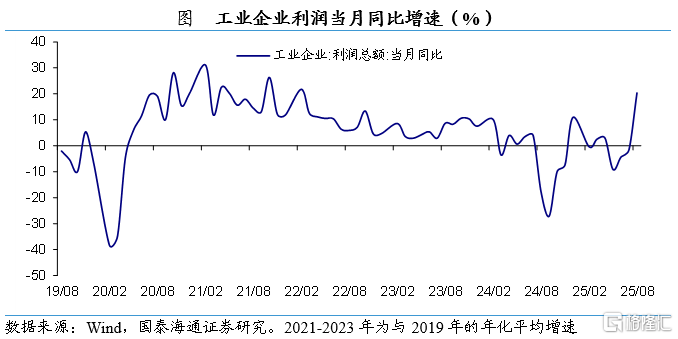
Core Viewpoint - In August, corporate profits showed a year-on-year recovery primarily due to a low base from the previous year, although the growth rate has slowed compared to July when viewed from a two-year annualized perspective [1] Summary by Relevant Sections Profit Trends - Corporate profits in August returned to positive year-on-year growth, largely influenced by last year's low base, with a notable slowdown in growth rate compared to July when viewed on a two-year basis [1] - The profit distribution has become more reasonable, with upstream industries benefiting from price increases and showing overall improvement, while the profit disparity in midstream and downstream industries continues [1] Revenue and Profit Margins - The trend in August indicated a decrease in volume but an increase in price, with marginal improvements in revenue and profit margins supported by the low base effect [1] - Industrial product inventory continues to decrease, leading to an improvement in corporate revenue growth year-on-year [1] Future Outlook - For corporate profits to achieve sustained and comprehensive recovery, policy support is essential. Effective stimulation of downstream demand could potentially transition industrial profits from structural recovery to comprehensive rebound [1]


国泰海通宏观:企业利润要实现持续全面修复仍需政策发力
Ge Long Hui· 2025-09-28 01:23
Group 1 - In August, corporate profits turned positive year-on-year, primarily due to a low base from the previous year, with a year-to-date growth rate of 0.9% compared to -1.7% in July, and an August growth rate of 20.4% compared to -1.5% in July [2][9] - The profit distribution has become more reasonable, with upstream industries showing overall improvement supported by anti-involution and price increases, while midstream and downstream industries continue to experience profit differentiation [6][7] - The industrial product inventory continued to decrease, indicating a passive destocking trend, with cumulative revenue growth of 2.3% year-on-year for the first eight months, and August's revenue growth also at 2.3%, both higher than the previous month [9][10] Group 2 - The profit margin showed marginal improvement, with the cumulative profit margin for August at 5.8% and the monthly value at 5.2%, both higher than the previous month, benefiting from a reduction in costs despite a slight increase in raw material prices [4][6] - Upstream industries benefited from price increases and margin improvements, particularly in the steel, coal, and non-ferrous sectors, while midstream industries saw profit growth driven by demand recovery [7][8] - The overall profit structure has improved, with upstream profits maintaining around 25%, midstream at 50%, and downstream slightly recovering to 25%, indicating a more balanced distribution compared to the previous month [6][7]

国泰海通证券:未来企业利润全面修复需政策发力提振下游需求
Zheng Quan Shi Bao Wang· 2025-08-29 13:00
Core Viewpoint - The overall decline in corporate profits has narrowed in July, showing a differentiated structure primarily due to profit recovery driven by "anti-involution" policies, supply contraction, price increases, and support from high-end manufacturing demand, while downstream consumer demand remains weak, leading to marginal profit shrinkage in downstream industries [1] Summary by Relevant Categories Corporate Profit Trends - In July, the decline in corporate profits showed signs of narrowing, indicating a potential recovery phase [1] - The recovery is largely dependent on supply-side adjustments and price increases rather than robust consumer demand [1] Structural Analysis - The profit recovery is characterized by a structural divergence, with some sectors benefiting from high-end manufacturing demand while others face challenges due to weak downstream consumption [1] - Downstream industries are experiencing marginal profit shrinkage, highlighting the uneven nature of the recovery [1] Inventory Cycle and Policy Impact - The current inventory cycle is marked by proactive destocking driven by policy measures [1] - For a comprehensive recovery in corporate profits, there is a need for policy initiatives to stimulate downstream demand, transitioning from structural recovery to a broader profit rebound [1]

国泰海通|宏观:利润改善,结构分化
国泰海通证券研究· 2025-08-29 12:07
Core Viewpoint - The overall decline in corporate profits has narrowed in July, showing a differentiated structure primarily due to profit recovery relying on "anti-involution" policies leading to supply contraction and price increases, alongside demand support from certain high-end manufacturing sectors. However, downstream consumer demand remains weak, causing marginal profit shrinkage in downstream industries. The current inventory cycle is characterized by proactive destocking driven by policies. A comprehensive recovery in corporate profits will require policy efforts to boost downstream demand, transitioning profit recovery from structural to comprehensive [1]. Summary by Sections - Corporate Profit Trends: The decline in corporate profits has slowed down, indicating a potential recovery phase influenced by specific policies and market conditions [1]. - Structural Differentiation: The recovery is uneven, with high-end manufacturing benefiting while downstream sectors face challenges due to weak consumer demand [1]. - Inventory Cycle: The current phase is marked by proactive destocking, suggesting a strategic approach to inventory management under policy guidance [1]. - Future Outlook: A full recovery in corporate profits hinges on policy measures aimed at stimulating downstream demand, which is essential for transitioning from structural recovery to overall profit growth [1].