企业投资意愿

Search documents
美耐用品数据高于预期银价高涨
Jin Tou Wang· 2026-01-27 04:06
Group 1 - The core point of the news is the significant increase in durable goods orders in the U.S., which rose by 5.3%, surpassing market expectations of 3.8% and reversing a previous decline of 2.2% [2] - This increase marks the largest growth in six months, driven by orders for commercial aircraft and other capital equipment, indicating a recovery in manufacturing demand [2] - Year-over-year, durable goods orders increased by 10.5%, representing the third-highest growth rate since June 2022, suggesting a positive trend in business investment [2] Group 2 - Core orders, excluding transportation equipment, have shown continuous month-over-month increases for eight consecutive months, reflecting sustained improvement in business equipment investment [2] - The durable goods orders are considered a key indicator of economic activity and business investment sentiment, providing strong support for economic growth momentum heading into the year-end [2] - Market sentiment indicates a 78% probability of a new government shutdown occurring by the end of January, a significant increase from less than 10% the previous week [2]
加元震荡 央行维稳共识下分歧掣肘上行
Jin Tou Wang· 2026-01-27 02:36
Core Viewpoint - The Canadian dollar (CAD) is experiencing a volatile start to 2026, with fluctuations against the US dollar influenced by oil prices and domestic economic conditions, while the market awaits clarity from the Bank of Canada on interest rates [1][2]. Group 1: Currency Performance - As of January 27, the CAD is trading at 0.7291 against the USD, showing a slight daily decline of 0.0656%, with a trading range between 0.7289 and 0.7299 [1]. - The CAD has depreciated approximately 1.55% against the Chinese yuan since the beginning of the year, although it has seen minor recovery due to the strengthening of non-USD currencies [1]. - The USD/CAD exchange rate is currently around 1.3680, close to the lower end of a previous downtrend channel, indicating a narrow trading range since the start of the year [1]. Group 2: Monetary Policy and Economic Outlook - The Bank of Canada is expected to maintain the benchmark interest rate at 2.25% in January, with 75% of institutions predicting stability throughout 2026, following a cumulative 100 basis points rate cut in 2025 [1][2]. - The current inflation rate in Canada is at 2.4%, slightly above the 2% target, reducing the urgency for rate cuts in the short term [1]. - The Bank of Canada is undergoing a five-year review of its monetary policy framework, leading to divergent predictions among institutions regarding future interest rate movements [2]. Group 3: Oil Prices and Economic Conditions - The CAD's performance is closely tied to international oil prices, which have stabilized around $61.10 per barrel, providing essential support for the CAD [2]. - Concerns over energy supply due to geopolitical risks and disruptions in certain regions have contributed to the recent increase in oil prices, positively impacting Canada's oil export revenues [2]. - However, domestic economic recovery remains weak, with the unemployment rate rising to 6.8% in December 2025, the highest since before the pandemic, and consumer confidence declining for three consecutive months [2]. Group 4: Technical Analysis and Market Sentiment - The USD/CAD exchange rate is currently in a downward trend since the previous high of 1.3927, with resistance around 1.3800 and support near 1.3641 [3]. - Technical indicators suggest a stalemate in market dynamics, with no clear reversal signals, indicating a pattern of limited downward movement without significant upward momentum [3]. - Future CAD movements will be influenced by three key variables: the Bank of Canada's interest rate decision, the stability of oil prices, and changes in the US dollar index and external demand [3].
刚刚!市场突现三大变数!
券商中国· 2026-01-16 04:22
Core Viewpoint - The market's expectations are changing, with a notable shift in sentiment following a structural interest rate cut, leading to adjustments in various market segments [1]. Group 1: Liquidity Expectations - The M1 growth rate fell in December, with a monthly increase of 2.6 trillion yuan, raising debates about liquidity transmission and corporate investment willingness [2][3]. - Some analysts believe the decline in M1 growth is due to a high base effect, while others point to a decrease in corporate and household liquidity willingness, as indicated by a drop in M0 and demand deposits [3]. - M2 growth increased by 0.5 percentage points to 8.5%, but M1 did not show a corresponding improvement, suggesting that credit expansion has not effectively converted into demand deposits [3]. Group 2: Interest Rate Cut Expectations - On January 15, the central bank announced a 25 basis point cut in the re-lending and rediscount rates, which initially boosted market sentiment [5]. - However, subsequent market performance indicated a divergence from initial expectations, with analysts suggesting that the likelihood of further interest rate cuts before the Spring Festival has decreased, although a reserve requirement ratio cut remains possible [6]. Group 3: Investor Profit Expectations - Market participants' profit expectations are shifting, with State Grid announcing a 4 trillion yuan fixed asset investment plan for the 14th Five-Year Plan, a 40% year-on-year increase [7]. - Despite the initial positive response in the smart grid sector, the overall market sentiment has cooled, as evidenced by a nearly 1 trillion yuan drop in trading volume [7]. - Analysts suggest that a temporary cooling of market sentiment is not necessarily negative, as maintaining high trading volumes could deplete market liquidity and disrupt market ecology [7].


德国银行信贷数据显示企业投资意愿下降
Xin Hua Wang· 2025-09-18 04:54
Core Insights - The report from the German Banking Association indicates that while overall new loan business in German banks remains stable in the first half of 2025, there is a significant decline in corporate financing loans due to decreased investment willingness among businesses [1] Loan Business Overview - New loan business in German banks amounted to €66.7 billion in the first half of the year, showing a slight year-on-year increase of 0.3% [1] - Consumer loan business saw new loans of €30 billion, reflecting a year-on-year growth of 4.2% [1] - Corporate financing loans experienced a downturn, with new loans totaling €5.2 billion, representing a year-on-year decline of 6.6% [1] Sector-Specific Insights - The motor vehicle loan sector also reflects the decline in corporate investment, with total loans issued for motor vehicles amounting to €11.9 billion, a decrease of 1.3% year-on-year [1] - Personal car loans remained stable, with a slight increase of 1.1% to €9.3 billion, while company vehicle financing saw a significant drop of 9.2%, falling to €2.6 billion [1] Economic Implications - The Executive Director of the German Banking Association, Jens Loy, emphasized that bank credit serves as a barometer for economic conditions. A reduction in corporate investment and persistently low consumer confidence could hinder Germany's economic growth [1] - For Germany to return to a path of sustainable growth, structural reforms are necessary to stimulate growth [1]
光大期货有色商品日报-20250529
Guang Da Qi Huo· 2025-05-29 05:03
1. Report Industry Investment Rating No information provided in the report. 2. Core Viewpoints of the Report - **Copper**: Overnight LME copper rose and then fell, with a 0.31% decline to $9,566 per ton; SHFE copper main contract dropped 0.33% to CNY 77,790 per ton. The US April durable goods orders' initial value of month - on - month decline was 6.3%, indicating weakened corporate investment willingness. China's industrial enterprise profits in the first four months increased by 1.4%, continuing the recovery trend. LME copper inventory decreased by 7,850 tons, while Comex copper inventory increased. High copper prices and premiums made downstream procurement cautious. Under the relatively eased macro - environment and supported by fundamentals, it's difficult for copper prices to drop significantly. The current market weakness is due to the arrival of the domestic off - season, and the ongoing de - stocking and high BACK structure are not suitable for unilateral short - selling. Copper may maintain the current oscillating trend [1]. - **Aluminum**: Alumina and Shanghai aluminum both trended weakly. The cost center of gravity declined, and alumina enterprises showed signs of复产. The processing was slack, and the terminal rush - export effect coexisted. The aluminum ingot turnover was smooth, and the overall de - stocking slowed down. In the short term, it was dragged down by upstream alumina and turned to a weak oscillation [1][2]. - **Nickel**: Overnight LME nickel fell 1.85% to $15,095 per ton, and Shanghai nickel dropped 1.19% to CNY 119,800 per ton. LME and SHFE nickel inventories increased. The news of the relaxation of Indonesia's RKAB approval affected market sentiment. The stainless - steel industry chain had firm cost support but weak demand. In the new - energy sector, raw material supply increased while sulfuric acid nickel demand had no increment. The supply of primary nickel slightly decreased, and the domestic inventory decreased slightly. Affected by news, but with firm ore prices and little change in fundamentals, it would run in an oscillating manner in the short term [3]. 3. Summary by Directory 3.1 Research Views - **Copper**: Overnight LME copper prices fell, and SHFE copper also declined. The US economic data showed weakened corporate investment, while China's industrial enterprise profits continued to recover. LME inventory decreased, Comex inventory increased, and domestic inventories had different changes. High prices made downstream procurement cautious. Macro - environment was relatively eased, and fundamentals supported copper prices, making a significant decline unlikely. It might oscillate currently [1]. - **Aluminum**: Alumina and Shanghai aluminum trended weakly. The cost decreased, and alumina enterprises planned to resume production. The processing was slack, and terminal export rush coexisted. The de - stocking of aluminum ingots slowed down, and it was expected to oscillate weakly in the short term [1][2]. - **Nickel**: LME and Shanghai nickel prices fell. Inventories increased. The news of Indonesia's RKAB approval relaxation affected the market. The stainless - steel industry had firm cost support but weak demand. In the new - energy sector, supply increased while demand was weak. Primary nickel supply decreased slightly, and domestic inventory decreased. It would oscillate in the short term [3]. 3.2 Daily Data Monitoring - **Copper**: The price of flat - water copper decreased slightly, and the scrap - refined copper price difference narrowed. LME and SHFE inventories decreased, while Comex inventory increased. The import loss widened [5]. - **Lead**: The average price of lead decreased, and the inventory decreased [5]. - **Aluminum**: The prices of aluminum in Wuxi and Nanhai increased, and the inventory decreased. The cost of raw materials and the processing fee of some products changed [6]. - **Nickel**: The price of nickel decreased, and the inventory of LME and SHFE increased. The prices of some nickel - related products remained stable, and the price of some new - energy products decreased [6]. - **Zinc**: The main contract settlement price decreased slightly, and the inventory of the previous period increased. The price of spot zinc increased [7]. - **Tin**: The main contract settlement price decreased, and the inventory of the previous period increased slightly. The price of tin concentrate decreased [7]. 3.3 Chart Analysis - **Spot Premium**: The report provides charts of the spot premiums of copper, aluminum, nickel, zinc, lead, and tin from 2019 - 2025 [9][11][14]. - **SHFE Near - Far Month Spread**: The report provides charts of the near - far month spreads of copper, aluminum, nickel, zinc, lead, and tin from 2020 - 2025 [17][21][23]. - **LME Inventory**: The report provides charts of the LME inventories of copper, aluminum, nickel, zinc, lead, and tin from 2019 - 2025 [24][26][28]. - **SHFE Inventory**: The report provides charts of the SHFE inventories of copper, aluminum, nickel, zinc, lead, and tin from 2019 - 2025 [31][33][35]. - **Social Inventory**: The report provides charts of the social inventories of copper, aluminum, nickel, zinc, stainless steel, and 300 - series from 2019 - 2025 [37][39][41]. - **Smelting Profit**: The report provides charts of the copper concentrate index, rough copper processing fee, aluminum smelting profit, nickel - iron smelting cost, zinc smelting profit, and stainless - steel 304 smelting profit rate from 2019 - 2025 [44][46][48]. 3.4 Introduction of the Non - ferrous Metals Team - **Zhan Dapeng**: A science master, currently the director of non - ferrous research at Everbright Futures Research Institute, a senior precious - metals researcher, a gold intermediate investment analyst, an excellent metal analyst of the Shanghai Futures Exchange, and the best industrial - product futures analyst of Futures Daily and Securities Times. He has more than a decade of commodity research experience, serves many leading spot enterprises, and has published dozens of professional articles in public newspapers and magazines. His team has won many awards [51]. - **Wang Heng**: A finance master from the University of Adelaide, Australia. As a non - ferrous researcher at Everbright Futures Research Institute, he focuses on aluminum and silicon research, tracks the new - energy industry chain, and provides timely hot - spot and policy interpretations [51]. - **Zhu Xi**: A science master from the University of Warwick, UK. As a non - ferrous researcher at Everbright Futures Research Institute, she focuses on the integration of non - ferrous metals and new energy, tracks the new - energy industry chain, and provides timely hot - spot and policy interpretations [52].
关税打击企业投资意愿 美国4月核心资本货物订单创半年最大降幅
智通财经网· 2025-05-27 13:45
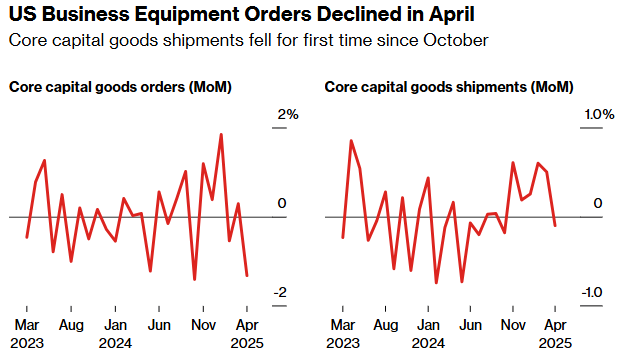
Core Insights - In April, U.S. factory orders for capital goods experienced the largest decline since October of the previous year, indicating a decrease in business investment sentiment amid uncertainties surrounding tariffs and tax policies [1][4] - Core capital goods orders fell by 1.3% month-over-month, while March was revised upward to a growth of 0.3% [1] - Durable goods orders overall decreased by 6.3%, primarily due to a reduction in commercial aircraft orders [4] Group 1: Capital Goods Orders - Core capital goods shipments, excluding defense and aircraft, saw a decline of 0.1%, marking the first decrease since October of the previous year [1] - The report highlights a cautious approach among businesses in assessing demand prospects, influenced by President Trump's trade policies and ongoing discussions in Congress regarding tax legislation [4] Group 2: Durable Goods and Economic Impact - Durable goods orders fell by 6.3%, which was better than the estimated decline of 7.8% [5] - Capital goods orders, excluding defense and aircraft, decreased by 1.3%, compared to an expected decline of 0.2% [5] - The Atlanta Fed's GDPNow forecast indicates that business equipment spending will contribute nearly 0.4 percentage points to U.S. economic growth in the second quarter [5] Group 3: Aircraft Orders - Commercial aircraft bookings saw a significant drop of 51.5% in April, with Boeing reporting only 8 orders, the lowest since May 2024 [6] - The previous month, March, had a much higher order count of 192, which was the highest since 2023 [6]