
美元弱势

Search documents
中东局势简评
Bank of China Securities· 2026-03-01 08:47
Geopolitical Impact - The recent escalation in the Middle East is expected to drive up oil and precious metal prices due to heightened geopolitical tensions[2] - The closure of the Strait of Hormuz, which accounts for approximately 20% of global oil transportation, poses significant risks to oil supply[4] Oil Price Projections - Brent crude oil prices are projected to exceed $80 per barrel as military actions disrupt Iranian production and shipping routes[7] - In extreme scenarios, oil prices may challenge the highs seen during the onset of the Russia-Ukraine conflict in March 2022[7] Precious Metals Outlook - Increased risk aversion from geopolitical developments is likely to push gold prices higher, although rising oil prices may complicate this trend by increasing U.S. inflation expectations[7] - The ability of gold to surpass previous highs remains uncertain and will depend on the interplay of inflation and interest rate expectations[7] Commodity Market Opportunities - The global fiscal and monetary easing, ongoing supply chain issues, and a weak U.S. dollar are expected to create favorable conditions for commodity investments in 2026[8] - Precious metals and non-ferrous metals are anticipated to maintain strong performance, while opportunities in oil and related chemicals are also noteworthy[16] Economic Context - Major economies, including China, the U.S., and Europe, are expected to continue fiscal expansion in 2026, which historically correlates with commodity price increases[8] - The U.S. dollar index fell over 9% in 2025, and its continued weakness in 2026 is expected to support dollar-denominated commodity prices[13]
人民币,会升破6.8吗?
Hua Er Jie Jian Wen· 2026-02-25 11:28
Core Viewpoint - The recent appreciation of the Renminbi (RMB) is primarily driven by the weakness of the US dollar, supported by the RMB's own fundamentals, with expectations for continued appreciation as long as the dollar's credit remains unhealed [1][4][21]. Group 1: RMB Exchange Rate Dynamics - The onshore RMB broke the 6.87 mark against the USD, reaching 6.8658, while the offshore RMB was at 6.8628, with daily gains exceeding 150 points [4]. - The appreciation is attributed to three main factors: stabilization of Sino-US trade relations, continued weakness of the USD boosting non-USD currencies, and concentrated demand for currency exchange from exporting companies [4][22]. - Financial institutions like Goldman Sachs and HSBC have set RMB targets at 6.70 and 6.85 respectively, indicating a potential undervaluation of around 22% [4][29]. Group 2: Underlying Economic Factors - The RMB's fundamentals are strong, with a projected current account surplus of 3.7% of GDP in 2025, expected to rise to 4.3% in 2026, supporting further appreciation [25][29]. - The RMB's exchange rate is considered deeply undervalued, with strong performance in exports contributing to its appreciation [25]. - The seasonal increase in currency exchange demand from exporters has accelerated the RMB's appreciation, with a notable surge in December 2025 [22]. Group 3: US Dollar Weakness and Its Implications - The core logic behind the RMB's appreciation is the weakening of the USD, driven by market distrust in US sovereign credit and long-term economic stability [11][21]. - The US dollar index is projected to decline by 9.4% in 2025, while the RMB appreciates only 4.3% against the dollar, indicating a relative strengthening of the RMB [7][11]. - The potential for the USD to stabilize in 2026 raises concerns about the sustainability of the RMB's appreciation momentum [4][21]. Group 4: Future Projections and Central Bank Interventions - Financial institutions predict that the RMB could reach levels around 6.8, contingent on continued high demand for currency exchange [27]. - The central bank is expected to intervene to prevent excessive unilateral appreciation of the RMB, maintaining a balance in export trade [29]. - The overall pressure on exports is manageable, with anticipated growth rates around 3.0% in 2026 despite potential appreciation [29].


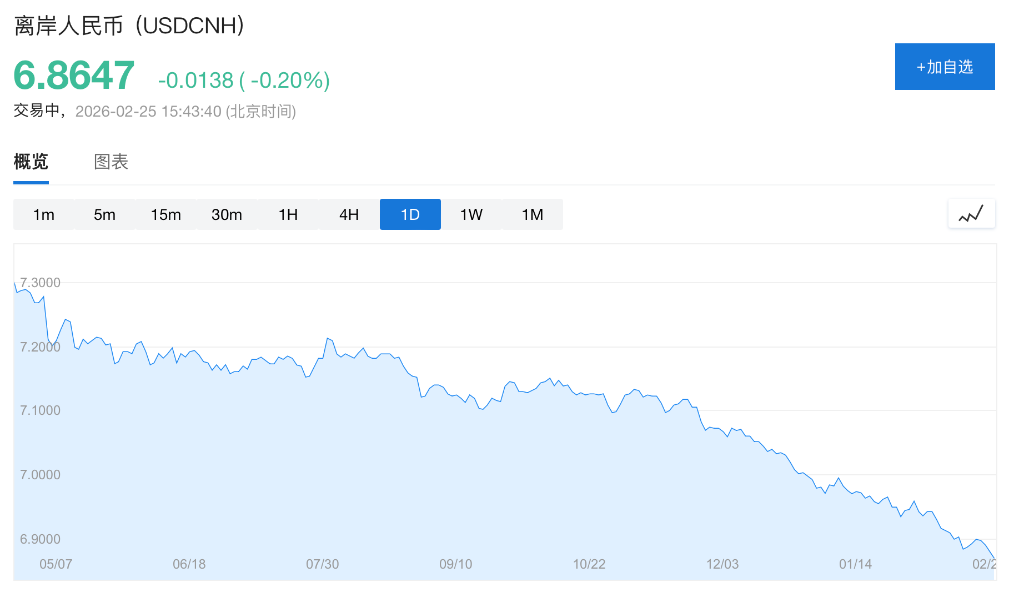
人民币汇率创34个月新高,在岸、离岸人民币双双升破6.87
Xin Lang Cai Jing· 2026-02-25 09:24
Core Viewpoint - The onshore and offshore RMB exchange rates against the US dollar have both surpassed the 6.87 mark, with the offshore RMB reaching a 34-month high, indicating a strong upward trend in the RMB's value [1][5][10]. Group 1: Exchange Rate Movements - As of February 25, the offshore RMB against the US dollar was reported at 6.8655, with a peak of 6.86179 during the day, marking an increase of 180 points from the previous trading day [1][6]. - The onshore RMB also broke the 6.87 threshold, peaking at 6.8622, appreciating over 200 points compared to the previous day [3][8]. - The RMB's midpoint against the US dollar was set at 6.9231, an increase of 93 basis points [9]. Group 2: Factors Influencing RMB Strength - The recent strengthening of the RMB is attributed to a combination of internal and external factors, including an improved external environment and a weakening US dollar [5][10]. - The stabilization of China-US trade relations since November 2025 has contributed to a more favorable external environment for the RMB [10]. - The weak US dollar, influenced by ongoing investigations into the Federal Reserve Chairman and the potential for a new chairman advocating for interest rate cuts, has created space for non-USD currencies to appreciate [5][10]. - Seasonal factors, such as concentrated corporate foreign exchange settlement demands and the traditional peak settlement period at year-end and early year, have also supported the RMB's appreciation [11].
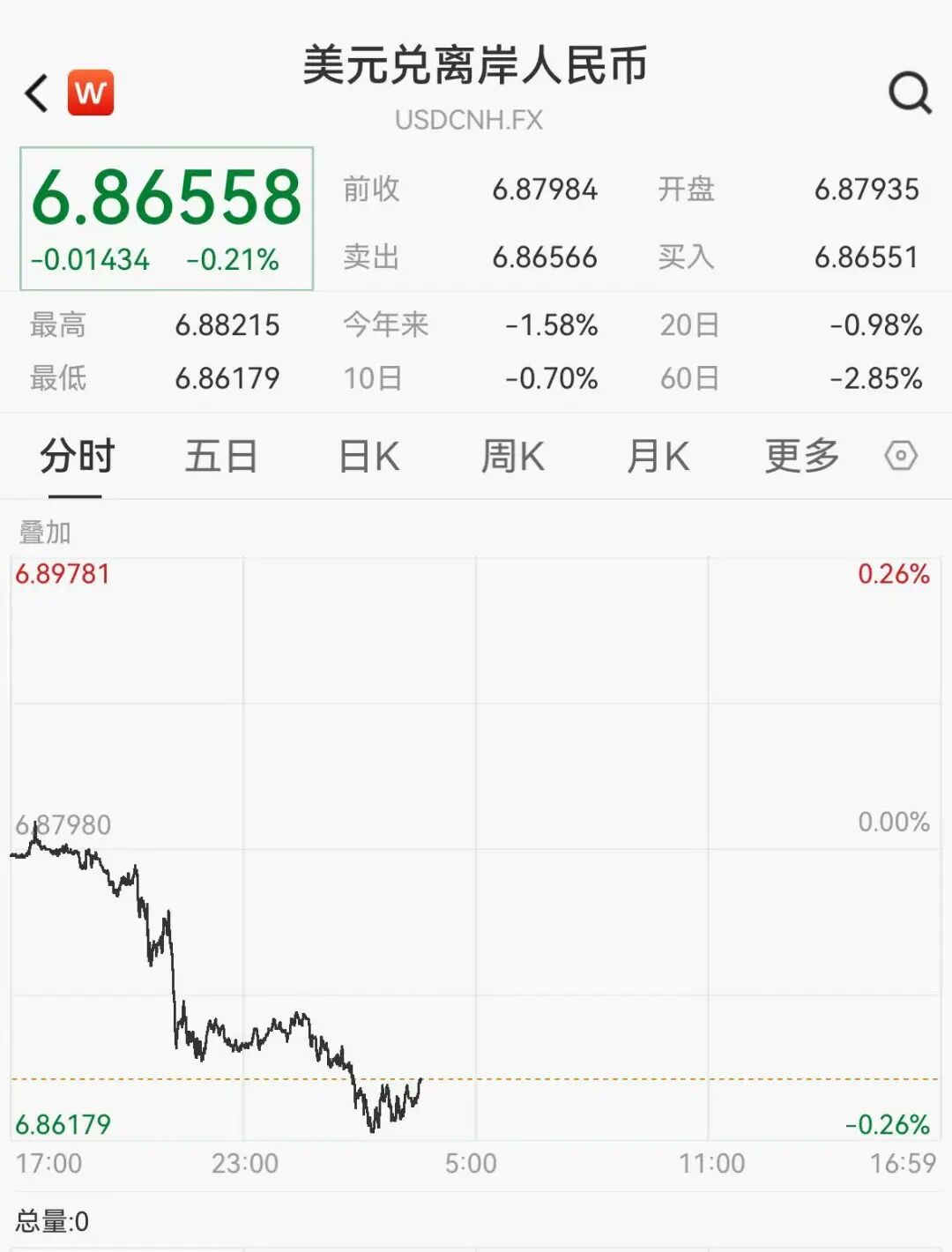
在岸、离岸人民币续创2023年4月以来升值高点
Sou Hu Cai Jing· 2026-02-24 13:52
Group 1 - The onshore RMB against the USD reached a new high, with the exchange rate peaking at 6.8804 on October 24, marking the highest level since April 28, 2023 [1] - The offshore RMB also saw a peak at 6.8760, indicating a shift from depreciation to appreciation [1] - The improvement in the external environment, particularly the stabilization of China-US trade relations since November 2025, is a significant factor contributing to the RMB's strength [1] Group 2 - The weakness of the USD has created space for non-USD currencies to appreciate, influenced by the ongoing criminal investigation into the Federal Reserve Chairman and the pressure on the dollar [1] - Seasonal demand for corporate foreign exchange settlements is also supporting the RMB's appreciation, as high export growth has led to increased settlement demand [1] - The sentiment in the foreign exchange market has been positive, with the offshore RMB leading the way, further boosting the RMB's strong performance [1][2]
飙升1100点!三重因素助推人民币走强,偏强状态将延续?
2 1 Shi Ji Jing Ji Bao Dao· 2026-02-24 11:16
Core Viewpoint - The offshore RMB has surged against the USD, reaching a high of 6.8760, with the onshore RMB also showing significant gains, indicating a strong performance of RMB assets in the market [1][2]. Group 1: Factors Driving RMB Strength - External environment improvement is a key background for the RMB's strength, with a stabilization in China-US trade relations since November 2025 [4]. - The weakness of the USD has opened up appreciation space for non-USD currencies, influenced by the ongoing investigation into the Federal Reserve Chairman and the proposed monetary policies [4]. - Seasonal support from concentrated corporate foreign exchange settlement demand is contributing to the RMB's appreciation, particularly during the traditional settlement peak at year-end and early year [4]. Group 2: Market Sentiment and Future Outlook - The recent strong performance of the offshore RMB has led to heightened market sentiment, which is a significant factor in the RMB's upward trend [5]. - The RMB is expected to maintain a strong position leading up to and following the Spring Festival, supported by continued export growth and high corporate settlement demand [6]. - However, there are concerns about potential depreciation pressures throughout the year, with expectations that the RMB will fluctuate around a central range of 7.0 to 7.2 against the USD in 2026 [6].

美元短期反弹难改长期弱势?借势布空或正当时!
Jin Shi Shu Ju· 2026-02-03 09:06
Group 1 - The core viewpoint of the articles indicates that despite a recent rebound attempt by the US dollar, its status as a safe-haven asset is not strengthening, particularly in the context of resilient economic performance and persistent inflation in the US [1][2]. - The Bloomberg Dollar Index recorded its largest two-day gain since April, driven by unexpectedly strong US factory data, which helped the dollar recover from a near four-year low reached last month, where it had declined approximately 1.3% [1]. - Jayati Bharadwaj from TD Securities predicts that the dollar will likely continue its recent rebound, with an expected increase of 2% in February, contrasting with the bearish sentiment that has suppressed the dollar's strength over the past month [1]. Group 2 - Bharadwaj suggests that all negative factors affecting the dollar will eventually manifest, recommending clients to take advantage of the dollar's rebound to establish short positions while going long on currencies like the euro, Australian dollar, British pound, and Swedish krona [2]. - Barclays Bank believes that the dollar's decline in January reflects ongoing weakness, as investor confidence in this global reserve currency has diminished to some extent [2]. - Analysts from Barclays note that the current dollar weakness occurs against a backdrop of significant resilience in the US economy, indicating a rise in risk pricing for the dollar and a growing skepticism about its reliability as a trade partner [2]. Group 3 - Concerns about potential disruptive changes in US trade policy persist, despite President Trump's announcement of a new trade agreement with India aimed at reducing tariffs on imports from India [3]. - DataTrek's Nicholas Colas highlights that the average decline of the dollar last month exceeded the monthly average for 2025, with the trend of dollar weakness against nearly all major currencies continuing into early 2026 [3].

美元沉沦,金银齐飞
Di Yi Cai Jing Zi Xun· 2026-01-26 03:17
Core Viewpoint - The recent surge in gold and silver prices is driven by heightened geopolitical tensions and economic uncertainties, prompting investors to seek safe-haven assets [2][3]. Group 1: Gold Market Insights - Gold futures for February delivery have risen over 2%, surpassing the $5,100 mark, while silver futures have increased by over 6%, reaching $108 per ounce, potentially marking the largest monthly gain in history [2]. - HSBC's latest report links the rise in gold and silver prices to geopolitical issues, with a weaker dollar further boosting the commodity market [4]. - Goldman Sachs has raised its gold price forecast for December 2026 from $4,900 to $5,400 per ounce, citing a persistent demand for hedging against macroeconomic risks [4][5]. - Central banks are purchasing gold at an average monthly rate of 60 tons, significantly higher than the pre-2022 average of 17 tons, indicating a shift towards gold assets in foreign reserves [5]. Group 2: Silver Market Dynamics - Silver futures have seen a remarkable increase, with prices rising over 50% this month, potentially achieving the best monthly performance since December 1979 [7]. - The current supply shortage in the silver market is a key factor driving prices higher, with analysts suggesting that the upward trend may still be in its early stages [6][7]. - The World Silver Association has indicated that 2025 will mark the fifth consecutive year of global silver supply shortages, enhancing silver's appeal as a more accessible alternative to gold [7]. - Analysts predict that silver prices could reach $120 per ounce by 2026, driven by ongoing geopolitical tensions and increased demand [7].


“非美投资趋势显著,中国股市更乐观,贵金属热潮将持续”
Xin Lang Cai Jing· 2026-01-22 03:17
Group 1: Market Trends and Investment Outlook - The global market is expected to see an expansion in participation, with many non-US economies' stock markets performing better than the US, a trend likely to continue this year [3][15] - The US market is perceived to be overvalued, and the high allocation of US stocks in many portfolios limits further investment in this area [3][15] - A downward trend in the US dollar is anticipated over the next few years, which will benefit non-US assets, particularly emerging market assets [3][15][16] Group 2: Focus on Non-US Markets - US investors are increasingly recognizing better returns from non-US markets, leading to a self-reinforcing cycle of capital flow towards these markets [4][16] - The investment outlook for China is optimistic, driven by a shift in market sentiment and potential government stimulus in manufacturing and infrastructure [5][17] - The Indian market is facing a comparative decline as investors shift focus back to China, which is expected to attract more international capital [5][17] Group 3: Federal Reserve Independence and Monetary Policy - The conflict between President Trump and the Federal Reserve has raised concerns about the independence of the Fed, although market reactions have been muted so far [6][18] - There is a possibility of aggressive rate cuts in the post-Powell era, which could lead to concerns about the Fed's independence and potential inflation risks [6][19][20] - The expectation is for the Fed to maintain its independence while potentially aligning more closely with the Trump administration's economic goals [20] Group 4: Precious Metals and Industrial Metals Outlook - Geopolitical risks and uncertainty in US policies have contributed to a strong performance in precious metals, with expectations for continued price increases in gold and silver [9][21] - The demand for industrial metals is expected to rise due to factors such as AI-related capital expenditures and stable supply conditions, creating a favorable environment for price increases [10][22] - The volatility of industrial metals may increase due to trade dynamics and tariffs, which have previously impacted prices [10][22]

瑞士经济韧性及美元弱势共振
Jin Tou Wang· 2025-12-26 02:32
Core Viewpoint - The Swiss Franc (CHF) is experiencing appreciation against the US Dollar (USD) due to diverging monetary policies between the Federal Reserve and the Swiss National Bank, alongside the CHF's safe-haven appeal and the resilience of the Swiss economy [1][2] Group 1: Monetary Policy Impact - The Federal Reserve has cut interest rates for the third time this year by 25 basis points to a range of 3.5%-3.75%, totaling a 75 basis point reduction, which diminishes the attractiveness of the USD [1] - The Swiss National Bank maintains its interest rate at 0%, with a high threshold for returning to negative rates, supporting the CHF [1] - The divergence in monetary policy, characterized by "Fed easing and Swiss stability," favors the CHF [1] Group 2: Economic Indicators - The Swiss economy shows resilience, with third-quarter GDP contraction offset by growth in manufacturing and services, and the central bank projects GDP growth slightly below 1.5% for 2025 [1] - The US third-quarter GDP exceeded expectations but failed to reverse the USD's weakness, with the USD index falling to a three-month low [1] Group 3: Market Sentiment and Technical Analysis - Increased global geopolitical and trade uncertainties are attracting funds into the CHF, although excessive appreciation could lead to deflation and impact exports [2] - Technical indicators show mixed signals, with RSI entering oversold territory suggesting a potential short-term rebound, while MACD remains bearish [2] - Institutions have differing views on future trends, with Standard Chartered suggesting a potential short-term rebound for the USD, while UBS expects continued weakness until mid-2026 [2] Group 4: Future Focus - Key future considerations include the pace of Federal Reserve rate cuts, signals from the Swiss National Bank, and global geopolitical risks [2] - Investors are advised to monitor Swiss inflation, Federal Reserve communications, and non-farm payroll data for risk management [2]
瑞郎承压走低政策分化主导走势
Jin Tou Wang· 2025-12-25 02:45
Core Viewpoint - The USD/CHF exchange rate continues to weaken, driven by the divergence in monetary policies between the Federal Reserve and the Swiss National Bank, alongside deflationary pressures in Switzerland and the broad weakness of the USD [1][2]. Group 1: Monetary Policy Divergence - The Federal Reserve has completed its third rate cut of 2025, lowering the federal funds rate target range by 25 basis points to 3.5%-3.75%, with a total reduction of 75 basis points for the year, diminishing the attractiveness of the USD [1]. - In contrast, the Swiss National Bank has maintained its policy rate at 0% for the second consecutive time, indicating a high threshold for returning to negative interest rates, which supports the CHF [2]. Group 2: Economic Indicators - Switzerland's economy shows resilience despite a contraction in GDP due to a decline in pharmaceutical exports, with moderate growth in manufacturing and services offsetting this decline [2]. - The signing of a trade agreement between the US and Switzerland has significantly reduced tariffs on Swiss goods from 39% to 15%, alleviating concerns about Swiss exports and providing additional support for the CHF [2]. Group 3: USD Performance - Despite a strong annualized GDP growth rate of 4.3% in the US for Q3, the USD remains broadly weak, with the USD index falling to a three-month low of 97.75 [3]. - The labor market's signs of weakness, highlighted by Fed Chair Powell, reinforce expectations for continued monetary easing, impacting the USD's performance [3]. Group 4: Technical Analysis - The technical indicators present mixed signals, with the RSI entering oversold territory at 22.79, suggesting potential for a short-term rebound, while the MACD indicates prevailing bearish momentum [3]. - The USD/CHF has broken below the key support level of 0.79, with short-term fluctuations expected between 0.79 and 0.80, and critical support at 0.7870 [3]. Group 5: Institutional Outlook - Institutions have differing views on the future of the USD/CHF exchange rate, with Standard Chartered suggesting a potential short-term technical rebound, while UBS Wealth Management emphasizes a long-term bearish trend for the USD [4].