
美元指数走弱

Search documents
美联储鹰派决议,铂钯?幅回调
Zhong Xin Qi Huo· 2026-03-20 01:49
Report Industry Investment Rating - Not provided Core Viewpoints - On March 19, 2026, the platinum and palladium futures prices on the Guangzhou Futures Exchange dropped significantly, with the platinum main contract down 7.66% to 506.95 yuan/gram and the palladium main contract down 8.18% to 371.45 yuan/gram [1] - The platinum price is expected to oscillate due to the high energy prices driving up inflation expectations in the US and delaying the Fed's rate - cut expectations [2] - The palladium price is also expected to oscillate as the short - term supply disturbances persist while the long - term supply - demand situation tends to ease, and it currently follows the overall fluctuations of the precious metals sector [3] Summary by Related Catalogs Platinum - **Main Logic**: The Fed's hawkish resolution led to a sharp decline in platinum prices. The March Fed meeting paused rate cuts as expected, and the dot - plot maintained the prediction of one rate cut in 2026. The Iran situation is the main trading line. On one hand, the risk - aversion sentiment supports precious metal prices; on the other hand, high oil prices increase inflation expectations, delay the Fed's rate - cut expectations, and may lead the US into a stagflation stage, suppressing prices. In the long run, the weakening of the US dollar index is beneficial for platinum valuation, but the current US - Iran geopolitical conflict still significantly affects market expectations and platinum prices [2] - **Outlook**: The platinum price is expected to oscillate [2] Palladium - **Main Logic**: There is continuous uncertainty on the supply side of palladium. The US imposed anti - dumping duties on Russian unforged palladium, and Europe is considering new sanctions on Russian palladium. On the demand side, palladium faces structural pressure. In general, the long - term supply - demand of palladium tends to ease, but short - term supply disturbances still exist, and it currently follows the overall fluctuations of the precious metals sector [3] - **Outlook**: The palladium price is expected to oscillate [3] Commodity Index - **Comprehensive Index**: The comprehensive index was 2569.19, down 0.50%; the commodity 20 index was 2885.41, down 1.06%; the industrial products index was 2567.44, up 0.39% [48] Non - ferrous Metals Index - **Performance**: On March 19, 2026, the non - ferrous metals index was 2616.34, with a daily decline of 2.17%, a 5 - day decline of 3.56%, a 1 - month decline of 2.91%, and a year - to - date decline of 2.59% [50]
美伊局势仍然严峻,铂钯震荡运
Zhong Xin Qi Huo· 2026-03-05 03:01
1. Report Industry Investment Rating - No relevant content provided 2. Core Views of the Report - On March 4, 2026, the platinum main contract on the Guangzhou Futures Exchange fell 4.55% to 563.50 yuan/gram, and the palladium main contract fell 2.78% to 433.80 yuan/gram [1] - The platinum price is expected to be volatile and bullish in the medium - to - long term due to fundamental resilience and the weakening of the US dollar's credit. The palladium price is also expected to be volatile and bullish in the medium - to - long term, with spot shortages and the weakening of the US dollar's credit [2][3] 3. Summary by Related Catalogs Platinum - **Price**: On March 4, 2026, the platinum main contract on the Guangzhou Futures Exchange fell 4.55% to 563.50 yuan/gram [1] - **Main Logic**: The tense situation in the Middle East, especially the situation in the Strait of Hormuz, has increased global energy transportation costs and oil prices. If the Strait of Hormuz is blocked for a long time, it may lead to global inflation, delayed Fed rate cuts, and increased economic recession risks. The short - term safe - haven sentiment supports the platinum price. In the long run, the damage to the Fed's independence and the loosening of the global political and economic order will weaken the US dollar index, which is beneficial to the release of platinum price elasticity [2] - **Outlook**: Volatile and bullish [2] Palladium - **Price**: On March 4, 2026, the palladium main contract on the Guangzhou Futures Exchange fell 2.78% to 433.80 yuan/gram [1] - **Main Logic**: There is continued uncertainty on the supply side. The US has imposed anti - dumping duties on Russian palladium, and Europe is considering new sanctions on Russian palladium. The supply disruption supports the price. On the demand side, palladium still faces structural pressure. In general, the long - term supply - demand of palladium tends to be loose, with short - term supply disruptions, and it mainly follows the overall fluctuations of the precious metals sector [3] - **Outlook**: Volatile and bullish [3] Commodity Index - **Comprehensive Index**: No specific data provided - **Special Index**: The commodity index was 2484.31, up 0.06%; the commodity 20 index was 2838.28, down 0.33%; the industrial products index was 2398.32, up 1.42% [50] Plate Index - **Non - ferrous Metals Index**: On March 4, 2026, the non - ferrous metals index was 2699.72. The daily decline was 0.64%, the decline in the past 5 days was 0.71%, the decline in the past month was 5.23%, and the increase since the beginning of the year was 0.51% [52]
杨德龙:人民币兑美元汇率稳步升值总体上看利大于弊 | 立方大家谈
Sou Hu Cai Jing· 2026-02-26 09:23
Core Viewpoint - The recent strengthening of the Renminbi (RMB) is attributed to multiple factors, including a weakening US dollar, improved China-US trade relations, and increased foreign investment confidence in Chinese assets [1][2][3]. Group 1: RMB Strengthening Factors - The RMB has appreciated significantly, with the onshore and offshore rates both surpassing 6.85, marking a new high since April 2023. Since February, the RMB has appreciated nearly 300 basis points against the US dollar [1]. - A primary reason for the RMB's strength is the weakening US dollar index, influenced by the Federal Reserve's ongoing interest rate cuts and potential future rate reductions under the new chair [1]. - Improved China-US trade relations and the implementation of domestic growth policies have bolstered global capital confidence in the Chinese economy, increasing demand for RMB assets [2]. Group 2: Impact on Investment and Market - The appreciation of the RMB reflects growing international capital confidence in the Chinese economy, particularly in sectors like robotics, semiconductors, and AI, which enhances the attractiveness of Chinese assets [3]. - The strengthening RMB is expected to attract more foreign investment into A-shares and Hong Kong stocks, positively impacting market performance. Historically, currency appreciation is associated with stronger stock market performance, providing positive support for the capital market [3]. - While the RMB's appreciation may pose challenges for export-oriented companies due to increased product prices, the overall sentiment remains that the benefits outweigh the drawbacks, suggesting a positive outlook for A-shares and Hong Kong stocks [3].
人民币走强的新格局
Sou Hu Cai Jing· 2026-02-26 04:29
Core Insights - The recent strength of the Renminbi (RMB) reflects a combination of robust domestic economic fundamentals, adjustments in the external monetary landscape, and improved supply-demand dynamics in the foreign exchange market, marking a new phase characterized by fundamental support, two-way fluctuations, policy backing, and functional upgrades [3][6][10] Exchange Rate Performance - The RMB has shown a clear upward trajectory, with the exchange rate against the US dollar breaking the 7.0 mark at the end of December 2025 and maintaining a strong performance in early 2026, reaching new highs since April 2023 [4][5] - After the Spring Festival, the RMB appreciated further, with the onshore rate hitting 6.8804 and the offshore rate reaching 6.8760, both marking significant increases [4][5] Supply-Demand Dynamics - The foreign exchange market has seen a continuous improvement in supply-demand relationships, with significant surpluses in bank customer foreign exchange settlements, indicating accelerated demand for currency conversion by enterprises [5][6] - As of January 2026, China's foreign exchange reserves stood at $3.3991 trillion, reflecting stability and supporting the RMB's strength [5] Internal Economic Support - The resilience of the domestic economy, with a GDP growth of 5.0% in 2025, provides a solid foundation for the RMB's stability, supported by a record trade surplus of over $1.076 trillion [7][17] - The shift in corporate behavior towards currency conversion has amplified the effects of trade surpluses, with banks reporting record high settlement volumes in January 2026 [7] External Factors - The weakening of the US dollar has created favorable conditions for the RMB's appreciation, driven by internal policy uncertainties and external economic factors [8][9] - Improvements in Sino-US trade relations have also contributed to a more stable external environment for the RMB [9] Policy Framework - The People's Bank of China has upgraded the policy framework for the RMB, emphasizing its role as a macroeconomic stabilizer and enhancing its management to prevent excessive fluctuations [10][13] - The new policy direction aims to foster a stable expectation for the RMB, moving away from a focus solely on preventing extreme fluctuations [10] Market Impact - The RMB's strength has led to a positive correlation among the stock, bond, and foreign exchange markets, enhancing the attractiveness of RMB-denominated assets globally [14] - The appreciation of the RMB is expected to boost asset values, particularly in sectors favored by foreign investment, such as consumption and advanced manufacturing [14] Long-term Trends - The RMB's appreciation is seen as a reflection of China's high-quality economic development and the ongoing internationalization of the currency, with expectations for continued long-term appreciation [15][17] - The RMB is transitioning from a trade currency to an investment and reserve currency, indicating a significant shift in its role within the global monetary system [17][18]

马年大类资产配置的三大方向|策马点金
Qi Huo Ri Bao· 2026-02-16 00:37
Group 1 - The core logic for asset allocation in 2026 is the synchronized resonance of the economic and policy cycles between China and the United States, providing support for risk assets [2][3] - China's "loose fiscal + loose monetary" policy combined with the U.S. dual easing of fiscal and monetary policy creates a favorable environment for global financial stability, enhancing risk appetite [2][3] - The U.S. is expected to lower interest rates 2-3 times this year, totaling 50-75 basis points, which will contribute to a downward trend in the U.S. dollar index, benefiting non-U.S. assets, particularly Chinese assets [2][3] Group 2 - The weakening of the U.S. dollar index is projected to create a favorable environment for the appreciation of the Chinese yuan, supported by China's systemic and industrial advantages [3] - The demand for industrial products such as non-ferrous metals and chemicals is expected to surge due to AI infrastructure and new energy, while supply remains constrained due to past capital expenditure shortages [3] - The A-share market is anticipated to exhibit a "structural slow bull" trend, driven by a favorable macro environment and the transition from "old economy" to "new economy" sectors [3][4] Group 3 - The absolute upside potential of stock indices remains uncertain, with more returns expected from alpha generation through selective investment rather than simple index betting [4] - Futures can serve as both a risk management tool and a means for value appreciation, allowing investors to hedge risks and optimize existing assets [4][5] - Utilizing futures can enhance cash flow and improve portfolio returns by taking advantage of the low correlation between commodities and traditional financial assets [5]
杨华曌:美元指数持续走弱 多重因素共同作用的结果
Xin Lang Cai Jing· 2026-01-29 15:37
Core Viewpoint - The US dollar index is experiencing significant weakness, with a notable downtrend and a breach of key support levels, indicating a broader asset reallocation in the forex market away from dollar assets towards currencies and asset classes with higher relative attractiveness [1][5]. Group 1: Dollar Index Performance - The dollar index was around 96.00 during the European session, showing a pronounced downtrend after previously reaching a high of 100.3900 [1][5]. - The index briefly rebounded to 99.4940 earlier this year but failed to maintain strength, subsequently accelerating its decline [1][5]. - Key support at 97.00 was effectively breached, with the index dipping to a low of 95.5660 before a slight recovery to around 96 [1][5]. Group 2: Currency Movements - The euro gained 0.3% against the dollar, reaching 1.1990, approaching the psychological level of 1.2000 [1][5]. - The dollar fell 0.4% against the Swiss franc, trading at 0.7650, while the Australian dollar surged 0.7% to 0.7090, nearing a two-year high [1][5]. - These movements reflect a widespread reallocation of assets in the forex market, driven by a reassessment of the long-term pricing logic of the dollar [1][5]. Group 3: Precious Metals Impact - Gold surged 2.5% on the day and has risen over 11% for the week, with prices around $5,550, nearing the $5,600 mark [2][6]. - Silver also strengthened, surpassing $120 and reaching new highs, indicating increased demand for hedging against inflation and geopolitical uncertainties [2][6]. - The rise in precious metals typically suggests a decline in real interest rate expectations or an increase in risk aversion, both of which diminish the dollar's attractiveness [2][6]. Group 4: Economic and Policy Factors - The decline of the dollar is attributed to multiple factors, including fluctuating trade policies and tariffs, which create instability in economic growth and interest rate expectations [2][7]. - Geopolitical uncertainties have raised risk premiums but have not translated into a unilateral benefit for the dollar, leading to a diversified investment approach favoring currencies like the euro and Australian dollar [2][7]. - Discussions around the independence of the Federal Reserve's monetary policy are gaining traction, affecting market confidence in long-term inflation and interest rate frameworks [3][7].
投机客蜂拥而入,伦铜突破14000美元创历史新高
Wen Hua Cai Jing· 2026-01-29 12:38
Group 1 - Copper prices surged to a historic high of over $14,000 per ton on the London Metal Exchange (LME), driven by strong demand expectations and speculative buying, alongside a weak dollar and geopolitical concerns [1][2] - Speculators are ignoring warnings from analysts about high prices potentially suppressing physical demand from industrial consumers, as well as the current supply-demand fundamentals not supporting such prices [2] - The three-month LME copper price increased by 6.3% to $13,911.50 per ton, with an intraday peak of $14,125, marking the largest single-day increase in years, driven by aggressive speculative trading [2] Group 2 - In China, copper prices closed at 109,110 yuan per ton, up 6.7% from the previous trading day, with an intraday high of 110,970 yuan [3] - Despite weak physical demand, copper prices rose, influenced by a surge in investment in physical assets and geopolitical tensions that have also pushed gold and silver to historic highs [3] - The dollar index's decline supports metal prices, making dollar-denominated commodities more attractive to buyers using other currencies [3] Group 3 - Other base metals also saw price increases, with three-month LME aluminum rising by 1.5% to $3,306 per ton, zinc up 3.83% to $3,493 per ton, lead up 1.36% to $2,044.5 per ton, nickel up 3.78% to $18,960 per ton, and tin up 1.10% to $56,570 per ton [3]
5300美元!金价再创新高,公募主动“降温”
Xin Lang Cai Jing· 2026-01-28 14:28
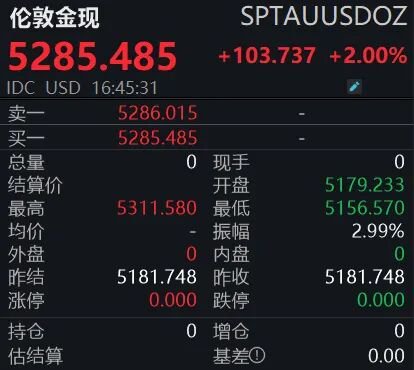
Core Viewpoint - The international gold market is experiencing a significant surge, with prices breaking through the $5,300 per ounce mark, driven by structural factors such as expanding U.S. fiscal debt, a weakening dollar, geopolitical uncertainties, and continued central bank purchases of gold [1][15]. Price Movement - On January 28, international gold prices reached new historical highs, with London gold first breaking the $5,200 per ounce mark and then surpassing $5,300 per ounce, closing at $5,285.485 per ounce, a daily increase of 2% [2][15]. - COMEX gold futures also saw a substantial rise, increasing by 4.38% to $5,305.3 per ounce, with intraday highs reaching $5,306 [4][17]. Domestic Market Impact - The rise in gold prices has led to significant increases in domestic gold jewelry prices, with some brands exceeding 1,620 yuan per gram [5][18]. - The surge in gold prices has prompted public funds to implement risk control measures, with E Fund's gold-themed LOF suspending subscriptions to cool the market [5][18]. Factors Supporting Gold Prices - The rapid increase in gold prices since the beginning of 2026 has been attributed to multiple factors, including heightened geopolitical risks, rising safe-haven demand, a weakening dollar index, and ongoing central bank gold purchases [9][22]. - As of January 28, gold prices have risen over 20% since the start of the year, from approximately $4,330 per ounce to above $5,300 per ounce, reflecting a nearly $1,000 increase in less than a month [9][22]. Future Outlook - Analysts believe that the upward trend in gold prices is likely to continue, with potential challenges around short-term volatility. The price may test the $5,500 per ounce level in the near term [11][24]. - Structural factors supporting gold prices, such as U.S. fiscal debt expansion and geopolitical uncertainties, remain unchanged, leading several institutions to raise their gold price targets [11][24]. - Investors are advised to approach gold investments cautiously, considering their risk tolerance and market conditions, while avoiding chasing high prices [11][24].
人民币升破7.0,赴美留学真迎来“打折季”?背后还有这些关键变化
Sou Hu Cai Jing· 2026-01-26 03:06
Core Insights - The offshore RMB has broken the 7.0 mark against the USD for the first time since September 2024, leading to a decrease in study abroad costs for Chinese families [1] - The RMB has appreciated approximately 6% since April 2025, resulting in significant savings for families planning to exchange USD for tuition and living expenses [1] - The weakening of the USD, primarily due to Federal Reserve interest rate cuts and an increase in China's trade surplus, has supported the RMB's strength [1] Exchange Rate Impact - The cost of exchanging 50,000 USD has decreased from 365,000 RMB at the beginning of the year to less than 350,000 RMB, effectively providing a "tuition discount" [1] - This reduction in costs could allow middle-class families to save several months' worth of income [1] Visa Policy Changes - The uncertainty surrounding U.S. visa policies has increased, with a comprehensive social media review introduced for applicants, impacting those with sensitive professional backgrounds [2] - The number of Chinese students in the U.S. for the 2024/25 academic year has decreased to 266,000, a 4.1% decline year-on-year [2] Trends in University Admissions - Despite the overall decline in international students, the number of Chinese students admitted to top-tier universities has increased, with R1 institutions seeing a rise to 30.1% of their student body [2] - Policies such as Shanghai's direct residency for graduates from top 50 global universities are driving this trend [2] Global Study Destination Shifts - The UK has surpassed the U.S. as a preferred study destination, capturing 19% of global study intentions compared to the U.S.'s 13%, particularly in master's programs where the UK holds a 24% share [2] - There is a growing trend towards practical fields of study, with data science, environmental sustainability, and healthcare becoming increasingly popular [2] Conclusion - Exchange rate fluctuations are just one factor in study abroad decisions; families are encouraged to weigh educational quality, policy risks, and personal development paths [3]
现货金回落震荡调整 美债隐忧与央行购金支撑长期走势
Jin Tou Wang· 2026-01-08 06:02
Group 1 - The current spot gold price is 994.30 yuan per gram, down by 6.67 USD or 0.69% from the previous trading day, with a trading range between 993.37 and 1003.35 yuan per gram [1] - Since 2025, the US dollar index has been weakening primarily due to the increasing scale of US debt, which has raised concerns about US debt credit and prompted central banks to increase their gold reserves since 2022, contributing to the rise in gold prices [1] Group 2 - According to the World Gold Council, global gold stock has increased by approximately 1.5 times since 1964 due to advancements in mining technology, with central banks ideally holding 50% of global gold stock, but currently holding only about 17.5% [2] - By the end of 2025, China's central bank's gold reserves are projected to be approximately 0.74 million ounces, accounting for 6.3% of total global central bank reserves, which is significantly lower than Russia's 1.1% [2] Group 3 - Gold prices faced a decline after failing to break the 4500 USD mark, with a minimum drop to around 4423 USD, indicating a correction after earlier gains [3] - The market is expected to maintain a range-bound trading strategy, with potential buying opportunities if prices dip to the 4410-4390 USD range, while a break above 4465-4475 USD could lead to targets of 4500-4600 USD [3]