
人民币走强

Search documents
李大霄:人民币走强是重要变量
Xin Lang Cai Jing· 2026-02-26 08:09
Group 1 - The article emphasizes the importance of using authoritative and professional analyst reports for stock trading, highlighting their role in identifying potential investment opportunities [1][1][1]
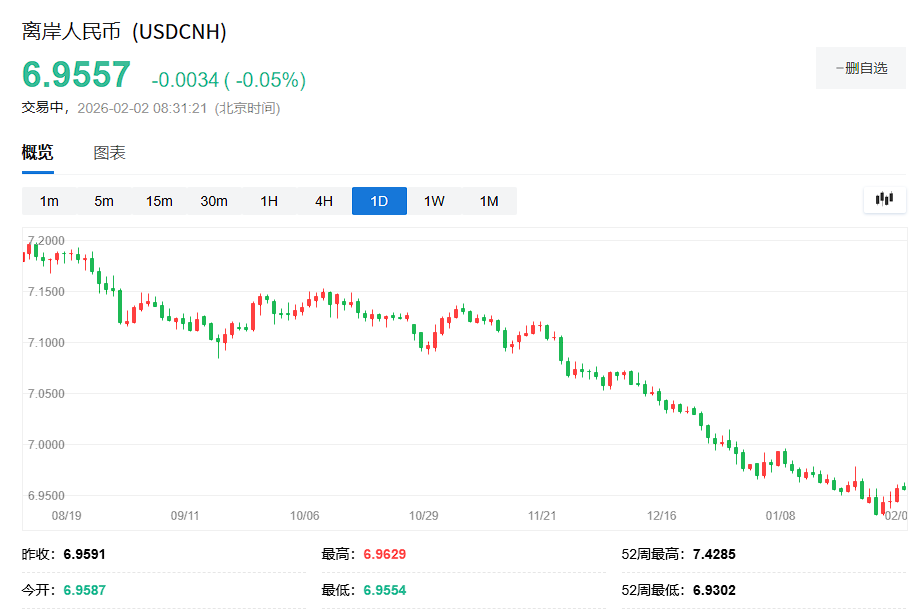
飙升1100点!三重因素助推人民币走强,偏强状态将延续?
2 1 Shi Ji Jing Ji Bao Dao· 2026-02-24 11:16
Core Viewpoint - The offshore RMB has surged against the USD, reaching a high of 6.8760, with the onshore RMB also showing significant gains, indicating a strong performance of RMB assets in the market [1][2]. Group 1: Factors Driving RMB Strength - External environment improvement is a key background for the RMB's strength, with a stabilization in China-US trade relations since November 2025 [4]. - The weakness of the USD has opened up appreciation space for non-USD currencies, influenced by the ongoing investigation into the Federal Reserve Chairman and the proposed monetary policies [4]. - Seasonal support from concentrated corporate foreign exchange settlement demand is contributing to the RMB's appreciation, particularly during the traditional settlement peak at year-end and early year [4]. Group 2: Market Sentiment and Future Outlook - The recent strong performance of the offshore RMB has led to heightened market sentiment, which is a significant factor in the RMB's upward trend [5]. - The RMB is expected to maintain a strong position leading up to and following the Spring Festival, supported by continued export growth and high corporate settlement demand [6]. - However, there are concerns about potential depreciation pressures throughout the year, with expectations that the RMB will fluctuate around a central range of 7.0 to 7.2 against the USD in 2026 [6].


海外游客激增40%!“中国入境游”火爆,或推动人民币继续走强
Hua Er Jie Jian Wen· 2026-02-02 00:54
Core Insights - The strong recovery of inbound tourism in China is exerting upward pressure on the Renminbi exchange rate [1][4] - Major tourist destinations in China saw a significant increase in overseas visitors, with a reported 40% surge, leading to double-digit growth in tourism-related capital inflows [1] - The People's Bank of China is managing the appreciation of the Renminbi to avoid excessive volatility in the market [4] Group 1: Inbound Tourism Impact - Inbound tourism generated a record capital inflow of $38.2 billion in the first three quarters of 2025 [1] - Beijing received foreign tourist spending of a record 50.6 billion RMB ($7.3 billion) in 2025, a 45% year-on-year increase [5] - Guangdong province welcomed over 90 million tourists, with spending exceeding 200 billion RMB, marking a 54% increase from 2024 [5] Group 2: Economic and Policy Implications - The tourism spending is recorded as service trade in China's current account, directly increasing demand for the Renminbi [6] - The Chinese government is optimizing tax refund policies and has included several countries in a visa-free list to boost inbound tourism [6] - Future growth in the tourism sector is projected at an annual rate of 7%, potentially contributing $3.8 trillion to GDP by 2035 [7]
21评论丨2026年A股有望在震荡中继续上扬
2 1 Shi Ji Jing Ji Bao Dao· 2026-01-04 23:10
Group 1: A-Share Market Performance - The A-share market demonstrated resilience, with the Shanghai Composite Index surpassing 4000 points in Q4, marking a nearly ten-year high and an annual increase of over 30% [1] - A-shares are expected to continue their upward trend in 2026, supported by policy dividends and improvements in both internal and external environments [1] Group 2: Global Liquidity and Currency Trends - The reopening of the Federal Reserve's interest rate cut cycle has led to marginal improvements in the global liquidity environment, with the US dollar index weakening significantly [2] - The RMB has shown a temporary strengthening trend, with the USD/RMB exchange rate breaking the 7.0 mark by year-end, reflecting recognition of China's economic resilience [2] - The combination of a weaker dollar and a stronger RMB enhances the relative attractiveness of Chinese assets, making A-shares more appealing to overseas investors [2] Group 3: Domestic Economic Policies and Demand - Fiscal policies aimed at expanding effective investment and moderately loose monetary policies are gradually strengthening domestic demand [3] - The overall inflation level in 2025 is showing a low recovery trend, with core CPI growth maintaining above 1% since September 2025, indicating improvements in domestic supply and demand structures [3] - These macroeconomic policies are expected to support a clearer recovery cycle for corporate profits in 2026, providing a fundamental backing for the A-share market [3] Group 4: Capital Market Dynamics - As the real estate market adjusts and risk-free interest rates decline, household funds are shifting towards equity assets with greater appreciation potential [4] - Continuous deepening of capital market reforms and improved investor protection mechanisms are accelerating this transition, leading to a stable and sustained influx of new funds into the A-share market [4] - Institutional investors are increasingly willing to allocate funds to equity assets, enhancing market effectiveness and stability [4] Group 5: Technological Advancements and Investment Opportunities - Continuous improvements in domestic technology levels are expected to create new investment themes and provide upward momentum for the A-share market [5] - Significant progress in fields such as AI, semiconductors, high-end manufacturing, and aerospace is injecting new vitality into economic development and offering fresh investment opportunities [5] - Technological innovation is becoming the core driving force for structural trends in the A-share market, expected to dominate market styles and capital flows in 2026 [5]
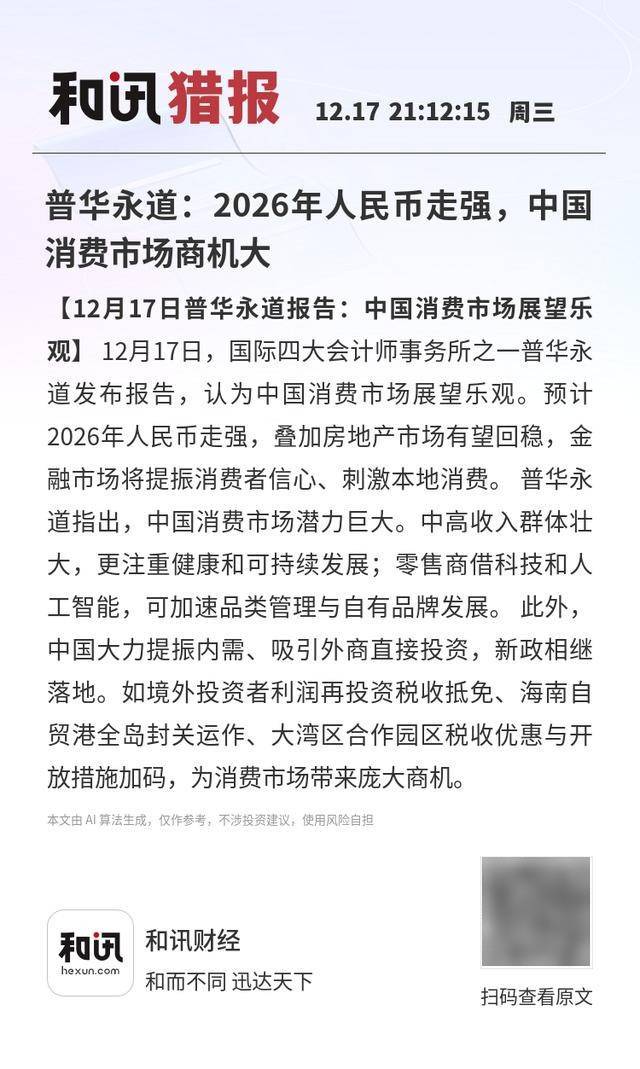
普华永道:2026年人民币走强,中国消费市场商机大
Sou Hu Cai Jing· 2025-12-17 14:04
Group 1 - The core viewpoint of the report is that the outlook for China's consumer market is optimistic, with expectations of a stronger RMB by 2026 and a stabilization in the real estate market, which will boost consumer confidence and stimulate local consumption [1] - PwC highlights the significant potential of the Chinese consumer market, driven by the growth of the middle and high-income groups who are increasingly focused on health and sustainability [1] - Retailers are leveraging technology and artificial intelligence to accelerate category management and the development of private labels, enhancing their competitive edge in the market [1] Group 2 - The Chinese government is actively promoting domestic demand and attracting foreign direct investment, with new policies being implemented to create substantial business opportunities in the consumer market [1] - Specific measures include tax incentives for reinvestment of profits by foreign investors, the full operation of the Hainan Free Trade Port, and enhanced tax benefits and open measures in the Greater Bay Area cooperation zones [1]
报告:中国消费市场展望乐观,中高收入群体扩大成核心驱动力
Zhong Guo Xin Wen Wang· 2025-12-17 10:24
Group 1 - The core viewpoint of the reports is an optimistic outlook for the Chinese consumer market, driven by the expansion of the middle and high-income groups [1] - The first key factor positively impacting the Chinese consumer market is the increase in middle and high-income households, with an estimated 64 million households expected to have a disposable income exceeding $25,000 by 2024, nearly doubling by 2029 [1] - In 2024, there will be 26.8 million households (equivalent to 77 million people) with an annual income exceeding $35,000, presenting significant opportunities for high-end and luxury brand operators [1] Group 2 - The second key factor is the rapid expansion of international and domestic leading grocery retailers, indicating strong consumer confidence in the Chinese market [1] - The third key factor highlights that Chinese consumers surpass global counterparts in acceptance of health, sustainability, and international products, creating opportunities for new categories and products [1] - The fourth factor indicates that the financial market anticipates the Chinese yuan will strengthen by 2026, which, along with a stabilized real estate market, will boost consumer confidence and stimulate local consumption [2]

人民币兑美元为何走强?用轻松方式讲透十二月六日汇率逻辑
Sou Hu Cai Jing· 2025-12-06 21:20
Core Viewpoint - The article explains the fluctuations in the RMB to USD exchange rate, emphasizing that these changes are influenced by various economic factors rather than random occurrences. Group 1: Factors Influencing RMB Strength - The stability of the domestic economy is a key factor, with signs of recovery in manufacturing and consumption contributing to a stronger RMB [4]. - The easing environment in the U.S. also plays a role, as expectations of interest rate cuts can enhance the comparative strength of the RMB [4]. - The direction of capital flows is crucial; an influx of foreign investment into the domestic market can bolster the RMB's value [4]. Group 2: Observations on Exchange Rate Trends - The RMB's performance over the past year has shown variability, with periods of gradual increase and sudden spikes, resembling a runner's pace [6]. - The outlook suggests a "steady but not frantic" approach, with the RMB likely to fluctuate around the 7.0 mark in the short term, influenced by domestic stability and external uncertainties [6]. - Long-term trends are expected to be non-linear, with gradual progress rather than sharp movements, indicating a cautious but optimistic outlook for the RMB [6]. Group 3: Public Perception and Practical Advice - For the general public, the exchange rate should be viewed as an economic signal rather than a daily concern, especially for those not involved in foreign trade or cross-border investments [8]. - Individuals are advised to consider exchange rate ranges for currency conversion rather than reacting to daily fluctuations, focusing on overall trends instead [8].
和讯投顾郑镇华:消息均为利好,4000点后如何走?
Sou Hu Cai Jing· 2025-10-30 01:46
Core Viewpoint - The recent announcements from the Federal Reserve and the launch of a strategic fund by state-owned enterprises are expected to positively impact the A-share and Hong Kong markets, leading to a revaluation of Chinese assets and a strengthening of the Renminbi [1] Group 1: Federal Reserve Announcement - The Federal Reserve has cut interest rates by 25 basis points and will cease balance sheet reduction starting December 1 [1] - This decision is anticipated to have a strong influence on the A-share and Hong Kong markets, particularly in terms of asset revaluation [1] Group 2: Strategic Fund Launch - The state-owned enterprise strategic emerging industry fund has been initiated with an initial scale of 51 billion [1] - This fund is expected to have a long-term positive impact on the sectors outlined in its planning, although the effects will not be immediate [1] Group 3: Market Outlook - Overall, the three major announcements are viewed as favorable for the market, but there are concerns about insufficient trading volume as the index approaches 4000 points [1] - Investors are advised to adopt a cautious approach and avoid aggressive trading strategies in the short term [1]
市场早间震荡调整,中证A500指数下跌0.47%,3只中证A500相关ETF成交额超29亿元
Sou Hu Cai Jing· 2025-09-26 05:27
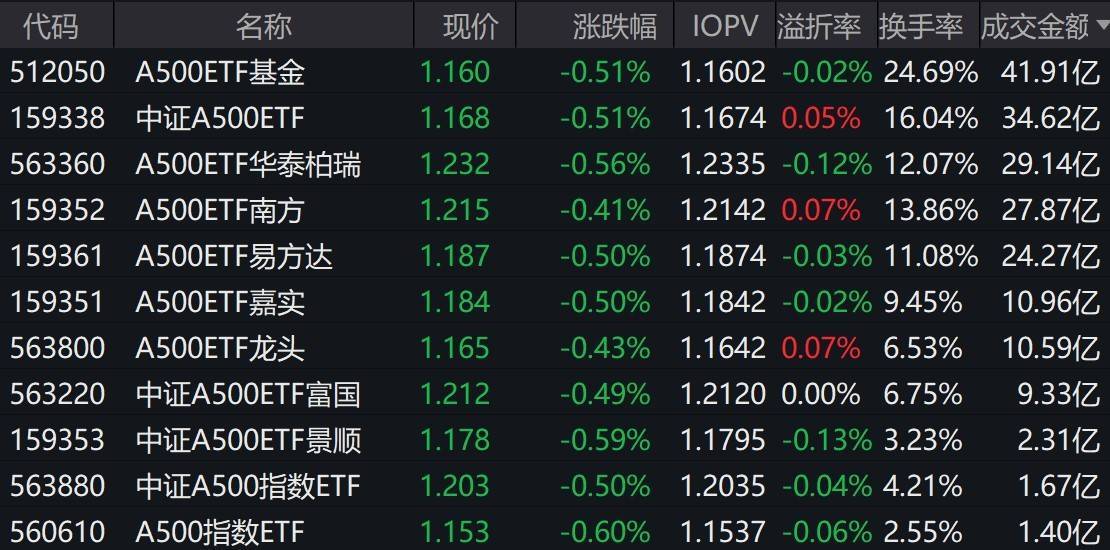
Market Overview - The market experienced fluctuations in the morning, with the ChiNext Index falling over 1% and the CSI A500 Index down by 0.47% [1] - Wind power concept stocks showed collective strength, while the semiconductor industry chain saw a partial recovery, and the automotive sector performed actively [1] - Conversely, gaming stocks collectively declined [1] ETF Performance - As of the morning close, ETFs tracking the CSI A500 Index saw slight declines, with 11 related ETFs having transaction amounts exceeding 100 million yuan, and 3 surpassing 2.9 billion yuan [1] - Specific transaction amounts for major ETFs included: A500 ETF Fund at 4.191 billion yuan, CSI A500 ETF at 3.462 billion yuan, and A500 ETF Huatai-PB at 2.914 billion yuan [1][2] Market Sentiment - Some brokerages indicated that a potential interest rate cut by the Federal Reserve could benefit A-shares, with expectations for the renminbi to strengthen, potentially improving market risk appetite [1] - The market is expected to maintain a steady upward trend in the short term, with close attention needed on policy, capital flow, and external market changes [1]
瑞银房东明:A股市场静待花开!
Zhong Guo Ji Jin Bao· 2025-09-04 08:16
Group 1 - The core viewpoint is that overseas long-term capital is increasingly interested in the Chinese market, particularly in A-shares, as indicated by the significant rise in participation from international investors at the UBS seminar [1] - The current liquidity environment, driven by global interest rate cuts and low domestic rates, is favorable for capital inflow into the Chinese stock market, with expectations for A-shares to maintain an upward trend due to supportive policies and improving external conditions [2] - The proportion of foreign investment in A-shares is currently only 7.4%, which is significantly lower than the 10% to 50% range seen in other Asian countries, indicating substantial room for growth in foreign allocation to Chinese assets [2] Group 2 - Foreign investors are particularly cautious and require tangible improvements in company fundamentals before making large-scale investments in China, with a focus on three main areas: geopolitical issues, economic and corporate fundamentals, and policy implementation [3] - Key sectors attracting foreign interest include the AI industry chain, biomedicine, new consumption, as well as established sectors like new energy vehicles and renewable energy [3] - Traditional companies are increasingly willing to invest in AI to enhance efficiency, which has positively impacted the stock performance of leading internet firms in AI research and application [3] Group 3 - The RMB is expected to strengthen due to the uncertainties brought by previous U.S. tariffs and the anticipated new round of interest rate cuts by the Federal Reserve, leading to a potential weakening of the USD and a natural strengthening of the RMB [4]