低轨星座组网

Search documents
商业航天全景产业链图谱:结构解构、价值分布与生态趋势
材料汇· 2026-01-28 16:00
Core Viewpoint - The article provides a comprehensive analysis of the commercial aerospace industry, focusing on the value chain, key segments, and investment opportunities within the sector [3][4]. Group 1: Industry Structure and Value Distribution - The commercial aerospace industry is characterized as technology and capital-intensive, aiming to utilize and monetize space resources through market mechanisms [3]. - The value chain can be dissected into four core segments, with ground equipment manufacturing and satellite operation services accounting for approximately 92% of the total satellite industry scale [8]. - Upstream satellite manufacturing and launch services, while representing only about 9% of the value, are crucial due to their high technical barriers and are currently hotspots for capital investment [8]. Group 2: Upstream Manufacturing - Satellite manufacturing is identified as the foundational segment of the industry, with a focus on high technology and value creation [13]. - The value distribution in satellite manufacturing shows that payloads account for about 50% of costs, with antenna subsystems representing 53% of the value in mass-produced communication satellites [16][17]. - The satellite platform also constitutes about 50% of costs, with the attitude control system being a key component [18]. - Major players in satellite manufacturing include state-owned enterprises like China Aerospace Science and Technology Corporation and private companies like Galaxy Space [19]. Group 3: Rocket Manufacturing - Rocket manufacturing is described as the only channel for large-scale deployment and a significant cost bottleneck [20]. - The propulsion system constitutes 70% of the total cost of liquid rockets, making it a critical area for cost management [21]. - Technologies such as "one rocket multiple satellites" and reusable rocket technology are pivotal for reducing launch costs [23]. - The competitive landscape includes both state-owned enterprises and emerging private companies focused on innovation in reusability [24]. Group 4: Ground Equipment and Operations - Ground equipment manufacturing is the largest revenue contributor in the satellite industry, accounting for approximately 51.6% of total revenue [31]. - Consumer devices, particularly satellite navigation equipment, dominate the ground equipment market, with a projected value of $111.9 billion [32]. - The operational segment, which includes satellite operation management and data services, is crucial for value realization, contributing about 40.3% of the industry's value [36][38]. Group 5: Investment Trends and Future Outlook - The investment focus is currently on upstream segments, particularly satellite manufacturing and reusable rocket launches driven by low Earth orbit constellation demands [41]. - As constellations are established, the industry value is expected to shift towards ground terminals and diversified downstream applications, particularly in consumer satellite internet [41].



商业航天行业深度系列(一):以第一性原理推演中国商业航天降本革命
Shanghai Aijian Securities· 2026-01-21 10:19
Investment Rating - The report rates the industry as "stronger than the market" [1] Core Insights - The report concludes that 2026 will mark a turning point for China's commercial aerospace industry, with a shift from state-driven missions to market-driven profitability, driven by the deployment of low-orbit satellite constellations and advancements in reusable rocket technology [1][6] - The commercial rocket launch service market in China is projected to grow from 10.26 billion yuan in 2025 to 47.39 billion yuan by 2030, with a CAGR of approximately 35.8% [1][12] - The report emphasizes that the core components of rocket launch services are engines (54%) and structural components (24%), which together account for 78% of the value in the launch service segment [1][12] Summary by Sections Industry Overview - The commercial aerospace industry is defined as activities that provide aerospace products and services through social capital investment under national policy guidance, including the R&D, manufacturing, launch, and operation of spacecraft and rockets [6][7] - The global aerospace economy is expected to reach $612 billion by 2024, with commercial aerospace revenues accounting for approximately $480 billion, representing about 78% of the total [6][7] Market Dynamics - The demand for satellite launches is expected to surge as China enters a concentrated deployment phase for low-orbit satellite constellations, with over 200,000 satellites planned for deployment [18][19] - The report highlights that the competition for low-orbit frequency resources is intensifying, necessitating faster deployment of satellite constellations [19][21] Cost Structure and Efficiency - The report breaks down the cost structure of rockets, indicating that engines and structural components dominate the value chain [1][12] - It outlines a pathway for reducing launch costs, projecting that the unit cost of launching payloads could decrease significantly as technology advances [1][12] Investment Recommendations - The report suggests focusing on companies involved in key segments such as propulsion systems, satellite communication systems, materials and structural components, and testing and validation services [2][4] - Specific companies to watch include 应流股份 (603308), 斯瑞新材 (688102), and 上海瀚讯 (300762), among others [2][4]


2026年商业航天“开门红”:从技术攻坚到商业闭环的奇点时刻
Zhong Guo Jing Ying Bao· 2026-01-17 11:00
Group 1 - The core viewpoint of the articles highlights the acceleration of China's private commercial space industry, transitioning from a technology validation phase to a stage of large-scale commercial deployment, driven by both national strategy and market forces [1][3][7] - The successful launch of the "Vesta-1" rocket by Beijing Xinghe Power Aerospace Technology Co., Ltd. marks the first private commercial space mission in 2026, with multiple private rocket companies announcing their annual launch plans [1][2] - The capital market is actively engaging with the commercial space sector, as evidenced by the updated IPO guidance status of Zhongke Aerospace, indicating a growing interest in the industry [2][3] Group 2 - The industry is moving from "self-driven exploration" to "systematic national guidance," with significant funding and support from the government addressing long-standing capital sourcing and exit issues [3][4] - The focus is shifting towards practical metrics such as launch costs, order visibility, and recovery validation data, reflecting a more cautious investment approach [3][4] - The urgency of strategic timelines is underscored by China's application to the International Telecommunication Union (ITU) for 203,000 satellites, emphasizing the need for timely satellite launches to secure frequency and orbital resources [3][4] Group 3 - The industry consensus indicates that the decisive moment for commercial space will depend on the formation of two critical "loops": a cost reduction loop through reusable rocket technology and a value realization loop in commercial operations [4][5] - The breakthrough in cost reduction is linked to the maturity of reusable rocket technology, with the need for comprehensive cost-cutting efforts across the supply chain [5][6] - The transition from being "tool providers" to "service operators" is essential for sustainable development in commercial space, requiring a robust downstream application market [5][6] Group 4 - The foundation for an application ecosystem is being established, with major telecom operators receiving licenses for satellite mobile communication, and the rise of low-altitude economies providing new opportunities for satellite internet [6][7] - The market has experienced speculative bubbles, highlighting the need for rational investment and differentiated, collaborative national policies to avoid redundancy and inefficiency [6][7] - The industry's evolution is characterized as a marathon rather than a sprint, with the realization of significant milestones requiring cumulative successes in satellite launches and applications [6][7]
引力一号实现第二次海上发射 中国星链冲刺提速
2 1 Shi Ji Jing Ji Bao Dao· 2025-10-11 11:56
Core Insights - The successful launch of three satellites using the "Yinli No. 1" rocket marks a significant achievement for the domestic aerospace industry, showcasing advancements in satellite deployment capabilities [1][3] - "Yinli No. 1" is the world's first all-solid bundled medium-sized launch vehicle, designed to meet the growing demand for large-scale networking of low-orbit small satellites [1][2] - The launch highlights the increasing frequency of satellite deployments in China, with a projected 68 orbital launches in 2024, indicating a shift towards a more robust low-orbit satellite constellation [3] Company Overview - Dongfang Space, established in June 2020, specializes in the design and manufacturing of launch vehicles and new aerospace transport tools, positioning itself as a leading private aerospace enterprise in China [2] - The company successfully completed a 600 million RMB Series B financing round in early 2024, indicating strong investor confidence and financial backing for future projects [3] Technical Specifications - The "Yinli No. 1" rocket has a near-Earth orbit carrying capacity of 6.5 tons and can deploy multiple satellites in a single launch, enhancing operational efficiency [1][3] - The upcoming "Yinli No. 2" rocket is under development, promising increased payload capacity of 15 tons and cost reductions, further solidifying Dongfang Space's competitive edge in the market [4] Market Context - The current landscape shows a "many satellites, few rockets" supply-demand situation, necessitating enhancements in launch capacity and organizational efficiency to keep pace with the rapid deployment of low-orbit satellite constellations [3]
引力一号实现第二次海上发射,中国星链冲刺提速
2 1 Shi Ji Jing Ji Bao Dao· 2025-10-11 10:11
Core Insights - The successful launch of three satellites using the "Yinli No.1" rocket marks a significant achievement for the domestic aerospace industry, showcasing advancements in satellite deployment capabilities [1][3] - "Yinli No.1" is the world's first all-solid bundled medium-sized launch vehicle, designed to meet the growing demand for large-scale low-orbit satellite networks [1][2] - The launch demonstrates a 30-40% reduction in launch costs compared to mainstream domestic rockets, indicating a competitive edge in the commercial space sector [3] Company Overview - Dongfang Space, established in June 2020, specializes in the design and manufacturing of launch vehicles and new aerospace transport tools, positioning itself as a leading private aerospace enterprise in China [2] - The company completed a 600 million RMB Series B financing round in early 2024, indicating strong investor confidence and financial backing for future projects [3] Technical Specifications - The "Yinli No.1" rocket has a near-Earth orbit carrying capacity of 6.5 tons and can deploy multiple satellites in a single launch, enhancing operational efficiency [1] - The upcoming "Yinli No.2" rocket is under development, featuring a liquid oxygen-kerosene engine with a thrust of 110 tons, aimed at increasing payload capacity to 15 tons and reducing costs further [4] Market Context - China's low-orbit satellite constellation deployment is entering a critical phase, with 68 orbital launches planned for 2024, reflecting a growing demand for satellite services [3] - The current market faces a "many satellites, few rockets" supply-demand imbalance, highlighting the need for increased launch capacity and efficiency [3]
中国商业航天迎技术+规模双拐点,航空航天ETF天弘(159241)近1周新增规模位居可比基金首位
Xin Lang Cai Jing· 2025-06-05 03:09
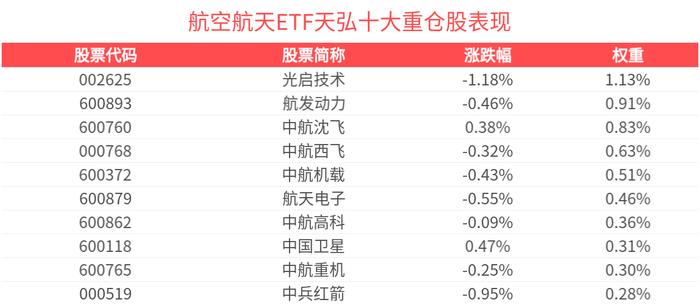
Group 1 - The core viewpoint of the news highlights the ongoing development and investment opportunities in China's commercial aerospace sector, particularly in reusable rockets and satellite applications [1][2]. - The CN5082 Aerospace Industry Index experienced a slight decline of 0.31% as of June 5, 2025, with mixed performance among constituent stocks [1]. - The top-performing stocks included Shanghai Hanyun, Changcheng Military Industry, and Narui Radar, while Guanglian Aviation and Aerospace Rainbow saw the largest declines [1]. Group 2 - Arrow Technology's Yuanhang-1 verification rocket successfully completed its first flight recovery test, indicating progress in China's commercial rocket development [1]. - Multiple commercial rocket development plans are underway, aiming for first flights by 2025, including Zhuque-3, Hyperbola-3, and Tianlong-3, in competition with SpaceX's Falcon 9 [1]. - The government is actively promoting the rapid development of commercial aerospace, with several launch sites planned across the country [1]. Group 3 - Huaxi Securities noted that the global commercial aerospace sector is accelerating the development of reusable rockets and low-orbit satellite constellations, marking a dual inflection point for China's commercial aerospace [2]. - The Aerospace ETF Tianhong has seen a significant increase in scale, growing by 400.82 million yuan over the past week, ranking in the top third among comparable funds [2]. - The Aerospace ETF Tianhong has achieved a 100% weekly profit percentage since its inception, with a maximum drawdown of 0.51% [2]. Group 4 - As of May 30, 2025, the top ten weighted stocks in the CN5082 Aerospace Industry Index accounted for 52.51% of the index, with companies like Guangqi Technology and AVIC Power leading the list [3]. - The performance of the top ten stocks varied, with Guangqi Technology experiencing a decline of 1.18% and AVIC Power down by 0.46% [5].