可复用火箭

Search documents
国防ETF(512670)涨超1.1%,2026年火箭发射次数有望破百
Xin Lang Cai Jing· 2026-02-13 02:45
Group 1 - The commercial aerospace sector is experiencing a rebound, with multiple new-generation rockets successfully completing their maiden flights, and the number of launches in 2026 expected to exceed 100 [1] - Key rockets planned for first flights in 2026 include Tianlong-3, Lijian-2, and Shuangjuxian-3, which will challenge single-stage recovery technology [1] - CITIC Securities highlights that reusable rockets will be the core engine of industrialization in 2026, with companies like Deep Blue Aerospace and Tianbing Technology focusing on recovery technology validation [1] Group 2 - The satellite internet and reusable rocket industries are identified as high-certainty main lines, emphasizing leading technology, frequency orbit advantages, and clear commercialization paths for top enterprises [1] - As of February 13, 2026, the CSI Defense Index (399973) rose by 1.10%, with notable increases in stocks such as Hangtian Materials (up 10.00%) and Hangfa Control (up 5.44%) [1] - The National Defense ETF (512670) closely tracks the CSI Defense Index and reflects the overall performance of listed companies in the defense industry [1] Group 3 - As of January 30, 2026, the top ten weighted stocks in the CSI Defense Index include Aerospace Electronics, Hangfa Power, and AVIC Shenyang Aircraft, collectively accounting for 42.4% of the index [2]
捷龙三号“一箭七星”海射成功,航空航天ETF(159227)涨近1%
Xin Lang Cai Jing· 2026-02-13 02:24
Group 1 - The CN5082 Aerospace Industry Index has risen by 1.16%, with notable increases in stocks such as Hailanxin up 9.87% and Hangcai shares up 8.49% [1] - On February 12, a successful launch of seven satellites was conducted using the Jielong-3 rocket from the Taiyuan Satellite Launch Center, marking a significant achievement in China's space endeavors [1] - CITIC Securities highlights that the year 2026 marks the beginning of the "14th Five-Year Plan," with reusable rockets becoming a core engine for industrialization, emphasizing the importance of leading companies in satellite internet and reusable rocket sectors [1] Group 2 - The Aerospace ETF (159227) closely tracks the CN5082 Aerospace Index, covering critical segments such as aerospace equipment, satellite navigation, and new materials, with a high concentration of 70% in commercial aerospace concepts [2] - The top ten holdings in the ETF include industry leaders like Aerospace Development, China Satellite, and Aerospace Electronics, indicating a strong focus on leading companies within the sector [2]
券商晨会精华 | 储能、SOFC将有效弥补美国用电负荷缺口
智通财经网· 2026-02-11 00:46
Market Overview - The market experienced narrow fluctuations with mixed performance across the three major indices, while the STAR 50 Index rose nearly 1% [1] - The total trading volume in the Shanghai and Shenzhen markets was 2.11 trillion yuan, a decrease of 143.9 billion yuan compared to the previous trading day [1] - Over 3,100 stocks in the market declined, with the media sector leading gains, while the commercial aerospace sector saw a decline [1] Energy Sector Insights - Tianfeng Securities suggests that energy storage and Solid Oxide Fuel Cells (SOFC) will effectively address the electricity load gap in the U.S. [2] - The EIA forecasts that from 2026 to 2030, the U.S. will add 7, 7, 16, 8, and 7 GW of gas-fired power generation, while stable power sources will see minimal additions [2] - By mid-October 2025, the planned capacity for data center reserve projects in the U.S. will reach 245 GW, indicating a significant load demand that stable power sources alone cannot meet [2] Aerospace Sector Developments - CITIC Construction Investment emphasizes that the commercial aerospace sector is focusing on technology leadership, frequency track superiority, and clear commercialization paths [3] - The core engine for industrialization in reusable rockets is being continuously optimized, with companies like Deep Blue Aerospace and Tianbing Technology validating recovery technologies [3] - The integration of satellite internet and reusable rockets is seen as a high-certainty mainline for the industry [3] Real Estate Market Analysis - CICC indicates that the real estate market's performance may primarily be driven by beta factors in 2026, with January's second-hand housing transaction volume stabilizing month-on-month and showing a narrowing year-on-year decline [4] - The transaction volume index for second-hand residential properties in 80 cities decreased by 3% month-on-month and also by 3% year-on-year [4] - Recent policy changes and improvements in supply-side conditions are expected to create investment opportunities in the real estate and property management sectors [4]



商业航天系列报告(二):SpaceX申请轨道数据中心,加速布局低轨道星座
Western Securities· 2026-02-01 03:42
Investment Rating - The industry investment rating is "Overweight" [4] Core Insights - SpaceX has applied to the FCC for the "Orbital Data Center system," which will consist of up to 1 million satellites operating at altitudes between 500 km and 2000 km to meet the growing demand for AI computing power and energy consumption [1] - The construction of low Earth orbit satellite constellations is expected to drive significant business demand for reusable rocket launch service providers, with companies that achieve technological breakthroughs gaining a competitive advantage [2] - The acceleration of low Earth orbit satellite constellation construction is anticipated to create new revenue opportunities for domestic leading rocket launch service providers, particularly in upstream supply chain segments such as manufacturing equipment and satellite payloads [3] Summary by Sections Industry Overview - The report highlights the importance of reusable rocket manufacturing and launch capabilities as a foundation for large-scale low Earth orbit satellite constellation construction [2] - The cost reduction potential of reusable rockets could decrease total launch costs by 40%-60%, significantly impacting the economics of satellite constellation deployment [2] Market Performance - As of December 2025, SpaceX's Starlink is projected to have approximately 9,300 satellites in orbit, making it the largest near-Earth satellite network in history [3] - SpaceX's total revenue for 2025 is estimated to be around $18.2 billion, with Starlink contributing approximately $12.8 billion, accounting for 70.3% of total revenue [3] Investment Opportunities - The report suggests focusing on 3D printing equipment companies such as Huashu High-Tech and Plater, which may benefit from the developments in the satellite constellation and rocket launch service sectors [3]
智能制造行业周报:SpaceX推进星链升级与IPO进程-20260126
Shanghai Aijian Securities· 2026-01-26 09:41
Investment Rating - The mechanical equipment industry is rated as "stronger than the market" based on its performance relative to the CSI 300 index, which decreased by 0.62% during the week while the mechanical equipment sector increased by 2.57% [5][6]. Core Insights - SpaceX is advancing its Starlink system upgrades and capitalizing on its operations, planning to launch a second-generation Starlink system by 2027, which will enhance satellite performance and network capacity. The company aims to reduce the cost of launching to below $100 per pound through full reusability of its Starship [2]. - The capital market is preparing for SpaceX's IPO, expected in Q3 2026, with a valuation around $800 billion based on recent internal equity transactions. The report suggests that the valuation uplift in China's private rocket companies will follow a similar trajectory as SpaceX, transitioning from project-based products to infrastructure and technology services [2]. - In the PCB equipment sector, companies such as Chipbond (688630), Dongwei Technology (688700), and Dazhu CNC (301200) are recommended, with a focus on the increasing demand for advanced packaging and fine line technology [3]. - The humanoid robot sector is highlighted with recommendations for companies like Inovance Technology (300124) and Sanhua Intelligent Control (002050), as the production of Tesla's Optimus V3 approaches, which is expected to catalyze the market [3]. - In the controlled nuclear fusion sector, Guoji Heavy Industry (601399) is recommended, with expectations of increased procurement activity related to fusion projects, potentially exceeding previous investment forecasts [4]. Summary by Sections Mechanical Equipment Sector - The mechanical equipment sector's PE-TTM valuation increased by 2.56%, with the best-performing sub-sector being abrasives, which rose by 8.58% [5][6]. - The report indicates that the mechanical equipment industry ranks 13th out of 31 in the Shenwan industry classification [5]. Commercial Aerospace - Companies such as Yingliu Co. (603308), Srey New Materials (688102), and West Materials (002149) are recommended for investment in the commercial aerospace sector [5]. PCB Equipment - The report emphasizes the transition towards thinner substrates and finer line requirements in PCB manufacturing, with specific recommendations for companies involved in advanced packaging technologies [3]. Humanoid Robots - The report suggests focusing on core enterprises in the humanoid robot sector, particularly as Tesla ramps up production of its Optimus V3 robot, which is expected to begin sales in 2027 [3]. Controlled Nuclear Fusion - The procurement pace for fusion projects is accelerating, with significant budget allocations expected for various projects, indicating a robust growth outlook for companies in this sector [4].





AI、能源、太空探索、机器人……马斯克最新预言
Zheng Quan Shi Bao Wang· 2026-01-23 10:45
Group 1: Robotics - Elon Musk predicts that humanoid robots will become standard in households, addressing labor shortages in caregiving and other essential areas [2] - The Tesla humanoid robot, Optimus, is expected to be available for public sale by the end of 2027, with prototypes already performing tasks in Tesla factories [2] - Musk emphasizes that the rise of robots will lead to the disappearance of traditional jobs, necessitating a redefinition of human existence [2] Group 2: Energy - Musk identifies electricity as the primary bottleneck for AI development, rather than chip production, with global electricity supply growth at only 3-4% annually [3] - China leads in solar energy production, with an annual capacity of 1500 GW and deployment exceeding 1000 GW, contributing significantly to stable electricity supply [3] - Tesla and SpaceX are forming specialized teams to achieve a breakthrough in solar panel production, targeting an annual output of 100 GW within three years [4] Group 3: Space Exploration - Musk envisions that within 2-3 years, space will become the most cost-effective location for deploying AI data centers due to the efficiency of solar energy in space [5] - The development of fully reusable rockets, such as SpaceX's Starship, is crucial for reducing space access costs by 100 times [5] - Musk expresses a desire to establish a human presence on Mars, emphasizing the importance of becoming a multi-planetary species [5] Group 4: Autonomous Driving - Musk claims that Full Self-Driving (FSD) technology is essentially solved, with some insurance companies already recognizing its safety [6] - Tesla is expanding its Robotaxi service to major cities, with regulatory approvals expected soon in Europe and China [6] Group 5: Longevity and Philosophy - Musk believes that reversing aging is a solvable problem, but warns that immortality could lead to societal stagnation [6] - His curiosity-driven philosophy aims to transform science fiction into scientific reality, focusing on understanding life's meaning and the universe [6] Group 6: Overall Vision - Musk's dialogue presents a comprehensive engineering roadmap where AI surpasses human intelligence, driven by electricity supply from solar energy, with space as the optimal environment for energy utilization [7] - Each sector, from AI to energy, space, and robotics, is interconnected in supporting humanity's transition to an era of abundance [7]


可复用火箭迎关键节点,商业航天迎运力降本拐点,航空航天ETF(159227)大涨3.96%
Mei Ri Jing Ji Xin Wen· 2026-01-22 08:16
Group 1 - The A-share market saw all three major indices rise collectively, with the aerospace sector performing strongly, as evidenced by the aerospace ETF (159227) increasing by 3.96% and achieving a trading volume of 666 million yuan, maintaining its position as the top performer in its category [1] - Several private rocket companies have announced their annual launch plans, including Star River Dynamics' reusable liquid rocket "Zhishen-1" expected to make its maiden flight in the first half of the year, and Jiangsu Deep Blue Aerospace's "Xingyun-1" planning to test its orbital insertion and sea recovery after the Spring Festival [1] - According to Aijian Securities, the Chinese commercial aerospace sector is projected to reach a turning point in cost reduction by 2026, driven by the concentrated deployment of low-orbit constellations and the normalization of high-frequency launches, with a shift in the industry's business model from state-driven tasks to market-driven profitability [1] Group 2 - The aerospace ETF (159227) closely tracks the Guozheng Aerospace Index, covering leading companies across the entire industry chain, including fighter jets, aircraft engines, rockets, missiles, satellites, and radars, aligning perfectly with the strategic direction of "aerospace integration" [2] - The ETF has a high commercial aerospace content of 70.19%, with its top ten holdings including industry leaders such as Aerospace Development, China Satellite, Aerospace Electronics, and AVIC [2]
商业航天行业深度系列(一):以第一性原理推演中国商业航天降本革命
Shanghai Aijian Securities· 2026-01-21 10:19
Investment Rating - The report rates the industry as "stronger than the market" [1] Core Insights - The report concludes that 2026 will mark a turning point for China's commercial aerospace industry, with a shift from state-driven missions to market-driven profitability, driven by the deployment of low-orbit satellite constellations and advancements in reusable rocket technology [1][6] - The commercial rocket launch service market in China is projected to grow from 10.26 billion yuan in 2025 to 47.39 billion yuan by 2030, with a CAGR of approximately 35.8% [1][12] - The report emphasizes that the core components of rocket launch services are engines (54%) and structural components (24%), which together account for 78% of the value in the launch service segment [1][12] Summary by Sections Industry Overview - The commercial aerospace industry is defined as activities that provide aerospace products and services through social capital investment under national policy guidance, including the R&D, manufacturing, launch, and operation of spacecraft and rockets [6][7] - The global aerospace economy is expected to reach $612 billion by 2024, with commercial aerospace revenues accounting for approximately $480 billion, representing about 78% of the total [6][7] Market Dynamics - The demand for satellite launches is expected to surge as China enters a concentrated deployment phase for low-orbit satellite constellations, with over 200,000 satellites planned for deployment [18][19] - The report highlights that the competition for low-orbit frequency resources is intensifying, necessitating faster deployment of satellite constellations [19][21] Cost Structure and Efficiency - The report breaks down the cost structure of rockets, indicating that engines and structural components dominate the value chain [1][12] - It outlines a pathway for reducing launch costs, projecting that the unit cost of launching payloads could decrease significantly as technology advances [1][12] Investment Recommendations - The report suggests focusing on companies involved in key segments such as propulsion systems, satellite communication systems, materials and structural components, and testing and validation services [2][4] - Specific companies to watch include 应流股份 (603308), 斯瑞新材 (688102), and 上海瀚讯 (300762), among others [2][4]


卫星ETF鹏华(563790)涨超5.8%,商业航天迎来密集催化
Xin Lang Cai Jing· 2026-01-09 07:36
Group 1 - The commercial aerospace industry is experiencing rapid growth, driven by favorable policies and significant investments, such as Guangzhou's plan to become a global hub for commercial aerospace by 2035 and the establishment of a 5.2 billion yuan rocket recovery base in Hangzhou [1] - The commercial rocket industry is entering a golden development period, transitioning from initial development to rapid iteration, with key components including propulsion systems, rocket structures, and control systems expected to benefit from increased demand [1] - As reusable rocket technology matures, liquid rocket engines will be increasingly reused, leading to sustained benefits for rocket structures and control systems, highlighting investment opportunities in these areas [1] Group 2 - The China Satellite Industry Index (931594) has seen a strong increase of 5.93%, with notable stock performances from companies such as Xinke Mobile (688387) up 20.00% and Zhenlei Technology (688270) up 18.43% [2] - The Satellite ETF Penghua (563790) closely tracks the China Satellite Industry Index, which includes 50 companies involved in satellite manufacturing, launching, communication, navigation, and remote sensing, reflecting the overall performance of the satellite industry [2] - As of December 31, 2025, the top ten weighted stocks in the China Satellite Industry Index account for 63.64% of the index, with major players including China Satellite (600118) and Aerospace Electronics (600879) [2]
卫星ETF鹏华(563790)涨超4.2%,2026年商业航天迎来密集发射
Xin Lang Cai Jing· 2026-01-08 03:24
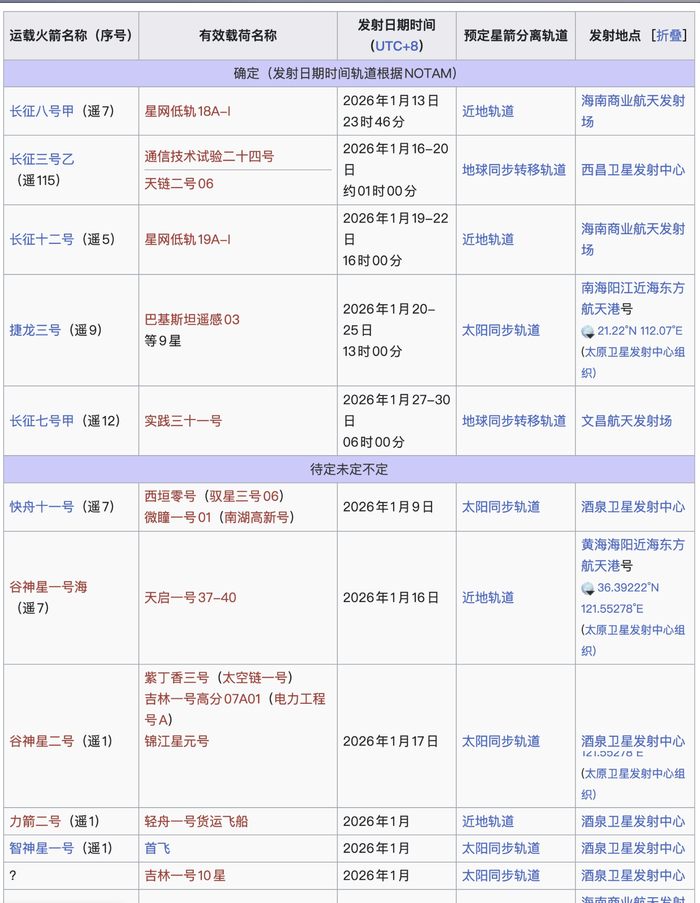
Group 1 - The commercial space industry in China is set for a busy launch schedule in 2026, with multiple companies planning high-frequency launches, including Dongfang Space's "Gravity One" and "Gravity Two" rockets, and Deep Blue Aerospace's "Nebula One" rocket [1] - The Long March 8 rocket is scheduled to launch the "StarNet Low Earth Orbit 18A-I" payload on January 13, 2026, from Hainan, while other rockets like Long March 3B and Long March 12 are also set for launches in January 2026 [2] - The average launch cost for expendable rockets is reported to be between 110 million to 180 million yuan, while reusable rockets are expected to reduce costs significantly to between 2 million to 5 million dollars as major companies develop recovery technologies [3] Group 2 - As of January 8, 2026, the Zhongzheng Satellite Industry Index (931594) has risen by 4.47%, with notable increases in stocks such as Aerospace Electric (10.01%) and Aerospace Electronics (10.00%) [3] - The Zhongzheng Satellite Industry Index includes 50 companies involved in satellite manufacturing, launching, communication, navigation, and remote sensing, reflecting the overall performance of the satellite industry [3] - The top ten weighted stocks in the Zhongzheng Satellite Industry Index as of December 31, 2025, include China Satellite, Aerospace Electronics, and China Satcom, accounting for 63.64% of the index [4]