商业航天产业链

Search documents
机械年度策略:内稳外增,科技驱动
野村东方国际证券· 2026-02-27 13:34
Core Viewpoint - The mechanical equipment industry has shown improvement in its fundamentals, but the trading landscape is differentiated, limiting the potential for pure valuation increases [3]. 2025 Mechanical Industry Review - Based on financial data and trading data from the first three quarters of 2025, the mechanical equipment industry has been reviewed, indicating a general improvement in the industry's fundamentals [3]. 2026 Industry Outlook - The "Mechanical Industry Steady Growth Work Plan (2025-2026)" sets an annual revenue growth target of 3.5% for the industry. The China Machinery Industry Federation predicts a stable operational trend for the mechanical industry in 2026, with an expected growth rate of 5.5% for major indicators. It is anticipated that the actual growth may exceed both the steady growth work plan and the federation's forecast due to favorable conditions for listed companies in terms of scale, brand, talent, and capital [4]. - Real estate investment pressures are not expected to significantly negatively impact the mechanical industry, while new infrastructure investments are expected to drive growth in related equipment. High-margin external demand is expected to continue driving the industry to expand internationally. Technological research and capital operations are expected to drive industrial upgrades [4]. 2026 Investment Recommendations - **Technology Innovation Directions**: Favorable on the AI industry chain and commercial aerospace industry chain. Specific recommendations for the AI industry chain include: 1) embodied intelligent robotics industry chain; 2) PCB equipment industry chain benefiting from the explosion of AI demand; 3) power supply, heat dissipation, cooling sources, and power supply equipment and components in the data center industry chain. For the commercial aerospace industry, recommended directions include: 1) suppliers of rocket and satellite bearings, aerospace forgings, and other components; 2) supporting equipment such as metal additive printing and metal processing machine tools [5]. - **Globalization Direction**: Favorable on intelligent warehousing logistics equipment and engineering machinery [5]. - **Energy Security Direction**: Favorable on mining equipment, oil and gas equipment, and nuclear power equipment [5]. - **M&A Direction**: Based on potential M&A opportunities, a small-cap M&A portfolio for the mechanical industry has been constructed [5].


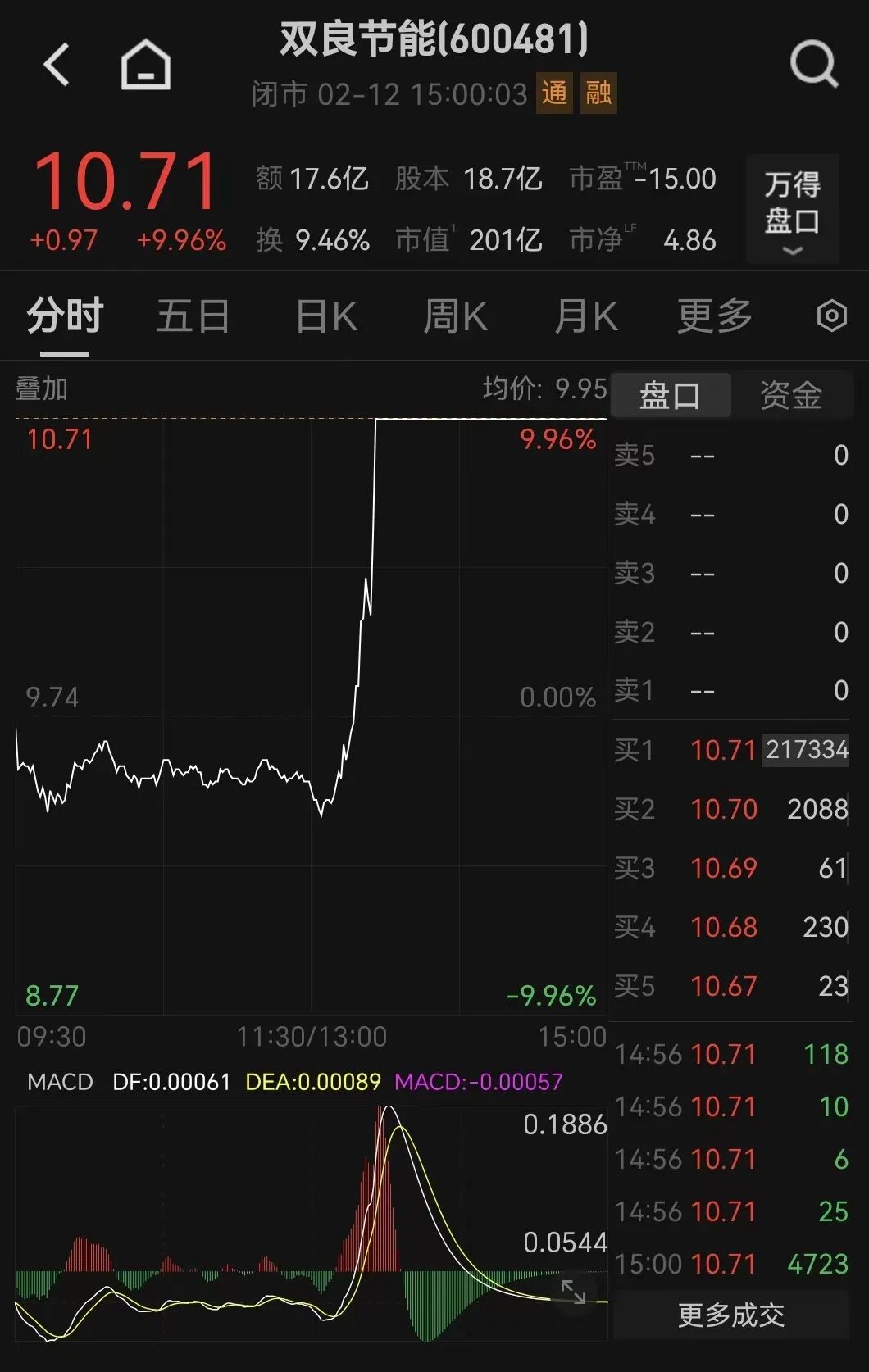
午后突发,直线拉涨停!官宣获SpaceX星舰发射基地订单,紧急公告来了
Zhong Guo Ji Jin Bao· 2026-02-12 11:44
Core Viewpoint - The stock price of Shuangliang Energy (600481) surged to the daily limit after the announcement of receiving orders for high-efficiency heat exchangers from SpaceX for its Starship launch facility expansion [1][2]. Group 1: Orders and Financial Impact - Shuangliang Energy announced it has secured three overseas orders totaling 12 high-efficiency heat exchangers, valued at approximately €170,000 (around ¥1,392.30 million) [5][9]. - The total order amount represents about 0.11% of the company's audited revenue for the fiscal year 2024, indicating that it will not have a significant impact on the company's financial performance [9]. - The company is indirectly involved in the commercial aerospace sector by supplying equipment for fuel projects related to SpaceX, although it does not have a direct partnership with SpaceX [6][9]. Group 2: Market Context and Future Prospects - SpaceX is accelerating its Starship launch capabilities, planning to build three new launch pads in Florida, which is expected to create exponential growth opportunities for the supply chain [5]. - Shuangliang Energy aims to strengthen its collaboration with Fortune 500 companies and expand its presence in the international market, leveraging its advanced manufacturing capabilities [5]. - The company’s main business includes energy-saving products, new energy equipment, and photovoltaic products, with commercial aerospace not being a primary application area [9].

国联民生证券:空间态势感知系统市场或成为商业航天产业链新亮点
智通财经网· 2026-02-04 06:00
Core Viewpoint - SpaceX's Starlink has announced the development of a new Space Situational Awareness (SSA) system named Stargaze, which significantly enhances the safety and sustainability of Low Earth Orbit (LEO) satellite operations [1] Group 1: Importance of SSA Systems - The increasing number of satellites launched in recent years has led to significant concerns regarding space traffic congestion and collision risks, making SSA systems increasingly important [3] - Traditional ground radar systems have limited observation frequencies and high uncertainties in orbit predictions, which are exacerbated by space weather, highlighting the need for advanced SSA technologies [3] Group 2: Stargaze System Capabilities - Stargaze's detection capabilities are reportedly improved by several orders of magnitude compared to traditional systems, utilizing nearly 30,000 trackers to monitor nearby objects and detect approximately 30 million close approach events daily [4] - The system can autonomously compile observational results and integrate them into a space traffic management platform, significantly reducing the time to filter results from several hours to just a few minutes [4] Group 3: Future Market Potential - The SSA systems market is expected to become a new highlight in the commercial space industry, especially as 2026 is anticipated to be a pivotal year for commercial space activities [5] - Countries, including China, are placing significant emphasis on developing space traffic management technologies, which will lay a solid foundation for international rule-making in space traffic management [5] Group 4: Investment Opportunities - The commercial space industry is expected to thrive in 2026, with a focus on satellite launch plans and emerging applications in space computing and solar power [7] - Key players in the U.S. commercial satellite industry and emerging application areas such as Rocket Lab, AST SpaceMobile, and Planet Labs are recommended for investment consideration [7]

商业航天全景产业链图谱:结构解构、价值分布与生态趋势
材料汇· 2026-01-28 16:00
Core Viewpoint - The article provides a comprehensive analysis of the commercial aerospace industry, focusing on the value chain, key segments, and investment opportunities within the sector [3][4]. Group 1: Industry Structure and Value Distribution - The commercial aerospace industry is characterized as technology and capital-intensive, aiming to utilize and monetize space resources through market mechanisms [3]. - The value chain can be dissected into four core segments, with ground equipment manufacturing and satellite operation services accounting for approximately 92% of the total satellite industry scale [8]. - Upstream satellite manufacturing and launch services, while representing only about 9% of the value, are crucial due to their high technical barriers and are currently hotspots for capital investment [8]. Group 2: Upstream Manufacturing - Satellite manufacturing is identified as the foundational segment of the industry, with a focus on high technology and value creation [13]. - The value distribution in satellite manufacturing shows that payloads account for about 50% of costs, with antenna subsystems representing 53% of the value in mass-produced communication satellites [16][17]. - The satellite platform also constitutes about 50% of costs, with the attitude control system being a key component [18]. - Major players in satellite manufacturing include state-owned enterprises like China Aerospace Science and Technology Corporation and private companies like Galaxy Space [19]. Group 3: Rocket Manufacturing - Rocket manufacturing is described as the only channel for large-scale deployment and a significant cost bottleneck [20]. - The propulsion system constitutes 70% of the total cost of liquid rockets, making it a critical area for cost management [21]. - Technologies such as "one rocket multiple satellites" and reusable rocket technology are pivotal for reducing launch costs [23]. - The competitive landscape includes both state-owned enterprises and emerging private companies focused on innovation in reusability [24]. Group 4: Ground Equipment and Operations - Ground equipment manufacturing is the largest revenue contributor in the satellite industry, accounting for approximately 51.6% of total revenue [31]. - Consumer devices, particularly satellite navigation equipment, dominate the ground equipment market, with a projected value of $111.9 billion [32]. - The operational segment, which includes satellite operation management and data services, is crucial for value realization, contributing about 40.3% of the industry's value [36][38]. Group 5: Investment Trends and Future Outlook - The investment focus is currently on upstream segments, particularly satellite manufacturing and reusable rocket launches driven by low Earth orbit constellation demands [41]. - As constellations are established, the industry value is expected to shift towards ground terminals and diversified downstream applications, particularly in consumer satellite internet [41].



视觉中国(000681.SZ):未在商业航天产业链中开展其他形式的深度合作或专项布局
Ge Long Hui· 2026-01-21 13:10
Group 1 - The core viewpoint of the article is that Vision China (000681.SZ) has stated it is not engaged in any other forms of deep cooperation or specialized layout within the commercial aerospace industry chain [1]

华鹏飞(300350.SZ):暂未在商业航天产业链方面进行布局
Ge Long Hui· 2026-01-19 15:49
Core Viewpoint - The company, Huapengfei (300350.SZ), focuses on providing global comprehensive logistics services tailored to the needs of manufacturing and import-export trade clients, and has not yet ventured into the commercial aerospace industry [1] Group 1: Business Overview - The main business of the company is global comprehensive modern logistics services [1] - The company offers global logistics solutions based on customer needs and the characteristics of supply chain segments [1] - Additional services include procurement agency and supply chain trade management for core client enterprises [1]

商业航天跟踪 28 期:长征十二号甲遥一运载火箭发射任务基本成功
国泰海通· 2025-12-30 06:30
Investment Rating - The report does not explicitly state an investment rating for the commercial aerospace industry Core Insights - The Long March 12甲遥一 rocket flight test was successfully completed, with the second stage entering the designated orbit, although the first stage was not successfully recovered [6] - The Shanghai Stock Exchange released guidelines for the fifth set of listing standards for commercial rocket companies, focusing on market capitalization and R&D rather than revenue and profit [10] - The 2025 Third Commercial Aerospace Development Conference was held in Beijing, highlighting key technology innovations and the establishment of a 2 billion yuan fund for commercial aerospace [12][13] - Blue Arrow Aerospace completed its IPO counseling work, indicating readiness for public offering [16] Summary by Sections Industry Development Dynamics - The Long March 12甲遥一 rocket was launched on December 23, 2025, achieving key flight data despite not recovering the first stage [6] - The new listing standards for commercial rocket companies emphasize "market value + R&D" as evaluation criteria, facilitating IPO applications [10] - The Third Commercial Aerospace Development Conference focused on technology innovation and industry collaboration, with a new fund established to support high-growth startups [12][13] - Blue Arrow Aerospace has completed its IPO counseling, preparing for its public offering [16] Industry Financing Progress - Elliptical Space completed a financing round of several hundred million yuan to advance its "Star Pool Project," which involves a constellation of 112 intelligent satellites [18][19] - Xingyi Space secured nearly 300 million yuan in Pre-A financing to enhance its global measurement and control capabilities [23][24] Capital Market Performance - The Wind Commercial Aerospace Index saw an 8.36% increase in the week of December 22-26, 2025, with a trading volume of 542.1 billion yuan [27] - 88.89% of the companies in the commercial aerospace sector experienced stock price increases during this period, with notable gains from companies like Chaojie Co., China Satellite, and Beidou Star [30]
中航重机(600765.SH):已为东方空间“引力一号”、星际荣耀卫星支架、星河动力“谷神星”、九州云箭发动机等商业航天领域稳定供应关键锻件
Ge Long Hui· 2025-12-29 09:57
Core Viewpoint - The company, AVIC Heavy Machinery (600765.SH), is actively seizing strategic opportunities in the rapidly developing commercial aerospace sector in China, leveraging its expertise in forging, casting, hydraulics, and environmental control [1] Group 1: Company Involvement in Commercial Aerospace - AVIC Heavy Machinery has been deeply involved in the domestic commercial aerospace supply chain, providing critical forged components for various projects [1] - The company’s subsidiary, Heavy Machinery Aerospace, has supplied key forged components for projects such as the "Gravitational One" by Oriental Space, satellite brackets for Interstellar Glory, and the "Vulcan" engine by Star River Power [1] - Another subsidiary, Anji Precision Casting, focuses on high-temperature structural components for engines, consistently supplying high-performance castings for the "Tianque 12" engine by Blue Arrow Aerospace and the "Gravitational One" by Oriental Space over the past five years [1] Group 2: Supply Chain Capabilities - AVIC Heavy Machinery has established a comprehensive supply capability for mainstream commercial aerospace enterprises, forming a specialized supply system for basic structural components aimed at the commercial aerospace sector [1]

午评:沪指半日小幅涨0.31%,商业航天产业链延续强势
Xin Lang Cai Jing· 2025-12-29 04:09
Market Overview - The three major indices showed mixed performance in the morning session, with the Shanghai Composite Index up by 0.31%, the Shenzhen Component Index up by 0.03%, and the ChiNext Index down by 0.32% [1] - The total trading volume in the Shanghai, Shenzhen, and Beijing markets reached 1.4078 trillion yuan, a decrease of 57.8 billion yuan compared to the previous day [1] - Over 3,400 stocks in the market experienced declines [1] Sector Performance - The top-performing sectors included carbon fiber, diversified finance, brain-computer interfaces, non-ferrous metals, CPO, wind power equipment, commercial aerospace, and humanoid robots [1] - The sectors that faced the most significant declines were food and beverage, retail, batteries, chemicals, and influenza [1] Notable Stocks - In the carbon fiber sector, Jilin Chemical Fiber reached the daily limit, with Jilin Carbon Valley, Zhongfu Shenying, and Nanjing Julong also showing significant gains [1] - The commercial aerospace sector continued its strong performance, with Shenjian Co. achieving eight consecutive trading limits, Daye Co. four consecutive limits, and Tailong Co. three consecutive limits [1] - Humanoid robot concept stocks saw a surge, with Haoshi Electromechanical, Wuzhou New Spring, and Siling Zhichui leading the gains [1] Underperforming Stocks - The food and beverage and retail sectors collectively declined, with Miaokelan Duo, Baida Group, and Dongbai Group hitting the daily limit down, while Huangshi Group, Nanjiao Food, and Western Pastoral also fell [1] - The battery supply chain underperformed, with XWANDA dropping over 10%, and Haike Xinyuan, Shida Shenghua, and Huasheng Lithium also experiencing declines [1]
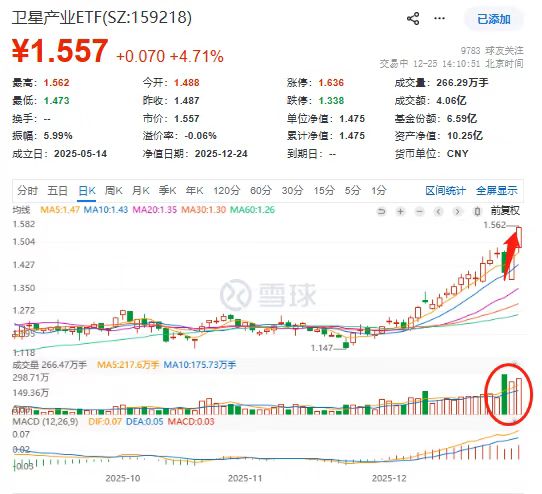
火力全开!卫星产业ETF(159218)涨近5%,盘中成交破4亿!复旦微电、臻镭科技、成都华微等涨超10CM
Jin Rong Jie· 2025-12-25 06:21
Core Insights - The commercial aerospace sector is experiencing significant growth, with the satellite industry ETF (159218) rising by 4.91% and reaching a new high for the 29th time this year as of December 25 [1][3]. Industry Structure - The commercial aerospace industry is evolving from a singular focus on launch manufacturing to a comprehensive ecosystem characterized by "Earth-Space Integration and Deep Space Expansion," forming a three-tier industrial structure: "Foundation Layer," "Network Layer," and "Frontier Layer" [3]. - The "Foundation Layer" is essential for entering space, centered on launch vehicle manufacturing, and aims to reduce entry costs through breakthroughs in reusable technology, with the U.S. and China currently leading the competition [3]. - The "Network Layer" is crucial for commercial monetization, relying on satellite internet to create a new type of information infrastructure through low Earth orbit satellite constellations, enabling wide coverage and low latency [3]. - The "Frontier Layer" focuses on the future of value expansion, emphasizing deep space economy and transitioning space activities from exploration to resource utilization, which is expected to generate trillion-level market increments and new productive forces in the future [3].