
债券收益率上升

Search documents
印度政府借款规模超预期 债市承压收益率看涨
Ge Long Hui· 2026-02-02 02:04
美股频道更多独家策划、专家专栏,免费查阅>> 责任编辑:栎树 2月2日,市场参与者表示,由于印度政府计划发行的债务规模创下历史新高且超出预期,加之需求疲软 压力,印度债券周一恐将遭遇损失。印度财政部长西塔拉曼在周日的预算演讲中宣布,在4月1日开始的 新财年,新德里将借款17.2万亿卢比(约合1870亿美元)。这一数字较本财年修正后的估算额增长了约 18%,并超过了调查预测的16.5万亿卢比。 根据科塔克马辛德拉人寿保险公司和Ujjivan小额信贷银行的交易员预测,供应量的增加可能导致周一10 年期国债收益率上升4到5个基点。工商信贷证券一级交易商有限公司表示,未来几周收益率可能会爬升 至7%。融资成本上升可能会加剧印度经济的压力,该经济目前已在应对美国的高额关税,而央行进一 步降息以支持增长的空间有限。由于各州政府大规模发债,加之养老金和保险基金的需求减弱,债券收 益率目前处于近一年来的最高水平。 ...
全球瞭望丨英国《经济学人》:高市早苗的经济政策将给日本带来麻烦
Xin Hua She· 2025-12-12 09:11
Group 1 - The article highlights the harmful combination of high inflation, yen depreciation, and rising bond yields in Japan, criticizing Prime Minister Kishi's outdated economic policies of "massive spending and maintaining low interest rates" [1] - Over the past six months, the yen has depreciated by 9% against the US dollar and reached its lowest level against the euro in 27 years, while the 30-year Japanese government bond yield has surged to its highest level since 1999 [1] - Kishi's supplementary budget plan amounts to 18.3 trillion yen (approximately 118 billion USD), which, despite its relatively low GDP ratio, sends negative signals to investors [1] Group 2 - The International Monetary Fund predicts that Japan's budget deficit as a percentage of GDP will rise to about 4.4% by 2030, significantly higher than the country's expected economic growth rate [2] - Factors such as defense spending, aging population-related expenses, and rising bond yields are expected to create a heavy burden on Japan's economy [2] - Kishi's approach mirrors that of former Prime Minister Shinzo Abe, who combined structural reforms with monetary and fiscal stimulus, although Abe's fiscal stance was more conservative than implied [2]
消息称日本央行对干预债市持谨慎态度
Xin Lang Cai Jing· 2025-12-11 06:34
Core Viewpoint - The Bank of Japan (BOJ) sees limited necessity for emergency measures to curb rising government bond yields, as such actions contradict its efforts to reduce stimulus [1][3]. Group 1: Market Response and Bond Yields - The benchmark 10-year Japanese government bond yield has reached an 18-year high, raising concerns about the BOJ's response amid increasing expectations for a rate hike in December [1][4]. - Recent yield increases are attributed to investor uncertainty regarding the potential extent of future rate hikes by the BOJ and the amount of bonds the government will sell to finance the next fiscal year's budget [4]. Group 2: BOJ's Stance on Intervention - BOJ Governor Kazuo Ueda indicated that the recent rise in bond yields is "somewhat rapid" and reaffirmed the BOJ's readiness to respond swiftly in special circumstances [1][3]. - BOJ decision-makers are closely monitoring market trends but are currently reluctant to take action, such as increasing bond purchases or conducting emergency market operations, due to high intervention thresholds [1][3]. - The BOJ is cautious about intervening, as it could send the wrong signal to the market regarding the central bank's commitment to normalizing policy [2][4].
日本参议院选举引发财政担忧 10Y日债利率创17年新高
智通财经网· 2025-07-15 06:58
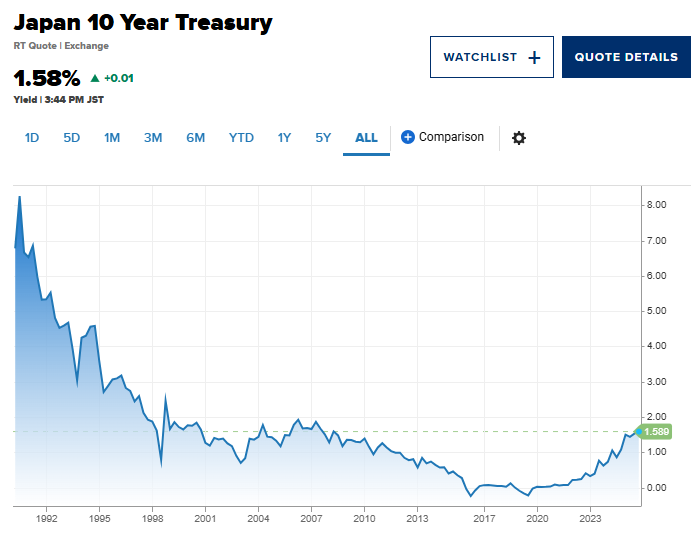
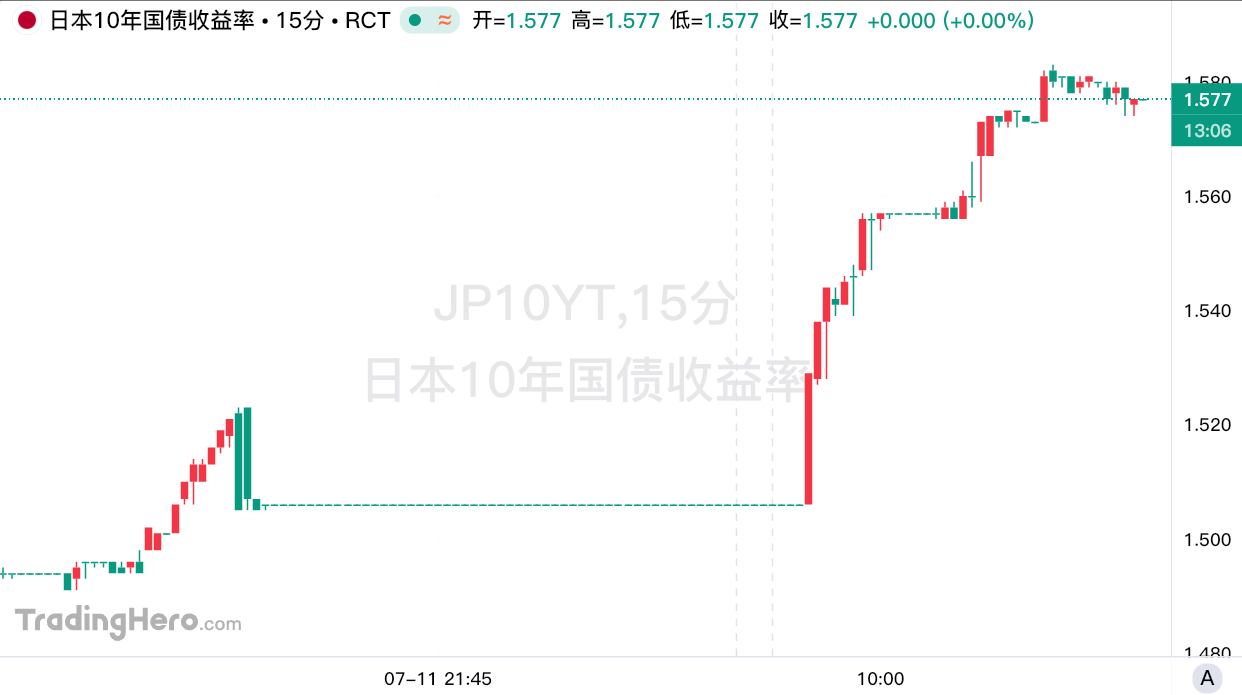
Group 1 - Japan's 10-year government bond yield has risen to 1.599%, the highest level since 2008, driven by concerns over fiscal spending ahead of the upcoming Senate elections [1] - The 30-year Japanese government bond yield reached a record 3.21%, while the 20-year yield hit its highest level since 1999 [1] - Market expectations of fiscal expansion policies due to the Senate elections are contributing to the rise in long-term and ultra-long-term bond yields [1][3] Group 2 - Discussions among Japanese politicians regarding lowering the consumption tax are intensifying ahead of the Senate elections, which may lead to increased economic volatility [3] - The current inflation rate in Tokyo decreased to 3.1% in June from 3.6% in May, but remains high, potentially prompting the Bank of Japan to adjust its inflation expectations and accelerate its next interest rate hike [3] - The supply-demand imbalance in the Japanese bond market may worsen, particularly as life insurance companies' capacity to absorb new supply has declined [3] Group 3 - The Bank of Japan announced plans to slow the pace of government bond purchase reductions starting April next year, maintaining the benchmark interest rate at 0.5% due to increasing economic risks [4] - The Bank of Japan reiterated its plan to reduce monthly purchases of Japanese government bonds by approximately 400 billion yen (about 2.76 billion USD) each quarter until March 2026, consistent with previous guidelines [4]

日本政坛暗流涌动!参议院变天或引爆“日债核爆”
Jin Shi Shu Ju· 2025-07-14 11:18
Core Viewpoint - Japan's long-term government bonds experienced a significant drop, leading to a sharp rise in yields, which has raised concerns in the global bond market [1] Group 1: Bond Market Reactions - The yields on Japanese government bonds from 10-year to 40-year maturities surged, reminiscent of the yield spikes that affected global markets in May [1] - Analysts suggest that the rise in yields is linked to concerns over increased government spending and liquidity issues [1] Group 2: Political Implications - The upcoming Senate elections may empower opposition parties advocating for tax cuts and increased government spending, potentially pressuring the Bank of Japan to maintain low interest rates [3] - Polls indicate that Prime Minister Shigeru Ishiba's ruling coalition may lose its majority, leading to potential collaborations with smaller parties favoring expansionary fiscal and monetary policies [3][4] - If the ruling coalition retains its majority, Ishiba might still adopt a less hawkish fiscal stance to mitigate the impacts of U.S. tariffs and rising living costs [4] Group 3: Economic Forecasts - Japan's public debt stands at 250% of GDP, with a significant portion of the budget allocated to servicing this debt, raising concerns about rising debt servicing costs as the central bank moves away from zero interest rates [4] - The Bank of Japan is expected to consider raising its inflation forecasts due to rising food costs, particularly rice, which has affected consumer prices [6][7] - Current inflation data shows core consumer inflation at 3.7%, exceeding the Bank of Japan's 2% target for over three years, driven by a 7.7% increase in food costs [7]
债市风暴尚未结束,美股反弹路上或再添“拦路虎”
Jin Shi Shu Ju· 2025-05-29 08:51
Group 1 - Rising bond yields are suppressing the stock market's strong start this week, with the 30-year U.S. Treasury yield approaching 5% [1] - RBC Wealth Management warns that the rise in bond yields poses an imminent threat to the stock market, indicating that a breakthrough of the 2023 highs in U.S. Treasury yields could lead to a market correction [1] - The increase in U.S. Treasury yields is attributed to concerns over government deficit spending linked to tax cut proposals and rising inflation expectations, alongside the Federal Reserve's decision to maintain current interest rates [1] Group 2 - The sell-off in overseas bond markets, particularly following a weak auction of Japan's 40-year government bonds, has contributed to the upward trend in bond yields [2] - The Optimistic Trader's founder suggests that the financial markets are currently "overly complacent," predicting that bond yields will continue to rise and may surpass recent highs, which could hinder stock market rebounds [2] - Current 10-year U.S. Treasury yields are around 4.50%, nearing previous highs, with the 30-year yield previously peaking at 5.09% [2]
MEX MARKETS:美国信用评级下调 高等级公司债券的吸引力如何?
Sou Hu Cai Jing· 2025-05-20 11:47
Core Viewpoint - Moody's downgrade of the US credit rating reflects concerns over rapidly expanding debt and fiscal deficits, which may increase borrowing costs and affect the US's status as a global capital destination [1][3][9] Group 1: Reasons for Credit Rating Downgrade - The primary reason for Moody's downgrade is the rapid expansion of US debt and fiscal deficits, with the national debt reaching $36 trillion [3] - Moody's believes that the ongoing deterioration of fiscal conditions will harm the US's position as a global capital destination and increase borrowing costs [3] Group 2: Impact on Borrowing Costs - The downgrade is expected to raise borrowing costs, as investors will reassess the risk associated with US Treasury and other government bonds, potentially leading to higher bond yields [4] - Increased borrowing costs could further impact economic growth by raising financing costs for both the government and corporations [4] Group 3: Attractiveness of High-Grade Corporate Bonds - As US credit ratings decline and bond yields rise, high-grade corporate bonds may become more attractive to fund managers, serving as a safer investment option amid market uncertainty [5][9] - High-grade corporate bonds typically offer higher credit ratings and relatively stable returns, making them appealing during times of increased market volatility [5] Group 4: Investor Sentiment and Market Dynamics - Investors are uncertain about how the downgrade will affect Treasury valuations in the short term, with potential structural changes in demand leading to a "bear steepening" of the yield curve [6] - Short-term market volatility may result from the downgrade, with funds potentially flowing into high-grade corporate bonds, which could increase their prices and lower yields [7] Group 5: Long-Term Market Trends - In the medium to long term, the downgrade may have more profound effects on the market, necessitating close monitoring of US fiscal policy adjustments, debt management measures, and global economic conditions [8] - These factors will collectively influence market valuations of US Treasuries and other bonds [8]


分析师:美国GDP数据差得令人惊讶 但其中确实存在一些噪音
news flash· 2025-04-30 13:27
Core Viewpoint - The U.S. GDP data for the first quarter is surprisingly poor, indicating potential economic stagnation similar to the 1970s, with persistent inflation [1] Group 1: Economic Indicators - The GDP report reflects a market downturn, aligning with expectations of weak economic growth and high inflation [1] - There is a correlation between rising bond yields and declining stock returns, suggesting a challenging economic environment [1] Group 2: Data Noise - The GDP report contains noise due to inventory accumulation activities and the impact of gold shipment volumes on international trade data [1]
美联储理事库格勒:债券收益率上升和美元贬值是罕见的,但不要急于得出结论我们不再是避风港。
news flash· 2025-04-22 23:00
Core Viewpoint - The Federal Reserve Governor Christopher Waller stated that the simultaneous rise in bond yields and depreciation of the dollar is unusual, but it is premature to conclude that the U.S. is no longer a safe haven [1] Group 1 - The increase in bond yields is noted as a rare occurrence alongside a weakening dollar [1] - Waller emphasizes caution in interpreting these market movements, suggesting that the U.S. still retains its status as a safe haven [1]