债券违约

Search documents
2025年信用债违约事件盘点:行业分化下的信用风险边界重构
Hua Yuan Zheng Quan· 2026-03-05 06:08
1. Report's Industry Investment Rating No information provided in the content. 2. Report's Core View - In 2025, credit bond default events showed a significant feature of overall mitigation of stock risks, but the structural differentiation of default events continued to intensify. The number of new defaulting entities decreased, but the impact of individual default events became more profound [1][7]. - Company bonds were the main type of defaulting credit bonds in 2025. Private enterprises were the hardest - hit area, and the real - estate industry had the highest default or extension scale in the past five years [1][12][17]. - By analyzing typical default cases in 2025, it aimed to provide references for investors to identify credit risks [31]. 3. Summary by Relevant Catalogs 3.1 2025 Credit Bond Default Panoramic Analysis - **Overall situation**: In 2025, 13 new bond - issuing entities had substantial defaults, the second - lowest level since 2018. A total of 123 bonds defaulted or were extended, involving a total scale of 117.8 billion yuan. The default of Tianan Property Insurance's 7.516 billion - yuan capital supplementary bond broke the "zero - default" record of the insurance industry [1][7]. - **By bond type**: Company bonds were the main type of defaulting bonds in 2025. In 2025, the number of defaulted or extended company bonds was 97, with a total amount of 94.7 billion yuan, accounting for 80.4% of the total default or extension scale of credit bonds in 2025. Short - term financing bonds and enterprise bonds had no defaults or extensions in 2025 [12]. - **By enterprise nature**: Private enterprises were the hardest - hit area of credit bond defaults or extensions in 2025. In 2025, private enterprises had 94 defaulted or extended bonds, with a total amount of 92.2 billion yuan, accounting for 78.3%. Local state - owned enterprises had relatively strong credit endorsements, with 3.4 billion yuan in default or extension amount, accounting for 2.9% [17]. - **By industry distribution**: The real - estate industry had the highest default or extension scale in the past five years. In 2025, the real - estate industry had 75 defaulted or extended bonds, with a total amount of 78.3 billion yuan, accounting for 66.5%. The non - bank financial industry was the second - largest industry with a default or extension amount of 15.6 billion yuan, accounting for 13.3% [19][22][23]. - **By regional distribution**: In 2025, Guangdong, Beijing, Shanghai, Fujian, and Hubei ranked in the top five in terms of credit bond default or extension scale, with 39.1 billion, 21.2 billion, 17.4 billion, 10.2 billion, and 8.4 billion yuan respectively [30]. 3.2 2025 Credit Bond Default Typical Case Inventory - **Tianqian Asset Management & Tianying Investment**: Tianqian Asset Management's bond default was due to a rapid decline in profitability and a continuous deterioration of the debt structure. Its debt pressure had been increasing in the past five years. Tianying Investment's bond default was mainly affected by Tianqian Asset Management's poor performance. Tianying Investment's asset - liability ratio and interest - bearing liability ratio increased significantly, and it had a huge net loss in 2024 [2][32][36]. - **Tianan Property Insurance & Tianan Life Insurance**: Their bond defaults were the first in the history of the Chinese insurance industry. The reasons included illegal related - party transactions, a continuous contraction of business scale under the low - interest - rate environment, and the loss of continuous operation ability after the license was revoked in 2025 [2][44][49]. - **R&F Properties**: Its debt default was due to an imbalanced debt structure caused by aggressive expansion, a continuous decline in profitability, and blocked financing channels combined with increasing short - term debt repayment pressure [3][50][55]. - **Guanghui Automobile**: It was the first bond default of an automobile dealer in the past five years. The root cause was a decline in self - hematopoietic ability and weakened debt - repayment ability. The "high - leverage + large - scale mergers and acquisitions" expansion strategy in the industry's upward period was an important catalyst [3][60][65].

万科中票展期问题,迎来关键时刻
Shang Hai Zheng Quan Bao· 2026-01-07 22:57
Group 1 - Vanke's two medium-term notes (MTN) are facing a critical moment regarding their extension, with a creditor meeting scheduled for January 21, just a week before the grace period ends on January 28 [1] - The balance of the "22 Vanke MTN004" is 2 billion yuan, with a coupon rate of 3.00%, and the original maturity date was December 15, 2025 [1] - If Vanke can communicate effectively with creditors and reach a consensus during the grace period, or if it pays the principal and interest, the bonds may avoid default risk [1] Group 2 - Shanghai Pudong Development Bank has extended the grace period for the repayment of the medium-term notes from 5 working days to 30 trading days, with the new deadline set for January 28, 2026 [2] - If the principal and interest are fully paid within the 30 trading days grace period, or if a waiver is granted through the bondholders' meeting, it will not constitute a default by the issuer [2] - The balance of the "22 Vanke MTN005" is 3.7 billion yuan, with a coupon rate of 3.00%, and the original maturity date was December 28, 2025 [3]

2025年债券行情回顾:收益率总体企稳回升,信用利差被动收窄
Guoxin Securities· 2026-01-05 05:44
1. Report Industry Investment Rating There is no information about the report industry investment rating in the provided content. 2. Core Viewpoints - In 2025, the bond market showed a volatile trend. The bond yield increased overall at the beginning of the year, then decreased in the second quarter, rose again in the third quarter, and fluctuated at a high level in the fourth quarter. The credit bond had a similar trend to the treasury bond, with the yield rising first, then falling, and then fluctuating higher. The credit spread first narrowed and then widened. The default risk continued to decline, and the default issuers were mainly concentrated in real - estate bonds and private enterprises. The risk of a downward adjustment in the implicit rating of the ChinaBond market increased, and the recovery rate of default bonds remained low [9][35][36]. 3. Summary by Relevant Catalogs 3.1 Valuation Curve: Yield Widely Fluctuated and Rose - By December 31, 2025, the yields of 1 - year treasury bonds, 10 - year treasury bonds, and 10 - year policy - bank bonds changed by 25BP, 17BP, and 27BP respectively. The yields of 3 - year AAA, 3 - year AA+, 3 - year AA, and 3 - year AA - changed by 15BP, 8BP, 9BP, and - 41BP respectively. The credit spreads of 3 - year AAA, 3 - year AA+, 3 - year AA, and 3 - year AA - narrowed by 4BP, 12BP, 11BP, and 61BP respectively. Overall, the yields of various maturities generally increased, the credit spreads of major maturities and ratings of credit bonds narrowed, and the 10 - 1 curve flattened [1][10]. 3.2 Treasury Bond Yield Oscillated Higher - **January - mid - March**: At the beginning of the year, the central bank tightened the money supply, causing short - term yields to rise rapidly and long - term yields to remain stable. After the Two Sessions in March, the market adjusted its expectations for monetary policy, and the 10 - year treasury bond yield reached a high of 1.90% [12][13]. - **Late March - April**: The money supply loosened, and the 10 - year treasury bond yield declined rapidly and oscillated in the range of 1.63% - 1.67% [16]. - **May - June**: The central bank implemented policies such as reserve requirement ratio cuts and interest rate cuts. The long - end interest - rate bond yield fluctuated slightly upward in May and downward in June [16]. - **July - September**: The "anti - involution" policy increased inflation expectations, the equity market strengthened, and the bond market was suppressed. The bond yield oscillated upward, showing a "bear steep" pattern [16]. - **October - December**: The economic data in the fourth quarter was weak. The central bank restarted treasury bond trading, but the scale was small. The equity market remained strong, and the bond yield oscillated [16]. 3.3 Credit Spread: Each Grade of Credit Spread First Narrowed and Then Widened - **January - mid - March**: The credit spread was compressed passively at the beginning of the month, widened briefly before the Two Sessions, and then narrowed rapidly again after the Two Sessions [17]. - **Late March - April**: The bond market recovered, and the credit spread widened passively [17]. - **May**: The credit spread narrowed to the lowest point of the year due to policies such as reserve requirement ratio cuts and interest rate cuts [17]. - **June - early July**: The credit spread first widened and then narrowed [17]. - **Mid - July - September**: The bond market declined, and the credit spread widened [17]. - **October - November**: The credit spread narrowed due to the weakening of the interest - rate bond and the moderate loosening of the money supply [18]. - **December**: The bond market sentiment was weak, and the credit spread widened [19]. 3.4 Risk of a Downward Adjustment in the Implicit Rating of the ChinaBond Market Increased - In 2025, the amount of credit bonds with a downward adjustment in the implicit rating of the ChinaBond market was 865.5 billion, a significant year - on - year increase. The total amount of bonds with an upward adjustment was 422.2 billion, significantly lower than the same period last year. The proportion of urban investment bonds in the upward and downward adjustment samples decreased compared with the same period last year [25]. 3.5 Default Risk Generally Decreased, and the Default Rate of Real - Estate Bonds Declined - In 2025, there were 9 new first - time default issuers. According to the broad default standard, the default amount was 17.5 billion, and the default rate was 0.04%. The annualized default rate decreased significantly compared with previous years. The default issuers were mainly concentrated in real - estate bonds and private enterprises. The default rate of real - estate bonds was 0.6%, and the default scale and annualized default rate decreased significantly compared with last year. The default rate of private enterprises was 0.8%, and the annualized default rate continued to decline [27][30]. 3.6 Recovery Rate Remained Low - In 2025, the default bonds recovered a principal of 2.453 billion. From 2014 to the present, the default bonds have paid a total principal of 129.4 billion, and the payment rate of overdue principal was 12.4% [32].
信用债市场周度回顾260104:赎回新规落地,3-5年修复窗口打开-20260104
GUOTAI HAITONG SECURITIES· 2026-01-04 05:20
Group 1 - The report highlights a significant reduction in credit bond issuance towards the end of the year, with a net repayment of 635 billion yuan, contrasting with a net financing of 482 billion yuan in the previous week [6][8]. - The primary active maturities remain in the short to medium term, with a focus on 3-year bonds as potential riding opportunities following the implementation of new redemption regulations [1][6]. - The report indicates a low trading volume in the secondary market, with total transactions amounting to 3964.25 billion yuan, a sharp decline from 9679.95 billion yuan in the previous week [6][9]. Group 2 - The issuance of short-term financing bonds totaled 380.8 billion yuan, while 942.8 billion yuan matured, indicating a significant outflow [6][7]. - The report notes that the majority of issuers are rated AA+, accounting for 39.44% of the total, with the construction sector being the largest contributor at 43.66% [6][7]. - The yield on 3-year AAA medium-term notes increased by 3.15 basis points to 1.89%, reflecting a general upward trend in medium to long-term yields [9][10].
债基踩雷风险,该如何应对?|投资小知识
银行螺丝钉· 2025-12-13 13:43
Group 1 - The article emphasizes the importance of understanding bond market risks, particularly the distinction between government bonds and corporate bonds, with the latter carrying a higher default risk [2][3]. - It highlights that in normal circumstances, bond indices exhibit low volatility, with short-term bonds typically having a maximum drawdown of less than 1% and medium to long-term bonds experiencing a few percentage points of fluctuation [2]. - The article warns that if a company faces operational difficulties, it may default, leading to significant drops in bond prices, which can exceed normal price fluctuations, with potential declines of 5% or more in a short period being a red flag for bond funds [3]. Group 2 - For individual investors, the goal of investing in bond funds should not be to chase high returns, but rather to seek stability, as stock funds can be utilized for long-term growth [4]. - The article advises that bond funds should primarily focus on low-risk assets, such as government bonds, to minimize the risk of defaults [5]. - To mitigate the risk of defaults, it suggests maintaining a portfolio primarily composed of government bonds and high-grade corporate bonds, along with diversifying investments to reduce the impact of any single bond [6].


ST岭南:“岭南转债”无法按期兑付,公司面临多重风险
Xin Lang Cai Jing· 2025-12-12 11:24
Core Viewpoint - ST Lingnan announced that "Lingnan Convertible Bonds" cannot be redeemed on time for principal and interest, leading to a downgrade of the company's and the bond's credit rating to C by United Ratings [1] Financial Performance - The company's revenue for 2024 is projected to be 862 million, a year-on-year decline of 59.55%, with a net loss of 984 million, which is a reduction in loss scale by 9.86% compared to the previous year [1] - For the first nine months of 2025, the revenue is expected to be 253 million, reflecting a year-on-year decrease of 68.75%, with a net loss of 206 million, which is a reduction in loss by 23.34% compared to the same period last year [1] Risks and Challenges - There are ongoing risks related to the monetization of pledged assets under the credit enhancement plan, potential delisting of the company's stock, and litigation issues [1] - The company will hold the second bondholders' meeting for "Lingnan Convertible Bonds" on December 29 [1]
展期VS违约,万科与债主开始博弈
第一财经· 2025-12-05 16:06
Core Viewpoint - Vanke is seeking to extend the maturity of its medium-term notes (MTN) due to severe operational challenges, proposing three different extension plans to its bondholders [3][6]. Summary by Sections Proposal Details - The first proposal involves a 12-month extension of the principal repayment date to December 15, 2026, with interest accrued before the extension being paid on the same date, maintaining a coupon rate of 3.00% during the extension period [3][5]. - The second proposal includes additional credit enhancement measures and conditional adjustments to the repayment arrangements, requiring guarantees from acceptable entities such as Shenzhen Metro Group [6][7]. - The third proposal mirrors the second in terms of repayment arrangements but emphasizes the need for corresponding credit enhancements [6][7]. Bondholder Concerns - Some bondholders have expressed opposition to the proposed extension plans, highlighting the critical nature of the upcoming vote on these proposals, which must be completed by December 12, 2025, to avoid default [7][8]. - Vanke's announcement on December 1 indicated that the company is facing significant operational difficulties, prompting the need for these proposals [6][7]. Financial Position - As of June 30, 2025, Vanke's interest-bearing liabilities totaled 364.26 billion, accounting for 30.5% of total assets, with 42.7% of these liabilities maturing within one year [7][8]. - Vanke has 15 outstanding bonds, with a total balance of 20.316 billion, and a significant portion of these bonds maturing before 2026 [7][8]. Credit Ratings - Vanke's credit ratings have been downgraded to "CCC-" by S&P and Fitch, indicating a risk of default or restructuring, with Fitch placing Vanke on a negative watch list [8][9]. - Fitch noted that without further support from shareholders, Vanke may struggle to meet its upcoming debt obligations, projecting negative cash flows for 2025 and 2026 even after accounting for asset sales [9].

时代中国控股预期境外债重组生效日期为11月28日
Xin Lang Cai Jing· 2025-11-26 03:17
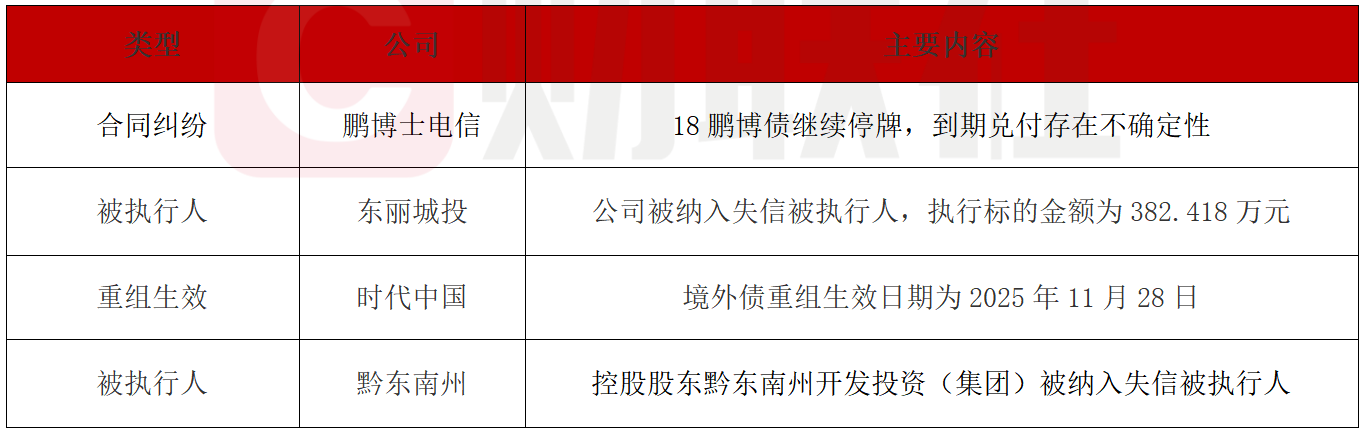
Group 1 - Peng Bo Telecom has announced that the "18 Peng Bo Bond" will be suspended from trading starting April 12, 2024, with the maturity date adjusted to May 25, 2026, indicating uncertainty in repayment [1][2] - Tianjin Dongli Urban Infrastructure Investment Group has been listed as a dishonest executor with an execution amount of 3.82418 million yuan due to disputes over construction quality and settlement with Tianjin Jinfeng Shengtai Technology Development Co., Ltd [2] - Times China Holdings has announced that the effective date for its offshore debt restructuring is expected to be November 28, 2025, with all restructuring conditions anticipated to be met by that date [2][3] Group 2 - Times China Holdings reported a cumulative contract sales amount of approximately 3.933 billion yuan for the nine months ending September 30, 2025, a year-on-year decrease of 37.1%, with a signed area of approximately 317,000 square meters [3] - The controlling shareholder of Qiandongnan State Investment Group has been listed as a dishonest executor with an execution amount of 159.6 million yuan due to a debt restructuring contract dispute with CITIC Financial Asset Management [3][4] - Qiandongnan State Investment Group has been involved in multiple legal disputes, including a loan contract dispute involving amounts of 21.05898 million yuan and 193.3 million yuan [4]
一周债市看点|华闻集团重大诉讼获法院提级管辖,碧桂园境外债务重组计划获大多数债权人批准
Xin Lang Cai Jing· 2025-11-09 11:23
Group 1 - Huawen Group is involved in a significant lawsuit regarding a share transfer dispute, with the case being transferred to Haikou Intermediate People's Court due to jurisdictional issues and the claim amount exceeding 100 million yuan [1] - Huawen Group has been notified of a pre-restructuring application due to inability to repay debts, with several financial investors selected for restructuring agreements [1] - Guokou Asset Management's subsidiary has had assets worth 1.01 billion yuan frozen due to bond defaults, with ongoing efforts to resolve debt issues [2] Group 2 - Country Garden's offshore debt restructuring plan has received approval from the required majority of creditors, with a court hearing scheduled for December 4 [5] - Country Garden has issued a profit warning, expecting a net loss of 18.5 to 21.5 billion yuan for the six months ending June 2025, a significant decline from a profit of 15.1 billion yuan in the same period last year [5] - Guangzhou Science City Investment reported a net loss of 4.544 billion yuan for the first three quarters of 2025, representing 12.89% of its net assets at the end of the previous year [5] Group 3 - Tsinghua Tongfang announced a deferral of interest payment on its bond "16 Sand MTN003" amounting to 78.135 million yuan, with the next payment scheduled for November 14, 2026 [6] - Shenwu Environmental Technology is facing public reprimand from the Shenzhen Stock Exchange for violations related to bond listing rules, involving its chairman and other executives [7] - Pan Hai Holdings has been ordered to pay 1.48 billion yuan in a lawsuit for unpaid loans to Minsheng Bank, with the court ruling for compulsory execution [8]