出口出海

Search documents
2025年北交所业绩快报梳理:北证盈利承压,关注科技+涨价主线-20260322
Shenwan Hongyuan Securities· 2026-03-22 14:06
Group 1 - The overall pre-announcement rate for the North Exchange is low at 43.9%, indicating that the performance of companies listed on this exchange is under pressure compared to other sectors [3][10][13] - In Q4 2025, the North Exchange's revenue grew by 2.9% year-on-year, but the net profit decreased by 47.5%, significantly lagging behind the overall A-share market [10][12][18] - The performance of large enterprises is recovering, while small and medium-sized enterprises are facing significant pressure, as indicated by the PMI data [18][20] Group 2 - The technology sector is expected to remain a key focus, with AI and semiconductor industries showing strong growth potential, benefiting companies like Hengtong Optics and Parallel Technology [3][34] - High-end manufacturing is also highlighted, with opportunities in robotics and aerospace, particularly for companies involved in exports like Sanyang Technology and Wuxin Tunneling [3][34] - The energy sector is seeing a price recovery in the photovoltaic and lithium battery industries, although profitability remains under pressure due to impairment provisions [3][34] Group 3 - The healthcare sector shows structural differentiation, with demand for high-end instruments and research equipment recovering, benefiting companies like Haineng Technology and New Zhi Biology [3][34] - Companies with performance exceeding expectations include Wuxin Tunneling and Jilin Carbon Valley, while those with high future profit forecasts include Shuguang Digital and Liancheng CNC [3][34] - The report emphasizes the importance of monitoring the performance of companies in the AI and semiconductor sectors, as well as those involved in high-end manufacturing and energy [3][34]
南向资金近期超百亿“爆买”,港股通科技ETF海富通(513860)盘中翻红,机构:指数历史表现上涨行情中弹性更大,下跌时防御性也更好
2 1 Shi Ji Jing Ji Bao Dao· 2026-02-06 05:43
Group 1 - The Hong Kong stock market showed signs of recovery after a low opening, with major indices narrowing their early losses. The Hong Kong Stock Connect Technology ETF, Haitong (513860), experienced a strong rebound, rising by 0.14% with a trading volume exceeding 1 billion yuan. Notably, automotive stocks led the gains, with Li Auto-W up over 5% and Leap Motor rising nearly 5% [1] - The Haitong CSI A500 ETF (563860) closely tracks the CSI A500 Index, which selects 500 stocks representing various industries with strong market capitalization and industry leadership. This index is designed to facilitate the allocation of domestic and foreign long-term funds into A-share assets [2] - Recent trends indicate that the Hong Kong market is undergoing adjustments, particularly in the internet technology sector, which has seen significant declines. However, southbound capital flows have increased, with over 10 billion Hong Kong dollars flowing in from February 4 to February 6 [2] Group 2 - The Haitong CSI Technology Index focuses on leading technology companies such as Alibaba and Tencent, with accelerated AI application deployment positively impacting cloud services and advertising revenue growth. This index has shown greater elasticity during market uptrends and better defensiveness during downturns compared to similar indices [3]
AI竞争加剧,资金持续布局港股科技,港股科技ETF(513020)连续4日资金净流入超1亿元
Mei Ri Jing Ji Xin Wen· 2026-02-06 03:25
Core Insights - The core focus of the market is on technology and overseas expansion, with the AI industry transitioning from infrastructure investment to addressing supply-demand gaps [1] - The logic of "exporting overseas" is shifting from downstream manufacturing to midstream and upstream sectors, with traditional industries like engineering machinery, wind power, and chemical sectors achieving stable profit growth through overseas operations [1] - The Hong Kong stock market's technology sector is experiencing valuation-driven gains, while fundamentals are under pressure due to price wars, leading to a cautious approach from institutional investors [1] Industry Trends - The AI supply chain is seeing increased attention on upstream components such as copper, storage, and power equipment, as well as downstream applications and components [1] - The market structure is expected to evolve from "new wins over old" to a phase where both new and old coexist by 2026 [1] Performance Metrics - The Hong Kong Stock Connect Technology Index (931573) has outperformed the Hang Seng Technology Index, with a cumulative return of 224.25% from the end of 2014 to the end of 2025, exceeding the Hang Seng Technology Index's return of 83.87% by over 140% [1] - The Hong Kong Stock Connect Technology ETF (513020) tracks the technology index, reflecting the diversified characteristics of the technology sector and the overall performance of core technology companies in the Hong Kong market [1]
港股科技板块回调,港股科技ETF(513020)跌超0.8%,连续3日迎资金净流入,回调或可布局
Mei Ri Jing Ji Xin Wen· 2026-02-05 07:16
Core Viewpoint - The Hong Kong stock technology sector is experiencing a pullback, with the Hong Kong Technology ETF (513020) declining over 0.8%, but it has seen net inflows for three consecutive days, indicating potential for positioning during the pullback [1] Group 1: Industry Trends - The dual main lines of industry fundamentals for the next 3-5 years are technology and overseas expansion, which are reshaping the market's profit structure and are expected to drive profits into a new upward cycle by 2026-2027 [1] - The essence of the "new" is the transition of AI technology to downstream applications, moving from infrastructure to supply-demand gaps, with upstream focus on copper, storage, and power equipment, and downstream focus on AI applications and components [1] - The "old" essence involves traditional industries moving away from outdated models, with profits from overseas business stabilizing and growing, extending the trend from downstream manufacturing to midstream and upstream sectors such as engineering machinery, wind power, electrical equipment, chemicals, building materials, and industrial metals [1] Group 2: Index Performance - The Hong Kong Technology ETF (513020) tracks the Hong Kong Stock Connect Technology Index (931573), which covers core assets in Hong Kong's technology sector, including internet, semiconductors, innovative pharmaceuticals, and new energy vehicles, reflecting the diversified characteristics of the technology industry [1] - From the base date at the end of 2014 to the end of 2025, the Hong Kong Stock Connect Technology Index has achieved a cumulative return of 224.25%, outperforming the Hang Seng Technology Index (83.87%) by over 140%, consistently beating similar indices [2]
行业出清与景气扩散:行业出清与景气扩散
SINOLINK SECURITIES· 2026-02-02 14:56
Group 1 - As of January 31, 2026, over 3,006 listed companies in A-shares disclosed their performance forecasts for 2025, representing 55.1% of all A-shares, slightly higher than 53.4% in 2024 [10][12] - The forecasted positive performance rate for 2025 is 36.7%, an increase of 3.3 percentage points from 2024, while the negative performance rate decreased from 66.2% in 2024 to 63.3% [14][15] - The proportion of companies expecting profit increases has risen significantly, with the share of profit-increasing companies reaching 21.1%, indicating a potential recovery in profit growth [15][18] Group 2 - The performance forecast rates for major indices such as CSI 300, ChiNext, and CSI 500 are around 60%, primarily driven by profit increases, indicating a recovery trend among large and mid-cap companies [18][19] - In contrast, the CSI 1000 index has a positive performance rate of only 37%, with a high proportion of companies still facing losses, reflecting weaker overall profitability [18][19] - The non-bank financial sector shows a high positive performance rate of 88%, with 72% of companies expecting profit increases, while the real estate sector has a low positive performance rate of only 18% [22][24] Group 3 - The analysis of performance changes indicates that AI, overseas exports, anti-involution, and price increases are the core growth drivers for over 40% of high-performing companies [22][24] - The performance of companies benefiting from AI is expanding beyond the tech sector into midstream manufacturing, while more industries are starting to gain from overseas exports [22][24] - The performance of companies in the anti-involution sector is expected to be a key area of focus for 2025, as they show a higher proportion of exceeding performance forecasts [22][24] Group 4 - The distribution of performance growth rates shows a rightward shift in the "U" shape curve, indicating an increase in companies experiencing recovery from difficulties [24][29] - The overall net profit growth rate for A-shares is projected to reach 29.6% year-on-year, with a median growth rate of 12.4%, suggesting a solidifying trend in profitability [29][32] - The fourth quarter of 2025 is expected to maintain high resilience in net profit growth, contrasting with the declines seen in previous years [29][32]
国投策略:2026年AI新科技要配,但顺周期这些“老东西”也要明显增配
Sou Hu Cai Jing· 2026-02-02 12:23
Core Conclusion - The institutional investors are shifting towards a "rebalancing" strategy for 2026, transitioning from "new triumphs over old" in 2025 to a "dance of new and old" in 2026. This indicates a need to allocate to both AI technologies and traditional cyclical sectors like manufacturing and commodities, marking a significant rebalancing trend [1][2]. Group 1: Rebalancing Trends - The rebalancing involves a focus on AI technology moving downstream, addressing supply-demand gaps in the fourth stage, with upstream gaps in copper, storage, and power equipment, and downstream gaps in AI applications and components [1][2]. - Traditional industries are stabilizing and growing profits from overseas operations, transitioning from downstream manufacturing to upstream sectors such as engineering machinery, wind power, chemicals, and industrial metals [3][4]. - The pricing of resource commodities in 2026 may not align with a consistently weak dollar assumption, suggesting a potential for stronger dollar conditions and a return to commodity fundamentals, making certain resource commodities more attractive for investment [3][4]. Group 2: Institutional Investment Insights - By Q4 2025, institutional investors showed a clear consensus on allocating to AI technology, overseas equipment, and globally priced resource commodities, which were the leading sectors in the A-share market prior to the Spring Festival [1][2]. - The share of technology and overseas sectors in A-share profits (excluding finance) is expected to approach 40% by 2025, indicating a significant shift towards high-end technology and manufacturing or export-oriented sectors [1][2]. - Observations from Q4 2025 indicate a notable increase in FOF products and a rise in demand for stable income-generating products, reflecting a strong interest in diversified asset allocation [4][5]. Group 3: Sector Performance and Changes - In Q4 2025, the top sectors for institutional investment included non-ferrous metals, communication, basic chemicals, non-bank financials, and machinery, while sectors like pharmaceuticals, computing, electronics, and media saw reductions in investment [5][6]. - The TMT sector's allocation has decreased to 37.95% due to mixed performance in earnings, with a notable increase in positions in high-performing areas like optical modules, while sectors with weaker earnings like integrated circuits and computing equipment saw reductions [6][7]. - The investment in resource commodities, particularly in non-ferrous and chemical sectors, has increased significantly, indicating a bullish outlook on these commodities due to expected price increases [6][7].

近3000家上市公司披露业绩预告 近四成企业业绩预喜
Sou Hu Cai Jing· 2026-02-01 15:02
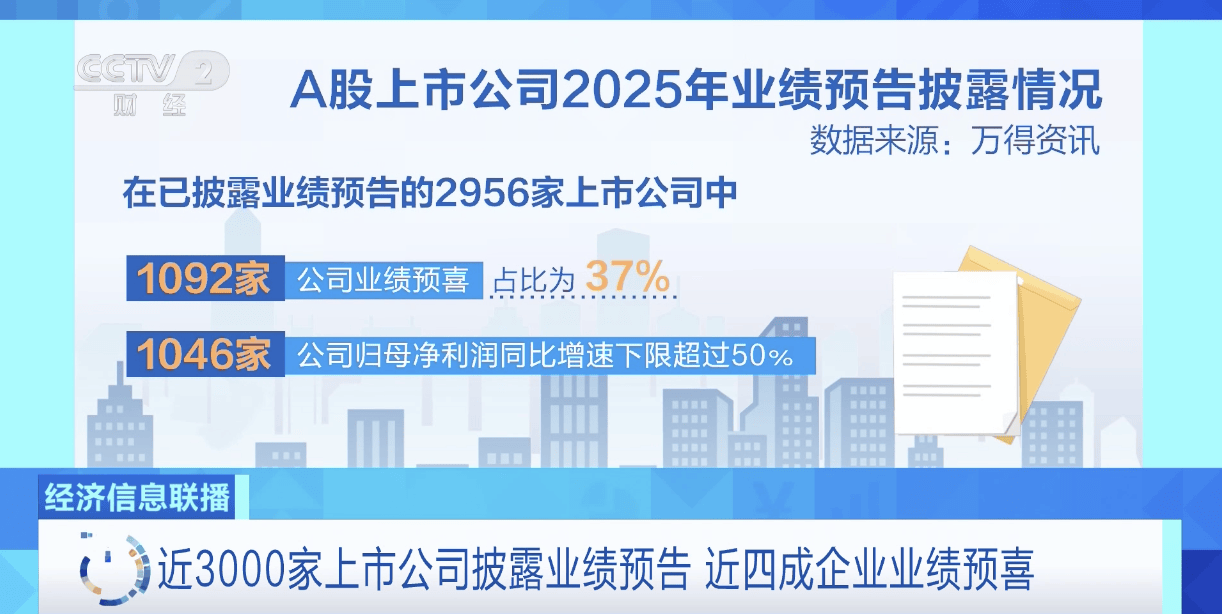
Group 1 - Among the listed companies that have disclosed performance forecasts, 1,092 companies are expected to have positive earnings, accounting for 37% of the total. Of these, 1,046 companies have a lower limit of net profit growth exceeding 50%, and 603 companies have a lower limit exceeding 100% [2] - The semiconductor sector is expected to see significant growth, with annual profits increasing over 300% year-on-year due to the positive impact of AI trends spreading across the industry chain [2][3] - The automotive sector has a positive forecast ratio exceeding 50%, with annual profits expected to grow approximately 140%, driven by manufacturing advantages and increased export orders [3] Group 2 - The non-ferrous metals sector is projected to see a year-on-year profit growth exceeding 40% in the first three quarters, with further price increases in copper and gold expected in the fourth quarter, leading to an overall annual profit growth exceeding 100% [4] - Experts predict that the A-share market is likely to maintain a stable and positive trend through 2026, driven by the restructuring of international order and domestic industrial innovation trends [6] - AI is expected to gradually enter the application realization phase by 2026, with certain sectors such as home appliances, engineering machinery, commercial buses, and power grid equipment anticipated to have relatively favorable growth opportunities [8]
长城基金汪立:把握“十五五”规划投资新线索
Xin Lang Ji Jin· 2025-10-27 09:41
Group 1 - The A-share market saw mixed performance last week, with major indices showing more declines than gains, while growth styles dominated, and the average daily trading volume across the market was 17,973 billion [1] - Key sectors that performed well included telecommunications, electronics, and power equipment, while agriculture, media, and automotive sectors lagged behind [1] Group 2 - The "14th Five-Year Plan" emphasizes technological leadership and boosting domestic demand, marking a critical period for foundational strengthening and comprehensive efforts [2] - Recent macroeconomic events include the 20th Central Committee's Fourth Plenary Session, which approved the guidelines for the "14th Five-Year Plan," focusing on advanced manufacturing and quality services [2] - The recent US inflation data showed a lower-than-expected increase, contributing to reduced inflation risk concerns, while China's economic growth in the first three quarters exceeded annual targets but still faces pressures from domestic and external demand [3] Group 3 - Investment strategies suggest focusing on potential beneficiaries of the "14th Five-Year Plan," with expectations for market upward movement due to reduced external disturbances and policy expectations [4] - The market is anticipated to experience fluctuations due to changes in trading sentiment and event impacts, but upcoming policy windows may provide good investment opportunities [4] - Long-term outlook remains positive for the stock market, supported by declining risk-free rates, ample liquidity, and improving profit expectations [5] Group 4 - Specific investment themes include focusing on advanced manufacturing, global competitiveness in Chinese manufacturing, and consumption promotion as key areas for structural economic transformation [5] - Emerging technologies and regional economic development strategies are highlighted as core investment themes to watch during the "14th Five-Year Plan" period [5]
十大券商:新一轮上行动能正在蓄势,10月市场中枢有望再上台阶!
天天基金网· 2025-09-29 02:15
Core Viewpoint - The article discusses the current state and future outlook of the A-share market, emphasizing the potential for a bullish trend driven by liquidity and policy expectations, with a focus on technology and resource sectors as key investment areas [3][4][6][7]. Group 1: Market Outlook - Most brokerages predict that investor sentiment will lean towards risk aversion before the holiday, but will likely shift to a more positive outlook post-holiday as policies and fundamentals become clearer [3][6][7]. - The current market is in the second phase of an upward trend, with liquidity easing and favorable policy expectations driving the market [3][7]. - A significant rebound in the market is anticipated in October, with many sectors showing reduced congestion, allowing for new upward momentum [11][12]. Group 2: Investment Strategies - The technology sector remains a favored investment direction, with many brokerages recommending a balanced allocation between new technology and cyclical stocks [5][13]. - Key areas for investment include semiconductor supply chains, chemical industries, and consumer sectors, particularly those benefiting from domestic demand recovery [8][9][10][14]. - The article highlights the importance of focusing on sectors with strong earnings support and growth potential, such as AI, renewable energy, and innovative pharmaceuticals [14][15][17]. Group 3: Economic Indicators - Recent economic data suggests that the effects of "anti-involution" policies are becoming evident, which could improve the economic fundamentals and support market recovery [8][9]. - The global economic environment, particularly the easing of high-interest rates in the U.S. and Europe, is expected to bolster demand and investment in various sectors [14][16]. - The upcoming third-quarter earnings reports are anticipated to provide critical insights and drive market sentiment [11][12].

高盛:若经济和基本面持续改善,投资者情绪仍有上行空间
Huan Qiu Wang· 2025-09-26 00:44
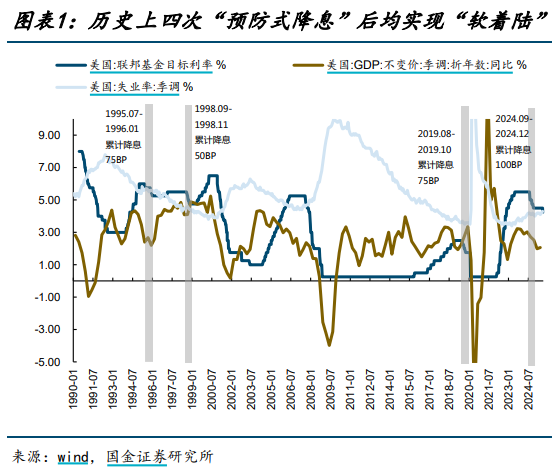
Group 1 - Goldman Sachs maintains an overweight view on China, indicating that the A-share market does not show signs of overheating [1] - The sentiment indicator for Chinese retail investors suggests that there is room for further improvement in investor sentiment if economic fundamentals continue to improve [1] - Guotai Junan Securities believes that contrary to market perceptions, a recovery in China's earnings fundamentals may be in the making, with opportunities arising from the recent interest rate cuts [1] Group 2 - Guotai Junan Securities highlights that the current preventive interest rate cuts could benefit export-oriented companies, which can avoid domestic price pressures while capitalizing on increased demand from overseas markets [4] - The firm anticipates that the realization of fundamental improvements will be a key driver for market upward movement, supported by historical experiences and the Federal Reserve's economic forecasts [4] - Positive factors are emerging in the domestic market, including a reduction in the drag from PPI and CPI tail effects, as well as inventory replenishment behaviors among domestic companies, reminiscent of the experiences from 2006 to 2007 [4]