
区域经济融合

Search documents
京唐城际铁路明日全线通车,唐山将正式融入“北京一小时”圈
Xin Lang Cai Jing· 2025-12-29 05:51
Core Viewpoint - The Beijing-Tangshan Intercity Railway will officially open on December 30, enhancing connectivity and integrating Tangshan into the "one-hour" transportation, living, logistics, and economic circles of Beijing [1] Group 1: Infrastructure Development - The railway starts from Tongzhou District in Beijing, passing through Langfang City and Baodi District in Tianjin, and ends in Tangshan City, featuring a total of eight stations [1] - The railway includes three passenger stations within Tangshan: Yutian South, Tangshan West, and Tangshan Station [1] Group 2: Travel Efficiency - After the full operation of the railway, the travel time from Beijing Tongzhou Station to Tangshan Station will be reduced to a maximum of 55 minutes, providing more diverse and convenient travel options for passengers [1] Group 3: Economic Impact - The full connectivity of the Beijing-Tangshan Intercity Railway significantly compresses the time and space distance between Beijing and Tangshan, injecting strong momentum into the integration of transportation in the Beijing-Tianjin-Hebei region and regional economic fusion [1]
京唐城际铁路明日全线通车 唐山将正式融入“北京一小时”圈
Yang Shi Xin Wen· 2025-12-29 05:18
Core Points - The Beijing-Tangshan Intercity Railway will officially open on December 30, integrating Tangshan into the "one-hour" transportation, living, logistics, and economic circles of Beijing [1] - The railway starts from Tongzhou District in Beijing, passing through Langfang City and Baodi District in Tianjin, and ends in Tangshan City, with a total of eight stations [1] - The full operation of the railway significantly reduces travel time between Beijing and Tangshan, with the fastest journey from Tongzhou Station to Tangshan Station taking only 55 minutes [1] Summary by Sections - **Transportation Integration** - The opening of the Beijing-Tangshan Intercity Railway enhances the connectivity of Tangshan with Beijing, facilitating a more integrated transportation network [1] - **Economic Impact** - The railway's full operation injects strong momentum into the integration of the Beijing-Tianjin-Hebei transportation system and regional economic collaboration [1] - **Travel Convenience** - The railway provides diverse and convenient travel options for passengers traveling between Beijing and Tangshan, improving overall accessibility [1]
“粤车南下”正式启动,初期每日配额100个
2 1 Shi Ji Jing Ji Bao Dao· 2025-12-23 12:31
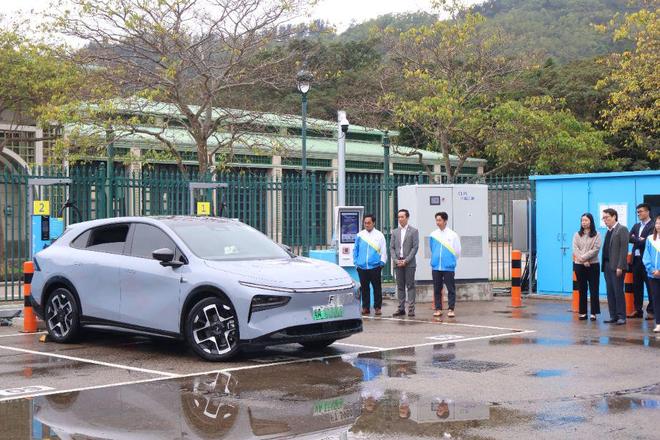
Group 1 - The "Yue Car Southbound" policy has been officially implemented, facilitating cross-border travel between Guangdong and Hong Kong, with a new electric vehicle charging station in Lantau Island, built by China Power Dynamic Group [2] - The charging station is equipped with 4 European standard charging piles and 5 national standard charging piles, capable of charging an electric vehicle to 60% in just 10 minutes, sufficient for two round trips across the Hong Kong-Zhuhai-Macao Bridge [2] - The initial phase allows for 100 daily inbound quotas for Guangdong residents, who can pre-book their travel times and access real-time information on road conditions, parking, and charging facilities through navigation platforms [2] Group 2 - China Power Dynamic Group has meticulously planned the charging station's design to enhance the charging experience for both cross-border and local drivers, with features like contactless entry and payment options [3] - The charging station supports various payment methods, including both mainland and Hong Kong versions of Alipay and WeChat Pay, as well as Octopus, Visa, and Mastercard, using a prepaid model [3] - The charging station has the potential to expand from the initial 9 charging points to a maximum of 40 based on demand, with plans to increase the total number of charging points in Hong Kong from 240 to nearly 1000 within two years [4] Group 3 - The "Yue Car Southbound" initiative not only enhances convenience for cross-border travel but also strengthens Hong Kong's role as a transportation hub, promoting economic integration and expanding development opportunities for the region [4]

携手开启区域经济深度融合新篇章(国际观澜)
Ren Min Ri Bao· 2025-12-02 22:33
Group 1 - The China-ASEAN railway has become a vital "steel artery" connecting China and ASEAN, showcasing the increasing economic and trade exchanges between the two regions [1] - The signing of the upgraded version 3.0 of the China-ASEAN Free Trade Area agreement supports multilateralism and free trade, aiming to enhance bilateral cooperation and address global challenges [1][2] - The China-ASEAN Free Trade Area 3.0 version aims to lower institutional transaction costs and eliminate non-tariff barriers, stimulating consumption potential and innovation across a market of over 2 billion people [1][2] Group 2 - The 3.0 version of the China-ASEAN Free Trade Area has achieved qualitative breakthroughs in cooperation fields, openness levels, and integration depth, adding five new areas including digital economy and green economy [2] - The new agreement integrates traditional trade facilitation topics with emerging areas such as intellectual property and consumer protection, enhancing the institutional openness level and providing a stable business environment [2] - The establishment of a supply chain connectivity chapter in the 3.0 version promotes mutual recognition of standards and emphasizes resilience and collaborative innovation in supply chains [2] Group 3 - The China-ASEAN Free Trade cooperation is becoming a significant driver of regional economic integration, with the 3.0 version serving as a model for building a comprehensive and high-level Asia-Pacific Free Trade Area [3] - The signing of the 3.0 version marks the beginning of a new chapter in deep regional economic integration, aiming for a more prosperous, stable, and sustainable common future [3]
中国—东盟自贸区3.0版升级议定书签署 双方自贸合作向更深层次迈进
Yang Shi Wang· 2025-10-28 06:26
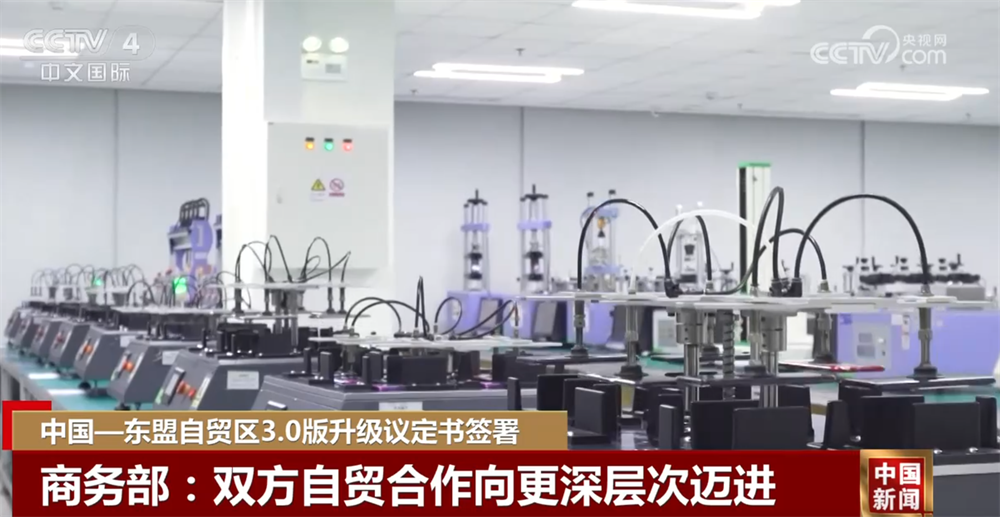
Core Viewpoint - The signing of the China-ASEAN Free Trade Area 3.0 upgrade protocol in Kuala Lumpur marks a significant step towards deeper economic integration and cooperation between China and ASEAN countries, focusing on new areas such as digital economy and green economy [1][3]. Group 1: Agreement Details - The 3.0 upgrade protocol covers nine major areas, adding five new fields: digital economy, green economy, supply chain connectivity, competition and consumer protection, and support for small and medium enterprises [1]. - The protocol aims to enhance fair competition, protect consumer rights, support the development of small and medium enterprises, and improve compliance capabilities of underdeveloped countries, promoting inclusive regional economic development [1]. Group 2: Historical Context - The China-ASEAN Free Trade Area is the first free trade area established through negotiations, initiated in 2002, with the 1.0 version completed in 2010 and the 2.0 version fully implemented in 2019 [5]. - Negotiations for the 3.0 version began in 2022 and were completed in May of this year [5]. Group 3: Multilateralism and Trade - The signing of the protocol demonstrates a commitment to multilateralism and free trade, serving as an important example for resisting unilateralism and protectionism while addressing international economic and trade challenges [3]. - It signifies a deeper level of cooperation in the free trade partnership, contributing to the construction of an open, inclusive, and rules-based regional integrated market [3].
沈白高铁试运行 促区域经济融合
Zhong Guo Xin Wen Wang· 2025-09-04 11:59
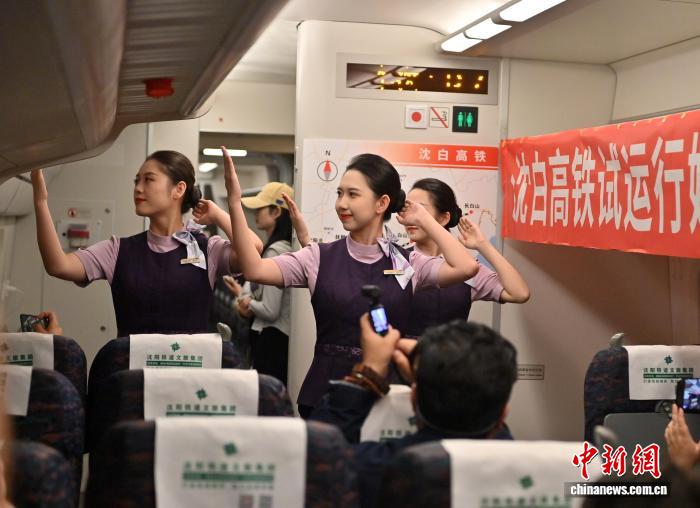
Core Viewpoint - The trial operation of the Shenbai High-speed Railway is expected to promote regional economic integration and enhance connectivity in the area [1]. Group 1 - The Shenbai High-speed Railway has commenced trial operations, marking a significant step in improving transportation infrastructure [1]. - The railway is anticipated to facilitate tourism and economic activities in the regions it connects, particularly benefiting the Changbai Mountain area [1]. - The trial operation includes various services aimed at enhancing passenger experience, such as staff performing service gestures [3][5]. Group 2 - The G9121 trial train has successfully arrived at the Changbai Mountain Station, demonstrating the operational readiness of the railway [7][8]. - The scenic views along the route are expected to attract more travelers, further boosting local tourism [10].
通讯丨从印尼自贸区到中国自贸港——新航线为中印尼经贸合作再添新通道
Xin Hua Wang· 2025-08-22 11:48
Core Points - The new direct shipping route from Indonesia's Batam Island to China's Yangpu Port enhances maritime connectivity between China and Southeast Asia, facilitating trade and reducing logistics costs [1][2] - Batam Island, strategically located at the intersection of Indonesia, Singapore, and Malaysia, has seen rapid industrial growth and foreign investment, particularly in electronics, shipbuilding, and renewable energy sectors [1][2] - The upgraded Batam Port now features modern container handling equipment, improving its capacity to handle international shipping [1][2] Company and Industry Impact - The new shipping route significantly lowers costs and improves efficiency for local businesses, such as the ecological green oil company, which sees enhanced competitiveness in the Chinese market [2] - The direct shipping line reduces transportation time for coconut products from Indonesia to Hainan, China, from approximately 20 days to 6 days, improving product quality and reducing waste [2] - The route connects Batam, Yangpu, and Kota Kinabalu in Malaysia, facilitating trade with North and South America, thus creating a fast channel for Indonesian products to reach these markets [2] - The ongoing deepening of economic cooperation between China and Indonesia positions China as Indonesia's largest trading partner and a key source of investment, particularly in renewable energy, manufacturing, and digital economy sectors [2]