
工业硅市场供需

Search documents
【安泰科】工业硅周评—期货情绪升温 现货平稳运行(3月20-26日)
中国有色金属工业协会硅业分会· 2026-03-27 12:36
Core Viewpoint - The industrial silicon market continues to exhibit a "weak supply and demand" pattern, with a divergence in futures and spot market trends. The futures market shows a strong oscillating trend influenced by capital speculation, while the spot market remains stable with no significant price fluctuations [1][3]. Futures Market Summary - As of March 26, the main contract 2605 closed at 8735 yuan/ton, an increase of 280 yuan/ton from the previous Friday (March 20), reflecting a weekly increase of 3.32%. The market maintains a strong oscillating pattern [1]. - The net short position of the top 20 futures companies decreased to 22,600 contracts from 35,200 contracts, indicating a significant reduction in short selling pressure [1]. Spot Market Summary - The overall spot market remains stable, with the national industrial silicon average price at 9010 yuan/ton, unchanged from the previous Friday. Specific grades such as 553 and 441 also maintained their prices at 8614 yuan/ton and 8963 yuan/ton, respectively [2]. - The total warehouse receipts for industrial silicon on the Guangxi Futures Exchange increased to 22,272 contracts from 21,668 contracts, indicating ongoing inventory pressure [2]. Supply Side Summary - The overall operating rate in the industry remains stable, with low operating rates in Yunnan and Sichuan due to high electricity prices during the dry season. The willingness of enterprises to resume production is weak [2]. - The anticipated electricity price increase in major factories in Xinjiang has dissipated, leading to reduced cost support. Other regions like Inner Mongolia, Gansu, and Ningxia maintain stable operations with a moderate supply release pace [2]. Demand Side Summary - Demand from downstream sectors shows continued divergence, with polysilicon companies primarily focused on inventory reduction and maintaining low operating loads, resulting in cautious purchasing of industrial silicon [3]. - In the organic silicon sector, weak downstream reception has led some companies to slightly reduce their operating loads, further tightening their purchasing of industrial silicon. The aluminum alloy sector has seen a slight increase in inquiries due to domestic supply needs, but actual transaction volumes remain limited [3]. - Overall, the industrial silicon market's "stable supply and weak demand" pattern persists, with the strong performance in the futures market not effectively transmitting to the spot market [3].

【安泰科】工业硅周评—弱需求主导市场格局延续(2026年1月15-21日)
中国有色金属工业协会硅业分会· 2026-01-22 08:18
Core Viewpoint - The industrial silicon market is experiencing a dual weakness in supply and demand, with a divergence between futures and spot prices, leading to a generally stable price environment despite fluctuations in specific regions [1][2]. Supply Side Summary - The supply of industrial silicon is showing a clear contraction trend, particularly in the southwestern region where production is significantly reduced. In Sichuan, production has nearly halted, while in Yunnan, most companies have ceased operations except for a few fulfilling long-term contracts [1][2]. - In the northwest region, production remains relatively stable, but there are increasing expectations of production cuts. A major factory in Xinjiang plans to reduce output by 50% starting at the end of January, which could significantly impact national production levels [1][2]. - Some small to medium-sized silicon plants in Inner Mongolia have begun maintenance, indicating a further tightening of supply in the future [1][2]. Demand Side Summary - The downstream demand is showing significant structural differentiation, with a notable reduction in direct demand for industrial silicon due to increased production cuts in the polysilicon sector. Some leading companies have initiated full production halts, while others are implementing substantial reductions [2]. - The organic silicon industry is maintaining self-discipline in emissions reduction, and the demand for aluminum alloys is weakening marginally. Both sectors are primarily engaging in just-in-time purchasing, failing to create effective demand support [2]. - Despite the gradual contraction in supply, the overall demand, particularly in the polysilicon sector, is decreasing more prominently, leading to a still loose supply-demand balance. Social inventory is expected to continue accumulating, and spot prices lack upward momentum in the short term [2]. Price Summary - As of January 21, the national comprehensive price for industrial silicon is reported at 9,245 yuan per ton, remaining stable compared to the previous week. Specific grades such as 553 and 441 are priced at 8,713 yuan and 9,169 yuan per ton, respectively, with no fluctuations observed [1][3]. - The futures price for industrial silicon fluctuated, starting at 8,845 yuan per ton and closing at 8,780 yuan per ton, with a cumulative increase of 50 yuan per ton during the week [1][3]. - Export prices have seen a decline of 50 USD per ton due to short-term fluctuations in the US dollar index, although the latest export control policies from the Ministry of Commerce do not affect industrial silicon products, keeping export channels open [2].

【安泰科】工业硅周评—期现走势分化,弱需求主导市场震荡(2026年1月8-14日)
中国有色金属工业协会硅业分会· 2026-01-16 07:15
Core Viewpoint - The industrial silicon market is experiencing a "strong futures and stable spot" divergence, with futures prices increasing while spot prices remain steady [1][2]. Supply Side Summary - The supply of industrial silicon continues to contract, with high production costs suppressing production enthusiasm among companies. Regions like Gansu and Ningxia are facing losses, and even traditional low-cost areas like Xinjiang are now experiencing financial difficulties, leading some companies to consider production cuts [1][2]. Demand Side Summary - Downstream demand remains weak, with three major sectors showing mixed performance. Although prices for organic silicon and aluminum alloys have increased, this has not significantly boosted the actual demand for industrial silicon. The price of organic silicon rose from 13,700 yuan/ton to 14,000 yuan/ton, primarily due to production cuts, while aluminum alloy futures increased to 23,380 yuan/ton but are affected by seasonal low production [2]. - The overall market for industrial silicon is dominated by weak demand logic, with downstream sectors generally reducing production or in off-peak seasons, leading to delayed procurement and expected continued accumulation of social inventory [2]. Price Summary - As of January 14, 2026, the national comprehensive price for industrial silicon is reported at 9,245 yuan/ton, with specific grades such as 553 at 8,713 yuan/ton and 441 at 9,169 yuan/ton showing no fluctuations [3][4]. - Regional prices include Xinjiang at 8,810 yuan/ton, Yunnan at 10,005 yuan/ton, and Sichuan at 10,050 yuan/ton, all remaining stable [3]. Freight and Participants - Freight costs are reported at 600 yuan/ton from Yili to Tianjin Port and 350 yuan/ton from Kunming to Huangpu Port [5]. - A list of participating companies in various regions is provided, indicating a diverse range of players in the industrial silicon market [5].

【安泰科】工业硅周评—弱需求逻辑主导 市场延续震荡格局(2026年1月7日)
中国有色金属工业协会硅业分会· 2026-01-08 13:22
Core Viewpoint - The industrial silicon market is currently stable, with a divergence between futures and spot prices, and overall demand remains weak despite some price increases in downstream products [1][2]. Group 1: Market Performance - The main futures contract 2605 closed at 8980 yuan/ton, up from 8860 yuan/ton before the holiday, with a total increase of 120 yuan/ton [1]. - The national comprehensive price for industrial silicon remained stable at 9245 yuan/ton as of January 7, with specific grades like 553 at 8713 yuan/ton and 441 at 9169 yuan/ton showing no fluctuations [1][3]. - Regional prices in Xinjiang, Yunnan, and Sichuan were reported at 8810 yuan/ton, 10005 yuan/ton, and 10050 yuan/ton respectively, with export FOB prices also stable [1][3]. Group 2: Production and Supply - Industrial silicon production has remained stable overall, although some regions have seen slight reductions. Companies are maintaining prices near cash cost levels due to long-term contract pressures [1][2]. - Despite some companies entering loss zones, most are continuing normal production to meet customer supply and stabilize market share [1][2]. Group 3: Demand and Inventory - The market is currently dominated by weak demand, with slow inventory depletion and reduced purchasing willingness from downstream sectors, leading to inventory accumulation in some areas [2]. - Although prices for downstream products like organic silicon and polysilicon have increased due to production cuts, actual demand for industrial silicon remains low [2]. - The future market dynamics will depend on the recovery pace of downstream demand and the actual inventory depletion situation [2].
硅业分会:工业硅供需双弱库存累积 市场震荡延续
智通财经网· 2025-12-26 10:55
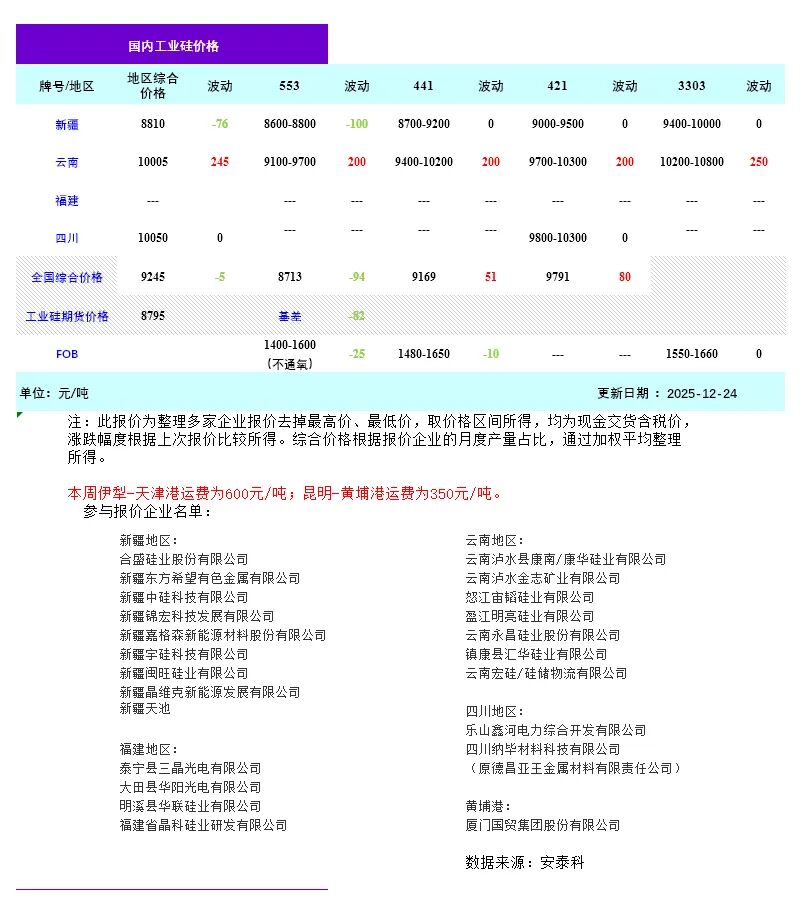
Core Viewpoint - The industrial silicon market is experiencing weak supply and demand, leading to price fluctuations constrained by cost support and weak demand [1][2]. Supply Side - Production remains stable across major production areas, particularly in Xinjiang, but price differentiation in the spot market has increased due to volatility in futures prices [2]. - Some manufacturers are either maintaining firm quotes, refraining from quoting, or selling below market average to improve cash flow, resulting in a low operating rate [2]. - The current low-price environment is suppressing production enthusiasm, with many existing capacities used for internal settlements or long-term sales [2]. - Overall, the supply side is supported by costs, but slow inventory depletion and reduced downstream production are leading to inventory accumulation in some regions [2]. Demand Side - Demand from downstream sectors, particularly organic silicon and polysilicon industries, is weak, leading to reduced procurement of industrial silicon [2]. - The photovoltaic industry is generally experiencing losses, further suppressing industrial silicon consumption [2]. - Although the aluminum alloy market saw a slight increase in futures prices (from 21,110 CNY/ton to 21,480 CNY/ton), it has limited impact on driving demand for industrial silicon [2]. Price Trends - The comprehensive price of industrial silicon in China as of December 24 is 9,245 CNY/ton, down 5 CNY/ton from the previous week [1][3]. - Specific prices include 5 at 8,713 CNY/ton (down 94 CNY/ton) and 4 at 9,169 CNY/ton (up 51 CNY/ton) [1][3]. - Regional prices vary, with Xinjiang at 8,810 CNY/ton, Yunnan at 10,005 CNY/ton, and Sichuan at 10,050 CNY/ton [1][3]. Market Outlook - The industrial silicon market is expected to continue its range-bound fluctuations in the short term, with future trends dependent on the recovery pace of downstream demand and the progress of inventory depletion [2].
工业硅周评—供需双弱库存累积 市场震荡延续(2025年12月24日)
中国有色金属工业协会硅业分会· 2025-12-26 09:29
Core Viewpoint - The industrial silicon market is experiencing weak supply and demand, leading to price fluctuations constrained by cost support and weak demand [1][3]. Supply Side - Production remains stable across major production areas, particularly in Xinjiang, but price differentiation has increased due to volatile futures prices. Some manufacturers are either maintaining high quotes or choosing not to quote at all, while others are selling below market average to improve cash flow [2]. - The operating rates in regions like Inner Mongolia, Sichuan, Yunnan, and Gansu are at low levels due to a prolonged low-price environment, which has suppressed production enthusiasm. Overall transaction volumes remain low despite some attempts to support prices [2]. - The pricing mechanism is becoming more financialized, with a growing trend of using a "futures price + basis" procurement model, enhancing the linkage between spot prices and futures markets [2]. Demand Side - Demand from downstream sectors, particularly the organic silicon and polysilicon industries, is weak, leading to reduced procurement of industrial silicon. The overall support for demand is insufficient, with risks of further demand contraction highlighted by losses across the photovoltaic industry chain [2]. - Although the aluminum alloy market has seen a slight increase in futures prices (from 21,110 yuan/ton to 21,480 yuan/ton), this has not significantly boosted demand for industrial silicon [2]. Market Overview - The industrial silicon market is characterized by weak supply and demand, with inventory accumulation and continued price fluctuations. While supply is supported by costs, slow inventory depletion and reduced downstream production are leading to demand contraction, resulting in price resistance [3]. - Short-term price expectations indicate continued range-bound fluctuations, with future trends heavily dependent on the recovery pace of downstream demand and the progress of inventory depletion [3]. Price Data - As of December 24, the national average price for industrial silicon is 9,245 yuan/ton, reflecting a slight decrease of 5 yuan/ton from the previous week. Specific grades show varied price movements, with 553 at 8,713 yuan/ton (down 94 yuan/ton) and 441 at 9,169 yuan/ton (up 51 yuan/ton) [1][4]. - Regional prices vary, with Xinjiang at 8,810 yuan/ton, Yunnan at 10,005 yuan/ton, and Sichuan at 10,050 yuan/ton [4].
工业硅期货日报-20251224
Guo Jin Qi Huo· 2025-12-24 12:24
Report Summary Investment Rating No investment rating is provided in the report. Core View The industrial silicon market is currently in a game situation of "macro - sentiment support + oversupply suppression". Short - term support is provided by production cuts in the southwest, but high inventory, weak demand, and long - term capacity expansion pressure are the core negatives. The short - term price is difficult to break away from the weak and volatile state [8][9]. Section Summaries 1. Futures Market - **Contract Quotes**: On December 23, 2025, the industrial silicon si2605 futures contract mainly rose, closing with a positive line. The opening price was 8,600 yuan/ton, the highest was 8,810 yuan/ton, the lowest was 8,595 yuan/ton, and the closing price was 8,780 yuan/ton. The trading volume increased slightly, with a full - day trading volume of 351,425 lots and an open interest of 213,776 lots [2]. - **Variety Prices**: The total open interest of 12 industrial silicon futures contracts was 401,013 lots, a decrease of 15,701 lots from the previous trading day. Among them, the open interest of the active contract si2605 decreased by 7,830 lots [3]. 2. Spot Market - **Basis Data**: In the past 10 trading days, the basis of the active contract industrial silicon si2605 strengthened. The quoted price of industrial silicon non - oxygenated 553 was 9,250 yuan/ton on that day, and the basis was 470 yuan/ton. The futures contract rose 185 yuan/ton compared with the previous day's closing price [6]. 3. Influencing Factors - **Industry News**: The supply side shows a differentiated pattern of "production cuts in the southwest and high operation in the north", and the overall oversupply pressure has not been fundamentally alleviated. Production cuts in the dry season in the southwest continue to materialize, with weekly output in Sichuan and Yunnan decreasing and the furnace - opening rate at a low level for the year. The Xinjiang sample enterprises maintain a high operation rate, and the output of new silicon furnaces drives the regional output to increase steadily, offsetting the impact of production cuts in the southwest. The cost - side support has weakened. The price of carbonaceous reducing agents has dropped significantly. Although the electricity price in the dry season in the southwest has increased, the expected decline in the electricity price in the wet season in the far - month, combined with the decrease in raw material costs, weakens the overall production cost support and further opens up the downward price space [7]. 4. Market Outlook The industrial silicon market is in a situation where macro - sentiment provides support while oversupply suppresses prices. Short - term support comes from southwest production cuts, but high inventory, weak demand, and long - term capacity expansion pressure are the main negative factors, resulting in a short - term weak and volatile price trend [8][9].
建信期货工业硅日报-20251121
Jian Xin Qi Huo· 2025-11-21 01:10
1. Report Date - The report is dated November 21, 2025 [2] 2. Research Team and Researchers - The research is conducted by the Energy and Chemical Research Team. Researchers include Li Jie, CFA (Crude Oil and Fuel Oil), Ren Junchi (PTA/MEG), Peng Haozhou (Industrial Silicon/Polycrystalline Silicon), Peng Jinglin (Polyolefins), and Liu Youran (Pulp) [3] 3. Market Performance - Industrial silicon futures prices basically gave back yesterday's gains. The closing price of Si2601 was 9,075 yuan/ton, a decline of 2.37%. The trading volume was 574,345 lots, the open interest was 273,978 lots, with a net decrease of 32,691 lots [4] - Spot prices were slightly raised. The price range of 553 was 9,300 - 9,500 yuan/ton, and that of 421 was 9,700 - 10,050 yuan/ton [4] 4. Market Outlook - Although the spot price of industrial silicon has increased recently, the stable price center provides no upside space for the futures market. Yesterday, the production cut of silicone was less than expected, leading to a joint upward movement with other market products due to capital sentiment. However, after the market closed, the significant increase in net short positions among the top 20 institutions reflected capital's pessimism about an upward breakthrough. Today's prices basically gave back yesterday's gains, and the collective weakness of other market products also showed a similar capital sentiment [4] - Fundamentally, production cuts on the supply side are ongoing, and weekly output still has room to decline. However, demand is lackluster, especially when polysilicon and silicone are both in the production - cut stage, so the supply - demand contradiction will not intensify. The relatively strong spot price provides support at the bottom. The price of the main contract has not effectively broken through, and the market should be treated as a range - bound one [4] 5. Market News - On November 20, the number of industrial silicon warehouse receipts on the GZFE was 43,297 lots, a net decrease of 115 lots from the previous trading day [4] - A meeting of actual controllers of silicone monomer plants was held in Shanghai as scheduled. The organizer was the China Fluorine and Silicone Organic Materials Industry Association, and all leading enterprises participated. The total production capacity of participating enterprises accounted for over 80% of the industry's capacity. The meeting was about joint production cuts and price support. According to SMM, regarding production cuts, the plan is to start on December 1st, with an unclear implementation period. Assuming full implementation in December, the DMC output in December is expected to be about 210,400 tons, a reduction of about 8,000 tons compared to before the cut. The expected impact on the monthly consumption of industrial silicon is about 4,400 tons [4]
瑞达期货工业硅产业日报-20251112
Rui Da Qi Huo· 2025-11-12 09:00
Report Summary 1. Report Industry Investment Rating - Not provided in the content 2. Core Viewpoints - The supply of industrial silicon will shrink next week as the dry - season production cuts in Southwest China are more significant, despite the复产 expectations in Northwest China [2] - The downstream demand for industrial silicon is diverse. Organic silicon maintains a rigid - demand state but has limited consumption upside due to the sluggish terminal market. The short - term weekly production of polysilicon is still high, but there are expectations of production cuts, which may reduce the demand for industrial silicon. The demand from the aluminum alloy industry is stable but has limited marginal impact on prices [2] - Industrial silicon follows the polysilicon trend and remains stable. It is expected to have a higher probability of oscillating upward in the future. It is recommended to go long on dips [2] 3. Summary by Relevant Catalogs 3.1 Futures Market - The closing price of the main contract is 9,195 yuan/ton, up 15 yuan; the main contract position is 262,136 hands, down 8,823 hands; the net position of the top 20 is - 64,101 hands, up 1,755 hands; the GZEE warehouse receipts are 45,936 hands, down 143 hands; the basis between the December and January industrial silicon contracts is 0, unchanged [2] 3.2 Spot Market - The average price of oxygen - passing 553 silicon is 9,500 yuan/ton, unchanged; the average price of 421 silicon is 9,750 yuan/ton, unchanged; the basis of the Si main contract is 305 yuan/ton, down 15 yuan; the DMC spot price is 11,800 yuan/ton, unchanged [2] 3.3 Upstream Situation - The average prices of silica, petroleum coke, clean coal, wood chips, and graphite electrodes (400mm) are 410 yuan/ton, 2,410 yuan/ton, 1,850 yuan/ton, 490 yuan/ton, and 12,250 yuan/ton respectively, all unchanged [2] 3.4 Industry Situation - The monthly industrial silicon output is 402,800 tons, an increase of 36,000 tons; the weekly social inventory of industrial silicon is 552,000 tons, an increase of 10,000 tons; the monthly import volume is 70,232.72 tons, an increase of 1,939.85 tons; the monthly export volume is 602.27 tons, a decrease of 6,409.29 tons [2] 3.5 Downstream Situation - The weekly output of organic silicon DMC is 44,900 tons, an increase of 700 tons; the average price of aluminum alloy ADC12 in the Yangtze River spot market is 21,400 yuan/ton, unchanged; the overseas market price of photovoltaic - grade polysilicon is 15.95 US dollars/kg, unchanged; the weekly average spot price of photovoltaic - grade polysilicon is 6.5 US dollars/kg, unchanged; the monthly export volume of unforged aluminum alloy is 23,495.34 tons, a decrease of 5,568.37 tons; the weekly operating rate of organic silicon DMC is 69.26%, an increase of 0.7%; the monthly aluminum alloy output is 1,776,000 tons, an increase of 141,000 tons; the monthly aluminum alloy export volume is 23,495.34 tons, a decrease of 5,568.37 tons [2] 3.6 Industry News - On November 11, 2025, Hesheng Silicon Industry announced that Fuda Industrial plans to reduce its shareholding by no more than 27.0705 million shares (2.29% of the total share capital) in the next three months for its own capital needs [2]

建信期货工业硅日报-20251107
Jian Xin Qi Huo· 2025-11-07 06:47
Report Summary 1. Report Industry Investment Rating No information provided. 2. Core Viewpoints - Industrial silicon futures prices fluctuated narrowly, with the Si2601 closing at 9020 yuan/ton, a decline of 0.06%, a trading volume of 276,196 lots, and an open interest of 232,849 lots, a net decrease of 9,304 lots [4]. - Spot prices were slightly raised and then stabilized, with the 553 price ranging from 9,000 to 9,400 yuan/ton and the 421 price ranging from 9,600 to 9,950 yuan/ton [4]. - In November, the southwest production areas are expected to enter the seasonal production - reduction stage. Sichuan and Yunnan produced over 90,000 tons in October, compared with 64,200 tons in the same period last year. However, the northern production areas have an expected increase in production. The current supply - demand imbalance has not been reversed, and the actual production reduction after profit repair remains to be observed. Spot prices are generally stable, and the 01 price is in a convergent oscillation stage, still operating within the adjustment range after August [4]. 3. Summary by Directory 3.1 Market Performance - Industrial silicon futures prices fluctuated narrowly. The Si2601 closed at 9020 yuan/ton, down 0.06%, with a trading volume of 276,196 lots and an open interest of 232,849 lots, a net decrease of 9,304 lots [4]. - Spot prices were slightly raised and then stabilized, with the 553 price ranging from 9,000 to 9,400 yuan/ton and the 421 price ranging from 9,600 to 9,950 yuan/ton [4]. 3.2 Market News - On November 6th, the number of industrial silicon warehouse receipts on the GZEE was 46,281 lots, a net increase of 86 lots from the previous trading day [5]. - On October 31st, the industrial silicon market inventory was 447,700 tons, a weekly increase of 0.58% and a year - on - year increase of 43.59% [5]. - In September, the industrial silicon export volume was 70,232.72 tons, a decrease of 8.36% from the previous month and a year - on - year increase of 7.73%. From January to September, the cumulative industrial silicon export volume was 491,400 tons, a cumulative year - on - year increase of 1.55%, with an average monthly export volume of 61,500 tons [5].